
|
시장보고서
상품코드
1982263
휴대용 누수 감지기 시장 : 기회, 성장 요인, 업계 동향 분석 및 예측(2026-2035년)Portable Water Leak Detector Market Opportunity, Growth Drivers, Industry Trend Analysis, and Forecast 2026 - 2035 |
||||||

세계의 휴대용 누수 감지기 시장은 2025년 5억 2,230만 달러로 평가되었고, CAGR은 6%를 나타낼 것으로 보이며, 2035년까지 9억 2,280만 달러에 이를 것으로 추정됩니다.
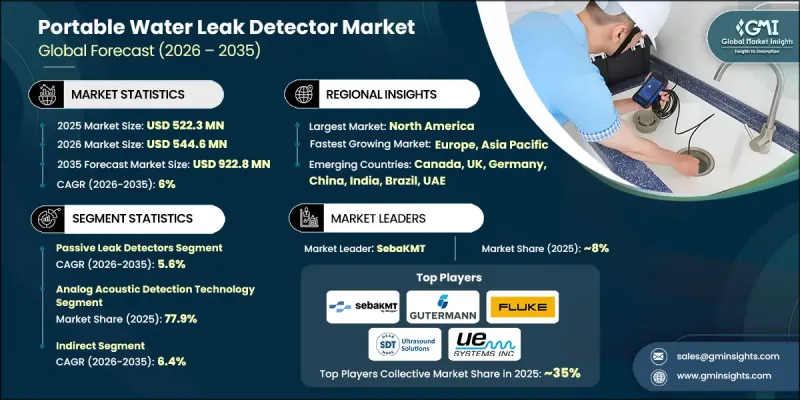
세계의 휴대용 누수 감지기 시장의 성장은 감지 정확도와 운영 성능을 혁신적으로 변화시키고 있는 급속한 기술 발전에 힘입고 있습니다. 사물인터넷(IoT) 연결성, 인공지능(AI), 실시간 데이터 처리의 첨단 통합은 휴대용 누수 감지 장비의 정밀도를 획기적으로 향상시켰습니다. 최신 기기들은 음향 패턴, 압력 변동, 환경 지표를 분석하여 누수 원인을 신속하고 효율적으로 파악하도록 설계되었습니다. 향상된 연결성을 통해 기술자들은 실행 가능한 인사이트를 즉시 확보할 수 있어 수리 기간을 단축하고 전반적인 의사결정 능력을 강화할 수 있습니다. 클라우드 기반 모니터링 기능과 예측 분석은 인프라 손상과 물 손실을 최소화하면서 유지보수 계획을 더욱 최적화하고 있습니다. 무선 통신, 스마트 알고리즘, 소형 시스템 설계 분야의 지속적인 혁신은 공공 시설, 상업 시설 및 산업 운영 전반에 걸쳐 적용 범위를 확대하고 있습니다. 또한, 휴대용 시스템은 고정형 모니터링 인프라에 비해 자본 투자 요구 사항이 적고 운영 유연성이 뛰어나기 때문에 여전히 매력적이며, 이동성과 비용 효율성을 추구하는 조직에게 실용적인 솔루션이 되고 있습니다.
| 시장 범위 | |
|---|---|
| 시작 연도 | 2025년 |
| 예측 기간 | 2026-2035년 |
| 시작 시장 규모 | 5억 2,230만 달러 |
| 예측 금액 | 9억 2,280만 달러 |
| CAGR | 6% |
수동 누수 감지기 부문은 2025년에 3억 9,400만 달러 시장 규모를 기록하고 2026년부터 2035년에 걸쳐 CAGR 5.6%를 나타낼 것으로 예측됩니다. 이들의 채택 증가세는 직관적인 기능, 합리적인 가격, 그리고 중단 없는 모니터링이 중요하지만 고도로 복잡한 시스템이 반드시 필요하지 않은 주거, 상업 및 산업 환경 전반에 걸친 적합성과 관련이 있습니다. 유지보수가 적은 구성과 최소한의 전력 요구 사항 덕분에 광범위한 배포에 매우 적합합니다. 수해 위험에 대한 인식이 높아지고, 노후화된 인프라와 더욱 엄격해진 건축 규정 기준이 결합되면서, 최종 사용자들은 막대한 구조적 손실을 방지하기 위한 초기 안전 장치로 수동형 장치를 도입하도록 장려받고 있습니다.
아날로그 음향 감지 기술 부문은 2025년에 77.9%의 점유율을 차지하며, 2035년까지 연평균 복합 성장률(CAGR) 5.6%를 나타낼 것으로 예측됩니다. 이러한 시스템은 복잡한 디지털 아키텍처에 의존하지 않고 음파 주파수를 분석하여 누수를 감지하는 능력으로 널리 인정받고 있습니다. 비용 효율성, 유지보수의 용이성, 비침습적 작동 방식 덕분에 기술자들은 서비스 중단을 최소화하면서 누수 위치를 효율적으로 파악할 수 있습니다. 인프라 업그레이드에 대한 투자 증가와 물 손실 감축에 대한 관심 고조는 음향 기반 휴대용 탐지 도구에 대한 수요를 강화하고 있습니다.
미국의 휴대용 누수 감지기 시장은 2025년에 1억 3,550만 달러에 이르렀으며, 2026년부터 2035년까지 연평균 복합 성장률(CAGR) 5.9%를 나타낼 것으로 예측됩니다. 물 절약 및 시설 안전과 관련된 엄격한 규제 기준은 유틸리티 업체와 부동산 소유주들이 미수익 수돗물(NRW)을 줄이고 구조적 손상을 방지하기 위해 첨단 탐지 솔루션을 도입하도록 유도하고 있습니다. 상업 및 주거 개발 분야 전반에서 도입률이 지속적으로 증가하고 있으며, 이는 선제적인 물 관리 전략으로의 광범위한 국가적 전환을 반영합니다.
자주 묻는 질문
목차
제1장 연구 방법과 범위
제2장 주요 요약
제3장 업계 인사이트
- 생태계 분석
- 공급자의 상황
- 이익률
- 각 단계의 부가가치
- 밸류체인에 영향을 주는 요인
- 업계에 미치는 영향요인
- 성장 촉진요인
- 효율적인 누수 감지 및 물 절약에 대한 수요 증가
- IoT, AI 및 실시간 분석의 기술 발전
- 비용 효율성과 유연성
- 업계의 잠재적 위험 및 과제
- 소음 간섭 및 오탐지
- 표준화된 프로토콜의 부족
- 성장 촉진요인
- 성장 가능성 분석
- 장래 시장 동향
- 기술 및 혁신 동향
- 현재의 기술 동향
- 신흥 기술
- 가격 동향
- 지역별
- 유형별
- 규제 상황
- 규격 및 규정 준수 요건
- 지역별 규제 프레임워크
- 인증 기준
- Porter's Five Forces 분석
- PESTEL 분석
제4장 경쟁 구도
- 소개
- 기업의 시장 점유율 분석
- 지역별
- 북미
- 유럽
- 아시아태평양
- 라틴아메리카
- 중동 및 아프리카
- 지역별
- 기업 매트릭스 분석
- 주요 시장 기업의 경쟁 분석
- 경쟁 포지셔닝 매트릭스
- 주요 발전
- 합병 및 인수
- 제휴 및 협업
- 신제품 발매
- 사업 확대 계획
제5장 시장 추계 및 예측 : 운용 모드별(2022-2035년)
- 자동 누수 감지기
- 수동 누수 감지기
제6장 시장 추계 및 예측 : 기술별(2022-2035년)
- 스마트 음향 감지 기술
- 아날로그 음향 감지 기술
제7장 시장 추계 및 예측 : 기술별(2022-2035년)
- 마이크식
- 상관 분석 기반
- 기타
제8장 시장 추계 및 예측 : 용도별(2022-2035년)
- 주택용
- 상업용
- 산업용
제9장 시장 추계 및 예측 : 최종 사용자별(2022-2035년)
- 지방 자치 단체/파이프라인 네트워크
- 산업용도
- 상업시설
- 주택용 부동산
제10장 시장 추계 및 예측 : 유통 채널별(2022-2035년)
- 직접 판매
- 간접 판매
제11장 시장 추계 및 예측 : 지역별(2022-2035년)
- 북미
- 미국
- 캐나다
- 유럽
- 독일
- 영국
- 프랑스
- 이탈리아
- 스페인
- 아시아태평양
- 중국
- 인도
- 일본
- 한국
- 호주
- 인도네시아
- 말레이시아
- 라틴아메리카
- 브라질
- 멕시코
- 아르헨티나
- 중동 및 아프리카(MEA)
- 사우디아라비아
- 아랍에미리트(UAE)
- 남아프리카
제12장 기업 프로파일
- Fluid Conservation Systems
- Fluke
- GAO Tek
- GE Measurement &Control
- Guangdong Hongsimai Technology
- Gutermann
- Hunan Puqi Water Environment Institute
- MSA(Mine Safety Appliances Company)
- SDT Ultrasound
- SebaKMT
- Shandong Relied Heavy Industry
- SONOTEC GmbH
- TECHNO-AC
- UE Systems
The Global Portable Water Leak Detector Market was valued at USD 522.3 million in 2025 and is estimated to grow at a CAGR of 6% to reach USD 922.8 million by 2035.
Growth in the global portable water leak detector market is supported by rapid technological progress that is reshaping detection accuracy and operational performance. Advanced integration of Internet of Things connectivity, artificial intelligence, and real-time data processing has significantly improved the precision of portable leak detection equipment. Modern devices are engineered to evaluate acoustic patterns, pressure fluctuations, and environmental indicators to identify leak sources quickly and efficiently. Enhanced connectivity allows technicians to access actionable insights instantly, accelerating repair timelines and strengthening overall decision-making. Cloud-based monitoring capabilities and predictive analytics are further optimizing maintenance planning while minimizing infrastructure damage and water loss. Continuous innovation in wireless communication, smart algorithms, and compact system design is expanding application versatility across utilities, commercial facilities, and industrial operations. In addition, portable systems remain attractive due to their lower capital investment requirements and operational flexibility when compared to permanent monitoring infrastructure, making them a practical solution for organizations seeking mobility and cost efficiency.
| Market Scope | |
|---|---|
| Start Year | 2025 |
| Forecast Year | 2026-2035 |
| Start Value | $522.3 Million |
| Forecast Value | $922.8 Million |
| CAGR | 6% |
The passive leak detectors segment generated USD 394 million in 2025 and is expected to grow at a CAGR of 5.6% between 2026 and 2035. Their increasing adoption is linked to straightforward functionality, budget-friendly pricing, and suitability across residential, commercial, and industrial environments where uninterrupted monitoring is important but highly complex systems may not be necessary. Low-maintenance configurations and minimal power requirements make them well-suited for broad deployment. Growing awareness of water damage risks, combined with aging infrastructure and stricter building compliance standards, is encouraging end users to implement passive devices as an initial safeguard against costly structural losses.
The analog acoustic detection technology segment held 77.9% share in 2025 and is forecast to grow at a CAGR of 5.6% through 2035. These systems are widely recognized for their ability to detect leaks by analyzing sound frequencies without relying on intricate digital architectures. Their cost-effectiveness, ease of maintenance, and non-invasive operation enable technicians to locate leaks efficiently while minimizing service disruptions. Rising investment in infrastructure upgrades and heightened focus on reducing water loss are reinforcing demand for acoustic-based portable detection tools.
United States Portable Water Leak Detector Market reached USD 135.5 million in 2025 and is anticipated to grow at a CAGR of 5.9% from 2026 to 2035. Strict regulatory standards related to water conservation and facility safety are driving utilities and property owners to deploy advanced detection solutions to reduce non-revenue water and prevent structural damage. Adoption rates continue to rise across both commercial and residential developments, reflecting a broader national shift toward proactive water management strategies.
Key companies operating in the Global Portable Water Leak Detector Market include Fluke, SebaKMT, UE Systems, SONOTEC GmbH, MSA (Mine Safety Appliances Company), Gutermann, GAO Tek, GE Measurement & Control, SDT Ultrasound, TECHNO-AC, Fluid Conservation Systems, Guangdong Hongsimai Technology, Hunan Puqi Water Environment Institute, and Shandong Relied Heavy Industry. Companies in the Portable Water Leak Detector Market are reinforcing their competitive advantage through continuous technological enhancement and global expansion strategies. Manufacturers are prioritizing research and development to refine acoustic sensitivity, integrate AI-driven diagnostics, and enhance wireless data transmission capabilities. Strategic partnerships with utilities and infrastructure contractors are strengthening distribution channels and long-term service agreements. Many firms are expanding product portfolios to address diverse end-user requirements, from compact handheld units to advanced multi-sensor systems.
Table of Contents
Chapter 1 Methodology & Scope
- 1.1 Market scope and definition
- 1.2 Research design
- 1.2.1 Research approach
- 1.2.2 Data collection methods
- 1.3 Data mining sources
- 1.3.1 Global
- 1.3.2 Regional/Country
- 1.4 Base estimates and calculations
- 1.4.1 Base year calculation
- 1.4.2 Key trends for market estimation
- 1.5 Primary research and validation
- 1.5.1 Primary sources
- 1.6 Forecast model
- 1.7 Research assumptions and limitations
Chapter 2 Executive Summary
- 2.1 Industry 360° synopsis
- 2.2 Key market trends
- 2.2.1 Regional
- 2.2.2 Operating mode
- 2.2.3 Technology
- 2.2.4 Technology type
- 2.2.5 Application
- 2.2.6 End-user type
- 2.2.7 Distribution channel
- 2.3 CXO perspectives: Strategic imperatives
- 2.3.1 Key decision points for industry executives
- 2.3.2 Critical success factors for market players
- 2.4 Future outlook and strategic recommendations
Chapter 3 Industry Insights
- 3.1 Industry ecosystem analysis
- 3.1.1 Supplier landscape
- 3.1.2 Profit margin
- 3.1.3 Value addition at each stage
- 3.1.4 Factor affecting the value chain
- 3.2 Industry impact forces
- 3.2.1 Growth drivers
- 3.2.1.1 Rising demand for efficient leak detection and water conservation
- 3.2.1.2 Technological advancements in IoT, AI & real-time analytics
- 3.2.1.3 Cost efficiency and flexibility
- 3.2.2 Industry pitfalls & challenges
- 3.2.2.1 Noise interference & false positives
- 3.2.2.2 Lack of standardized protocols
- 3.2.1 Growth drivers
- 3.3 Growth potential analysis
- 3.4 Future market trends
- 3.5 Technology and innovation landscape
- 3.5.1 Current technological trends
- 3.5.2 Emerging technologies
- 3.6 Price trends
- 3.6.1 By region
- 3.6.2 By type
- 3.7 Regulatory landscape
- 3.7.1 Standards and compliance requirements
- 3.7.2 Regional regulatory frameworks
- 3.7.3 Certification standards
- 3.8 Porter's analysis
- 3.9 PESTEL analysis
Chapter 4 Competitive Landscape, 2025
- 4.1 Introduction
- 4.2 Company market share analysis
- 4.2.1 By Region
- 4.2.1.1 North America
- 4.2.1.2 Europe
- 4.2.1.3 Asia Pacific
- 4.2.1.4 Latin America
- 4.2.1.5 Middle East & Africa
- 4.2.1 By Region
- 4.3 Company matrix analysis
- 4.4 Competitive analysis of major market players
- 4.5 Competitive positioning matrix
- 4.6 Key developments
- 4.6.1 Mergers & acquisitions
- 4.6.2 Partnerships & collaborations
- 4.6.3 New product launches
- 4.6.4 Expansion plans
Chapter 5 Market Estimates & Forecast, By Operating Mode, 2022 - 2035, (USD Million) (Thousand Units)
- 5.1 Key trends
- 5.2 Active leak detectors
- 5.3 Passive leak detectors
Chapter 6 Market Estimates & Forecast, By Technology, 2022 - 2035, (USD Million) (Thousand Units)
- 6.1 Key trends
- 6.2 Smart acoustic detection technology
- 6.3 Analog acoustic detection technology
Chapter 7 Market Estimates & Forecast, By Technology type, 2022 - 2035, (USD Million) (Thousand Units)
- 7.1 Key trends
- 7.2 Microphone-based
- 7.3 Correlator-based
- 7.4 Others
Chapter 8 Market Estimates & Forecast, By Application, 2022 - 2035, (USD Million) (Thousand Units)
- 8.1 Key trends
- 8.2 Residential
- 8.3 Commercial
- 8.4 Industrial
Chapter 9 Market Estimates & Forecast, By End-User Type, 2022 - 2035, (USD Million) (Thousand Units)
- 9.1 Key trends
- 9.2 Municipal/pipeline networks
- 9.3 Industrial applications
- 9.4 Commercial facilities
- 9.5 Residential properties
Chapter 10 Market Estimates & Forecast, By Distribution Channel, 2022 - 2035, (USD Million) (Thousand Units)
- 10.1 Key trends
- 10.2 Direct
- 10.3 Indirect
Chapter 11 Market Estimates & Forecast, By Region, 2022 - 2035, (USD Million) (Thousand Units)
- 11.1 Key trends
- 11.2 North America
- 11.2.1 U.S.
- 11.2.2 Canada
- 11.3 Europe
- 11.3.1 Germany
- 11.3.2 UK
- 11.3.3 France
- 11.3.4 Italy
- 11.3.5 Spain
- 11.4 Asia Pacific
- 11.4.1 China
- 11.4.2 India
- 11.4.3 Japan
- 11.4.4 South Korea
- 11.4.5 Australia
- 11.4.6 Indonesia
- 11.4.7 Malaysia
- 11.5 Latin America
- 11.5.1 Brazil
- 11.5.2 Mexico
- 11.5.3 Argentina
- 11.6 MEA
- 11.6.1 Saudi Arabia
- 11.6.2 UAE
- 11.6.3 South Africa
Chapter 12 Company Profiles
- 12.1 Fluid Conservation Systems
- 12.2 Fluke
- 12.3 GAO Tek
- 12.4 GE Measurement & Control
- 12.5 Guangdong Hongsimai Technology
- 12.6 Gutermann
- 12.7 Hunan Puqi Water Environment Institute
- 12.8 MSA (Mine Safety Appliances Company)
- 12.9 SDT Ultrasound
- 12.10 SebaKMT
- 12.11 Shandong Relied Heavy Industry
- 12.12 SONOTEC GmbH
- 12.13 TECHNO-AC
- 12.14 UE Systems