|
시장보고서
상품코드
1982271
실내 전동 카트 운영 시장 기회, 성장 촉진요인, 업계 동향 분석 및 예측(2026-2035년)Indoor Electric Karting Operator Market Opportunity, Growth Drivers, Industry Trend Analysis, and Forecast 2026 - 2035 |
||||||

세계의 실내 전동 카트 운영 시장은 2025년에 5억 2,710만 달러로 평가되었으며, CAGR 5.4%로 성장하여 2035년까지 8억 7,800만 달러에 달할 것으로 추정됩니다.
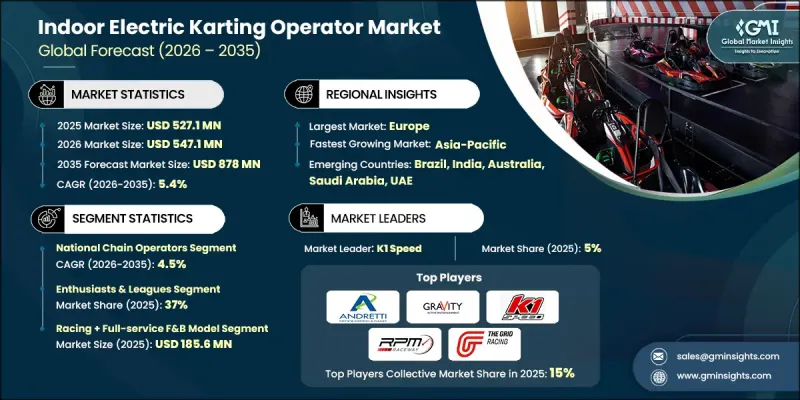
전 세계 실내 전동 카트 운영 시장의 성장은 진화하는 도시 라이프스타일 트렌드에 따라 지속가능하고 연중 내내 즐길 수 있는 엔터테인먼트 경험에 대한 수요가 증가함에 따라 주도되고 있습니다. 운영 사업자들은 환경 규제 강화와 전기 시스템에 따른 운영 효율성 향상에 대응하기 위해 휘발유 차량에서 전기 카트로의 전환을 가속화하고 있습니다. 유지보수 요구 사항 감소, 소음 수준 감소, 에너지 효율 개선은 시설 업그레이드 및 신규 경기장 개발을 촉진하고 있습니다. 현대식 실내 카트 센터는 첨단 트랙 디자인, 다층 레이아웃, 디지털 레이스 관리 플랫폼이 통합되어 고객 참여도를 높입니다. 또한, 업계에서는 데이터 기반 성능 추적, 인터랙티브 게임 인터페이스, 레이싱 경험을 확장하는 시뮬레이션 등 몰입형 기술을 적극적으로 도입하여 전체 사용자 경험을 향상시키고 있습니다. 이러한 혁신은 고객 유지율을 높이고, 사업자가 프리미엄 가격을 책정할 수 있게 해줍니다. 경쟁형 소셜 엔터테인먼트가 지속적으로 성장하고 있는 가운데, 실내 전동 카트 운영 산업은 광범위한 위치 기반 엔터테인먼트 시장에서 높은 성장세를 보이고 있는 분야로 자리매김하고 있습니다.
| 시장 범위 | |
|---|---|
| 시작 연도 | 2025년 |
| 예측 기간 | 2026-2035년 |
| 개시시 시장 규모 | 5억 2,710만 달러 |
| 예측액 | 8억 7,800만 달러 |
| CAGR | 5.4% |
전국 체인 사업자 부문은 2025년 44%의 점유율을 차지했으며, 2026년부터 2035년까지 연평균 4.5%의 성장률을 보일 것으로 예상됩니다. 이 부문은 규모의 경제, 표준화된 서비스 모델, 중앙 집중식 차량 조달 전략으로 인해 실내 전동 카트 운영 시장을 주도하고 있습니다. 주요 사업자들은 일관된 브랜딩, 통합된 기술 생태계, 그리고 여러 경기장에 자체적인 레이스 관리 시스템을 구축할 수 있는 능력을 통해 운영 효율성과 고객 충성도를 높일 수 있는 혜택을 누리고 있습니다.
애호가 및 리그 부문은 2025년에 37%의 점유율을 차지했으며, 2026년부터 2035년까지 연평균 3.9%의 CAGR로 성장할 것으로 예상됩니다. 이 부문은 운영자에게 안정적인 수익원을 제공하는 열성적인 레이서 및 단골 참가자로 구성되어 있습니다. 체계화된 리그 운영은 일정의 예측 가능성을 높이고, 차량 가동률을 최적화하며, 장기적인 수익성을 뒷받침하는 커뮤니티 주도형 참여 모델을 구축합니다.
미국의 실내 전동 카트 운영 시장은 2025년에 1억 5천만 달러에 달할 것으로 예상됩니다. 미국 시장 확대는 강력한 소비자 구매력, 확립된 모터스포츠 문화, 성숙한 가족용 엔터테인먼트 인프라가 뒷받침하고 있습니다. 경쟁력 있는 리그 형식과 정기적인 이벤트 모델은 고객 유지율과 지역 시장 침투를 지속적으로 강화하여 미국 전역의 시설 운영자의 수익 성장을 주도하고 있습니다.
자주 묻는 질문
목차
제1장 조사 방법과 범위
제2장 주요 요약
제3장 업계 인사이트
제4장 경쟁 구도
제5장 시장 추정 및 예측 : 사업자별, 2022-2035
제6장 시장 추정 및 예측 : 수익 모델별, 2022-2035
제7장 시장 추정 및 예측 : 시설 규모별, 2022-2035
제8장 시장 추정 및 예측 : 고객별, 2022-2035
제9장 시장 추정 및 예측 : 지역별, 2022-2035
제10장 기업 개요
KSM 26.04.10The Global Indoor Electric Karting Operator Market was valued at USD 527.1 million in 2025 and is estimated to grow at a CAGR of 5.4% to reach USD 878 million by 2035.
Growth in the global indoor electric karting operator market is driven by rising demand for sustainable, all-season entertainment experiences aligned with evolving urban lifestyle trends. Operators are increasingly transitioning from gasoline-powered fleets to electric karts in response to stricter environmental policies and the operational efficiencies associated with electric systems. Lower maintenance requirements, reduced noise levels, and improved energy efficiency are encouraging facility upgrades and new venue development. Modern indoor karting centers are integrating advanced track designs, multi-level layouts, and digital race management platforms to enhance customer engagement. The industry is also embracing immersive technologies, including data-driven performance tracking, interactive gaming interfaces, and augmented race simulations that elevate the overall user experience. These innovations are strengthening customer retention and enabling operators to command premium pricing. As competitive social entertainment continues to gain traction, the indoor electric karting operator industry is positioning itself as a high-growth segment within the broader location-based entertainment market.
| Market Scope | |
|---|---|
| Start Year | 2025 |
| Forecast Year | 2026-2035 |
| Start Value | $527.1 Million |
| Forecast Value | $878 Million |
| CAGR | 5.4% |
The national chain operators segment accounted for 44% share in 2025 and is expected to grow at a CAGR of 4.5% between 2026 and 2035. This segment leads the indoor electric karting operator market due to its scale advantages, standardized service models, and centralized fleet procurement strategies. Large operators benefit from consistent branding, integrated technology ecosystems, and the ability to deploy proprietary race management systems across multiple venues, strengthening operational efficiency and customer loyalty.
The enthusiasts and leagues segment held 37% share in 2025 and is forecast to grow at a CAGR of 3.9% during 2026-2035. This segment consists of dedicated racers and recurring participants who generate stable revenue streams for operators. Structured league programming enhances scheduling predictability, optimizes fleet utilization, and builds community-driven engagement models that support long-term profitability.
United States Indoor Electric Karting Operator Market reached USD 100.5 million in 2025. Market expansion in the U.S. is supported by strong consumer spending power, a well-established motorsports culture, and a mature family entertainment infrastructure. Competitive league-based formats and recurring event models continue to strengthen customer retention and regional market penetration, driving revenue growth for facility operators across the country.
Key companies operating in the Global Indoor Electric Karting Operator Market include K1 Speed, Andretti Indoor Karting & Games, RPM Raceway, R1 Indoor Karting, Pole Position Raceway, Urban Air Adventure Park, Gravity Active Entertainment, Karting Genk, MONZA Foxwoods, and The Grid. Companies in the Indoor Electric Karting Operator Market are enhancing their competitive positioning through expansion strategies, technology integration, and diversified service offerings. Operators are investing in advanced electric kart fleets, upgrading track configurations, and incorporating digital race analytics to deliver differentiated customer experiences. Strategic site selection in high-traffic urban areas and partnerships with retail and entertainment complexes are strengthening brand visibility. Many players are implementing membership programs and loyalty initiatives to encourage repeat visits and stabilize recurring revenue. Businesses are also leveraging data insights to personalize marketing campaigns and optimize pricing strategies.
Table of Contents
Chapter 1 Methodology & Scope
- 1.1 Research approach
- 1.2 Quality Commitments
- 1.2.1 GMI AI policy & data integrity commitment
- 1.2.1.1 Source consistency protocol
- 1.2.1 GMI AI policy & data integrity commitment
- 1.3 Research Trail & Confidence Scoring
- 1.3.1 Research Trail Components
- 1.3.2 Scoring Components
- 1.4 Data Collection
- 1.4.1 Partial list of primary sources
- 1.5 Data mining sources
- 1.5.1 Paid sources
- 1.5.1.1 Sources, by region
- 1.5.1 Paid sources
- 1.6 Base estimates and calculations
- 1.6.1 Base year calculation for any one approach
- 1.7 Forecast
- 1.7.1 Quantified market impact analysis
- 1.7.1.1 Mathematical impact of growth parameters on forecast
- 1.7.1 Quantified market impact analysis
- 1.8 Research transparency addendum
- 1.8.1 Source attribution framework
- 1.8.2 Quality assurance metrics
- 1.8.3 Our commitment to trust
Chapter 2 Executive Summary
- 2.1 Industry 360° synopsis
- 2.2 Key market trends
- 2.2.1 Regional
- 2.2.2 Operator
- 2.2.3 Revenue Model
- 2.2.4 Facility Scale
- 2.2.5 Customer
- 2.3 TAM Analysis, 2026-2035
- 2.4 CXO perspectives: Strategic imperatives
Chapter 3 Industry Insights
- 3.1 Industry ecosystem analysis
- 3.1.1 Supplier landscape
- 3.1.2 Cost structure
- 3.1.3 Profit margin
- 3.1.4 Value addition at each stage
- 3.1.5 Vertical integration trends
- 3.1.6 Disruptors
- 3.2 Impact on forces
- 3.2.1 Growth drivers
- 3.2.1.1 Shift toward electric powertrains
- 3.2.1.2 Rise of experience economy
- 3.2.1.3 Integration of F&B & entertainment
- 3.2.1.4 Corporate & group event demand
- 3.2.2 Industry pitfalls & challenges
- 3.2.2.1 High capital intensity
- 3.2.2.2 Escalating insurance & liability costs
- 3.2.3 Market opportunities
- 3.2.3.1 Gamification & Data Analytics
- 3.2.3.2 Fleet Management & Fast Charging
- 3.2.3.3 Hybrid Realities & Simulators
- 3.2.3.4 International Franchise Expansion
- 3.2.1 Growth drivers
- 3.3 Technology trends & innovation ecosystem
- 3.3.1 Current technologies
- 3.3.2 Emerging technologies
- 3.4 Growth potential analysis
- 3.5 Regulatory landscape
- 3.5.1 North America
- 3.5.1.1 U.S. safety and facility regulations
- 3.5.1.2 Industry certifications and operational standards
- 3.5.1.3 Insurance and liability considerations
- 3.5.2 Europe
- 3.5.2.1 EU Machinery Directive (MD) & CE Certification
- 3.5.2.2 EU Stage V Emission Standards
- 3.5.2.3 ISO 12100 & EN 13814
- 3.5.3 Asia-Pacific
- 3.5.3.1 Japan Industrial Safety & Health Act
- 3.5.3.2 China GB Standards
- 3.5.3.3 India AIS/Emission & Safety Guidelines
- 3.5.4 Latin America
- 3.5.4.1 Brazil INMETRO Certification
- 3.5.4.2 Colombia Ministry of Labor Safety Regulations
- 3.5.4.3 Argentina Amusement & Equipment Safety Guidelines
- 3.5.5 Middle East & Africa
- 3.5.5.1 UAE Federal Authority for Human Resources & ESMA Standards
- 3.5.5.2 Oman Ministry of Labor Equipment Safety Regulations
- 3.5.5.3 South Africa SABS Construction Equipment Standards
- 3.5.1 North America
- 3.6 Porter's analysis
- 3.7 PESTEL analysis
- 3.8 Price trends
- 3.8.1 By race session pricing
- 3.8.2 By membership and package pricing
- 3.9 Patent analysis
- 3.10 Operating cost structure analysis
- 3.10.1 Fixed cost breakdown by facility format
- 3.10.2 Variable cost breakdown
- 3.10.3 Cost structure by geographic zone
- 3.10.4 Variable cost optimization strategies
- 3.11 Revenue model mechanics
- 3.11.1 Revenue mix structure, by revenue model
- 3.11.2 Revenue per visitor economics
- 3.11.2.1 Average spends per visit
- 3.11.2.2 Upsell contribution (F&B, merch, add-ons)
- 3.12 Recurring revenue levels
- 3.12.1 Membership models
- 3.12.2 Racing leagues
- 3.12.3 Loyalty programs
- 3.13 Demand and utilization dynamics
- 3.13.1 Customer segment contribution, by customer segment
- 3.13.2 Time-based utilization patterns
- 3.13.2.1 Peak vs off-peak hours
- 3.13.2.2 Weekend vs weekday demand
- 3.14 Capacity monetization strategy
- 3.14.1 Booking optimization
- 3.14.2 Event block scheduling
- 3.15 Impact of Artificial Intelligence (AI)
- 3.15.1 Predictive maintenance of electric karts
- 3.15.2 Optimized scheduling & track utilization
- 3.15.3 Personalization & dynamic pricing
- 3.15.4 Gamification and leaderboards
- 3.15.5 Real-time collision detection
- 3.15.6 Automated race analytics & coaching
- 3.16 Use cases
- 3.16.1 Rpm Raceway Long Island Renovation - Multi-Attraction Integration
- 3.16.2 TeamSport Uk - Competitive Leagues and Membership Programs
- 3.16.3 K1 Speed Global Expansion & Franchise Model
- 3.16.4 Emerging Concepts - AR/VR Karting Experiences
- 3.17 Future trends & market impact
- 3.17.1 Growth of multi-entertainment complex models
- 3.17.2 Corporate & b2b segment expansion
- 3.17.3 Smart facility management & iot adoption
- 3.17.4 Sustainability and electric fleet upgrades
- 3.17.5 Integration with e-sports & gamification
- 3.18 Sustainability and environmental aspects
- 3.18.1 Sustainable practices
- 3.18.2 Waste reduction strategies
- 3.18.3 Energy efficiency in production
- 3.18.4 Eco-friendly initiatives
- 3.18.5 Carbon footprint considerations
Chapter 4 Competitive Landscape, 2025
- 4.1 Introduction
- 4.2 Company market share analysis
- 4.2.1 North America
- 4.2.2 Europe
- 4.2.3 Asia-Pacific
- 4.2.4 Latin America
- 4.2.5 Middle East & Africa
- 4.3 Competitive analysis of major market players
- 4.4 Competitive positioning matrix
- 4.5 Key developments
- 4.5.1 Mergers & acquisitions
- 4.5.2 Partnerships & collaborations
- 4.5.3 New product launches
- 4.5.4 Expansion plans and funding
Chapter 5 Market Estimates & Forecast, By Operator, 2022 - 2035 ($Mn)
- 5.1 Key trends
- 5.2 National chain operators
- 5.2.1 Franchise-model chains
- 5.2.2 Corporate-owned chains
- 5.3 Regional operators
- 5.3.1 Regional franchise clusters
- 5.3.2 Regional independent chains
- 5.4 Single-location independents
- 5.4.1 Karting-focused
- 5.4.2 Multi-entertainment independents
Chapter 6 Market Estimates & Forecast, By Revenue Model, 2022 - 2035 ($Mn)
- 6.1 Key trends
- 6.2 Racing-dominant model
- 6.2.1 Basic F&B offering
- 6.2.2 Small arcade/limited add-ons
- 6.3 Racing + full-service F&B model
- 6.3.1 Sit-down restaurant/bar
- 6.3.2 Commercial kitchen operations
- 6.4 Multi-entertainment complex model
- 6.4.1 Karting + arcade
- 6.4.2 Karting + bowling
- 6.4.3 Karting + laser tag
- 6.4.4 Karting + VR/simulators
Chapter 7 Market Estimates & Forecast, By Facility Scale, 2022 - 2035 ($Mn)
- 7.1 Key trends
- 7.2 Large format facilities
- 7.3 Medium format facilities
- 7.4 Compact format facilities
Chapter 8 Market Estimates & Forecast, By Customer, 2022 - 2035 ($Mn)
- 8.1 Key trends
- 8.2 Individual & Walk-in customers
- 8.3 Corporate B2B
- 8.4 Events & parties
- 8.5 Enthusiasts & leagues
Chapter 9 Market Estimates & Forecast, By Region, 2022 - 2035 ($Mn)
- 9.1 North America
- 9.1.1 US
- 9.1.2 Canada
- 9.2 Europe
- 9.2.1 UK
- 9.2.2 Germany
- 9.2.3 France
- 9.2.4 Italy
- 9.2.5 Spain
- 9.2.6 Belgium
- 9.2.7 Netherlands
- 9.2.8 Sweden
- 9.2.9 Russia
- 9.3 Asia Pacific
- 9.3.1 China
- 9.3.2 India
- 9.3.3 Japan
- 9.3.4 Australia
- 9.3.5 Singapore
- 9.3.6 South Korea
- 9.3.7 Vietnam
- 9.3.8 Indonesia
- 9.4 Latin America
- 9.4.1 Brazil
- 9.4.2 Mexico
- 9.4.3 Argentina
- 9.5 MEA
- 9.5.1 South Africa
- 9.5.2 Saudi Arabia
- 9.5.3 UAE
Chapter 10 Company Profiles
- 10.1 Global players
- 10.1.1 Andretti Indoor Karting & Games
- 10.1.2 Autobahn Indoor Speedway
- 10.1.3 K1 Speed
- 10.1.4 Karting Genk
- 10.1.5 MONZA Foxwoods
- 10.1.6 Pole Position Raceway
- 10.1.7 R1 Indoor Karting
- 10.1.8 RushHour Karting
- 10.1.9 The Grid
- 10.2 Regional players
- 10.2.1 Autobahn Indoor Speedway
- 10.2.2 Karting Arena
- 10.2.3 Kartworld
- 10.2.4 Le Mans Karting International
- 10.2.5 Monaco Kart
- 10.2.6 Octane Raceway
- 10.2.7 RPM Raceway
- 10.2.8 TeamSport Indoor Karting
- 10.3 Emerging players
- 10.3.1 F1 Boston
- 10.3.2 Race Planet
- 10.3.3 SMAAASH Entertainment