

|
시장보고서
상품코드
1982350
지열 에너지 시장 기회, 성장요인, 업계 동향 분석 및 예측(2026-2035년)Geothermal Energy Market Opportunity, Growth Drivers, Industry Trend Analysis, and Forecast 2026 - 2035 |
||||||

세계의 지열 에너지 시장은 2025년에 669억 달러로 평가되었고, 2035년까지 연평균 복합 성장률(CAGR) 5.5%로 확대되어 1,096억 달러에 이를 것으로 추정되고 있습니다.
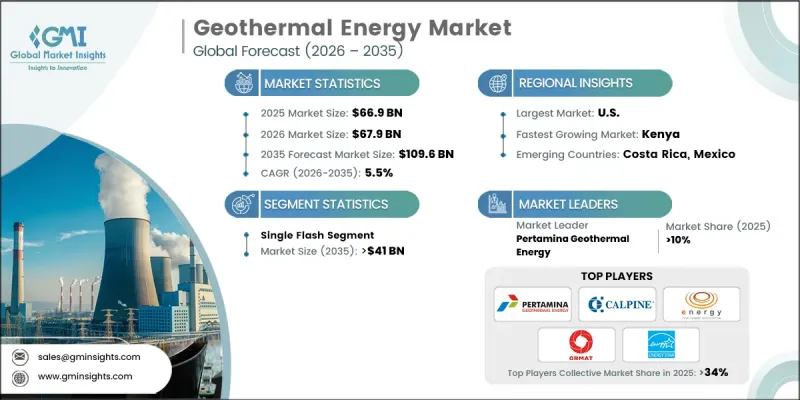
이 시장은 송전망의 신뢰성을 뒷받침하고 높은 가동률의 지열 자원을 우대하는 클린 팜 전력 조달 의무에 의해 주도되고 있습니다. 프로젝트 비용 절감, 학습 효과로 인한 성능 향상, 규제 당국의 지원으로 인한 전력 회사 조달은 장기적인 수익의 확실성을 제공하여 투자 정당성을 강화합니다. 기업들은 기존 우물이나 증기전을 재사용하고 발전 용량을 빠르게 확대하기 위해 하부 순환 열병합 발전을 활용하여 기존 부지(브라운필드)의 최적화를 점점 더 많이 추진하고 있습니다. 에너지 안보에 대한 우려와 특혜 대출로 인해 소규모 섬 지역에 세계 최초의 지열 발전소 건설이 가능해졌습니다. 시장의 성장은 여전히 완만하고 집중되어 있으며, 기존 설비에 대한 증설이 주류를 이루고 있습니다. 정책 입안자들은 지열을 변동성이 큰 재생에너지를 보완하는 신뢰할 수 있는 전원으로 인식하고 있으며, 첨단 지열기술은 연구개발 단계에서 실지 실증 단계로 넘어가면서 적용 가능한 지질과 프로젝트 유형을 확대하고 있습니다. 실행상의 과제와 계통연계 제약이 조달 동향을 좌우하고 있으며, 단계적 도입이 선호되고 있습니다. 아시아에서 정부 주도의 노력으로 자금 조달이 가능한 파이프라인이 확대되고 프로젝트 개발권을 둘러싼 경쟁이 심화되고 있는 가운데, 기존 발전소의 리파워링 및 출력 증대는 신규 그린필드 개발보다 빠르게 단기적인 발전량 증가를 가져오고 있습니다.
| 시장 범위 | |
|---|---|
| 개시 연도 | 2025년 |
| 예측 기간 | 2026-2035년 |
| 개시시 시장 규모 | 669억 달러 |
| 예측액 | 1,096억 달러 |
| CAGR | 5.5% |
싱글 플래시 지열 부문은 2025년 35.9%의 점유율을 차지할 것으로 예상되며, 2035년까지 410억 달러에 달할 것으로 전망됩니다. 단일 플러시 시스템은 고압의 지열수를 증기로 변환하여 터빈을 구동하고 남은 유체를 저류층에 재주입하는 방식입니다. 지열은 이미 확립된 기술, 운영의 편의성, 고온 열수전에서의 효율성으로 인해 전 세계적으로 주류 지열 솔루션으로 자리 잡았습니다.
미국 지열 에너지 시장은 2025년 155억 달러에 달할 것으로 예측됩니다. 이러한 성장은 재생에너지에 대한 투자 확대, 저배출 전력에 대한 수요, 그리고 청정 에너지를 장려하는 정부의 인센티브가 반영된 결과입니다. 연방정부의 공유지 허가 및 프로젝트 승인은 불확실성을 줄이고 새로운 자원 지역을 개척함으로써 지열 개발을 가속화하고 있습니다.
자주 묻는 질문
목차
제1장 조사 방법과 범위
제2장 주요 요약
제3장 업계 인사이트
제4장 경쟁 구도
제5장 시장 규모와 예측 : 기술별, 2022-2035
제6장 시장 규모와 예측 : 국가별, 2022-2035
제7장 기업 개요
LSH 26.04.13The Global Geothermal Energy Market was valued at USD 66.9 billion in 2025 and is estimated to grow 5.5% to reach USD 109.6 billion by 2035.
The market is propelled by clean-firm procurement mandates that support grid reliability, rewarding high-capacity-factor geothermal resources. Falling project costs, improved performance through learning effects, and regulatory-backed utility procurement are strengthening the investment case by providing long-term revenue certainty. Companies are increasingly optimizing brownfield sites using bottoming-cycle cogeneration, leveraging existing wells and steamfields to add capacity quickly. Energy security concerns and concessional financing are enabling first-of-a-kind geothermal plants in small island systems. Market growth remains gradual and concentrated, with incremental additions dominating. Policymakers are positioning geothermal as a reliable complement to variable renewables, while advanced geothermal technologies are moving from R&D to field demonstrations, expanding viable geologies and project types. Execution challenges and interconnection constraints are shaping procurement, favoring phased deployment. Government-led initiatives in Asia are expanding bankable pipelines and intensifying competition for project development rights, while repowering and uprating existing plants provide near-term output gains faster than new greenfield development.
| Market Scope | |
|---|---|
| Start Year | 2025 |
| Forecast Year | 2026-2035 |
| Start Value | $66.9 Billion |
| Forecast Value | $109.6 Billion |
| CAGR | 5.5% |
The single-flash geothermal segment accounted for 35.9% share in 2025 and is projected to reach USD 41 billion by 2035. Single-flash systems convert high-pressure geothermal water into steam to drive turbines, reinjecting remaining fluid into reservoirs. Their proven technology, operational simplicity, and efficiency in high-temperature hydrothermal fields make them the dominant geothermal solution globally.
U.S. Geothermal Energy Market reached USD 15.5 billion in 2025. This growth reflects rising investments in renewable energy, demand for low-emission electricity, and government incentives promoting clean power. Federal permitting and project approvals on public lands have accelerated geothermal development by reducing uncertainties and unlocking new resource areas.
Key players in the Global Geothermal Energy Market include Ansaldo Energia, Energy Development Corporation, Enel Green Power, Contact Energy, Ormat Technologies, Pertamina Geothermal Energy, GE Vernova, Halliburton, Mitsubishi Heavy Industries, Star Energy, Reykjavik Geothermal, Fuji Electric, SLB, Exergy International, Calpine, Enertime, Toshiba, Turboden, and KenGen. Companies in the Geothermal Energy Market are focusing on strategic initiatives to strengthen their position. They are investing in technology upgrades, including advanced drilling, resource characterization, and high-efficiency turbines, to improve plant output and operational reliability. Many are entering joint ventures and partnerships to share project risks, expand geographic reach, and accelerate development pipelines. Firms are also leveraging government incentives, concessional financing, and carbon credit programs to lower CAPEX barriers and improve ROI. Additionally, players are repowering and uprating existing plants to boost output cost-effectively while expanding service offerings to include engineering, procurement, and operations management for integrated solutions.
Table of Contents
Chapter 1 Methodology & Scope
- 1.1 Research design
- 1.1.1 Research approach
- 1.1.2 Data collection methods
- 1.2 Base estimates and calculations
- 1.2.1 Base year calculation
- 1.2.2 Market estimates & forecast parameters
- 1.3 Forecast
- 1.3.1 Key trends for market estimates
- 1.3.2 Quantified market impact analysis
- 1.3.2.1 Mathematical impact of growth parameters on forecast
- 1.3.3 Scenario analysis framework
- 1.4 Primary research and validation
- 1.4.1 Some of the primary sources (but not limited to)
- 1.5 Data mining sources
- 1.5.1 Paid Sources
- 1.5.2 Sources, by region
- 1.6 Research trail & scoring components
- 1.6.1 Research trail components
- 1.6.2 Scoring components
- 1.7 Research transparency addendum
- 1.7.1 Source attribution framework
- 1.7.2 Quality assurance metrics
- 1.7.3 Our commitment to trust
- 1.8 Market definitions
Chapter 2 Executive Summary
- 2.1 Industry synopsis, 2022 - 2035
- 2.1.1 Business trends
- 2.1.2 Technology trends
- 2.1.3 Country trends
Chapter 3 Industry Insights
- 3.1 Industry ecosystem analysis
- 3.2 Regulatory landscape
- 3.3 Industry impact forces
- 3.3.1 Growth drivers
- 3.3.2 Industry pitfalls & challenges
- 3.4 Growth potential analysis
- 3.5 Porter's analysis
- 3.5.1 Bargaining power of suppliers
- 3.5.2 Bargaining power of buyers
- 3.5.3 Threat of new entrants
- 3.5.4 Threat of substitutes
- 3.6 PESTEL analysis
- 3.6.1 Political factors
- 3.6.2 Economic factors
- 3.6.3 Social factors
- 3.6.4 Technological factors
- 3.6.5 Legal factors
- 3.6.6 Environmental factors
- 3.7 Price trend analysis, 2022-2035
- 3.8 Emerging opportunities & trends
- 3.9 Investment analysis & future prospects
Chapter 4 Competitive Landscape, 2025
- 4.1 Introduction
- 4.2 Company market share analysis, 2025
- 4.3 Key developments
- 4.3.1 Mergers & acquisitions
- 4.3.2 Partnerships & collaborations
- 4.3.3 New product launches
- 4.3.4 Expansion plans and funding
- 4.4 Competitive benchmarking
- 4.5 Innovation & sustainability landscape
Chapter 5 Market Size and Forecast, By Technology, 2022 - 2035 (USD Million & MW)
- 5.1 Key trends
- 5.2 Binary
- 5.3 Single flash
- 5.4 Double flash
- 5.5 Triple flash
- 5.6 Dry
- 5.7 Back pressure
Chapter 6 Market Size and Forecast, By Country, 2022 - 2035 (USD Million & MW)
- 6.1 Key trends
- 6.2 U.S.
- 6.3 Mexico
- 6.4 Turkey
- 6.5 Iceland
- 6.6 Italy
- 6.7 Germany
- 6.8 China
- 6.9 Philippines
- 6.10 Indonesia
- 6.11 New Zealand
- 6.12 Japan
- 6.13 Kenya
- 6.14 Ethiopia
- 6.15 Costa Rica
- 6.16 El Salvador
- 6.17 Nicaragua
- 6.18 Guatemala
- 6.19 Rest of World
Chapter 7 Company Profiles
- 7.1 Ansaldo Energia
- 7.2 Calpine
- 7.3 Contact Energy
- 7.4 Energy Development Corporation
- 7.5 Enel Green Power
- 7.6 Enertime
- 7.7 Exergy International
- 7.8 First Gen
- 7.9 Fuji Electric
- 7.10 GE Vernova
- 7.11 Halliburton
- 7.12 KenGen
- 7.13 Mitsubishi Heavy Industries
- 7.14 Ormat Technologies
- 7.15 Pertamina Geothermal Energy
- 7.16 Reykjavik Geothermal
- 7.17 SLB
- 7.18 Star Energy
- 7.19 Toshiba
- 7.20 Turboden


