
|
시장보고서
상품코드
1982360
탄소 관리 시스템 시장 기회, 성장 요인, 산업 동향 분석 및 예측(2026-2035년)Carbon Management System Market Opportunity, Growth Drivers, Industry Trend Analysis, and Forecast 2026 - 2035 |
||||||

세계의 탄소 관리 시스템 시장은 2025년 142억 달러로 평가되었으며 CAGR 9.8%로 성장해 2035년까지 368억 달러에 이를 것으로 추정됩니다.
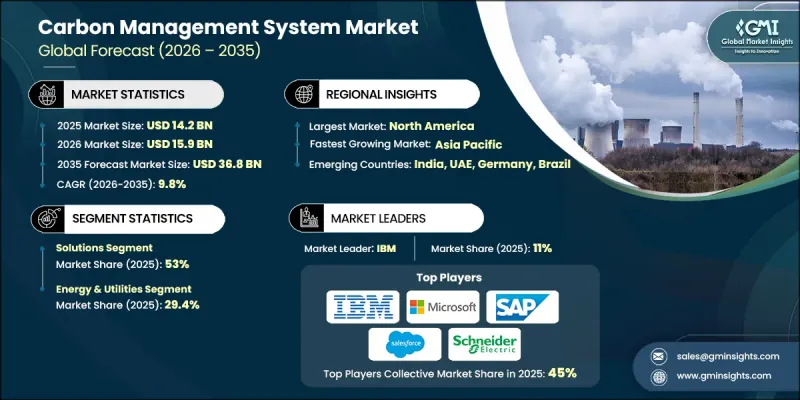
이 시장은 기술 혁신, 규제 압력, 기업의 지속가능성에 대한 우선순위 변화가 함께 변화하고 있습니다. 기업은 세계 기후 목표에 부합하고, 사업 활동과 관련된 배출량을 관리하고, 기후 관련 위험을 줄이기 위해 CMS 솔루션의 도입을 점차 추진하고 있습니다. 클라우드 기반 플랫폼의 상승과 더불어 인공지능(AI), 머신러닝(ML) 및 사물 인터넷(IoT) 기술의 통합으로 탄소 관리 실천이 재구성되어 실시간 모니터링, 예측 분석 및 자동화된 보고를 가능하게 하여 정확성과 업무 효율성을 향상시킬 수 있습니다. 환경, 사회 및 거버넌스(ESG) 보고는 전략적 필수사항이 되고 있으며, 이에 따라 CMS 공급자는 배출량, 에너지 소비 및 보다 광범위한 지속가능성 노력을 추적하는 통합형 ESG 툴을 제공하게 되었습니다. 수명 주기 평가도 중요성을 높이고 있으며, 조직은 제품 제조, 물류, 사용 및 폐기 단계에서 배출량을 정량화할 수 있어 공급망 전체에서 탄소 실적를 줄일 수 있는 실용적인 데이터를 제공합니다.
| 시장 범위 | |
|---|---|
| 시작 연도 | 2025년 |
| 예측 기간 | 2026-2035년 |
| 시작 금액 | 142억 달러 |
| 예측 금액 | 368억 달러 |
| CAGR | 9.8% |
솔루션 부문은 2025년에 53%의 점유율을 차지했고 2035년까지 연평균 복합 성장률(CAGR) 9.4%를 나타낼 것으로 예측됩니다. 제조, 에너지 및 운송의 각 분야에서 배출 프로파일의 복잡화가 진행됨에 따라 예측 분석, 실시간 추적 및 ESG 보고 기능을 제공하는 엔터프라이즈급 CMS 플랫폼에 대한 수요가 주도되고 있습니다.
에너지 및 유틸리티 부문은 2025년에 29.4%의 점유율을 차지하고, 2035년까지 연평균 복합 성장률(CAGR)10%를 나타낼 것으로 예측됩니다. 이 섹터는 온실가스 배출량이 방대하기 때문에 CMS의 주요 도입처가 되고 있습니다. 유틸리티가 신재생에너지 도입, 축전, 스마트그리드, 녹색 요금계획의 제공을 확대함에 따라 탄소강 도를 실시간으로 정확하게 정량화하고, 계획 수립 및 고객보고를 위해 투명하고 감사 가능한 데이터를 제공하는 시스템이 필요합니다.
미국의 탄소 관리시스템 시장은 82%의 점유율을 차지했으며, 2025년에는 39억 달러 시장 규모를 기록했습니다. 규제 요건에 따라 배출량 관리는 업무상의 필수 사항으로 변화하고 있으며, 특히 석유 및 가스 인프라의 메탄 배출 관리에서 현저합니다. 기업은 CMS 플랫폼을 활용하고, 센서 데이터와 위성 데이터를 통합하고, 누출 감지 및 복구 워크플로우를 자동화하고, 기술적 추정치와 실제 측정치를 비교하며, 법 집행에 적합한 감사가능한 기록을 유지하고 있습니다. 주 수준의 규제와 조달 프로그램도 스코프 1-3의 데이터 통합을 자금 조달이나 계약에 통합하도록 추진하고 있으며, CMS를 단순한 컴플라이언스 툴에서 핵심적인 업무, 리스크, 재무 시스템으로 승화시키고 있습니다.
자주 묻는 질문
목차
제1장 조사 방법과 범위
제2장 주요 요약
제3장 업계 인사이트
- 생태계 분석
- 규제 상황
- 업계에 미치는 영향요인
- 성장 촉진요인
- 업계의 잠재적 위험 및 과제
- 성장 가능성 분석
- Porter's Five Forces 분석
- 공급기업의 협상력
- 구매자의 협상력
- 신규 참가업체의 위협
- 대체품의 위협
- PESTEL 분석
- 새로운 기회와 동향
- 디지털화와 IoT의 통합
- 신흥 시장 진출
제4장 경쟁 구도
- 소개
- 기업의 시장 점유율 분석
- 북미
- 유럽
- 아시아태평양
- 중동 및 아프리카
- 라틴아메리카
- 전략적 노력
- 경쟁 벤치마킹
- 전략적 대시보드
- 혁신 및 기술 동향
제5장 시장 규모 및 예측 : 컴포넌트별(2022-2035년)
- 솔루션
- 서비스
제6장 시장 규모 및 예측 : 전개별(2022-2035년)
- 클라우드
- On-Premise
제7장 시장 규모 및 예측 : 산업별(2022-2035년)
- 에너지 및 유틸리티
- 제조업
- 주택 및 상업 건축
- 운송 및 물류
- IT 및 통신
- 기타
제8장 시장 규모 및 예측 : 지역별(2022-2035년)
- 북미
- 미국
- 캐나다
- 유럽
- 독일
- 프랑스
- 영국
- 스페인
- 이탈리아
- 아시아태평양
- 중국
- 인도
- 일본
- 호주
- 한국
- 중동 및 아프리카
- 아랍에미리트(UAE)
- 사우디아라비아
- 남아프리카
- 라틴아메리카
- 브라질
- 아르헨티나
제9장 기업 프로파일
- Accuvio
- Carbon Footprint Ltd.
- Dakota Software
- Enablon
- EnergyCap
- Engie
- Enviance
- Envirosoft
- ESP
- IBM
- Intelex
- Isometrix
- Locus Technologies
- NativeEnergy
- Salesforce
- SAP
- Schneider Electric
- Trinity Consultants
- Watershed
- Zevero
The Global Carbon Management System Market was valued at USD 14.2 billion in 2025 and is estimated to grow at a CAGR of 9.8% to reach USD 36.8 billion by 2035.
The market is transformed by a combination of technological innovation, regulatory pressure, and evolving corporate sustainability priorities. Businesses are increasingly adopting CMS solutions to align with global climate targets, manage operational emissions, and mitigate climate-related risks. The rise of cloud-based platforms, along with the integration of Artificial Intelligence (AI), Machine Learning (ML), and Internet of Things (IoT) technologies, is reshaping carbon management practices, enabling real-time monitoring, predictive insights, and automated reporting for improved accuracy and operational efficiency. Environmental, Social, and Governance (ESG) reporting has become a strategic imperative, prompting CMS providers to offer integrated ESG tools that track emissions, energy consumption, and broader sustainability initiatives. Lifecycle assessments are also gaining prominence, allowing organizations to quantify emissions from product manufacturing, logistics, use, and end-of-life disposal, providing actionable data to reduce carbon footprints across supply chains.
| Market Scope | |
|---|---|
| Start Year | 2025 |
| Forecast Year | 2026-2035 |
| Start Value | $14.2 Billion |
| Forecast Value | $36.8 Billion |
| CAGR | 9.8% |
The solutions segment held 53% share in 2025 and is anticipated to grow at a CAGR of 9.4% through 2035. Rising complexity in emissions profiles across manufacturing, energy, and transport sectors is driving demand for enterprise-grade CMS platforms offering predictive analytics, real-time tracking, and ESG reporting capabilities.
The energy and utilities segment held 29.4% share in 2025 and is projected to grow at a CAGR of 10% by 2035. The sector is a major adopter of CMS due to its substantial greenhouse gas emissions. As utilities increase renewable integration, storage, smart grids, and green tariff offerings, they require systems that quantify carbon intensity accurately in real time and provide transparent, auditable data for planning and customer reporting.
U.S. Carbon Management System Market held 82% share, generating USD 3.9 billion in 2025. Regulatory mandates are converting emissions management into operational imperatives, particularly for methane across oil and gas infrastructure. Companies are leveraging CMS platforms to integrate sensor and satellite data, automate leak detection and repair workflows, reconcile engineering estimates with actual measurements, and maintain auditable records suitable for enforcement. State-level regulations and procurement programs are also driving Scope 1-3 data integration into financing and contracts, elevating CMS from a compliance tool to a core operational, risk, and financial system.
Key players in the Global Carbon Management System Market include: Engie, SAP, Enablon, Watershed, Locus Technologies, Accuvio, Dakota Software, IBM, EnergyCap, Intelex, Zevero, NativeEnergy, ESP, Isometrix, Schneider Electric, Carbon Footprint Ltd., Envirosoft, Trinity Consultants, Salesforce, and Enviance. Companies in the Carbon Management System Market are employing strategic initiatives to strengthen their position and expand market presence. They are investing heavily in AI, IoT, and cloud-based innovations to deliver real-time emissions monitoring, predictive analytics, and automated ESG reporting. Strategic alliances and partnerships with utilities, manufacturing firms, and government agencies improve market access and long-term adoption. Companies are expanding globally, localizing solutions to meet regional compliance standards, and integrating CMS platforms with energy management, sustainability, and finance systems.
Table of Contents
Chapter 1 Methodology & Scope
- 1.1 Research approach
- 1.2 Quality commitment
- 1.2.1 GMI AI policy & data integrity commitment
- 1.2.1.1 Source consistency protocol
- 1.2.1 GMI AI policy & data integrity commitment
- 1.3 Research Trail & Confidence Scoring
- 1.3.1 Research Trail Components
- 1.3.2 Scoring Components
- 1.4 Data Collection
- 1.4.1 Partial list of primary sources
- 1.5 Data mining sources
- 1.5.1 Paid sources
- 1.5.1.1 Sources, by region
- 1.5.1 Paid sources
- 1.6 Base estimates and calculations
- 1.6.1 Base year calculation for any one approach
- 1.7 Forecast model
- 1.8 Research transparency addendum
- 1.8.1 Source attribution framework
- 1.8.2 Quality assurance metrics
- 1.8.3 Our commitment to trust
- 1.9 Market definitions
Chapter 2 Executive Summary
- 2.1 Industry synopsis, 2022 - 2035
- 2.1.1 Business trends
- 2.1.2 Component trends
- 2.1.3 Deployment trends
- 2.1.4 Industry trends
- 2.1.5 Regional trends
Chapter 3 Industry Insights
- 3.1 Industry ecosystem analysis
- 3.2 Regulatory landscape
- 3.3 Industry impact forces
- 3.3.1 Growth drivers
- 3.3.2 Industry pitfalls & challenges
- 3.4 Growth potential analysis
- 3.5 Porter's analysis
- 3.5.1 Bargaining power of suppliers
- 3.5.2 Bargaining power of buyers
- 3.5.3 Threat of new entrants
- 3.5.4 Threat of substitutes
- 3.6 PESTEL analysis
- 3.6.1 Political factors
- 3.6.2 Economic factors
- 3.6.3 Social factors
- 3.6.4 Technology factors
- 3.6.5 environmental factors
- 3.6.6 Legal factors
- 3.7 Emerging opportunities & trends
- 3.7.1 Digitalization and IoT integration
- 3.7.2 Emerging market penetration
Chapter 4 Competitive landscape, 2025
- 4.1 Introduction
- 4.2 Company market share analysis, 2025
- 4.2.1 North America
- 4.2.2 Europe
- 4.2.3 Asia Pacific
- 4.2.4 Middle East & Africa
- 4.2.5 Latin America
- 4.3 Strategic initiatives
- 4.4 Competitive benchmarking
- 4.5 Strategic dashboard
- 4.6 Innovation & technology landscape
Chapter 5 Market Size and Forecast, By Component, 2022 - 2035 (USD Million)
- 5.1 Key trends
- 5.2 Solutions
- 5.3 Services
Chapter 6 Market Size and Forecast, By Deployment, 2022 - 2035 (USD Million)
- 6.1 Key trends
- 6.2 Cloud
- 6.3 On-premises
Chapter 7 Market Size and Forecast, By Industry, 2022 - 2035 (USD Million)
- 7.1 Key trends
- 7.2 Energy & utilities
- 7.3 Manufacturing
- 7.4 Residential & commercial building
- 7.5 Transportation & logistics
- 7.6 IT & telecom
- 7.7 Others
Chapter 8 Market Size and Forecast, By Region, 2022 - 2035 (USD Million)
- 8.1 Key trends
- 8.2 North America
- 8.2.1 U.S.
- 8.2.2 Canada
- 8.3 Europe
- 8.3.1 Germany
- 8.3.2 France
- 8.3.3 UK
- 8.3.4 Spain
- 8.3.5 Italy
- 8.4 Asia Pacific
- 8.4.1 China
- 8.4.2 India
- 8.4.3 Japan
- 8.4.4 Australia
- 8.4.5 South Korea
- 8.5 Middle East & Africa
- 8.5.1 UAE
- 8.5.2 Saudi Arabia
- 8.5.3 South Africa
- 8.6 Latin America
- 8.6.1 Brazil
- 8.6.2 Argentina
Chapter 9 Company Profiles
- 9.1 Accuvio
- 9.2 Carbon Footprint Ltd.
- 9.3 Dakota Software
- 9.4 Enablon
- 9.5 EnergyCap
- 9.6 Engie
- 9.7 Enviance
- 9.8 Envirosoft
- 9.9 ESP
- 9.10 IBM
- 9.11 Intelex
- 9.12 Isometrix
- 9.13 Locus Technologies
- 9.14 NativeEnergy
- 9.15 Salesforce
- 9.16 SAP
- 9.17 Schneider Electric
- 9.18 Trinity Consultants
- 9.19 Watershed
- 9.20 Zevero