

|
시장보고서
상품코드
1982362
장기 에너지 저장 시장 기회, 성장 요인, 산업 동향 분석 및 예측(2026-2035년)Long Duration Energy Storage Market Opportunity, Growth Drivers, Industry Trend Analysis, and Forecast 2026 - 2035 |
||||||

세계의 장기 에너지 저장 시장은 2025년 36억 달러로 평가되었으며 CAGR 10.5%로 성장해 2035년까지 95억 달러에 이를 것으로 추정됩니다.
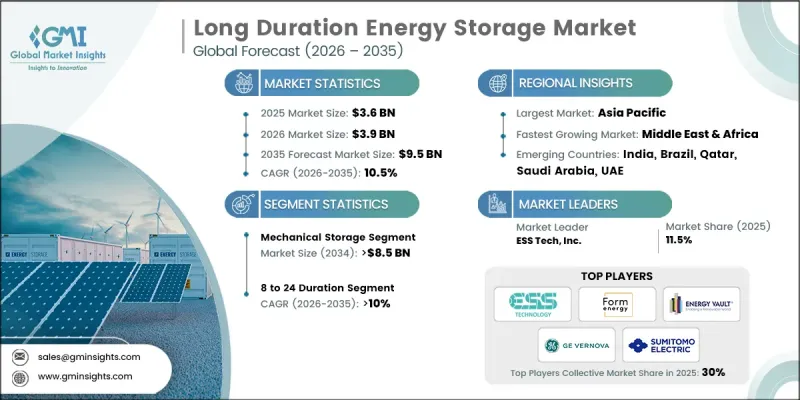
세계적으로 재생가능 에너지 발전이 계속 확대되고 있는 가운데, 장기 에너지 저장(LDES) 업계는 강한 기세를 보이고 있습니다. 태양광발전과 풍력발전이 전력 공급에서 차지하는 비율이 증가함에 따라 송전망 운영자는 장기간에 걸쳐 에너지를 공급할 수 있는 저장시스템을 점점 우선시하고 있습니다. 단시간 배터리와 달리 LDES 기술은 10시간 이상 전력을 방전할 수 있으며, 장기간 공급 변동 시에도 송전망의 균형을 유지하는 데 필수적입니다. 탈탄소화로 향하는 움직임이 가속화됨에 더하여, 신뢰성이 높고 강인한 전력 네트워크에 대한 요구가 증가하고 있는 것은 첨단 축전 인프라에 대한 투자를 뒷받침하고 있습니다. 전력 시스템은 기상 조건의 변화와 계절적 수요 패턴의 변동으로 인한 변동성을 관리해야 하며, 확장 가능한 장시간 축전 솔루션의 중요성이 더욱 높아지고 있습니다. 연방 및 주 차원에서의 지원책은 다양한 축전 기법의 개발을 촉진하고 있습니다. 업계 이해관계자들은 확고한 공급 능력 확보, 신재생에너지 통합 안정화, 진화하는 에너지 시장에서 장기적인 송전망의 신뢰성 향상을 목적으로 한 혁신적인 기술에 주력하고 있습니다.
| 시장 범위 | |
|---|---|
| 시작 연도 | 2025년 |
| 예측 기간 | 2026-2035년 |
| 시작 금액 | 36억 달러 |
| 예측 금액 | 95억 달러 |
| CAGR | 10.5% |
저장 시간을 기준으로 8-24시간 부문은 2035년까지 연평균 복합 성장률(CAGR) 10%를 나타낼 것으로 예측됩니다. 8-24시간 및 24-36시간 이상의 범위에서 전력을 공급할 수 있는 시스템은 하루 단위 및 수일 단위 공급 불균형을 다루는데 있어 매우 중요한 역할을 합니다. 단기 저장 시스템이 수요의 급격한 변동에 대응하는 한편, 장기 시스템은 재생에너지의 출력이 저하되는 장기적인 기간에 안정성을 제공합니다. 이 기능은 기존의 피크 발전 자원에 대한 의존도를 줄이고 재생에너지를 안정적으로 활용할 수 있게 함으로써 보다 광범위한 탈탄소화 목표를 지원합니다.
2025년 전기기계식 에너지 저장 기술 부문은 운동에너지와 위치에너지를 이용하여 전력을 저장하는 플라이휠 시스템과 모터 구동식의 기계적 구성을 원동력으로 하여 상당한 수익을 창출했습니다. 이러한 솔루션은 하루 및 수일에 걸쳐 그리드 균형 조정 시나리오에 적합성이 점점 인식되고 있습니다. 신속한 응답 능력으로 주파수 조정 및 그리드 지원 서비스에 가치가 있습니다. 게다가, 확립된 산업 구성요소에 대한 의존성은 신흥 화학적 또는 열적 축전 기술에 비해 도입 기간의 단축과 비용 효율성을 향상시킵니다.
2025년 미국의 장기 에너지 저장 시장은 8억 1,320만 달러로 평가되었습니다. 이 꾸준한 성장 궤도는 송전망 현대화 전략의 필수 요소로서 장기 에너지 저장(LDES) 솔루션의 채택이 확대되고 있음을 보여줍니다. 도입 증가는 신재생에너지의 간헐성을 관리하고, 시스템의 탄력성을 높이고, 미국의 에너지 안보를 강화하기 위한 장기간 기술에 대한 신뢰가 높아지고 있음을 반영합니다.
자주 묻는 질문
목차
제1장 조사 방법과 범위
제2장 주요 요약
제3장 업계 인사이트
- 생태계 분석
- 업계에 미치는 영향요인
- 성장 촉진요인
- 업계의 잠재적 위험 및 과제
- 성장 가능성 분석
- 규제 상황
- Porter's Five Forces 분석
- 공급기업의 협상력
- 구매자의 협상력
- 신규 참가업체의 위협
- 대체품의 위협
- PESTEL 분석
- 새로운 기회와 동향
- 디지털화와 IoT의 통합
- 신흥 시장 진출
- 투자분석과 전망
제4장 경쟁 구도
- 소개
- 기업의 시장 점유율 분석 : 지역별
- 북미
- 유럽
- 아시아태평양
- 중동 및 아프리카
- 라틴아메리카
- 전략적 노력
- 경쟁 벤치마킹 분석
- 전략 대시보드
- 혁신 및 기술 동향
제5장 장기 에너지 저장 시장 규모 및 예측 : 기술별(2022-2035년)
- 기계식 저장
- 열식 저장
- 전기기계식 저장
- 화학식 저장
제6장 장기 에너지 저장 시장 규모 및 예측 : 저장 기간별(2022-2035년)
- 8-24
- 24-36
- 36 초과
제7장 장기 에너지 저장 시장 규모 및 예측 : 용량별(2022-2035년)
- 50MW 이하
- 50-100 MW
- 100MW 초과
제8장 장기 에너지 저장 시장 규모 및 예측 : 용도별(2022-2035년)
- 그리드 관리
- 전원 백업
- 재생에너지 통합
- 오프 그리드 및 마이크로그리드 시스템
제9장 장기 에너지 저장 시장 규모 및 예측 : 지역별(2022-2035년)
- 북미
- 미국
- 캐나다
- 멕시코
- 유럽
- 영국
- 프랑스
- 독일
- 이탈리아
- 러시아
- 스페인
- 아시아태평양
- 중국
- 호주
- 인도
- 일본
- 한국
- 중동 및 아프리카
- 사우디아라비아
- 아랍에미리트(UAE)
- 튀르키예
- 남아프리카
- 이집트
- 라틴아메리카
- 브라질
- 아르헨티나
제10장 기업 프로파일
- Sumitomo Electric
- ESS Tech, Inc.
- EOS Energy Enterprise
- Invinity Energy Systems
- Energy Vault, Inc.
- MAN, Energy Solutions
- Highview Power
- Primus Power
- CMBlu Energy AG
- Malta Inc.
- RheEnergise Limited
- QuantumScape Battery, Inc.
- Form Energy
- Alsym Energy, Inc.
- Ambri Incorporated
- VFlowTech Pte. Ltd.
- VoltStorage
- MGA Thermal Pty. Ltd.
- Rondo Energy, Inc.
- Lina Energy Ltd.
- e-Zinc Inc.
- GE Vernova
- Enersys
- LG Energy Solutions
- Store electric Ltd.
The Global Long Duration Energy Storage Market was valued at USD 3.6 billion in 2025 and is estimated to grow at a CAGR of 10.5% to reach USD 9.5 billion by 2035.
The long duration energy storage (LDES) industry is gaining strong momentum as renewable power generation continues to expand worldwide. With solar and wind contributing a larger share to electricity generation, grid operators are increasingly prioritizing storage systems capable of delivering energy for extended periods. Unlike short-duration batteries, LDES technologies can discharge power for 10 hours or longer, making them essential for maintaining grid balance during prolonged supply fluctuations. The accelerating push toward decarbonization, combined with the need for reliable and resilient electricity networks, is driving investment in advanced storage infrastructure. Power systems must manage variability caused by changing weather conditions and seasonal demand patterns, reinforcing the importance of scalable long-duration solutions. Supportive federal and state-level initiatives are encouraging development across multiple storage pathways. Industry stakeholders are focusing on innovative technologies designed to provide firm capacity, stabilize renewable integration, and enhance long-term grid reliability in evolving energy markets.
| Market Scope | |
|---|---|
| Start Year | 2025 |
| Forecast Year | 2026-2035 |
| Start Value | $3.6 Billion |
| Forecast Value | $9.5 Billion |
| CAGR | 10.5% |
Based on storage duration, the 8 to 24-hour segment is projected to grow at a CAGR of 10% through 2035. Systems capable of delivering electricity within the 8-24-hour and over 24-36-hour ranges play a critical role in addressing daily and multi-day supply imbalances. While shorter-duration batteries manage brief demand shifts, longer-duration systems provide stability during extended periods of reduced renewable output. This capability reduces dependency on conventional peak-generation resources and supports broader decarbonization objectives by enabling consistent renewable energy utilization.
The electromechanical energy storage technologies segment generated significant revenues in 2025, fueled by flywheel systems along with motor-driven mechanical configurations that utilize kinetic or potential energy to store electricity. These solutions are increasingly recognized for their suitability in inter-day and multi-day grid balancing scenarios. Their rapid-response capabilities make them valuable for frequency regulation and grid support services. Additionally, reliance on established industrial components supports faster deployment timelines and cost efficiencies compared to emerging chemical or thermal storage technologies.
U.S. Long Duration Energy Storage Market was valued at USD 813.2 million in 2025. This steady growth trajectory highlights increasing adoption of LDES solutions as integral elements of grid modernization strategies. Rising deployment reflects expanding confidence in long-duration technologies to manage renewable intermittency, enhance system resilience, and strengthen energy security across the United States.
Key companies operating in the Global Long Duration Energy Storage Market include Form Energy, Highview Power, Energy Vault, Inc., ESS Tech, Inc., EOS Energy Enterprise, Invinity Energy Systems, Sumitomo Electric, Malta Inc., Ambri Incorporated, GE Vernova, LG Energy Solutions, Enersys, Storelectric Ltd., VoltStorage, Primus Power, CMBlu Energy AG, RheEnergise Limited, QuantumScape Battery, Inc., Alsym Energy, Inc., Rondo Energy, Inc., e-Zinc Inc., VFlowTech Pte. Ltd., MGA Thermal Pty. Ltd., Lina Energy Ltd., and MAN Energy Solutions. Companies in the Long Duration Energy Storage Market are reinforcing their competitive position through diversified technology development and strategic collaborations. Industry leaders are investing in advanced materials research, system efficiency improvements, and scalable manufacturing processes to lower costs and improve performance. Partnerships with utilities, grid operators, and renewable energy developers are accelerating commercial deployment and demonstration projects. Firms are also pursuing government-backed funding opportunities to support pilot programs and infrastructure expansion. Expanding global supply chains and localized production capabilities are helping companies reduce lead times and enhance reliability.
Table of Contents
Chapter 1 Methodology & Scope
- 1.1 Research design
- 1.2 Market estimates & forecast parameters
- 1.3 Forecast calculation
- 1.4 Data sources
- 1.4.1 Primary
- 1.4.2 Secondary
- 1.4.2.1 Paid
- 1.4.2.2 Public
Chapter 2 Executive Summary
- 2.1 Industry synopsis, 2022- 2035
Chapter 3 Industry Insights
- 3.1 Industry ecosystem analysis
- 3.2 Industry impact forces
- 3.2.1 Growth drivers
- 3.2.2 Industry pitfalls & challenges
- 3.3 Growth potential analysis
- 3.4 Regulatory landscape
- 3.5 Porter's analysis
- 3.5.1 Bargaining power of suppliers
- 3.5.2 Bargaining power of buyers
- 3.5.3 Threat of new entrants
- 3.5.4 Threat of substitutes
- 3.6 PESTEL analysis
- 3.6.1 Political factors
- 3.6.2 Economic factors
- 3.6.3 Social factors
- 3.6.4 Technological factors
- 3.6.5 Legal factors
- 3.6.6 Environmental factors
- 3.7 Emerging opportunities & trends
- 3.7.1 Digitalization & IoT integration
- 3.7.2 Emerging market penetration
- 3.8 Investment analysis & future outlook
Chapter 4 Competitive Landscape, 2026
- 4.1 Introduction
- 4.2 Company market share analysis, by Region, 2025
- 4.2.1 North America
- 4.2.2 Europe
- 4.2.3 Asia Pacific
- 4.2.4 Middle East & Africa
- 4.2.5 Latin America
- 4.3 Strategic initiatives
- 4.4 Competitive benchmarking depictions
- 4.5 Strategy dashboard
- 4.6 Innovation & technology landscape
Chapter 5 Long Duration Energy Storage Market Size and Forecast, By Technology, 2022 - 2035 (USD Million)
- 5.1 Key trends
- 5.2 Mechanical storage
- 5.3 Thermal storage
- 5.4 Electromechanical storage
- 5.5 Chemical storage
Chapter 6 Long Duration Energy Storage Market Size and Forecast, By Duration, 2022 - 2035 (USD Million)
- 6.1 Key trends
- 6.2 8 to 24
- 6.3 > 24 to 36
- 6.4 > 36
Chapter 7 Long Duration Energy Storage Market Size and Forecast, By Capacity, 2022 - 2035 (USD Million)
- 7.1 Key trends
- 7.2 Up to 50 MW
- 7.3 50-100 MW
- 7.4 More than 100 MW
Chapter 8 Long Duration Energy Storage Market Size and Forecast, By Application, 2022 - 2035 (USD Million)
- 8.1 Key trends
- 8.2 Grid management
- 8.3 Power backup
- 8.4 Renewable energy integration
- 8.5 Off grid & microgrid systems
Chapter 9 Long Duration Energy Storage Market Size and Forecast, By Region, 2022 - 2035 (USD Million)
- 9.1 North America
- 9.1.1 U.S.
- 9.1.2 Canada
- 9.1.3 Mexico
- 9.2 Europe
- 9.2.1 UK
- 9.2.2 France
- 9.2.3 Germany
- 9.2.4 Italy
- 9.2.5 Russia
- 9.2.6 Spain
- 9.3 Asia Pacific
- 9.3.1 China
- 9.3.2 Australia
- 9.3.3 India
- 9.3.4 Japan
- 9.3.5 South Korea
- 9.4 Middle East & Africa
- 9.4.1 Saudi Arabia
- 9.4.2 UAE
- 9.4.3 Turkey
- 9.4.4 South Africa
- 9.4.5 Egypt
- 9.5 Latin America
- 9.5.1 Brazil
- 9.5.2 Argentina
Chapter 10 Company Profiles
- 10.1 Sumitomo Electric
- 10.2 ESS Tech, Inc.
- 10.3 EOS Energy Enterprise
- 10.4 Invinity Energy Systems
- 10.5 Energy Vault, Inc.
- 10.6 MAN, Energy Solutions
- 10.7 Highview Power
- 10.8 Primus Power
- 10.9 CMBlu Energy AG
- 10.10 Malta Inc.
- 10.11 RheEnergise Limited
- 10.12 QuantumScape Battery, Inc.
- 10.13 Form Energy
- 10.14 Alsym Energy, Inc.
- 10.15 Ambri Incorporated
- 10.16 VFlowTech Pte. Ltd.
- 10.17 VoltStorage
- 10.18 MGA Thermal Pty. Ltd.
- 10.19 Rondo Energy, Inc.
- 10.20 Lina Energy Ltd.
- 10.21 e-Zinc Inc.
- 10.22 GE Vernova
- 10.23 Enersys
- 10.24 LG Energy Solutions
- 10.25 Store electric Ltd.


