
|
시장보고서
상품코드
1982366
기능성 인쇄 시장 기회, 성장 촉진요인, 업계 동향 분석 및 예측(2026-2035년)Functional Printing Market Opportunity, Growth Drivers, Industry Trend Analysis, and Forecast 2026 - 2035 |
||||||

세계의 기능성 인쇄 시장은 2025년에 173억 달러로 평가되었으며, 2035년까지 CAGR 24.2%로 성장하여 1,349억 달러에 달할 것으로 추정됩니다.
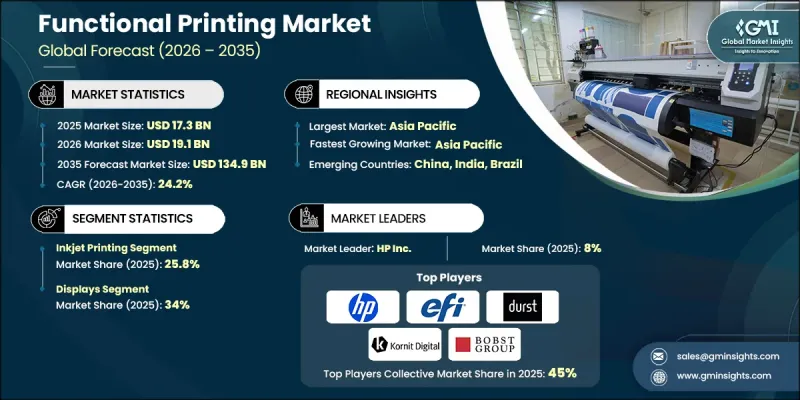
이 시장은 첨단 소재, 전도성 잉크 및 잉크젯, 스크린, 그라비어 인쇄와 같은 차세대 인쇄 기술의 지속적인 혁신에 의해 주도되고 있습니다. 기능성 인쇄는 고도의 맞춤화, 폐기물 감소, 제품 개발 주기 단축이 가능하기 때문에 고부가가치 응용 분야에서 점점 더 선호되고 있습니다. 리소그래피 및 표준 PCB 제조와 같은 전통적인 감산 제조 방식에서 적층 가공 및 디지털화된 생산으로의 전환은 제조 철학의 큰 패러다임 전환을 나타냅니다. 합병, 인수, 기술 제휴를 통한 전략적 통합은 전도성 잉크, 플렉서블 기판 및 인쇄 센서 기술의 주요 기업들이 통합 솔루션을 구축할 수 있게함으로써 시장 성장을 가속화하고 있습니다. 업계가 유연성, 소량 생산, 다품종 생산에 대한 요구가 높아지면서 기능성 인쇄는 전자, 패키징, 스마트 기기 등의 분야에서 중요한 원동력으로 부상하고 있습니다.
| 시장 범위 | |
|---|---|
| 시작 연도 | 2025년 |
| 예측 기간 | 2026-2035년 |
| 개시시 시장 규모 | 173억 달러 |
| 예측액 | 1,349억 달러 |
| CAGR | 24.2% |
잉크젯 인쇄 부문은 25.8%의 점유율을 차지하며, 2025년에는 44억 달러 규모에 달했습니다. 잉크젯은 인쇄전자, 고해상도 기능층, 스마트 포장에 대한 적응성으로 시장을 선도하고 있습니다. 나노입자 전도성 잉크, 플렉서블 기판, 저온 소결 기술의 급속한 기술 혁신이 시장 성장을 뒷받침하고 있습니다. 주문형 생산, 다품종 소량 생산에 적합하여 전자제품, 섬유 및 고급 패키징 용도에 적합합니다.
2025년에는 플렉서블 디스플레이, OLED 패널, 터치 인터페이스, 프린트 백플레인의 채택 확대로 디스플레이 분야가 34%의 점유율을 차지했습니다. 롤투롤 생산과 투명 전도성 소재의 사용은 더 많은 성장을 뒷받침하고 있습니다. 잉크젯, 스크린, 그라비어를 포함한 기능성 인쇄 기술은 유연하고 복잡한 디스플레이 구조의 제조를 가능하게 하여 휴대용 전자기기, 에너지 솔루션 및 건축 통합 기술(BIT)의 응용에 기여하고 있습니다.
2025년 미국의 기능성 인쇄 시장은 64.4%의 점유율을 차지했습니다. 인쇄전자, 플렉서블 디스플레이, 디지털화된 패키징의 보급이 시장 성장을 견인하고 있습니다. 스마트 라벨, 인쇄 센서, RFID 추적, 적층형 전자제품에 대한 수요 급증은 E-Commerce, 헬스케어, 소비자 전자제품 등의 분야에서 주도하고 있습니다. 플렉소와 잉크젯 기술을 결합한 하이브리드 인쇄 플랫폼 활용과 더불어 AI를 활용한 인쇄 최적화, 인라인 검사, 예지보전 등을 통해 산업 전반에서 OEM 및 컨버터들의 신뢰성을 강화하고 있습니다.
자주 묻는 질문
목차
제1장 조사 방법과 범위
제2장 주요 요약
제3장 업계 인사이트
제4장 경쟁 구도
제5장 시장 추정 및 예측 : 재료별, 2022-2035
제6장 시장 추정 및 예측 : 기술별, 2022-2035
제7장 시장 추정 및 예측 : 용도별, 2022-2035
제8장 시장 추정 및 예측 : 지역별, 2022-2035
제9장 기업 개요
KSM 26.04.10The Global Functional Printing Market was valued at USD 17.3 billion in 2025 and is estimated to grow at a CAGR of 24.2% to reach USD 134.9 billion by 2035.
The market is driven by continuous innovations in advanced materials, conductive inks, and next-generation printing technologies such as inkjet, screen, and gravure printing. Functional printing is increasingly preferred in high-value applications due to its ability to enable high customization, low waste, and faster product development cycles. The shift from traditional subtractive manufacturing methods, like lithography and standard PCB fabrication, toward additive and digitalized production represents a major paradigm shift in manufacturing philosophy. Strategic consolidations through mergers, acquisitions, and technology partnerships are accelerating market growth, allowing key players in conductive inks, flexible substrates, and printed sensor technologies to build integrated solutions. As industries increasingly demand flexible, low-volume, and high-mix production, functional printing is emerging as a critical enabler across sectors like electronics, packaging, and smart devices.
| Market Scope | |
|---|---|
| Start Year | 2025 |
| Forecast Year | 2026-2035 |
| Start Value | $17.3 Billion |
| Forecast Value | $134.9 Billion |
| CAGR | 24.2% |
The inkjet printing segment held 25.8% share, valued at USD 4.4 billion in 2025. Inkjet dominates due to its adaptability for printed electronics, high-resolution functional layers, and smart packaging. Rapid innovations in nanoparticle conductive inks, flexible substrates, and low-temperature sintering are supporting growth. Its suitability for on-demand, high-mix, and low-volume production makes it ideal for electronics, textiles, and advanced packaging applications.
In 2025, the displays segment held a 34% share, driven by the increasing adoption of flexible displays, OLED panels, touch interfaces, and printed backplanes. Roll-to-roll manufacturing and the use of transparent conductive materials further support growth. Functional printing technologies, including inkjet, screen, and gravure, enable the production of flexible and complex display structures, serving applications in portable electronics, energy solutions, and building-integrated technologies.
U.S. Functional Printing Market held 64.4% share in 2025. Strong adoption of printed electronics, flexible displays, and digitized packaging fuels the market. Rapid growth in demand for smart labels, printed sensors, RFID tracking, and additive electronics is being driven by sectors such as e-commerce, healthcare, and consumer electronics. The use of hybrid printing platforms combining flexo and inkjet technologies, coupled with AI-driven print optimization, inline inspection, and predictive maintenance, strengthens reliability for OEMs and converters across industrial applications.
Key players in the Global Functional Printing Market include Bobst Group, Comexi Group, Domino, Durst Group, EFI, HP Inc., Kornit Digital, KYMC, Mark Andy, Mimaki Engineering, PCMC, Roland DG, SPGPrints, Thieme, and Uteco Converting. Companies in the Global Functional Printing Market are strengthening their position by investing heavily in R&D to develop high-precision, high-speed, and energy-efficient printing technologies. They focus on expanding their product portfolios with hybrid printing solutions and customizable applications to meet diverse industry needs. Strategic partnerships, joint ventures, and acquisitions help them integrate complementary technologies, enhance scale, and expand geographic reach. Companies also leverage AI, IoT, and predictive maintenance tools to improve reliability, minimize downtime, and optimize print quality. Expanding into emerging markets, targeting high-growth verticals like flexible electronics and smart packaging, and offering service and support solutions help players enhance customer loyalty and maintain a competitive advantage.
Table of Contents
Chapter 1 Methodology and Scope
- 1.1 Market scope and definition
- 1.2 Research design
- 1.2.1 Research approach
- 1.2.2 Data collection methods
- 1.3 Data mining sources
- 1.3.1 Global
- 1.3.2 Regional/Country
- 1.4 Base estimates and calculations
- 1.4.1 Base year calculation
- 1.4.2 Key trends for market estimation
- 1.5 Primary research and validation
- 1.5.1 Primary sources
- 1.6 Forecast model
- 1.7 Research assumptions and limitations
Chapter 2 Executive Summary
- 2.1 Industry 360° synopsis
- 2.2 Key market trends
- 2.2.1 Regional
- 2.2.2 Material
- 2.2.3 Application
- 2.2.4 Technology
- 2.3 CXO perspectives: Strategic imperatives
- 2.3.1 Key decision points for industry executives
- 2.3.2 Critical success factors for market players
- 2.4 Future outlook and strategic recommendations
Chapter 3 Industry Insights
- 3.1 Industry ecosystem analysis
- 3.1.1 Supplier landscape
- 3.1.2 Profit margin
- 3.1.3 Value addition at each stage
- 3.1.4 Factor affecting the value chain
- 3.2 Industry impact forces
- 3.2.1 Growth drivers
- 3.2.1.1 Rising Labor Shortages & Manufacturing Reshoring
- 3.2.1.2 AI, Generative Design & Software Integration
- 3.2.1.3 IT/OT Convergence in Printing Operations
- 3.2.2 Industry pitfalls & challenges
- 3.2.2.1 High Integration Complexity
- 3.2.2.2 Data Privacy & Cybersecurity
- 3.2.3 Opportunities
- 3.2.3.1 Printing-as-a-Service (PaaS)
- 3.2.3.2 Growth in Printed Electronics & Smart Packaging
- 3.2.1 Growth drivers
- 3.3 Growth potential analysis
- 3.4 Future market trends
- 3.5 Technology and innovation landscape
- 3.5.1 Current technological trends
- 3.5.2 Emerging technologies
- 3.6 Price trends
- 3.6.1 By region
- 3.6.2 By Technology
- 3.7 Regulatory landscape
- 3.7.1 Standards and compliance requirements
- 3.7.2 Regional regulatory frameworks
- 3.7.3 Certification standards
- 3.8 Porter’s analysis
- 3.9 PESTEL analysis
Chapter 4 Competitive Landscape, 2025
- 4.1 Introduction
- 4.2 Company market share analysis
- 4.2.1 By region
- 4.2.1.1 North America
- 4.2.1.2 Europe
- 4.2.1.3 Asia Pacific
- 4.2.1.4 Latin America
- 4.2.1.5 Middle East and Africa
- 4.2.1 By region
- 4.3 Company matrix analysis
- 4.4 Competitive analysis of major market players
- 4.5 Competitive positioning matrix
- 4.6 Key developments
- 4.6.1 Mergers & acquisitions
- 4.6.2 Partnerships & collaborations
- 4.6.3 New product launches
- 4.6.4 Expansion plans
Chapter 5 Market Estimates and Forecast, By Material, 2022 - 2035 (USD Billion) (Thousand Units)
- 5.1 Key trends
- 5.2 Substrate
- 5.2.1 Glass
- 5.2.2 Plastic
- 5.2.3 Paper
- 5.2.4 Silicon Carbide
- 5.2.5 Gallium Nitride
- 5.2.6 Others
- 5.3 Inks
- 5.3.1 Conductive Inks
- 5.3.2 Dielectric Inks
- 5.3.3 Graphene Inks
- 5.3.4 Others
Chapter 6 Market Estimates and Forecast, By Technology, 2022 - 2035 (USD Billion) (Thousand Units)
- 6.1 Key trends
- 6.2 Inkjet Printing
- 6.3 Screen Printing
- 6.4 Flexographic Printing
- 6.5 Gravure Printing
- 6.6 Others
Chapter 7 Market Estimates and Forecast, By Application, 2022 - 2035 (USD Billion) (Thousand Units)
- 7.1 Key trends
- 7.2 Displays
- 7.3 Sensors
- 7.4 Photovoltaics
- 7.5 Lighting
- 7.6 Batteries
- 7.7 RFID Tags
- 7.8 Others
Chapter 8 Market Estimates and Forecast, By Region, 2022 - 2035 (USD Billion) (Thousand Units)
- 8.1 Key trends
- 8.2 North America
- 8.2.1 U.S.
- 8.2.2 Canada
- 8.3 Europe
- 8.3.1 Germany
- 8.3.2 UK
- 8.3.3 France
- 8.3.4 Italy
- 8.3.5 Spain
- 8.4 Asia Pacific
- 8.4.1 China
- 8.4.2 Japan
- 8.4.3 India
- 8.4.4 Australia
- 8.4.5 South Korea
- 8.5 Latin America
- 8.5.1 Brazil
- 8.5.2 Mexico
- 8.5.3 Argentina
- 8.6 Middle East and Africa
- 8.6.1 South Africa
- 8.6.2 Saudi Arabia
- 8.6.3 UAE
Chapter 9 Company Profiles
- 9.1 Bobst Group
- 9.2 Comexi Group
- 9.3 Domino
- 9.4 Durst Group
- 9.5 EFI
- 9.6 HP Inc.
- 9.7 Kornit Digital
- 9.8 KYMC
- 9.9 Mark Andy
- 9.10 Mimaki Engineering
- 9.11 PCMC
- 9.12 Roland DG
- 9.13 SPGPrints
- 9.14 Thieme
- 9.15 Uteco Converting