

|
시장보고서
상품코드
1982375
에너지 분야 블록체인 시장 기회, 성장 요인, 산업 동향 분석 및 예측(2026-2035년)Blockchain in Energy Market Opportunity, Growth Drivers, Industry Trend Analysis, and Forecast 2026 - 2035 |
||||||

세계의 에너지 분야의 블록체인 시장은 2025년 40억 달러로 평가되었으며 CAGR 44.3%로 성장해 2035년에는 1,381억 달러에 이를 것으로 추정됩니다.
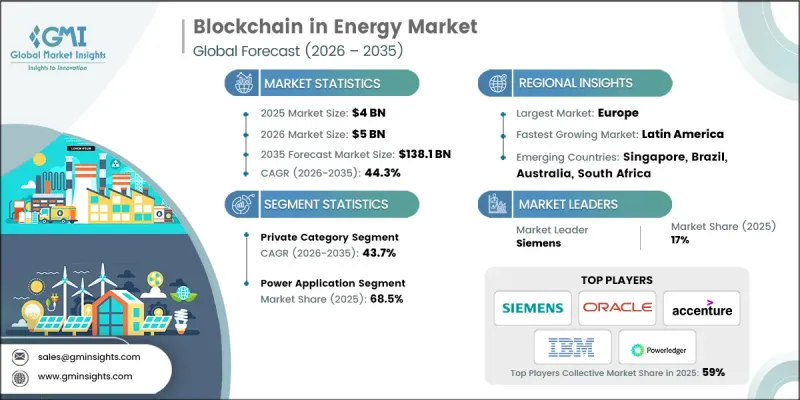
에너지 인프라 전반의 급속한 디지털화와 세계 스마트 미터 시스템의 도입 확대가 시장 성장을 크게 가속화하고 있습니다. 전력 회사가 송전망을 현대화하고 디지털 기술을 통합함에 따라 블록체인 플랫폼은 안전한 데이터 교환, 거래 투명성 및 자동화된 에너지 결제를 위한 중요한 도구로 부상하고 있습니다. 업계 자유화와 정부 주도의 절전 이니셔티브에 의해 지원되는 재생에너지의 점유율 확대는 블록체인 기반 에너지 관리 솔루션에 대한 수요를 더욱 강화하고 있습니다. 이러한 플랫폼은 정확한 에너지 추적, 송전망 안정성 향상, 지능형 시스템 연계를 가능하게 하여 대규모 재생에너지 통합을 지원합니다. 강력한 정책 지원과 초기 단계의 파일럿 프로그램도 규제 불확실성을 줄이고 혁신을 촉진함으로써 광범위한 도입을 뒷받침하고 있습니다. 각국 정부는 에너지의 투명성과 국가의 에너지 안보를 강화하기 위해 설계된 자금 조달 메커니즘과 규제 프레임워크를 통해 블록체인 이니셔티브를 적극적으로 지원하고 있습니다. 병행하여 스마트 그리드 기술의 발전은 안전하고 자동화된 실시간 에너지 관리를 가능하게 함으로써 블록체인 도입에 유리한 조건을 만들어 냈습니다. 블록체인을 활용한 스마트 계약은 효율적인 수급 균형 조정을 촉진하고 있으며, 실시간 데이터 관리 기능은 하이브리드 에너지 네트워크 최적화, 운영 효율성 향상 및 전체 시스템 비용 절감을 제공합니다.
| 시장 범위 | |
|---|---|
| 시작 연도 | 2025년 |
| 예측 기간 | 2026-2035년 |
| 시작 금액 | 40억 달러 |
| 예측 금액 | 1,381억 달러 |
| CAGR | 44.3% |
공공 부문 부문은 2035년까지 연평균 복합 성장률(CAGR) 45%를 나타낼 것으로 예측됩니다. 이는 국가의 에너지 시스템 전체에서 투명성, 책임, 지속가능성을 향상시키기 위해 정부가 블록체인에 대한 의존도를 높이고 있음을 반영합니다. 이 부문의 확대는 신재생에너지의 의무화, 안전한 디지털 인프라 요건 및 분산 에너지 네트워크를 통한 탄소 배출량 감소를 위한 노력의 강화에 의해 지원되고 있습니다. 공공투자와 규제면의 지원으로 송전망의 현대화 전략에 대한 블록체인의 통합이 가속화되고 있습니다.
용도별로는 전력 부문이 2025년 68.5%의 점유율을 차지했습니다. 블록체인은 신재생에너지의 통합을 촉진하고, 분산형 에너지거래를 가능하게 하며, 투명성이 높은 전력거래의 틀을 지원하는 데 중요한 역할을 합니다. 정부의 인센티브와 전력 인프라 전체에 대한 기술 침투는 이 부문의 지속적인 성장에 기여하고 있습니다.
미국의 에너지 분야 블록체인 시장은 2035년까지 176억 달러에 달할 것으로 예측됩니다. 이 나라 시장 확대는 기술 혁신과 분산 에너지 에코시스템을 촉진하는 지원 정책 이니셔티브에 의해 견인되고 있습니다. 투명성이 높고 안전하고 효율적인 에너지 거래 플랫폼에 대한 수요가 증가함에 따라 미국의 에너지 네트워크 전체에서 블록체인 도입이 가속화되고 있습니다.
자주 묻는 질문
목차
제1장 조사 방법과 범위
제2장 주요 요약
제3장 업계 인사이트
- 업계의 생태계
- 블록체인 플랫폼 제공업체
- 솔루션 통합자 및 컨설턴트
- 에너지 시장 운영 사업자
- 최종 사용자 참가자
- 규제 상황
- 업계에 미치는 영향요인
- 성장 촉진요인
- 업계의 잠재적 위험 및 과제
- 성장 가능성 분석
- Porter's Five Forces 분석
- PESTEL 분석
- 비용 구조 분석
- 투자 및 자금 조달 분석
- 벤처캐피탈 투자
- 정부의 조성금 및 우대조치
- 기업의 투자 동향
- 지속가능성 및 ESG 영향 평가
제4장 경쟁 구도
- 소개
- 기업의 시장 점유율 분석 : 지역별
- 북미
- 유럽
- 아시아태평양
- 중동 및 아프리카
- 라틴아메리카
- 경쟁 벤치마킹
- 주요 발전
- 합병 및 인수
- 제휴 및 협업
- 신제품 발매
- 사업 확대 계획과 자금 조달
제5장 시장 규모 및 예측 : 카테고리별(2022-2035년)
- 공공
- 민간
제6장 시장 규모 및 예측 : 용도별(2022-2035년)
- 전력
- 그리드 거래
- P2P 거래
- 에너지 파이낸스
- 지속가능성 어트리뷰션
- 전기자동차 충전
- 기타
- 석유 및 가스
- 공급망
- 운영
- 거래
- 보안
제7장 시장 규모 및 예측 : 지역별(2022-2035년)
- 북미
- 미국
- 캐나다
- 멕시코
- 유럽
- 독일
- 영국
- 네덜란드
- 프랑스
- 스페인
- 아시아태평양
- 중국
- 일본
- 싱가포르
- 호주
- 중동 및 아프리카
- 사우디아라비아
- 아랍에미리트(UAE)
- 남아프리카
- 라틴아메리카
- 브라질
- 칠레
제8장 기업 프로파일
- Accenture
- Acciona Energy
- ConsenSys
- Electron
- Greeneum
- Iberdrola Group
- IBM
- Infosys Limited
- Kaleido
- LO3 Energy
- Oracle
- Power Ledger
- SAP
- Siemens
- Sun Exchange
- SunContract
- UrbanChain
- VAKT Global
- VeChain
- Zupple Labs
The Global Blockchain in Energy Market was valued at USD 4 billion in 2025 and is estimated to grow at a CAGR of 44.3% to reach USD 138.1 billion in 2035.
Rapid digitization across energy infrastructure and the increasing deployment of smart metering systems worldwide are significantly accelerating market growth. As utilities modernize grid networks and integrate digital technologies, blockchain platforms are emerging as critical tools for secure data exchange, transaction transparency, and automated energy settlements. The rising share of renewable energy, supported by industry liberalization and government-led electricity conservation initiatives, is further strengthening demand for blockchain-based energy management solutions. These platforms enable accurate energy tracking, improved grid stability, and intelligent system coordination, supporting large-scale renewable integration. Strong policy backing and early-stage pilot programs are also encouraging widespread adoption by reducing regulatory uncertainty and fostering innovation. Governments are actively supporting blockchain initiatives through funding mechanisms and regulatory frameworks designed to enhance energy transparency and national energy security. In parallel, advancements in smart grid technologies are creating favorable conditions for blockchain deployment by enabling secure, automated, and real-time energy management. Blockchain-powered smart contracts are facilitating efficient supply-demand balancing, while real-time data management capabilities are optimizing hybrid energy networks, improving operational efficiency, and lowering overall system costs.
| Market Scope | |
|---|---|
| Start Year | 2025 |
| Forecast Year | 2026-2035 |
| Start Value | $4 Billion |
| Forecast Value | $138.1 Billion |
| CAGR | 44.3% |
The public sector segment is anticipated to grow at a CAGR of 45% through 2035, reflecting growing government reliance on blockchain to improve transparency, accountability, and sustainability across national energy systems. Expansion in this segment is supported by renewable energy mandates, secure digital infrastructure requirements, and intensified efforts to lower carbon emissions through decentralized energy networks. Public investments and regulatory support are accelerating blockchain integration into grid modernization strategies.
By application, the power segment accounted for 68.5% share in 2025. Blockchain is playing a vital role in facilitating renewable energy integration, enabling decentralized energy exchange, and supporting transparent electricity trading frameworks. Government incentives and technological penetration across power infrastructure are contributing to sustained growth in this segment.
U.S. Blockchain In Energy Market is expected to reach USD 17.6 billion by 2035. Market expansion in the country is driven by technological innovation and supportive policy initiatives promoting decentralized energy ecosystems. Growing demand for transparent, secure, and efficient energy trading platforms is accelerating blockchain deployment across U.S. energy networks.
Prominent companies operating in the Global Blockchain in Energy Market include IBM, Oracle, Accenture, SAP, Infosys Limited, Power Ledger, Electron, LO3 Energy, Kaleido, Sun Exchange, and Greeneum. Companies in the Global Blockchain in Energy Market are reinforcing their competitive position through strategic collaborations, platform innovation, and ecosystem expansion. Leading players are investing in scalable blockchain architectures, smart contract capabilities, and cybersecurity enhancements to improve transaction speed and reliability. Partnerships with utilities, grid operators, and renewable energy developers are expanding real-world deployment opportunities and strengthening long-term contracts. Many firms are focusing on interoperability solutions to ensure seamless integration with existing smart grid and energy management systems. Geographic expansion into emerging markets is also a key strategy to capture untapped demand.
Table of Contents
Chapter 1 Methodology & Scope
- 1.1 Research design
- 1.2 Quality commitment
- 1.2.1 GMI AI policy & data integrity commitment
- 1.2.1.1 Source consistency protocol
- 1.2.1 GMI AI policy & data integrity commitment
- 1.3 Research trail & confidence scoring
- 1.3.1 Research trail components
- 1.3.2 Scoring components
- 1.4 Data Collection
- 1.4.1 Partial list of primary sources
- 1.5 Data mining sources
- 1.5.1 Paid sources
- 1.5.1.1 Sources, by region
- 1.5.1 Paid sources
- 1.6 Base estimates and calculations
- 1.6.1 Base year calculation for any one approach
- 1.7 Forecast model
- 1.8 Research transparency addendum
- 1.8.1 Source attribution framework
- 1.8.2 Quality assurance metrics
- 1.8.3 Our commitment to trust
- 1.9 Market definitions
Chapter 2 Executive Summary
- 2.1 Industry synopsis, 2022 - 2035
- 2.2 Business trends
- 2.3 Category trends
- 2.4 Application trends
- 2.5 Regional trends
Chapter 3 Industry Insights
- 3.1 Industry ecosystem
- 3.1.1 Blockchain platform providers
- 3.1.2 Solution integrators & consultants
- 3.1.3 Energy market operators
- 3.1.4 End user participants
- 3.2 Regulatory landscape
- 3.3 Industry impact forces
- 3.3.1 Growth drivers
- 3.3.2 Industry pitfalls & challenges
- 3.4 Growth potential analysis
- 3.5 Porter's analysis
- 3.5.1 Bargaining power of suppliers
- 3.5.2 Bargaining power of buyers
- 3.5.3 Threat of new entrants
- 3.5.4 Threat of substitutes
- 3.6 PESTEL analysis
- 3.6.1 Political factors
- 3.6.2 Economic factors
- 3.6.3 Social factors
- 3.6.4 Technological factors
- 3.6.5 Legal factors
- 3.6.6 Environmental factors
- 3.7 Cost structure analysis
- 3.8 Investment & funding analysis
- 3.8.1 Venture capital investments
- 3.8.2 Government grants & incentives
- 3.8.3 Corporate investment trends
- 3.9 Sustainability & ESG impact assessment
Chapter 4 Competitive landscape, 2026
- 4.1 Introduction
- 4.2 Company market share analysis, by region, 2025
- 4.2.1 North America
- 4.2.2 Europe
- 4.2.3 Asia Pacific
- 4.2.4 Middle East & Africa
- 4.2.5 Latin America
- 4.3 Competitive benchmarking
- 4.4 Key developments
- 4.4.1 Mergers & acquisitions
- 4.4.2 Partnerships & collaborations
- 4.4.3 New product launches
- 4.4.4 Expansion plans and funding
Chapter 5 Market Size and Forecast, By Category, 2022 - 2035 (USD Billion)
- 5.1 Key trends
- 5.2 Public
- 5.3 Private
Chapter 6 Market Size and Forecast, By Application, 2022 - 2035 (USD Billion)
- 6.1 Key trends
- 6.2 Power
- 6.2.1 Grid transactions
- 6.2.2 Peer to peer transactions
- 6.2.3 Energy financing
- 6.2.4 Sustainability attribution
- 6.2.5 Electric vehicle charging
- 6.2.6 Other
- 6.3 Oil & Gas
- 6.3.1 Supply chain
- 6.3.2 Operations
- 6.3.3 Trading
- 6.3.4 Security
Chapter 7 Market Size and Forecast, By Region, 2022 - 2035 (USD Billion)
- 7.1 Key trends
- 7.2 North America
- 7.2.1 U.S.
- 7.2.2 Canada
- 7.2.3 Mexico
- 7.3 Europe
- 7.3.1 Germany
- 7.3.2 UK
- 7.3.3 Netherlands
- 7.3.4 France
- 7.3.5 Spain
- 7.4 Asia Pacific
- 7.4.1 China
- 7.4.2 Japan
- 7.4.3 Singapore
- 7.4.4 Australia
- 7.5 Middle East & Africa
- 7.5.1 Saudi Arabia
- 7.5.2 UAE
- 7.5.3 South Africa
- 7.6 Latin America
- 7.6.1 Brazil
- 7.6.2 Chile
Chapter 8 Company Profiles
- 8.1 Accenture
- 8.2 Acciona Energy
- 8.3 ConsenSys
- 8.4 Electron
- 8.5 Greeneum
- 8.6 Iberdrola Group
- 8.7 IBM
- 8.8 Infosys Limited
- 8.9 Kaleido
- 8.10 LO3 Energy
- 8.11 Oracle
- 8.12 Power Ledger
- 8.13 SAP
- 8.14 Siemens
- 8.15 Sun Exchange
- 8.16 SunContract
- 8.17 UrbanChain
- 8.18 VAKT Global
- 8.19 VeChain
- 8.20 Zupple Labs


