|
시장보고서
상품코드
1982379
화재 방지 시스템 시장 기회, 성장 요인, 산업 동향 분석 및 예측(2026-2035년)Fire Protection Systems Market Opportunity, Growth Drivers, Industry Trend Analysis, and Forecast 2026 - 2035 |
||||||

세계의 화재 방지 시스템 시장은 2025년에 814억 달러로 평가되었으며 CAGR 7.1%로 성장해 2035년까지 1,609억 달러에 이를 것으로 추정됩니다.
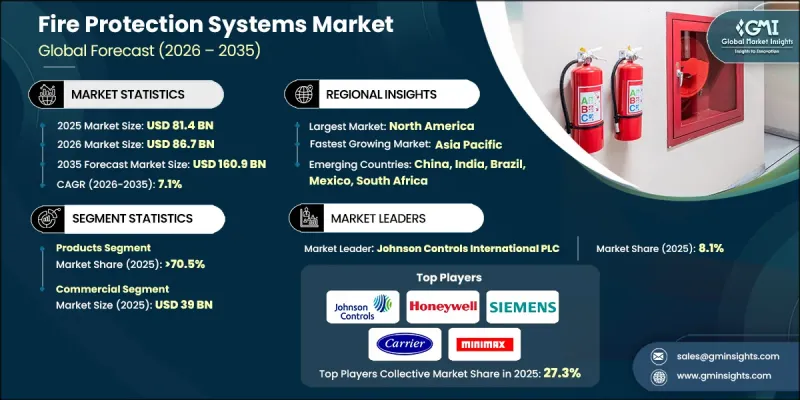
시장의 성장은 화재 안전에 관한 규제 요건의 엄격화, 건설 활동의 지속적인 증가, 상업, 산업, 주택의 각 부문에서 안전 기준에 대한 의식이 높아짐에 따라 견인되고 있습니다. 세계 인프라의 현대화는 첨단 화재 방지 솔루션에 대한 수요를 더욱 뒷받침하고 있습니다. 도시화의 진전과 상업용 건물, 산업 시설, 교통 허브, 주택 개발에 대한 투자 증가는 화재 감지, 경보, 스프링클러 및 소화 시스템의 도입에 직접적인 영향을 미쳤습니다. 또한 IoT, 클라우드 플랫폼, 빌딩 관리 시스템과 통합된 지능형 화재 방지 솔루션으로 전환이 진행되고 있습니다. 이러한 기술은 실시간 모니터링, 원격 경보, 예측 보전 및 신속한 대응을 가능하게 하여 기업 및 건물 사용자의 안전 수준, 운영 효율성 및 위험 완화를 향상시킵니다.
| 시장 범위 | |
|---|---|
| 시작 연도 | 2025년 |
| 예측 기간 | 2026-2035년 |
| 시작 규모 | 814억 달러 |
| 예측 금액 | 1,609억 달러 |
| CAGR | 7.1% |
2025년에는 제품 부문이 70.5%의 점유율을 차지했습니다. 규제의 엄격화와 화재 위험에 대한 의식 증가를 배경으로, 화재 감지 장치, 경보기, 스프링클러, 소화 시스템에 대한 수요가 높아지고 있는 것이 제품 부문의 성장을 뒷받침하고 있습니다.
산업 부문은 석유 및 가스, 화학, 유틸리티, 제조업에서 안전성 향상이 요구되기 때문에 견조한 확대가 전망되고 있어 2035년까지 연평균 복합 성장률(CAGR) 7.3%로 확대되어 520억 달러에 이를 것으로 예측되고 있습니다. 규제 요건, 직장에서 높은 화재 위험 및 자동 화재 감지 및 소화 시스템에 대한 투자는 제조업체에게 위험한 환경을 위한 전문 솔루션을 개발하도록 촉구하고 있습니다.
2025년 현재 북미 화재 방지 시스템 시장은 40.5%의 점유율을 차지했습니다. 이 지역의 성장은 화재 방지 규제의 엄격한 시행, 산업 및 상업시설의 확대, 화재 위험에 대한 일반 시민의 의식 상승, 첨단 감지 및 소화 기술의 도입에 의해 지지되고 있습니다. 스마트 빌딩 통합 및 산업 안전 노력은 최신 화재 방지 솔루션의 도입을 더욱 강화하고 있습니다. 이 지역의 제조업체들은 시장 수요에 부응하기 위해 신뢰성이 높고 규제를 준수하며 기술적으로 첨단 시스템에 대한 투자를 선호합니다.
자주 묻는 질문
목차
제1장 조사 방법과 범위
제2장 주요 요약
제3장 업계 인사이트
- 생태계 분석
- 공급자의 상황
- 이익률
- 비용 구조
- 각 단계에서의 부가가치
- 밸류체인에 영향을 주는 요인
- 혁신
- 업계에 미치는 영향요인
- 성장 촉진요인
- 상업시설, 공업시설 및 주택의 화재 방지 규제 강화
- 세계 건설 및 인프라 개발 성장
- 직장의 안전과 자산 보호에 대한 의식의 고조
- 산업화의 진전 및 고위험 산업의 확대
- 고도로 자동화된 화재 감지 기술의 채용 확대
- 업계의 잠재적 위험 및 과제
- 화재 방지 시스템의 높은 설치 및 유지 보수 비용
- 기존 건물에 대한 시스템 통합의 복잡성
- 시장 기회
- 스마트 및 IoT 대응 방화 솔루션에 대한 수요 증가
- 노후화된 인프라에서 레트로핏 및 현대화 프로젝트의 확대
- 성장 촉진요인
- 성장 가능성 분석
- 규제 상황
- 북미
- 유럽
- 아시아태평양
- 라틴아메리카
- 중동 및 아프리카
- Porter's Five Forces 분석
- PESTEL 분석
- 기술 및 혁신 동향
- 현재의 기술 동향
- 신흥기술
- 신흥 비즈니스 모델
- 컴플라이언스 요건
- 특허 분석
제4장 경쟁 구도
- 소개
- 기업의 시장 점유율 분석
- 지역별
- 북미
- 유럽
- 아시아태평양
- 라틴아메리카
- 중동 및 아프리카
- 시장 집중도 분석
- 지역별
- 주요 기업의 경쟁 벤치마킹
- 재무실적의 비교
- 매출액
- 이익률
- 연구개발
- 제품 포트폴리오 비교
- 제품 라인업의 폭
- 기술
- 혁신
- 지역 전개의 비교
- 세계 전개의 분석
- 서비스 네트워크의 커버율
- 지역별 시장 침투율
- 경쟁 포지셔닝 매트릭스
- 리더
- 챌린저
- 팔로워
- 틈새 기업
- 전략적 전망 매트릭스
- 재무실적의 비교
- 주요 발전, 2022-2025년
- 합병 및 인수
- 파트너십 및 제휴
- 기술적 진보
- 사업 확대 및 투자 전략
- 지속가능성 노력
- 디지털 전환의 대처
- 신흥/스타트업 경쟁기업의 동향
제5장 화재 방지 시스템 시장 추계 및 예측 : 제품별(2022-2035년)
- ,
- 제품
- 화재 감지 시스템
- 연기 감지기
- 열 감지기
- 화염 감지기
- 가스 검출기
- 소화 시스템
- 수계 소화 시스템
- 스프링클러
- 미분무 시스템
- 소화기
- 가스 소화 시스템
- 거품 소화 시스템
- 수계 소화 시스템
- 화재 알람 및 통보 시스템
- 기타
- 화재 감지 시스템
- 서비스
- 설치 및 설계 서비스
- 유지보수 및 점검 서비스
- 기타
제6장 시장 추계 및 예측 : 최종 용도별(2022-2035년)
- 주택용
- 상업용
- 소매
- 의료시설
- 접객
- 오피스 빌딩
- 기타
- 산업용
- 제조업
- 에너지 및 전력
- 석유 및 가스
- 광업
- 기타
제7장 화재 방지 시스템 시장 추계 및 예측 : 지역별(2022-2035년)
- : 지역별
- 북미
- 미국
- 캐나다
- 유럽
- 영국
- 독일
- 프랑스
- 이탈리아
- 스페인
- 네덜란드
- 기타 유럽
- 아시아태평양
- 중국
- 인도
- 일본
- 한국
- 호주
- 기타 아시아태평양
- 라틴아메리카
- 브라질
- 멕시코
- 아르헨티나
- 기타 라틴아메리카
- 중동 및 아프리카(MEA)
- 사우디아라비아
- 남아프리카
- 아랍에미리트(UAE)
- 기타 중동 및 아프리카
제8장 기업 프로파일
- Viking Group Inc.
- Carrier
- Kidde-Fenwal, LLC
- Fike Corporation
- Johnson Controls International plc
- Control Fire Systems Ltd
- Troy Life & Fire Safety Ltd.
- Vipond Fire Protection
- Siemens AG
- Elite Fire Protection
- Chubb Fire &Security.
- Onyx Fire Protection Services Inc.
- Georgian Bay Fire &Safety
- Automated Fire Protection Systems Ltd.
- Honeywell International Inc.
- Minimax GmbH &Co. KG
- Securiton AG
- Robert Bosch GmbH
The Global Fire Protection Systems Market was valued at USD 81.4 billion in 2025 and is estimated to grow at a CAGR of 7.1% to reach USD 160.9 billion by 2035.
Market growth is driven by stricter regulatory requirements for fire safety, the ongoing rise in construction activity, and growing awareness of safety standards across commercial, industrial, and residential sectors. The modernization of infrastructure worldwide is further supporting demand for advanced fire protection solutions. Increasing urbanization and investments in commercial buildings, industrial facilities, transportation hubs, and residential developments are directly influencing the adoption of fire detection, alarm, sprinkler, and suppression systems. The trend is also shifting toward intelligent fire protection solutions integrated with IoT, cloud platforms, and building management systems. These technologies provide real-time monitoring, remote alerts, predictive maintenance, and faster response times, improving safety levels, operational efficiency, and risk mitigation for businesses and building occupants.
| Market Scope | |
|---|---|
| Start Year | 2025 |
| Forecast Year | 2026-2035 |
| Start Value | $81.4 Billion |
| Forecast Value | $160.9 Billion |
| CAGR | 7.1% |
The products segment accounted for 70.5% share in 2025. Rising demand for fire detection devices, alarms, sprinklers, and suppression systems, supported by stricter compliance mandates and increasing awareness of fire hazards, has fueled growth in the products segment.
The industrial sector is expected to witness robust expansion, projected to reach USD 52 billion by 2035 at a CAGR of 7.3%, due to the need for enhanced safety in oil and gas, chemical, utility, and manufacturing operations. Regulatory requirements, high workplace fire risks, and investments in automated fire detection and suppression systems are encouraging manufacturers to develop specialized solutions for hazardous environments.
North America Fire Protection Systems Market held a 40.5% share in 2025. Growth in the region is supported by stricter enforcement of fire safety regulations, expansion of industrial and commercial facilities, increased public awareness of fire risks, and adoption of advanced detection and suppression technologies. Smart building integration and industrial safety initiatives are further driving the adoption of modern fire protection solutions. Manufacturers in the region are prioritizing investments in reliable, code-compliant, and technologically advanced systems to meet market demand.
Key players operating in the Global Fire Protection Systems Market include: Johnson Controls International plc, Siemens AG, Carrier, Honeywell International Inc., Viking Group Inc., Fike Corporation, Kidde-Fenwal LLC, Troy Life & Fire Safety Ltd., Onyx Fire Protection Services Inc., Minimax GmbH & Co. KG, Robert Bosch GmbH, Securiton AG, Control Fire Systems Ltd., Vipond Fire Protection, Elite Fire Protection, Chubb Fire & Security, Georgian Bay Fire & Safety, and Automated Fire Protection Systems Ltd. Companies in the Fire Protection Systems Market are adopting multiple strategies to enhance their market position and expand global reach. Key approaches include developing smart, IoT-enabled fire detection and suppression solutions with predictive maintenance capabilities and cloud connectivity. Firms are investing in R&D to create code-compliant, energy-efficient, and modular systems tailored for industrial, commercial, and residential applications. Strategic partnerships with construction companies, facility managers, and governments help improve market penetration. Companies are also focusing on after-sales service, training programs, and maintenance contracts to boost customer loyalty and recurring revenue.
Table of Contents
Chapter 1 Methodology and Scope
- 1.1 Market scope and definition
- 1.2 Research design
- 1.2.1 Research approach
- 1.2.2 Data collection methods
- 1.3 Data mining sources
- 1.3.1 Global
- 1.3.2 Regional/Country
- 1.4 Base estimates and calculations
- 1.4.1 Base year calculation
- 1.4.2 Key trends for market estimation
- 1.5 Primary research and validation
- 1.5.1 Primary sources
- 1.6 Forecast model
- 1.7 Research assumptions and limitations
Chapter 2 Executive Summary
- 2.1 Industry snapshot
- 2.2 Key market trends
- 2.2.1 Offerings trends
- 2.2.2 End Use trends
- 2.2.3 Regional
- 2.3 TAM Analysis, 2026-2035 (USD Billion)
- 2.4 CXO perspectives: Strategic imperatives
Chapter 3 Industry Insights
- 3.1 Industry ecosystem analysis
- 3.1.1 Supplier Landscape
- 3.1.2 Profit Margin
- 3.1.3 Cost structure
- 3.1.4 Value addition at each stage
- 3.1.5 Factor affecting the value chain
- 3.1.6 Disruptions
- 3.2 Industry impact forces
- 3.2.1 Growth drivers
- 3.2.1.1 Stricter fire safety regulations across commercial, industrial, and residential buildings
- 3.2.1.2 Growth in construction and infrastructure development worldwide
- 3.2.1.3 Rising awareness of workplace safety and asset protection
- 3.2.1.4 Increasing industrialization and expansion of high-risk industries
- 3.2.1.5 Growing adoption of advanced and automated fire detection technologies
- 3.2.2 Industry pitfalls and challenges
- 3.2.2.1 High installation and maintenance costs of fire protection systems
- 3.2.2.2 Complexity of integrating systems in existing buildings
- 3.2.3 Market opportunities
- 3.2.3.1 Rising demand for smart and IoT-enabled fire protection solutions
- 3.2.3.2 Expansion of retrofitting and modernization projects in aging infrastructure
- 3.2.1 Growth drivers
- 3.3 Growth potential analysis
- 3.4 Regulatory landscape
- 3.4.1 North America
- 3.4.2 Europe
- 3.4.3 Asia Pacific
- 3.4.4 Latin America
- 3.4.5 Middle East & Africa
- 3.5 Porter’s analysis
- 3.6 PESTEL analysis
- 3.7 Technology and innovation landscape
- 3.7.1 Current technological trends
- 3.7.2 Emerging technologies
- 3.8 Emerging business models
- 3.9 Compliance requirements
- 3.10 Patent analysis
Chapter 4 Competitive Landscape, 2025
- 4.1 Introduction
- 4.2 Company market share analysis
- 4.2.1 By Region
- 4.2.1.1 North America
- 4.2.1.2 Europe
- 4.2.1.3 Asia Pacific
- 4.2.1.4 Latin America
- 4.2.1.5 Middle East & Africa
- 4.2.2 Market Concentration Analysis
- 4.2.1 By Region
- 4.3 Competitive benchmarking of key players
- 4.3.1 Financial performance comparison
- 4.3.1.1 Revenue
- 4.3.1.2 Profit margin
- 4.3.1.3 R&D
- 4.3.2 Product portfolio comparison
- 4.3.2.1 Product range breadth
- 4.3.2.2 Technology
- 4.3.2.3 Innovation
- 4.3.3 Geographic presence comparison
- 4.3.3.1 Global footprint analysis
- 4.3.3.2 Service network coverage
- 4.3.3.3 Market penetration by region
- 4.3.4 Competitive positioning matrix
- 4.3.4.1 Leaders
- 4.3.4.2 Challengers
- 4.3.4.3 Followers
- 4.3.4.4 Niche players
- 4.3.5 Strategic outlook matrix
- 4.3.1 Financial performance comparison
- 4.4 Key developments, 2022-2025
- 4.4.1 Mergers and acquisitions
- 4.4.2 Partnerships and collaborations
- 4.4.3 Technological advancements
- 4.4.4 Expansion and investment strategies
- 4.4.5 Sustainability initiatives
- 4.4.6 Digital transformation initiatives
- 4.5 Emerging/ startup competitors landscape
Chapter 5 Fire Protection Systems Market Estimates & Forecast, By Offerings, 2022 - 2035 (USD Billion)
- 5.1 Key trends,
- 5.2 Products
- 5.2.1 Fire detection systems
- 5.2.1.1 Smoke detectors
- 5.2.1.2 Heat detectors
- 5.2.1.3 Flame detectors
- 5.2.1.4 Gas detectors
- 5.2.2 Fire suppression systems
- 5.2.2.1 Water-based suppression systems
- 5.2.2.1.1 Fire sprinkler
- 5.2.2.1.2 Water mist systems
- 5.2.2.2 Fire extinguishers
- 5.2.2.3 Gas-based suppression systems
- 5.2.2.4 Foam-based suppression systems
- 5.2.2.1 Water-based suppression systems
- 5.2.3 Fire alarm & notification systems
- 5.2.4 Others
- 5.2.1 Fire detection systems
- 5.3 Service
- 5.3.1 Installation and design service
- 5.3.2 Maintenance and inspection services
- 5.3.3 Others
Chapter 6 Market Estimates and Forecast, By End Use, 2022 - 2035 (USD Billion)
- 6.1 Key trends
- 6.2 Residential
- 6.3 Commercial
- 6.3.1 Retail
- 6.3.2 Healthcare facilities
- 6.3.3 Hospitality
- 6.3.4 Office buildings
- 6.3.5 Others
- 6.4 Industrial
- 6.4.1 Manufacturing
- 6.4.2 Energy & power
- 6.4.3 Oil & gas
- 6.4.4 Mining
- 6.4.5 Others
Chapter 7 Fire Protection Systems Market Estimates & Forecast, By Region, 2022 - 2035 (USD Billion)
- 7.1 Key trends, by region
- 7.2 North America
- 7.2.1 U.S.
- 7.2.2 Canada
- 7.3 Europe
- 7.3.1 UK
- 7.3.2 Germany
- 7.3.3 France
- 7.3.4 Italy
- 7.3.5 Spain
- 7.3.6 Netherlands
- 7.3.7 Rest of Europe
- 7.4 Asia-Pacific
- 7.4.1 China
- 7.4.2 India
- 7.4.3 Japan
- 7.4.4 South Korea
- 7.4.5 Australia
- 7.4.6 Rest of Asia-Pacific
- 7.5 Latin America
- 7.5.1 Brazil
- 7.5.2 Mexico
- 7.5.3 Argentina
- 7.5.4 Rest of Latin America
- 7.6 MEA
- 7.6.1 Saudi Arabia
- 7.6.2 South Africa
- 7.6.3 UAE
- 7.6.4 Rest of MEA
Chapter 8 Company Profiles
- 8.1 Viking Group Inc.
- 8.2 Carrier
- 8.3 Kidde-Fenwal, LLC
- 8.4 Fike Corporation
- 8.5 Johnson Controls International plc
- 8.6 Control Fire Systems Ltd
- 8.7 Troy Life & Fire Safety Ltd.
- 8.8 Vipond Fire Protection
- 8.9 Siemens AG
- 8.10 Elite Fire Protection
- 8.11 Chubb Fire & Security.
- 8.12 Onyx Fire Protection Services Inc.
- 8.13 Georgian Bay Fire & Safety
- 8.14 Automated Fire Protection Systems Ltd.
- 8.15 Honeywell International Inc.
- 8.16 Minimax GmbH & Co. KG
- 8.17 Securiton AG
- 8.18 Robert Bosch GmbH