

|
시장보고서
상품코드
1982386
자전거 프레임 시장 기회, 성장 요인, 산업 동향 분석 및 예측(2026-2035년)Bicycle Frames Market Opportunity, Growth Drivers, Industry Trend Analysis, and Forecast 2026 - 2035 |
||||||

세계의 자전거 프레임 시장은 2025년 279억 달러로 평가되었으며 CAGR 7.2%로 성장해 2035년까지 555억 달러에 이를 것으로 추정됩니다.
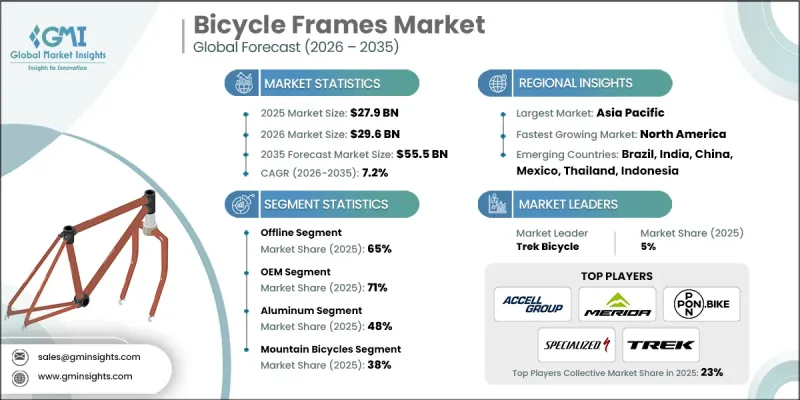
자전거 프레임은 도로 자전거, 산악 자전거, 하이브리드 자전거, 전동 자전거를 불문하고 자전거의 전반적인 성능, 안전, 내구성 및 라이더 경험에 매우 중요한 역할을 합니다. 프레임은 승차감, 무게, 공기 역학 특성, 적재 능력에 직접 영향을 미치기 때문에 제조 업체는 경량 소재와 혁신적인 디자인에 주력하고 있습니다. 이 시장에는 알루미늄, 탄소섬유, 강철, 티타늄 및 고급 복합재료를 사용한 프레임의 제조가 포함되어 있으며 설계, 튜브 성형, 용접, 표면 마감 및 OEM 및 애프터마켓 채널에 대한 공급을 포괄합니다. 하이드로포밍 알루미늄과 고탄성률 탄소섬유 프레임의 기술 진보로 강성 대 중량비가 대폭 향상되어 성능이 향상되었습니다. 건강, 도시 이동성, 사이클링 인프라에 대한 관심 증가는 첨단 프레임에 대한 수요를 이끌고 있습니다. 지속 가능한 교통수단을 추진하는 정부의 이니셔티브와 전동 자전거의 보급은 강화된 배터리 대응 프레임 설계에 대한 수요를 더욱 뒷받침하고 있으며, 시장은 고성능, 환경 친화적인 모빌리티 솔루션으로 향하고 있습니다.
| 시장 범위 | |
|---|---|
| 시작 연도 | 2025년 |
| 예측 기간 | 2026-2035년 |
| 시작 금액 | 279억 달러 |
| 예측 금액 | 555억 달러 |
| CAGR | 7.2% |
오프라인 부문은 2025년에 65%의 점유율을 차지하고 2035년까지 연평균 복합 성장률(CAGR) 6.9%를 나타낼 것으로 예측됩니다. 자전거 구입은 실물을 손에 들고 확인하는 성향이 있기 때문에 시승이나 전문적인 피팅 서비스, 커뮤니티와의 관계를 가능하게 하는 오프라인 채널은 여전히 중요합니다. 전문 소매점은 전문가 상담, 납품 전 조립, 지속적인 정비 지원을 제공함으로써 고객 충성도를 구축하고 소매 마진을 정당화하고 있습니다.
OEM 부문은 2025년에 71%의 점유율을 차지했으며 2035년까지 연평균 복합 성장률(CAGR) 7.5%로 성장할 것으로 추정됩니다. OEM 파트너십은 수량 보증, 기술 공동 개발, 공급망 통합, 지적 재산(IP) 연계에 중점을 둡니다. 프레임 제조업체는 소재 혁신, 서스펜션 설계, 제조 최적화, 제품 테스트를 통해 자전거 브랜드를 지원합니다. 전동 자전거의 성장은 OEM 채널을 더욱 강화하고 있으며, 배터리, 모터 및 전자 기기의 통합에는 프레임 공급업체와 브랜드 간의 긴밀한 기술적 협력이 필요하기 때문입니다.
중국의 자전거 프레임 시장은 2026년부터 2035년까지 CAGR 5.6%를 나타낼 것으로 예측됩니다. 국가 정책은 도시의 이동성 현대화, 환경 친화적인 교통 인프라 및 국내 제조업의 경쟁력을 지원하기 위해 경량 프레임 기술과 전기 자전거 지원 설계를 중시합니다. 현지 조달에 대한 인센티브 및 수출 규제 준수는 국내 프레임 제조업체의 국내 및 국제 시장에서 경쟁력을 높이고 있습니다.
자주 묻는 질문
목차
제1장 조사 방법
제2장 주요 요약
제3장 업계 인사이트
- 생태계 분석
- 공급자의 상황
- 이익률 분석
- 비용 구조
- 각 단계에서의 부가가치
- 밸류체인에 영향을 주는 요인
- 혁신
- 업계에 미치는 영향요인
- 성장 촉진요인
- 건강 의식 고조와 사이클링의 보급
- 도시 모빌리티의 변화와 교통 정체의 해결책
- 자전거 인프라를 촉진하는 정부의 대처
- 전동 자전거 시장의 급성장이 전용 프레임 수요를 견인
- 고성능 사이클링용 경량 소재 수요
- 업계의 잠재적 위험 및 과제
- 첨단 재료(탄소섬유, 티타늄)의 높은 비용
- 공급망의 혼란과 원재료의 부족
- 포스트 코로나 시장 포화 및 과잉 재고
- 저비용 아시아계 제조업체에 의한 경쟁
- 시장 기회
- 강화 프레임을 필요로 하는 성장 중인 전동 자전거 부문
- 커스터마이즈 수요가 프리미엄 가격 설정을 허용
- 지속 가능한 소재 및 재활용 소재의 혁신
- 신흥 시장(인도, 동남아시아, 라틴아메리카)의 사업 확대
- D2C(Direct-to-Consumer) 비즈니스 모델의 성장
- 성장 촉진요인
- 성장 가능성 분석
- 규제 상황
- 북미
- 미국 - 소비자 제품 안전위원회(CPSC) 자전거 프레임 기준
- 캐나다 - 캐나다 소비자 제품 안전법(CCPSA) 자전거 규제
- 유럽
- 독일 - DIN 규격 및 EN 15194 전동 자전거 프레임 인증
- 영국 - 브렉시트 후 자전거 프레임의 안전성 및 UKCA 마킹 요건
- 프랑스 - NF 규격 및 국내 액티브 모빌리티 인증 프레임워크
- 이탈리아 - UNI 표준과 ITS 사이클링 인프라의 통합
- 아시아태평양
- 중국 - 중국 표준 및 MIIT의 전동 자전거 프레임에 관한 기술 규제
- 인도 - BIS 인증 및 AIS 자전거 프레임 안전 기준
- 일본 - JIS 규격 및 국토교통성의 자전거 안전 프레임워크
- 호주 - 호주 소비자법 및 AS/NZS 자전거 프레임 규격
- 라틴아메리카
- 멕시코 - NOM 자전거 안전 기준 및 액티브 모빌리티의 틀
- 아르헨티나 - 교통법 24.449호
- 중동 및 아프리카(MEA)
- 남아프리카 - 도로교통법(1996년)
- 사우디아라비아 - SASO 규격 및 비전 2030 액티브 모빌리티에 관한 대처
- 북미
- Porter's Five Forces 분석
- PESTEL 분석
- 기술과 혁신 동향
- 현재의 기술 동향
- 센서 기술의 진화(카메라, LiDAR, 레이더, 초음파)
- 센서 퓨전과 통합
- 보행자 감지에서의 AI 및 머신러닝
- 신흥기술
- 감지 능력 향상을 위한 V2X 통신
- 야간 및 저조도 환경에서의 감지 기술
- 현재의 기술 동향
- 특허 분석
- 주된 특허 동향
- 기술 혁신의 핫스팟
- 주요 기업에 의한 특허 출원
- 새로운 지적재산 전략
- 가격 분석
- 과거 가격 동향 분석
- 알루미늄 프레임 가격 동향(2022-2025년)
- 강철 프레임 가격 동향(2022-2025년)
- 탄소섬유 프레임 가격 동향(2022-2025년)
- 티타늄 프레임 가격 동향(2022-2025년)
- 기업 유형별 가격 전략
- 프리미엄 포지셔닝 전략(티타늄, 고탄성률 탄소섬유)
- 밸류 부문 전략(알루미늄, 표준 탄소강)
- 코스트 플러스 가격 설정 모델(OEM 제조)
- 이용 사례와 성공 사례
- 사례 연구
- 지속가능성과 환경면
- 지속가능한 대처
- 폐기물 감축 전략
- 생산의 에너지 효율
- 환경에 배려한 대처
- 탄소발자국에 관한 고려 사항
- AI 및 생성형 AI가 시장에 미치는 영향
- AI에 의한 기존 비즈니스 모델의 변화
- 설계 자동화 및 제너레이티브 엔지니어링
- 품질 관리 및 결함 검출 시스템
- 수요 예측 및 재고 최적화
- 위험, 제약 및 규제 고려 사항
- 고객의 설계 데이터에 대한 데이터 프라이버시
- 구조 공학에서 AI 모델의 신뢰성
- 노동력 대체에 대한 우려
- 전망과 기회
- 신흥 시장 부문
- 향후 예상되는 기술적 변혁
- 지속가능성의 동향
- 비즈니스 모델의 혁신
- 장기 성장 예측(2030-2040년)
- 이해관계자별 전략적 제안
제4장 경쟁 구도
- 소개
- 기업의 시장 점유율 분석
- 북미
- 유럽
- 아시아태평양
- 라틴아메리카
- 중동 및 아프리카(MEA)
- 주요 시장 기업의 경쟁 분석
- 경쟁 포지셔닝 매트릭스
- 전략적 전망 매트릭스
- 주요 발전
- 합병 및 인수
- 제휴 및 협업
- 신제품 발매
- 사업 확대 계획과 자금 조달
제5장 시장 추계 및 예측 : 재료별(2022-2035년)
- 알루미늄
- 철강
- 탄소섬유
- 티타늄
- 기타
제6장 시장 추계 및 예측 : 프레임별(2022-2035년)
- 산악 자전거
- 하이브리드 자전거
- 전동 자전거
- 로드 자전거
- 기타
제7장 시장 추계 및 예측 : 판매 채널별(2022-2035년)
- 온라인
- 오프라인
제8장 시장 추계 및 예측 : 유통 채널별(2022-2035년)
- OEM
- 애프터마켓
제9장 시장 추계 및 예측 : 최종 용도별(2022-2035년)
- 프로 및 경기용 자전거
- 레크리에이션 및 애호가용 자전거
- 통근자 및 도시 사이클리스트
- 청년 자전거 이용자
- 기타
제10장 시장 추계 및 예측 : 지역별(2022-2035년)
- 북미
- 미국
- 캐나다
- 유럽
- 독일
- 영국
- 프랑스
- 이탈리아
- 스페인
- 러시아
- 네덜란드
- 스웨덴
- 덴마크
- 폴란드
- 아시아태평양
- 중국
- 인도
- 일본
- 호주
- 한국
- 싱가포르
- 태국
- 인도네시아
- 베트남
- 라틴아메리카
- 브라질
- 멕시코
- 아르헨티나
- 콜롬비아
- 중동 및 아프리카(MEA)
- 남아프리카
- 사우디아라비아
- 아랍에미리트(UAE)
- 이스라엘
제11장 기업 프로파일
- 세계기업
- Argon 18
- Bianchi
- Cannondale Bikes
- Canyon
- Cervelo
- Cicli Pinarello SRL
- Giant Manufacturing
- GT Bicycles
- Kona Bikes
- Merida
- Santa Cruz
- SCOTT Sports
- Specialized Bicycle
- Trek
- 지역 기업
- Chicago Bicycle Company
- Ideal Bike
- Dengfu Sports Equipment
- 신흥기업 및 기술 기반 기업
- Pinion
- YT Industries
- Aventon Bikes
The Global Bicycle Frames Market was valued at USD 27.9 billion in 2025 and is estimated to grow at a CAGR of 7.2% to reach USD 55.5 billion by 2035.
Bicycle frames play a crucial role in overall bicycle performance, safety, durability, and rider experience across road, mountain, hybrid, and electric models. They directly affect ride quality, weight, aerodynamics, and load capacity, prompting manufacturers to focus on lightweight materials and innovative designs. The market includes frame production using aluminum, carbon fiber, steel, titanium, and advanced composite materials, encompassing design, tube forming, welding, surface finishing, and supply to OEM and aftermarket channels. Advances in hydroformed aluminum and high-modulus carbon fiber frames have significantly improved stiffness-to-weight ratios, enhancing performance. Rising interest in health, urban mobility, and cycling infrastructure is driving demand for advanced frames. Government initiatives promoting sustainable transportation and the growth of e-bikes further support demand for reinforced, battery-compatible frame designs, positioning the market toward high-performance, eco-friendly mobility solutions.
| Market Scope | |
|---|---|
| Start Year | 2025 |
| Forecast Year | 2026-2035 |
| Start Value | $27.9 Billion |
| Forecast Value | $55.5 Billion |
| CAGR | 7.2% |
The offline segment held a 65% share in 2025 and is expected to grow at a CAGR of 6.9% through 2035. Offline channels remain critical due to the hands-on nature of bicycle purchases, enabling test rides, professional fitting services, and community engagement. Specialty retailers provide expert consultations, pre-delivery assembly, and ongoing mechanical support, creating customer loyalty and justifying retail margins.
The OEM segment accounted for 71% share in 2025 and is estimated to grow at a CAGR of 7.5% through 2035. OEM partnerships focus on volume commitments, technical co-development, supply chain integration, and IP collaboration. Frame manufacturers support bicycle brands through material innovation, suspension design, manufacturing optimization, and product testing. Growth in e-bikes further strengthens the OEM channel, as integrating batteries, motors, and electronics requires close technical collaboration between frame suppliers and brands.
China Bicycle Frames Market is projected to grow at a CAGR of 5.6% from 2026 to 2035. National policies emphasize lightweight frame technologies and e-bike-compatible designs to support urban mobility modernization, green transportation infrastructure, and domestic manufacturing competitiveness. Incentives for local sourcing and compliance with export regulations enhance the competitiveness of domestic frame manufacturers in both local and international markets.
Key players in the Global Bicycle Frames Market include Trek, Cannondale Bikes, Bianchi, Cervelo, Specialized Bicycle, SCOTT Sports, Argon 18, Santa Cruz, Giant Manufacturing, and Canyon. Leading companies in the Global Bicycle Frames Market strengthen their position through strategic approaches. They invest in research and development to launch innovative, lightweight, and high-performance frames, integrating advanced materials and e-bike-ready designs. Firms expand distribution across offline and online channels, ensuring professional fitting and after-sales support. Partnerships with OEMs and component manufacturers enhance co-development and technical collaboration. Marketing emphasizes performance, durability, and sustainability, while strategic global expansion, manufacturing localization, and adherence to regulatory requirements allow companies to capture new markets and reinforce brand reputation in a highly competitive landscape.
Table of Contents
Chapter 1 Methodology
- 1.1 Research approach
- 1.2 Quality commitments
- 1.3 Research trail and confidence scoring
- 1.3.1 Research trail components
- 1.3.2 Scoring components
- 1.4 Data collection
- 1.4.1 Partial list of primary sources
- 1.5 Data mining sources
- 1.5.1 Paid sources
- 1.6 Best estimates and calculations
- 1.6.1 Base year calculation for any one approach
- 1.7 Forecast model
- 1.8 Research transparency addendum
Chapter 2 Executive Summary
- 2.1 Industry 360° synopsis, 2022 - 2035
- 2.2 Key market trends
- 2.2.1 Regional
- 2.2.2 Material
- 2.2.3 Frame
- 2.2.4 Sales Channel
- 2.2.5 Distribution Channel
- 2.2.6 End Use
- 2.3 TAM Analysis, 2026-2035
- 2.4 CXO perspectives: Strategic imperatives
Chapter 3 Industry Insights
- 3.1 Industry ecosystem analysis
- 3.1.1 Supplier landscape
- 3.1.2 Profit margin analysis
- 3.1.3 Cost structure
- 3.1.4 Value addition at each stage
- 3.1.5 Factor affecting the value chain
- 3.1.6 Disruptions
- 3.2 Industry impact forces
- 3.2.1 Growth drivers
- 3.2.1.1 Rising health awareness and cycling adoption.
- 3.2.1.2 Urban mobility shift and traffic congestion solutions.
- 3.2.1.3 Government initiatives promoting cycling infrastructure.
- 3.2.1.4 E-bike market boom driving specialized frame demand.
- 3.2.1.5 Lightweight material demand for performance cycling.
- 3.2.2 Industry pitfalls and challenges
- 3.2.2.1 High cost of advanced materials (carbon fiber, titanium).
- 3.2.2.2 Supply chain disruptions and raw material shortages.
- 3.2.2.3 Post-COVID market saturation and excess inventory.
- 3.2.2.4 Price competition from low-cost Asian manufacturers.
- 3.2.3 Market opportunities
- 3.2.3.1 Growing e-bike segment requiring reinforced frames.
- 3.2.3.2 Customization demand enabling premium pricing.
- 3.2.3.3 Sustainable and recycled material innovation.
- 3.2.3.4 Expansion in emerging markets (India, Southeast Asia, LATAM).
- 3.2.3.5 Direct-to-consumer (D2C) business model growth.
- 3.2.1 Growth drivers
- 3.3 Growth potential analysis
- 3.4 Regulatory landscape
- 3.4.1 North America
- 3.4.1.1 US- Consumer product safety commission (CPSC) bicycle frame Standards
- 3.4.1.2 Canada - Canada consumer product safety act (CCPSA) bicycle regulations
- 3.4.2 Europe
- 3.4.2.1 Germany- DIN standards & EN 15194 E-bike frame certification
- 3.4.2.2 UK- Post-brexit bicycle frame safety & UKCA marking requirements
- 3.4.2.3 France- NF standards & national active mobility certification framework
- 3.4.2.4 Italy- UNI standards & ITS cycling infrastructure integration
- 3.4.3 Asia Pacific
- 3.4.3.1 China- GB standards & MIIT E-bike frame technical regulations
- 3.4.3.2 India- BIS certification & AIS bicycle frame safety standards
- 3.4.3.3 Japan- JIS standards & ministry of land infrastructure transport and tourism bicycle safety framework
- 3.4.3.4 Australia- Australian consumer law & AS/NZS bicycle frame standards
- 3.4.4 LATAM
- 3.4.4.1 Mexico- NOM bicycle safety standards & active mobility framework
- 3.4.4.2 Argentina- National traffic law 24.449
- 3.4.5 MEA
- 3.4.5.1 South Africa- National road traffic act (1996)
- 3.4.5.2 Saudi Arabia- SASO standards & vision 2030 active mobility initiatives
- 3.4.1 North America
- 3.5 Porter’s analysis
- 3.6 PESTEL analysis
- 3.7 Technology and innovation landscape
- 3.7.1 Current technological trends
- 3.7.1.1 Sensor technology evolution (camera, LiDAR, RADAR, ultrasonic)
- 3.7.1.2 Sensor fusion & integration
- 3.7.1.3 AI & machine learning in pedestrian detection
- 3.7.2 Emerging technologies
- 3.7.2.1 V2X communication for enhanced detection
- 3.7.2.2 Nighttime & low-light detection technologies
- 3.7.1 Current technological trends
- 3.8 Patent analysis
- 3.8.1 Key patent trends
- 3.8.2 Technology innovation hotspots
- 3.8.3 Patent filing by key players
- 3.8.4 Emerging IP strategies
- 3.9 Pricing analysis
- 3.9.1 Historical price trend analysis
- 3.9.2 Aluminum frame price trends (2022-2025)
- 3.9.3 Steel frame price trends (2022-2025)
- 3.9.4 Carbon fiber frame price trends (2022-2025)
- 3.9.5 Titanium frame price trends (2022-2025)
- 3.10 Pricing strategy by player type
- 3.10.1 Premium positioning strategy (titanium, high-modulus carbon)
- 3.10.2 Value segment strategy (aluminum, standard carbon)
- 3.10.3 Cost-plus pricing models (OEM manufacturing)
- 3.11 Use cases & success stories
- 3.12 Case studies
- 3.13 Sustainability and environmental aspects
- 3.13.1 Sustainable practices
- 3.13.2 Waste reduction strategies
- 3.13.3 Energy efficiency in production
- 3.13.4 Eco-friendly Initiatives
- 3.13.5 Carbon footprint considerations
- 3.14 Impact of AI & generative AI on the market
- 3.14.1 AI-driven disruption of existing business models
- 3.14.2 Design automation & generative engineering
- 3.14.3 Quality control & defect detection systems
- 3.14.4 Demand forecasting & inventory optimization
- 3.15 Risks, limitations & regulatory considerations
- 3.15.1 Data privacy in customer design data
- 3.15.2 AI model reliability in structural engineering
- 3.15.3 Workforce displacement concerns
- 3.16 Future outlook & opportunities
- 3.16.1 Emerging market segments
- 3.16.2 Technology disruptions on the horizon
- 3.16.3 Sustainability trends
- 3.16.4 Business model innovations
- 3.16.5 Long-term growth projections (2030-2040)
- 3.16.6 Strategic recommendations by stakeholder type
Chapter 4 Competitive Landscape, 2025
- 4.1 Introduction
- 4.2 Company market share analysis
- 4.2.1 North America
- 4.2.2 Europe
- 4.2.3 Asia Pacific
- 4.2.4 LATAM
- 4.2.5 MEA
- 4.3 Competitive analysis of major market players
- 4.4 Competitive positioning matrix
- 4.5 Strategic outlook matrix
- 4.6 Key developments
- 4.6.1 Mergers & acquisitions
- 4.6.2 Partnerships & collaborations
- 4.6.3 New product launches
- 4.6.4 Expansion plans and funding
Chapter 5 Market Estimates & Forecast, By Material, 2022 - 2035 ($Bn, Units)
- 5.1 Key trends
- 5.2 Aluminum
- 5.3 Steel
- 5.4 Carbon Fiber
- 5.5 Titanium
- 5.6 Others
Chapter 6 Market Estimates & Forecast, By Frame, 2022 - 2035 ($Bn, Units)
- 6.1 Key trends
- 6.2 Mountain bicycle
- 6.3 Hybrid bicycle
- 6.4 Electric bicycle
- 6.5 Road bicycle
- 6.6 Others
Chapter 7 Market Estimates & Forecast, By Sales Channel, 2022 - 2035 ($Bn, Units)
- 7.1 Key trends
- 7.2 Online
- 7.3 Offline
Chapter 8 Market Estimates & Forecast, By Distribution Channel, 2022 - 2035 ($Bn, Units)
- 8.1 Key trends
- 8.2 OEM
- 8.3 Aftermarket
Chapter 9 Market Estimates & Forecast, By End Use, 2022 - 2035 ($Bn, Units)
- 9.1 Key trends
- 9.2 Professional/competitive cyclists
- 9.3 Recreational/enthusiast cyclists
- 9.4 Commuters/urban cyclists
- 9.5 Youth cyclists
- 9.6 Others
Chapter 10 Market Estimates & Forecast, By Region, 2022 - 2035 ($Bn, Units)
- 10.1 Key trends
- 10.2 North America
- 10.2.1 US
- 10.2.2 Canada
- 10.3 Europe
- 10.3.1 Germany
- 10.3.2 UK
- 10.3.3 France
- 10.3.4 Italy
- 10.3.5 Spain
- 10.3.6 Russia
- 10.3.7 Netherlands
- 10.3.8 Sweden
- 10.3.9 Denmark
- 10.3.10 Poland
- 10.4 Asia Pacific
- 10.4.1 China
- 10.4.2 India
- 10.4.3 Japan
- 10.4.4 Australia
- 10.4.5 South Korea
- 10.4.6 Singapore
- 10.4.7 Thailand
- 10.4.8 Indonesia
- 10.4.9 Vietnam
- 10.5 Latin America
- 10.5.1 Brazil
- 10.5.2 Mexico
- 10.5.3 Argentina
- 10.5.4 Colombia
- 10.6 MEA
- 10.6.1 South Africa
- 10.6.2 Saudi Arabia
- 10.6.3 UAE
- 10.6.4 Israel
Chapter 11 Company Profiles
- 11.1 Global Players
- 11.1.1 Argon 18
- 11.1.2 Bianchi
- 11.1.3 Cannondale Bikes
- 11.1.4 Canyon
- 11.1.5 Cervelo
- 11.1.6 Cicli Pinarello SRL
- 11.1.7 Giant Manufacturing
- 11.1.8 GT Bicycles
- 11.1.9 Kona Bikes
- 11.1.10 Merida
- 11.1.11 Santa Cruz
- 11.1.12 SCOTT Sports
- 11.1.13 Specialized Bicycle
- 11.1.14 Trek
- 11.2 Regional Players
- 11.2.1 Chicago Bicycle Company
- 11.2.2 Ideal Bike
- 11.2.3 Dengfu Sports Equipment
- 11.3 Emerging Players & Technology Enablers
- 11.3.1 Pinion
- 11.3.2 YT Industries
- 11.3.3 Aventon Bikes


