
|
시장보고서
상품코드
1998701
비장착형 수면 추적기 시장 비즈니스 기회, 성장요인, 업계 동향 분석 및 예측(2026-2035년)Non-Wearable Sleep Tracker Market Opportunity, Growth Drivers, Industry Trend Analysis, and Forecast 2026 - 2035 |
||||||

세계의 비장착형 수면 추적기 시장은 2025년에 18억 달러로 평가되었고, 2035년까지 연평균 복합 성장률(CAGR) 11.9%로 성장하여 54억 달러에 달할 것으로 예측됩니다.
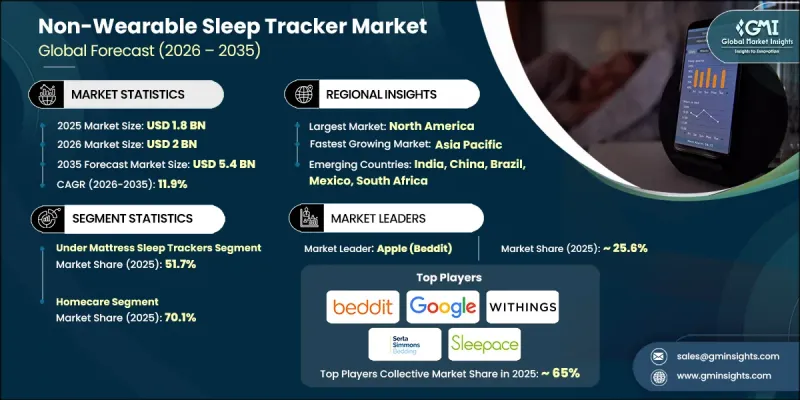
비장착형 수면 추적기 시장의 성장은 수면과 관련된 건강 문제 증가와 신체 접촉이 필요 없는 모니터링 기술에 대한 소비자 수요 증가에 영향을 받고 있습니다. 소비자들은 편안함을 해치지 않으면서도 상세한 수면 정보를 제공하는 편리하고 비침습적인 솔루션을 점점 더 중요하게 여기고 있습니다. 센싱 기술의 지속적인 개선과 더불어 인공지능과 데이터 분석의 발전으로 제품의 기능은 더욱 강화되고 있습니다. 비장착형 수면 추적기는 사용자가 직접 착용할 필요 없이 수면 주기, 호흡 패턴, 심장 박동 신호 및 신체 움직임을 분석하도록 설계된 비접촉식 모니터링 시스템 역할을 합니다. 이러한 장치는 일반적으로 수면 환경 근처에 설치되거나 수면을 지원하는 인프라에 내장되어 휴식 중 생리적 신호를 수집합니다. 탄도 심전도, 레이더 기반 모니터링, 압력 감지 감지 등의 감지 기법의 지속적인 개발로 이러한 시스템의 신뢰성과 정확도가 향상되고 있습니다. AI와 머신러닝 알고리즘을 통합하여 수면 단계에 대한 고급 분석을 통해 불규칙한 패턴을 보다 정확하게 감지할 수 있게 되었습니다. 제조업체들이 지능형 분석 플랫폼을 통합하고, 디지털 생태계와의 연결성을 확장하고, 원격 건강 모니터링 기능을 지원함에 따라 비장착형 수면 추적기 산업은 지속적으로 성장하고 있습니다.
| 시장 범위 | |
|---|---|
| 개시 연도 | 2025년 |
| 예측 기간 | 2026-2035년 |
| 개시 연도 시장 규모 | 18억 달러 |
| 예측액 | 54억 달러 |
| CAGR | 11.9% |
매트리스 하부 수면 추적기 시장은 수동적이고 매우 편안한 수면 모니터링을 제공할 수 있다는 점에서 2025년 51.7%의 점유율을 차지했습니다. 이러한 시스템은 수면 중에 사용자가 기기를 직접 조작할 필요가 없기 때문에 널리 선호되고 있습니다. 설치가 간편하고, 일상적인 수면 환경에 자연스럽게 녹아들어 지속적이고 장기적인 사용을 촉진합니다. 매트리스 하부 모니터링 솔루션은 사용자의 편안함을 해치지 않으면서도 지속적인 추적이 가능하여 컴플라이언스를 향상시키고, 수집된 수면 데이터의 신뢰성을 높입니다. 눈에 띄지 않고 일관된 모니터링을 제공할 수 있다는 점이 이 부문이 전체 시장에서 지배적인 위치를 차지하는 데 크게 기여하고 있습니다.
시설 부문은 2026년부터 2035년까지 연평균 복합 성장률(CAGR) 12.3%를 나타낼 것으로 예측됩니다. 이 부문의 성장은 주로 전문적인 치료 환경에서 비접촉식 수면 모니터링 기술의 도입이 증가함에 따라 상세한 수면 데이터가 임상 관찰 및 웰니스 모니터링 노력을 뒷받침하는 전문 치료 환경에서의 비접촉식 수면 모니터링 기술 도입이 증가함에 따라 이루어졌습니다. 조직은 전반적인 웰빙 관리와 데이터 기반 건강 평가를 개선하기 위해 지능형 수면 모니터링 시스템에 대한 투자를 점점 더 많이 늘리고 있습니다. 휴식 주기를 방해하지 않고 일관된 수면 지표를 제공할 수 있는 이러한 장치의 능력은 시설 환경 전반에 걸쳐 더 광범위한 채택을 촉진하고 있습니다.
북미 비장착형 수면 추적기 시장은 2025년 42.4%의 점유율을 차지하며 업계에서 확고한 리더십을 유지하고 있습니다. 이 지역의 성장은 수면 건강에 대한 인식이 높아지고 수면 관련 질환의 발생률이 증가함에 따라 크게 뒷받침되고 있습니다. 조기 발견과 지속적인 모니터링에 초점을 맞춘 의료 이니셔티브는 주거 환경에서 비침습적 수면 추적 기술의 도입을 촉진하고 있습니다. 재택 건강 모니터링 도구에 대한 관심이 높아지면서 사용자의 편안함과 편리함을 유지하면서 지속적인 수면 정보를 제공하는 비웨어러블 수면 추적 시스템에 대한 수요도 증가하고 있습니다.
자주 묻는 질문
목차
제1장 조사 방법
제2장 주요 요약
제3장 업계 인사이트
제4장 경쟁 구도
제5장 시장 추산 및 예측 : 제품 유형별, 2022-2035
제6장 시장 추산 및 예측 : 최종 용도별, 2022-2035
제7장 시장 추산 및 예측 : 지역별, 2022-2035
제8장 기업 개요
LSH 26.04.23The Global Non-Wearable Sleep Tracker Market was valued at USD 1.8 billion in 2025 and is estimated to grow at a CAGR of 11.9% to reach USD 5.4 billion by 2035.
The growth in the non-wearable sleep tracker market is influenced by the increasing occurrence of sleep-related health conditions and the growing consumer demand for monitoring technologies that do not require physical contact with the body. Consumers are increasingly prioritizing convenient and non-intrusive solutions that provide detailed sleep insights without compromising comfort. Continuous improvements in sensing technologies, along with advancements in artificial intelligence and data analytics, are further strengthening product capabilities. Non-wearable sleep trackers function as contact-free monitoring systems designed to analyze sleep cycles, respiration patterns, heart rate signals, and body movement without requiring direct attachment to the user. These devices are typically positioned near sleeping environments or integrated within sleep-supporting infrastructure to collect physiological signals during rest. Ongoing developments in sensing methods such as ballistocardiography, radar-based monitoring, and pressure-sensitive detection have improved the reliability and accuracy of these systems. The integration of AI and machine learning algorithms allows devices to perform advanced sleep stage interpretation and detect irregular patterns with greater precision. The non-wearable sleep tracker industry continues to gain momentum as manufacturers incorporate intelligent analytics platforms, expand connectivity with digital ecosystems, and support remote health monitoring capabilities.
| Market Scope | |
|---|---|
| Start Year | 2025 |
| Forecast Year | 2026-2035 |
| Start Value | $1.8 Billion |
| Forecast Value | $5.4 Billion |
| CAGR | 11.9% |
The under mattress sleep trackers segment held a 51.7% share in 2025, owing to its ability to provide passive and highly comfortable sleep monitoring. These systems are widely preferred because they operate without requiring users to interact directly with the device during sleep. Their simple installation and seamless integration into everyday sleeping environments encourage consistent long-term use. Under mattress monitoring solutions enable continuous tracking without disrupting user comfort, which improves compliance and enhances the reliability of collected sleep data. Their ability to provide discreet and consistent monitoring has significantly contributed to the segment's dominant position within the broader market.
The institutional segment is expected to grow at a CAGR of 12.3% during 2026-2035. Growth within this segment is primarily driven by the increasing deployment of non-contact sleep monitoring technologies across professional care environments where detailed sleep data supports clinical observation and wellness monitoring initiatives. Organizations are increasingly investing in intelligent sleep monitoring systems to improve overall wellness management and data-driven health assessments. The ability of these devices to deliver consistent sleep metrics without disrupting rest cycles is encouraging broader adoption across institutional settings.
North America Non-Wearable Sleep Tracker Market accounted for 42.4% share in 2025, maintaining a strong leadership position within the industry. The region's growth is largely supported by increasing awareness of sleep health and the rising incidence of sleep-related medical conditions. Healthcare initiatives focused on early detection and continuous monitoring are encouraging the adoption of non-intrusive sleep tracking technologies across residential settings. Growing interest in home-based health monitoring tools is also supporting the demand for non-wearable sleep tracking systems that provide continuous sleep insights while maintaining user comfort and convenience.
Key companies operating in the Global Non-Wearable Sleep Tracker Market include Apple (Beddit), Eight Sleep, Emfit, Google, iFIT, Sleep Number Corporation, Sleepace, Vitalthings, Wakefit, Withings, Beautyrest (Serta Simmons Bedding), Tochtech Technologies, and Sleep Solutions. Companies in the Non-Wearable Sleep Tracker Market are strengthening their competitive position through continuous innovation, technology partnerships, and ecosystem integration strategies. Manufacturers are focusing on developing advanced sensor technologies combined with artificial intelligence to improve sleep detection accuracy and provide deeper behavioral insights. Strategic collaborations with healthcare providers and digital health platforms are also enabling companies to expand clinical applications and remote monitoring capabilities. Many firms are integrating their devices with broader smart home environments to create connected wellness ecosystems.
Table of Contents
Chapter 1 Research Methodology
- 1.1 Research approach
- 1.2 Quality commitments
- 1.2.1 GMI AI policy & data integrity commitment
- 1.2.1.1 Source consistency protocol
- 1.2.1 GMI AI policy & data integrity commitment
- 1.3 Research trail & confidence scoring
- 1.3.1 Research trail components
- 1.3.2 Scoring components
- 1.4 Data collection
- 1.4.1 Partial list of primary sources
- 1.5 Data mining sources
- 1.5.1 Paid sources
- 1.5.1.1 Sources, by region
- 1.5.1 Paid sources
- 1.6 Base estimates and calculations
- 1.6.1 Base year calculation for any one approach
- 1.7 Forecast model
- 1.7.1 Quantified market impact analysis
- 1.7.1.1 Mathematical impact of growth parameters on forecast
- 1.7.1 Quantified market impact analysis
- 1.8 Research transparency addendum
- 1.8.1 Source attribution framework
- 1.8.2 Quality assurance metrics
- 1.8.3 Our commitment to trust
Chapter 2 Executive Summary
- 2.1 Industry 3600 synopsis
- 2.2 Key market trends
- 2.2.1 Regional trends
- 2.2.2 Product type trends
- 2.2.3 End use trends
- 2.3 CXO perspectives: Strategic imperatives
Chapter 3 Industry Insights
- 3.1 Industry ecosystem analysis
- 3.2 Industry impact forces
- 3.2.1 Growth drivers
- 3.2.1.1 Rising awareness of sleep health and disorders
- 3.2.1.2 Increasing adoption of smart home and IoT devices.
- 3.2.1.3 Growing preference for non-intrusive sleep monitoring solutions.
- 3.2.1.4 Technological advancements in sensor accuracy and AI-driven analytics.
- 3.2.2 Industry pitfalls and challenges
- 3.2.2.1 High cost of smart mattresses and advanced trackers.
- 3.2.2.2 Data privacy and security concerns
- 3.2.3 Market opportunities
- 3.2.3.1 Expansion into emerging economies
- 3.2.3.2 Integration with telehealth and digital therapeutics
- 3.2.1 Growth drivers
- 3.3 Growth potential analysis
- 3.4 Regulatory landscape
- 3.4.1 North America
- 3.4.2 Europe
- 3.4.3 Asia Pacific
- 3.5 Technology landscape
- 3.5.1 Current technological trends
- 3.5.2 Emerging technologies
- 3.6 Future market trends
- 3.7 Pricing analysis, 2025
- 3.8 Value chain analysis
- 3.9 Porter's analysis
- 3.10 PESTEL analysis
- 3.11 Customer insights
- 3.12 Start-up scenarios
- 3.13 Gap analysis
- 3.15 Impact of AI and generative AI on the market
Chapter 4 Competitive Landscape, 2025
- 4.1 Introduction
- 4.2 Company matrix analysis
- 4.3 Company market share analysis
- 4.3.1 Global
- 4.3.2 North America
- 4.3.3 Europe
- 4.3.4 Asia Pacific
- 4.4 Competitive positioning matrix
- 4.5 Competitive analysis of major market players
- 4.6 Key developments
- 4.6.1 Mergers & acquisitions
- 4.6.2 Partnerships & collaborations
- 4.6.3 New product launches
- 4.6.4 Expansion plans
Chapter 5 Market Estimates and Forecast, By Product Type, 2022 - 2035 ($ Mn)
- 5.1 Key trends
- 5.2 Under mattress sleep trackers
- 5.3 Smart mattresses sleep trackers
- 5.4 Bedside sleep trackers
- 5.5 Other product types
Chapter 6 Market Estimates and Forecast, By End Use, 2022 - 2035 ($ Mn)
- 6.1 Key trends
- 6.2 Homecare
- 6.3 Institutional (healthcare, hospitality)
Chapter 7 Market Estimates and Forecast, By Region, 2022 - 2035 ($ Mn)
- 7.1 Key trends
- 7.2 North America
- 7.2.1 U.S.
- 7.2.2 Canada
- 7.3 Europe
- 7.3.1 Germany
- 7.3.2 UK
- 7.3.3 France
- 7.3.4 Spain
- 7.3.5 Italy
- 7.3.6 Netherlands
- 7.4 Asia Pacific
- 7.4.1 China
- 7.4.2 Japan
- 7.4.3 India
- 7.4.4 Australia
- 7.4.5 South Korea
- 7.5 Latin America
- 7.5.1 Brazil
- 7.5.2 Mexico
- 7.5.3 Argentina
- 7.6 Middle East and Africa
- 7.6.1 South Africa
- 7.6.2 Saudi Arabia
- 7.6.3 UAE
Chapter 8 Company Profiles
- 8.1 Apple (Beddit)
- 8.2 Beautyrest (Serta Simmons Bedding)
- 8.3 Eight Sleep
- 8.4 Emfit
- 8.5 Google
- 8.6 iFIT
- 8.7 Sleep Number Corporation
- 8.8 Sleep Solutions
- 8.9 Sleepace
- 8.10 Tochtech Technologies
- 8.11 Vitalthings
- 8.12 Wakefit
- 8.13 Withings