

|
시장보고서
상품코드
1998703
고성능 안료 시장 비즈니스 기회, 성장요인, 업계 동향 분석 및 예측(2026-2035년)High Performance Pigments Market Opportunity, Growth Drivers, Industry Trend Analysis, and Forecast 2026 - 2035 |
||||||

세계의 고성능 안료 시장은 2025년에 67억 달러로 평가되었고, CAGR 4.6%로 성장하여 2035년까지 105억 달러에 달할 것으로 예측됩니다.
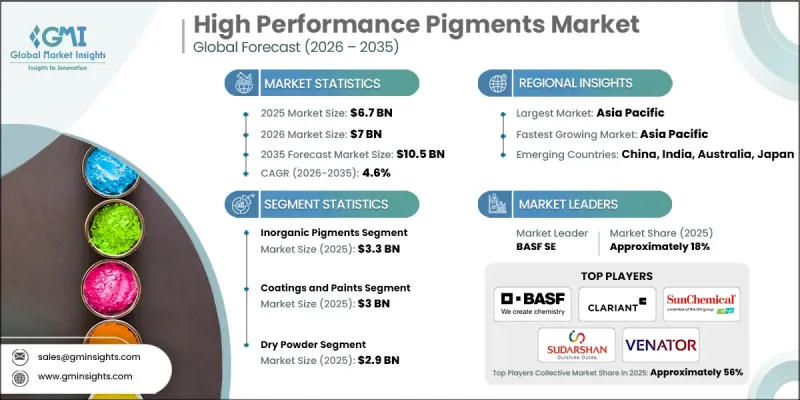
지난 10년간, 우수한 자외선 저항성, 장기적인 발색 유지력 및 내구성 향상을 위한 안료에 대한 수요가 증가함에 따라 이 산업은 눈부신 발전을 거듭해 왔습니다. 고성능 안료는 오래 지속되는 마감과 일관된 색상 품질이 필수적인 자동차, 건설, 산업용 페인트, 플라스틱, 포장 등의 산업에서 중요한 역할을 하고 있습니다. 지속가능성은 시장 전반에서 중요한 화두로 떠오르고 있으며, 제조업체와 최종 사용자 모두 환경 친화적인 배합을 우선순위에 두고 있습니다. 저독성 화학물질로의 전환과 중금속 함량 감소는 환경 기준의 강화와 기업의 지속가능성에 대한 노력의 강화를 반영합니다. 동시에, 생산 기술의 발전은 경쟁 구도를 새롭게 바꾸고 있습니다. 나노기술과 바이오기술을 활용한 혁신으로 밝기, 성능, 다기능성을 향상시킨 안료 개발이 가능해졌습니다. 또한, 각 기업들은 디지털 제조 시스템 및 스마트 생산 공정를 도입하여 업무 효율성 향상, 제조 비용 절감, 그리고 변화하는 고객의 요구에 효과적으로 대응하고 있습니다.
| 시장 범위 | |
|---|---|
| 개시 연도 | 2025년 |
| 예측 기간 | 2026-2035년 |
| 개시 연도 시장 규모 | 67억 달러 |
| 예측액 | 105억 달러 |
| CAGR | 4.6% |
무기 안료 부문은 2025년 33억 달러 시장 규모를 기록했으며, 2026년부터 2035년까지 연평균 4.8%의 성장률을 보일 것으로 전망됩니다. 무기 안료는 뛰어난 열 안정성, 내화학성 및 장기적인 색상 견뢰도로 인해 고성능 안료 시장에서 중요한 위치를 차지하고 있습니다. 이 소재들은 가혹한 환경 조건에서도 높은 성능이 요구되는 용도에 널리 사용되고 있습니다. 일관된 색조의 안정성과 구조적 신뢰성이 요구되는 산업에서는 무기계 배합에 크게 의존하고 있습니다. 지속가능성에 대한 노력이 가속화되는 가운데, 무기 안료는 내구성이 뛰어나고 전체 수명주기 동안 환경에 미치는 영향이 상대적으로 적기 때문에 친환경 제품 라인에 점점 더 많이 채택되고 있습니다.
건조 분말 부문은 2025년에 29억 달러 규모에 달했고, 2026년부터 2035년까지 연평균 복합 성장률(CAGR) 5.1%를 나타낼 것으로 예측됩니다. 형태별 수요는 코팅, 엔지니어링 플라스틱, 인쇄 응용 분야의 가공 요건에 따라 크게 좌우됩니다. 건조 분말 안료는 고온 가공과의 호환성 및 산업 및 건설 분야의 성능 중심의 최종 용도에 대한 적합성으로 인해 선도적인 위치를 유지하고 있습니다. 액체 분산액은 고급 코팅 기술에서 일관된 분산 품질과 효율적인 도포를 제공하는 즉시 통합 가능한 안료 시스템에 대한 수요 증가에 힘입어 또 다른 중요한 카테고리로 부상하고 있습니다.
북미 고성능 안료 시장은 2025년 14억 달러 규모에 달했습니다. 내열성 및 내후성이 우수한 착색제를 필요로 하는 자동차 보수 도장, 산업기계용 코팅, 폴리머 컴파운딩 및 특수 인쇄용도의 활발한 수요로 인해 지역별 수요는 안정적으로 유지되고 있습니다. 이 지역의 엄격한 환경 규제는 코팅 및 첨단 폴리머 솔루션 전반에 걸쳐 고순도, 저휘발성 유기화합물(VOC) 안료 시스템의 사용을 촉진하고 있습니다. 표면 처리 안료 및 맞춤형 분산액의 지속적인 혁신은 특히 경량 소재 및 첨단 제조 공정과 관련된 응용 분야에서 시장 성장을 더욱 촉진하고 있습니다.
자주 묻는 질문
목차
제1장 조사 방법
제2장 주요 요약
제3장 업계 인사이트
제4장 경쟁 구도
제5장 시장 추산 및 예측 : 제품 유형별, 2022-2035
제6장 시장 추산 및 예측 : 용도별, 2022-2035
제7장 시장 추산 및 예측 : 형태별, 2022-2035
제8장 시장 추산 및 예측 : 지역별, 2022-2035
제9장 기업 개요
LSH 26.04.23The Global High Performance Pigments Market was valued at USD 6.7 billion in 2025 and is estimated to grow at a CAGR of 4.6% to reach USD 10.5 billion by 2035.
Over the last decade, the industry has experienced meaningful evolution driven by increasing demand for pigments that deliver superior UV resistance, long-term color retention, and enhanced durability. High performance pigments play a critical role in industries such as automotive, construction, industrial coatings, plastics, and packaging, where long-lasting finishes and consistent color quality are essential. Sustainability has become a defining theme across the market, with both manufacturers and end users prioritizing environmentally responsible formulations. The transition toward low-toxicity chemistries and reduced heavy metal content reflects tightening environmental standards and growing corporate sustainability commitments. At the same time, advancements in production technologies are reshaping the competitive landscape. Innovations involving nanotechnology and biotechnology are enabling the development of pigments with improved brightness, performance, and multifunctional properties. Companies are also integrating digital manufacturing systems and smart production processes to enhance operational efficiency, lower manufacturing costs, and respond more effectively to evolving customer requirements.
| Market Scope | |
|---|---|
| Start Year | 2025 |
| Forecast Year | 2026-2035 |
| Start Value | $6.7 Billion |
| Forecast Value | $10.5 Billion |
| CAGR | 4.6% |
The inorganic pigments segment generated USD 3.3 billion in 2025 and is projected to grow at a CAGR of 4.8% from 2026 to 2035. Inorganic pigments continue to hold a substantial position within the high-performance pigments market due to their exceptional thermal stability, chemical resistance, and long-term color durability. These materials are widely utilized in applications that demand strong performance under harsh environmental conditions. Industries requiring consistent color integrity and structural reliability rely heavily on inorganic formulations. As sustainability initiatives accelerate, inorganic pigments are increasingly incorporated into environmentally aligned product lines because of their durability and relatively lower environmental impact over extended lifecycles.
The dry powder segment was valued at USD 2.9 billion in 2025 and is anticipated to grow at a CAGR of 5.1% during 2026-2035. Demand by form is largely influenced by processing requirements across coatings, engineered plastics, and printing applications. Dry powder pigments maintain a leading position due to their compatibility with high-temperature processing and their suitability for performance-driven end uses in industrial and construction settings. Liquid dispersions represent another important category, supported by rising preference for ready-to-integrate pigment systems that offer consistent dispersion quality and efficient application in advanced coating technologies.
North America High Performance Pigments Market accounted for USD 1.4 billion in 2025. Regional demand remains stable due to strong activity in automotive refinishing, industrial machinery coatings, polymer compounding, and specialty printing applications that require heat-resistant and weather-stable colorants. Strict environmental regulations in the region encourage the use of high-purity and low-volatile organic compound (VOC) pigment systems across coatings and advanced polymer solutions. Ongoing innovation in surface-treated pigments and customized dispersions further supports growth, particularly in applications linked to lightweight materials and advanced manufacturing processes.
Key participants in the Global High Performance Pigments Market include Clariant AG, BASF SE, Venator Materials PLC, Sudarshan Chemical Industries Ltd., and Sun Chemical Corporation, a subsidiary of DIC Corporation. Companies operating in the High Performance Pigments Market are reinforcing their market presence through strategic investments in research and development, advanced formulation technologies, and sustainability-driven product lines. Many manufacturers are prioritizing eco-friendly pigment systems that comply with evolving environmental standards while maintaining high performance characteristics. Capacity expansions and geographic diversification strategies help companies serve growing demand across emerging markets. Digitalization of manufacturing processes improves efficiency, quality control, and supply chain responsiveness. Collaborative partnerships with coatings, plastics, and packaging producers enable tailored pigment solutions aligned with specific performance requirements.
Table of Contents
Chapter 1 Methodology
- 1.1 Market scope and definition
- 1.2 Research design
- 1.2.1 Research approach
- 1.2.2 Data collection methods
- 1.3 Data mining sources
- 1.3.1 Global
- 1.3.2 Regional/Country
- 1.4 Base estimates and calculations
- 1.4.1 Base year calculation
- 1.4.2 Key trends for market estimation
- 1.5 Primary research and validation
- 1.5.1 Primary sources
- 1.6 Forecast model
- 1.7 Research assumptions and limitations
Chapter 2 Executive Summary
- 2.1 Industry 360° synopsis
- 2.2 Key market trends
- 2.2.1 Regional
- 2.2.2 Material Type
- 2.2.3 Aircraft Platform
- 2.2.4 Component Type
- 2.2.5 Product Type
- 2.2.6 Manufacturing Process
- 2.2.7 End-User
- 2.3 TAM Analysis, 2026-2035
- 2.4 CXO perspectives: Strategic imperatives
Chapter 3 Industry Insights
- 3.1 Industry ecosystem analysis
- 3.1.1 Supplier Landscape
- 3.1.2 Profit Margin
- 3.1.3 Value addition at each stage
- 3.1.4 Factor affecting the value chain
- 3.1.5 Disruptions
- 3.2 Industry impact forces
- 3.2.1 Growth drivers
- 3.2.2 Industry pitfalls and challenges
- 3.2.3 Market opportunities
- 3.3 Growth potential analysis
- 3.4 Regulatory landscape
- 3.4.1 North America
- 3.4.2 Europe
- 3.4.3 Asia Pacific
- 3.4.4 Latin America
- 3.4.5 Middle East & Africa
- 3.5 Porter's analysis
- 3.6 PESTEL analysis
- 3.7 Price trends
- 3.7.1 By region
- 3.7.2 By product
- 3.8 Future market trends
- 3.9 Technology and Innovation landscape
- 3.9.1 Current technological trends
- 3.9.2 Emerging technologies
- 3.10 Patent Landscape
- 3.11 Trade statistics (Note: the trade statistics will be provided for key countries only)
- 3.11.1 Major importing countries
- 3.11.2 Major exporting countries
- 3.12 Sustainability and Environmental Aspects
- 3.12.1 Sustainable Practices
- 3.12.2 Waste Reduction Strategies
- 3.12.3 Energy Efficiency in Production
- 3.12.4 Eco-friendly Initiatives
- 3.13 Carbon Footprint Considerations
Chapter 4 Competitive Landscape, 2025
- 4.1 Introduction
- 4.2 Company market share analysis
- 4.2.1 By region
- 4.2.1.1 North America
- 4.2.1.2 Europe
- 4.2.1.3 Asia Pacific
- 4.2.1.4 LATAM
- 4.2.1.5 MEA
- 4.2.1 By region
- 4.3 Company matrix analysis
- 4.4 Competitive analysis of major market players
- 4.5 Competitive positioning matrix
- 4.6 Key developments
- 4.6.1 Mergers & acquisitions
- 4.6.2 Partnerships & collaborations
- 4.6.3 New Product Launches
- 4.6.4 Expansion Plans
Chapter 5 Market Estimates and Forecast, By Product Type, 2022- 2035 (USD Billion, Kilo Tons)
- 5.1 Key trends
- 5.2 Inorganic pigments
- 5.3 Organic pigments
- 5.4 Specialty pigments
- 5.5 Metallic pigments
Chapter 6 Market Estimates and Forecast, By Application, 2022 - 2035 (USD Billion, Kilo Tons)
- 6.1 Key trends
- 6.2 Coatings and paints
- 6.3 Plastics and polymers
- 6.4 Printing inks
- 6.5 Cosmetics
- 6.6 Textiles and fabrics
- 6.7 Others
Chapter 7 Market Estimates and Forecast, By Form, 2022 - 2035 (USD Billion, Kilo Tons)
- 7.1 Key trends
- 7.2 Dry Powder
- 7.2.1 Neat Pigment Powder
- 7.2.2 Dry Powder Blends
- 7.3 Liquid Dispersions
- 7.3.1 Water-Based Dispersions
- 7.3.2 Solvent-Based Dispersions
- 7.4 Masterbatch & Concentrates
- 7.4.1 Polymer-Based Masterbatch
- 7.4.2 Wax-Based Concentrates
- 7.5 Paste & Flushed Pigments
- 7.6 Encapsulated & Surface-Treated Pigments
- 7.7 Others
Chapter 8 Market Estimates and Forecast, By Region, 2022 - 2035 (USD Billion, Kilo Tons)
- 8.1 Key trends
- 8.2 North America
- 8.2.1 U.S.
- 8.2.2 Canada
- 8.3 Europe
- 8.3.1 Germany
- 8.3.2 UK
- 8.3.3 France
- 8.3.4 Italy
- 8.3.5 Spain
- 8.3.6 Rest of Europe
- 8.4 Asia Pacific
- 8.4.1 China
- 8.4.2 India
- 8.4.3 Japan
- 8.4.4 Australia
- 8.4.5 South Korea
- 8.4.6 Rest of Asia Pacific
- 8.5 Latin America
- 8.5.1 Brazil
- 8.5.2 Mexico
- 8.5.3 Argentina
- 8.5.4 Rest of Latin America
- 8.6 Middle East & Africa
- 8.6.1 Saudi Arabia
- 8.6.2 South Africa
- 8.6.3 UAE
- 8.6.4 Rest of Middle East & Africa
Chapter 9 Company Profiles
- 9.1 BASF SE
- 9.2 Clariant AG
- 9.3 Sun Chemical Corporation (DIC Corporation)
- 9.4 Sudarshan Chemical Industries Limited
- 9.5 Venator Materials PLC
- 9.6 The Chemours Company
- 9.7 Tronox Holdings plc
- 9.8 Zhejiang D-Ray Technology Co., Ltd
- 9.9 Atul Ltd
- 9.10 Cathay Industries
- 9.11 Kolorjet Chemicals Pvt Ltd


