



|
시장보고서
상품코드
1998718
BTK 저해제 시장 기회, 성장요인, 업계 동향 분석 및 예측(2026-2035년)BTK Inhibitor Market Opportunity, Growth Drivers, Industry Trend Analysis, and Forecast 2026 - 2035 |
||||||

세계의 BTK 저해제 시장은 2025년에 104억 달러로 평가되며, 2035년까지 CAGR 12.2%로 성장하며, 327억 달러에 달할 것으로 추정되고 있습니다.
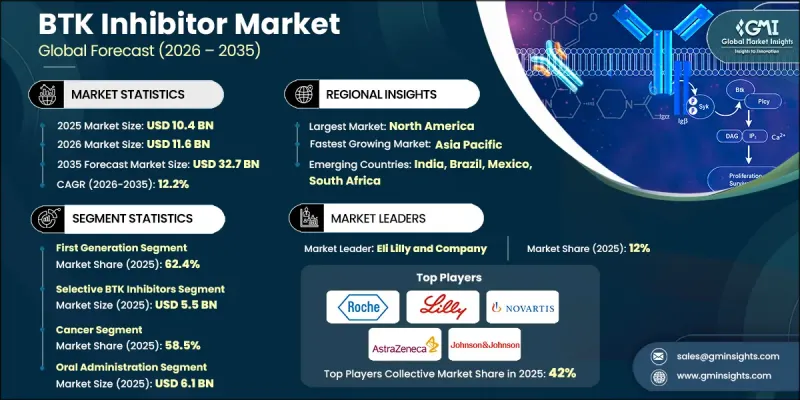
이러한 꾸준한 성장은 전 세계 암 및 자가면역질환 증가와 더불어 표적치료제 개발의 괄목할 만한 발전이 지원하고 있습니다. 제약 연구는 질병 진행과 관련된 분자 경로를 정확하게 표적화하는 치료법으로 점점 더 이동하고 있으며, 이로 인해 BTK 억제제의 임상적 중요성이 커지고 있습니다. 맞춤형 의료 접근법의 확산은 특정 유전자 변이에 맞춘 치료법, 바이오마커에 기반한 치료법, 최적화된 투여 전략의 개발을 더욱 촉진하고 있습니다. 또한 신약개발 분야의 지속적인 혁신으로 치료 저항성을 극복하고 치료 결과를 개선할 수 있는 차세대 BTK 억제제를 개발할 수 있게 되었습니다. BTK 억제제는 면역계에서 B세포의 생존과 활성을 조절하는 데 핵심적인 역할을 하는 효소인 브루톤형 티로신 키나아제를 억제하는 방식으로 작용합니다. 비정상적인 B세포 신호전달을 억제함으로써, 이러한 치료법은 일부 혈액질환 및 면역 관련 질환의 질병 진행을 억제하는 데 도움이 될 수 있습니다. 시간이 지남에 따라 BTK 억제제는 현대 표적치료 전략의 중요한 구성요소가 되어 여러 악성 종양 및 면역계 질환의 치료 프로토콜에 큰 영향을 미치고 있습니다.
| 시장 범위 | |
|---|---|
| 시작연도 | 2025 |
| 예측 기간 | 2026-2035년 |
| 개시 금액 | 104억 달러 |
| 예측액 | 327억 달러 |
| CAGR | 12.2% |
1세대 부문은 2025년 65억 달러로 62.4%의 점유율을 차지했습니다. 초기 BTK 억제제 치료는 일부 B세포 관련 질환의 치료에 상당한 임상적 효과를 보여주었습니다. 이들의 도입으로 질병의 진행을 늦추고 환자의 생존기간을 연장하여 치료 성적이 크게 개선되었습니다. 1세대 BTK 억제제의 보급을 지원하는 또 다른 요인은 경구 투여의 편리성으로 기존 정맥주사 요법에 비해 덜 침습적인 치료 옵션을 제공한다는 점입니다. 경구용 치료 옵션은 환자의 편의성을 개선하고 장기적인 질병 관리를 간소화하여 치료 순응도를 높이고 치료 순응도를 향상시킬 수 있습니다. 또한 이 치료법은 B세포 수용체 신호전달 경로에 관여하는 중요한 효소인 브루톤형 티로신 키나아제를 특이적으로 표적화하여 작용하므로 기존 화학요법에서 흔히 동반되는 많은 부작용을 완화하는 데 도움이 될 수 있습니다.
선택적 BTK 억제제 부문은 2025년 52.5%의 점유율을 차지하며 55억 달러의 시장 규모를 창출했습니다. 이 치료법은 기존 치료법에 비해 더 높은 정확도로 브루톤형 티로신 키나아제를 표적으로 삼을 수 있도록 설계되었습니다. 이러한 특이성 향상으로 약물이 의도한 분자 경로에 더 효과적으로 작용하는 동시에 관련 없는 키나아제와의 상호 작용을 제한할 수 있습니다. 그 결과, 오프타겟 생물학적 영향의 위험을 줄일 수 있습니다. 선택적 BTK 억제제의 또 다른 장점은 우수한 안전성 프로파일에 있습니다. 이는 특히 장기 치료가 필요한 환자나 보다 세심한 관리가 필요한 기존 건강 상태를 가진 환자들에게 특히 중요합니다. 고선택성 치료법 개발은 정밀의료와 보다 정교한 치료 전략을 향한 업계 전반의 추세를 반영하고 있습니다.
미국 BTK 억제제 시장은 탄탄한 제약 연구 생태계와 첨단 표적치료제에 대한 강력한 수요에 힘입어 2025년 38억 달러 규모로 성장할 것으로 예측됩니다. 미국내 암 유병률 증가는 치료 효과를 향상시킬 수 있는 표적 치료 솔루션에 대한 큰 수요를 지속적으로 창출하고 있습니다. 또한 미국 식품의약국(FDA)의 규제 감독도 안전성, 유효성 및 의약품 품질에 대한 엄격한 승인 기준을 유지함으로써 BTK 억제제 시장 형성에 중요한 역할을 해왔습니다. 이러한 규제 요건은 제약사들이 환자의 안전을 보장하면서 진화하는 임상적 기대에 부응하는 보다 진보된 치료법을 개발하도록 유도하고 있습니다.
자주 묻는 질문
목차
제1장 조사 방법과 범위
제2장 개요
제3장 업계 인사이트
제4장 경쟁 구도
제5장 시장 추산·예측 : 유형별, 2022-2035
제6장 시장 추산·예측 : 약제 유형별, 2022-2035
제7장 시장 추산·예측 : 용도별, 2022-2035
제8장 시장 추산·예측 : 투여 경로별, 2022-2035
제9장 시장 추산·예측 : 유통 채널별, 2022-2035
제10장 시장 추산·예측 : 지역별, 2022-2035
제11장 기업 개요
KSA 26.04.20The Global BTK Inhibitor Market was valued at USD 10.4 billion in 2025 and is estimated to grow at a CAGR of 12.2% to reach USD 32.7 billion by 2035.
The consistent growth is supported by the increasing burden of cancer and autoimmune disorders worldwide, along with notable progress in targeted drug development. Pharmaceutical research has increasingly shifted toward therapies designed to precisely target molecular pathways associated with disease progression, which has elevated the clinical relevance of BTK inhibitors. The rising adoption of personalized medicine approaches is further encouraging the development of therapies tailored to specific genetic mutations, biomarker-guided treatment methods, and optimized dosing strategies. In addition, continued innovation in drug discovery is enabling the development of next-generation BTK inhibitors capable of addressing treatment resistance and improving therapeutic outcomes. BTK inhibitors function by blocking Bruton's tyrosine kinase, an enzyme that plays a central role in regulating the survival and activity of B-cells within the immune system. By suppressing abnormal B-cell signaling, these therapies help control disease progression in several hematological conditions and immune-related disorders. Over time, BTK inhibitors have become an important component of modern targeted therapy strategies, significantly influencing treatment protocols for multiple malignancies and immune system disorders.
| Market Scope | |
|---|---|
| Start Year | 2025 |
| Forecast Year | 2026-2035 |
| Start Value | $10.4 Billion |
| Forecast Value | $32.7 Billion |
| CAGR | 12.2% |
The first-generation segment reached USD 6.5 billion in 2025 and held 62.4% share. Early BTK inhibitor therapies demonstrated substantial clinical effectiveness in treating several B-cell-related conditions. Their adoption significantly improved treatment outcomes by slowing disease progression and extending patient survival. Another factor supporting the widespread use of first-generation BTK inhibitors is their convenient oral administration, which offers a less invasive alternative to traditional intravenous therapies. Oral treatment options improve patient comfort and simplify long-term disease management, leading to better treatment adherence and higher compliance rates. These therapies also work by specifically targeting Bruton's tyrosine kinase, an essential enzyme involved in B-cell receptor signaling pathways, which helps reduce many of the adverse effects often associated with conventional chemotherapy approaches.
The selective BTK inhibitors segment accounted for 52.5% share and generated USD 5.5 billion in 2025. These therapies are designed to target Bruton's tyrosine kinase with a higher degree of precision compared with earlier treatment approaches. Their improved specificity allows the drugs to focus more effectively on the intended molecular pathway while limiting interaction with unrelated kinases. As a result, the risk of off-target biological effects is reduced. Another advantage of selective BTK inhibitors is their favorable safety profile, particularly for patients who require long-term therapy or have existing health conditions that demand more carefully managed treatment options. The development of highly selective therapies reflects the broader industry trend toward precision medicine and more refined therapeutic strategies.
United States BTK Inhibitor Market was valued at USD 3.8 billion in 2025, supported by a well-established pharmaceutical research ecosystem and a strong demand for advanced targeted therapies. Increasing cancer prevalence in the United States continues to generate significant demand for targeted therapeutic solutions capable of improving treatment effectiveness. Regulatory oversight from the U.S. Food and Drug Administration has also played an important role in shaping the BTK inhibitor landscape by maintaining strict approval standards for safety, performance, and drug quality. These regulatory requirements encourage pharmaceutical companies to develop more advanced therapies that meet evolving clinical expectations while ensuring patient safety.
Key participants active in the Global BTK Inhibitor Market include Novartis, Bristol Myers Squibb, Johnson & Johnson, Amgen, AstraZeneca, Merck & Co., Sanofi, Takeda Pharmaceutical, F. Hoffmann-La Roche Ltd, Gilead Sciences, Eli Lilly and Company, Incyte, Biogen, Celgene, and Agilent Technologies. Companies operating in the BTK Inhibitor Market are implementing multiple strategic initiatives to strengthen their competitive positioning. Leading pharmaceutical firms are prioritizing extensive research and development investments to discover improved BTK inhibitor formulations with greater selectivity and enhanced therapeutic performance. Strategic collaborations with biotechnology companies, academic institutions, and clinical research organizations are also being pursued to accelerate drug development and clinical trial programs. Many companies are expanding their oncology and immunology pipelines through acquisitions, licensing agreements, and technology partnerships that support innovation in targeted therapies. In addition, firms are strengthening regulatory approval strategies and increasing global commercialization capabilities to broaden their geographic reach.
Table of Contents
Chapter 1 Methodology and Scope
- 1.1 Research approach
- 1.2 Quality commitments
- 1.2.1 GMI AI policy & data integrity commitment
- 1.2.1.1 Source consistency protocol
- 1.2.1 GMI AI policy & data integrity commitment
- 1.3 Research trail & confidence scoring
- 1.3.1 Research trail components
- 1.3.2 Scoring components
- 1.4 Data collection
- 1.4.1 Partial list of primary sources
- 1.5 Data mining sources
- 1.5.1 Paid sources
- 1.5.1.1 Sources, by region
- 1.5.1 Paid sources
- 1.6 Base estimates and calculations
- 1.6.1 Base year calculation for any one approach
- 1.7 Forecast model
- 1.7.1 Quantified market impact analysis
- 1.7.1.1 Mathematical impact of growth parameters on forecast
- 1.7.2 Research transparency addendum
- 1.7.3 Source attribution framework
- 1.7.4 Quality assurance metrics
- 1.7.1 Quantified market impact analysis
- 1.8 Our commitment to trust
Chapter 2 Executive Summary
- 2.1 Industry 360° synopsis
- 2.2 Key market trends
- 2.2.1 Regional trends
- 2.2.2 Type trends
- 2.2.3 Drug type trends
- 2.2.4 Application trends
- 2.2.5 Route of administration trends
- 2.2.6 Distribution channel trends
- 2.3 CXO perspectives: Strategic imperatives
Chapter 3 Industry Insights
- 3.1 Industry ecosystem analysis
- 3.2 Industry impact forces
- 3.2.1 Growth drivers
- 3.2.1.1 Rising prevalence of cancers and autoimmune diseases
- 3.2.1.2 Advancements in targeted therapies
- 3.2.1.3 Ongoing research and development
- 3.2.1.4 Increasing focus on personalized medicine
- 3.2.2 Industry pitfalls and challenges
- 3.2.2.1 High cost of BTK inhibitors
- 3.2.2.2 Stringent regulatory scenario
- 3.2.3 Market opportunities
- 3.2.3.1 Rising healthcare infrastructure in emerging markets
- 3.2.1 Growth drivers
- 3.3 Growth potential analysis
- 3.4 Regulatory landscape
- 3.4.1 North America
- 3.4.2 Europe
- 3.4.3 Asia Pacific
- 3.5 Future market trends
- 3.6 Pipeline analysis (Driven by Primary Research)
- 3.7 Pricing analysis, 2025
- 3.8 Porter's analysis
- 3.9 PESTEL analysis
Chapter 4 Competitive Landscape, 2025
- 4.1 Introduction
- 4.2 Company market share analysis
- 4.3 Company matrix analysis
- 4.4 Competitive analysis of major market players
- 4.5 Competitive positioning matrix
- 4.6 Key developments
- 4.6.1 Mergers and acquisitions
- 4.6.2 Partnerships and collaborations
- 4.6.3 New product launches
- 4.6.4 Expansion plans
Chapter 5 Market Estimates and Forecast, By Type, 2022 - 2035 ($ Mn)
- 5.1 Key trends
- 5.2 First generation
- 5.3 Second generation
Chapter 6 Market Estimates and Forecast, By Drug Type, 2022 - 2035 ($ Mn)
- 6.1 Key trends
- 6.2 Selective BTK inhibitors
- 6.3 Non-selective BTK inhibitors
- 6.4 Dual BTK inhibitors
Chapter 7 Market Estimates and Forecast, By Application, 2022 - 2035 ($ Mn)
- 7.1 Key trends
- 7.2 Cancer
- 7.2.1 Chronic lymphocytic leukemia (CLL)
- 7.2.2 Follicular lymphoma
- 7.2.3 Mantle cell lymphoma
- 7.2.4 Marginal zone lymphoma
- 7.2.5 Small lymphocytic lymphoma (SLL)
- 7.2.6 Waldenstrom macroglobulinemia
- 7.2.7 Other selective B cell malignancies
- 7.3 Autoimmune diseases
- 7.3.1 Systemic lupus erythematosus (SLE)
- 7.3.2 Rheumatoid arthritis (RA)
- 7.3.3 Multiple sclerosis (MS)
- 7.3.4 Immune thrombocytopenia (ITP)
- 7.4 Inflammatory disorders
- 7.4.1 Inflammatory bowel disease (IBD)
- 7.4.2 Asthma and allergic diseases
- 7.4.3 IgG4-Related diseases
- 7.4.4 Vasculitis
- 7.5 Other applications
Chapter 8 Market Estimates and Forecast, By Route of Administration, 2022 - 2035 ($ Mn)
- 8.1 Key trends
- 8.2 Oral administration
- 8.3 Intravenous administration
- 8.4 Subcutaneous administration
Chapter 9 Market Estimates and Forecast, By Distribution Channel, 2022 - 2035 ($ Mn)
- 9.1 Key trends
- 9.2 Hospital pharmacy
- 9.3 Retail pharmacy
- 9.4 Online pharmacy
Chapter 10 Market Estimates and Forecast, By Region, 2022 - 2035 ($ Mn)
- 10.1 Key trends
- 10.2 North America
- 10.2.1 U.S.
- 10.2.2 Canada
- 10.3 Europe
- 10.3.1 Germany
- 10.3.2 UK
- 10.3.3 France
- 10.3.4 Spain
- 10.3.5 Italy
- 10.3.6 Netherlands
- 10.4 Asia Pacific
- 10.4.1 China
- 10.4.2 India
- 10.4.3 Japan
- 10.4.4 Australia
- 10.4.5 South Korea
- 10.5 Latin America
- 10.5.1 Brazil
- 10.5.2 Mexico
- 10.5.3 Argentina
- 10.6 Middle East and Africa
- 10.6.1 Saudi Arabia
- 10.6.2 South Africa
- 10.6.3 UAE
Chapter 11 Company Profiles
- 11.1 Amgen
- 11.2 AstraZeneca
- 11.3 Agilent Technologies
- 11.4 BristolMyers Squibb
- 11.5 Celgene
- 11.6 Biogen
- 11.7 Eli Lilly and Company
- 11.8 F. Hoffmann-La Roche Ltd
- 11.9 Gilead Sciences
- 11.10 Johnson and Johnson
- 11.11 Incyte
- 11.12 Merck and Co
- 11.13 Novartis
- 11.14 Sanofi
- 11.15 Takeda Pharmaceutical


