|
시장보고서
상품코드
1998722
열가소성 가황 고무 시장 기회, 성장요인, 업계 동향 분석 및 예측(2026-2035년)Thermoplastic Vulcanizates Market Opportunity, Growth Drivers, Industry Trend Analysis, and Forecast 2026 - 2035 |
||||||

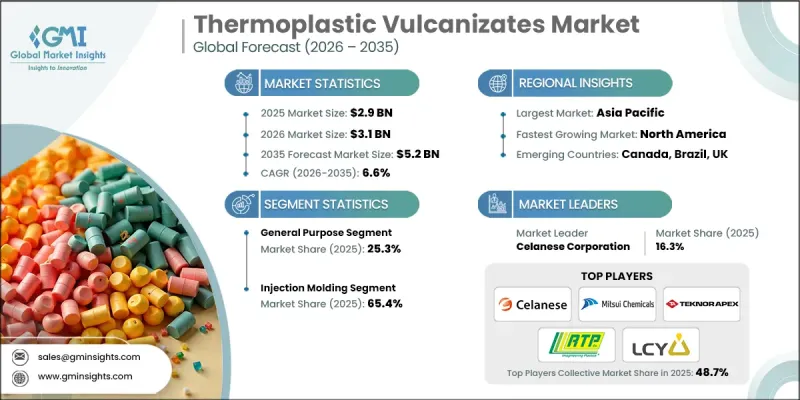
세계의 열가소성 가황 고무 시장은 2025년에 29억 달러로 평가되며, CAGR 6.6%로 성장하며, 2035년까지 52억 달러에 달할 것으로 추정되고 있습니다.
열가소성 가황 고무(TPV)는 열가소성 엘라스토머의 일종으로 고무 특유의 유연성과 탄성을 열가소성 수지의 가공상의 장점과 결합시킨 제품입니다. 이러한 독특한 특성의 조합으로 인해 다양한 산업 분야에서 이러한 재료에 대한 수요가 크게 증가하고 있습니다. TPV는 가혹한 온도 조건에서도 성능을 유지할 수 있을 뿐만 아니라 내구성과 구조적 무결성을 겸비한 것으로 알려진 합성 엘라스토머 소재입니다. 경량 소재에 대한 수요가 증가함에 따라 제조업체들은 기존의 무거운 고무 부품을 보다 진보된 폴리머 솔루션으로 대체할 것을 촉구하고 있습니다. 이 소재들은 현대 제품 디자인에 요구되는 탄성, 강도, 내구성의 바람직한 균형을 제공합니다. 또한 열가소성 가황 고무는 재가열 및 재성형이 가능하므로 기존 가황 고무에 비해 환경적 이점을 제공하여 제조업체는 생산 폐기물을 줄이고 자원 효율을 향상시킬 수 있습니다. TPV 배합의 지속적인 혁신으로 내열성, 내화학성 및 환경 노출에 대한 내성이 향상되어 그 잠재적 용도가 확대되고 있습니다. 자동차 산업은 여전히 열가소성 가황 고무의 주요 수요처이며, 제조업체들이 부품 제조의 성능, 효율성 및 지속가능성을 향상시키기 위해 첨단 소재를 점점 더 많이 채택함에 따라 예측 기간 중 시장 수요를 계속 견인할 것으로 예측됩니다.
| 시장 범위 | |
|---|---|
| 시작연도 | 2025년 |
| 예측 기간 | 2026-2035년 |
| 개시 금액 | 29억 달러 |
| 예측액 | 52억 달러 |
| CAGR | 6.6% |
2025년에는 사출성형 부문이 65.4%의 점유율을 차지했습니다. 이 가공 방법은 복잡한 고정밀 부품을 대량으로 효율적으로 생산할 수 있으므로 여전히 널리 선호되고 있습니다. 사출성형 기술은 빠른 생산 주기를 실현하는 동시에 자동화 공정을 통합하여 인건비를 절감하고 생산 효율성을 향상시킵니다. 이 기술을 통해 제조업체는 세밀한 설계와 일관된 품질 기준이 필요한 내구성 있는 부품을 생산할 수 있습니다. 산업계에서 더 높은 정밀도와 신뢰성을 갖춘 부품에 대한 수요가 계속 증가하고 있는 가운데, 사출성형은 열가소성 가황 고무(TPV) 기반 제품을 제조하는 데 있으며, 중요한 가공 방법 중 하나로 자리매김하고 있습니다.
열가소성 가황수지(TPV) 시장은 2026-2035년 연평균 복합 성장률(CAGR) 6.6%를 나타낼 것으로 예측됩니다. 이 지역 수요는 여러 산업에서 첨단 고분자 재료의 사용 확대에 의해 지원되고 있습니다. 기존 소재에 비해 재활용성이 향상되고 지속가능성 목표를 지원할 수 있으므로 제조업체들은 점차 열가소성 가황수지를 채택하고 있습니다. 내구성과 친환경성을 겸비한 이 소재의 특성은 다양한 제품 제조 공정에 도입을 촉진하고 있습니다. 친환경 소재에 대한 인식이 높아지고 산업 생산 능력의 확대와 함께 열가소성 가황수지에 대한 수요는 지속적으로 증가하고 있습니다. 주요 기업으로는 Celanese Corporation, Mitsui Chemicals, Inc., Elastron, LCY, RTP Company, FlexiShine Polyblends, SantopSeal 및 VKS Plastic Compound Private Limited를 들 수 있습니다. 열가소성 가황 고무 시장에서 활동하는 기업은 경쟁력을 강화하고 세계 입지를 확대하기 위해 몇 가지 전략적 노력에 집중하고 있습니다. 많은 조직이 재료 성능 향상, 내구성 강화 및 열가소성 가황 고무의 적용 범위 확대를 위해 연구개발에 대한 투자를 늘리고 있습니다. 폴리머 배합의 혁신을 통해 제조업체는 내열성, 화학적 안정성 및 가공 효율이 향상된 재료를 제공할 수 있게 되었습니다. 또한 기업은 공급망을 강화하고 제품 보급을 촉진하기 위해 다양한 산업 분야의 제조업체와 전략적 제휴를 맺고 있습니다. 생산능력 확대와 유통망 강화도 세계 수요 증가에 대응하기 위한 추가 전략으로 채택되고 있습니다. KK
자주 묻는 질문
목차
제1장 조사 방법과 범위
제2장 개요
제3장 업계 인사이트
제4장 경쟁 구도
제5장 시장 추산·예측 : 등급별, 2022-2035
제6장 시장 추산·예측 : 가공 방법별, 2022-2035
제7장 시장 추산·예측 : 용도별, 2022-2035
제8장 시장 추산·예측 : 지역별, 2022-2035
제9장 기업 개요
KSA 26.04.20The Global Thermoplastic Vulcanizates Market was valued at USD 2.9 billion in 2025 and is estimated to grow at a CAGR of 6.6% to reach USD 5.2 billion by 2035.
Thermoplastic vulcanizates are a specialized category of thermoplastic elastomers that combine the flexibility and resilience typically associated with rubber with the processing advantages of thermoplastics. This unique combination of characteristics has contributed significantly to the rising demand for these materials across multiple industries. TPVs are synthetic elastomer materials known for their ability to maintain performance under demanding temperature conditions while also offering durability and structural integrity. Increasing demand for lightweight materials is encouraging manufacturers to replace heavier conventional rubber components with more advanced polymer solutions. These materials provide the desired balance of elasticity, strength, and durability required in modern product designs. Thermoplastic vulcanizates also offer environmental advantages compared with traditional vulcanized rubber because they can be reheated and reshaped, allowing manufacturers to reduce production waste and improve resource efficiency. Continuous innovation in TPV formulations has resulted in improved resistance to heat, chemicals, and environmental exposure, which is expanding their potential applications. The automotive industry remains the primary consumer of thermoplastic vulcanizates and is expected to continue driving market demand throughout the forecast period as manufacturers increasingly adopt advanced materials to improve performance, efficiency, and sustainability in component manufacturing.
| Market Scope | |
|---|---|
| Start Year | 2025 |
| Forecast Year | 2026-2035 |
| Start Value | $2.9 Billion |
| Forecast Value | $5.2 Billion |
| CAGR | 6.6% |
The injection molding segment accounted for 65.4% share in 2025. This processing method remains widely preferred because it enables the efficient production of complex and high-precision components in large volumes. Injection molding technology supports rapid production cycles while incorporating automated processes that reduce labor requirements and enhance manufacturing efficiency. The technique allows manufacturers to produce durable components that require detailed designs and consistent quality standards. As industries continue to demand components with greater precision and reliability, injection molding remains a critical processing approach for producing thermoplastic vulcanizate-based products.
The thermoplastic vulcanizates segment is expected to grow at a CAGR of 6.6% between 2026 and 2035. Demand across the region is being supported by the increasing use of advanced polymer materials across several industries. Manufacturers are gradually adopting thermoplastic vulcanizates as they offer improved recyclability and support sustainability goals compared with traditional materials. The material's ability to combine durability with environmental benefits is encouraging its integration into various product manufacturing processes. Growing awareness regarding environmentally responsible materials, along with expanding industrial production capabilities, continues to strengthen demand for thermoplastic Company, Celanese Corporation, Mitsui Chemicals, Inc., Elastron, LCY, RTP Company, FlexiShine Polyblends, SantopSeal, and VKS Plastic Compound Private Limited. Companies active in the Thermoplastic Vulcanizates Market are focusing on several strategic initiatives to strengthen their competitive position and expand their global presence. Many organizations are increasing investments in research and development to improve material performance, enhance durability, and expand the application scope of thermoplastic vulcanizates. Innovation in polymer formulation is enabling manufacturers to deliver materials with improved thermal resistance, chemical stability, and processing efficiency. Businesses are also forming strategic partnerships with manufacturers across multiple industries to strengthen supply chains and increase product adoption. Expanding production capacity and enhancing distribution networks are additional strategies used to meet rising global demand. KK
Table of Contents
Chapter 1 Methodology & Scope
- 1.1 Market scope and definition
- 1.2 Research design
- 1.2.1 Research approach
- 1.2.2 Data collection methods
- 1.3 Data mining sources
- 1.3.1 Global
- 1.3.2 Regional/Country
- 1.4 Base estimates and calculations
- 1.4.1 Base year calculation
- 1.4.2 Key trends for market estimation
- 1.5 Primary research and validation
- 1.5.1 Primary sources
- 1.6 Forecast model
- 1.7 Research assumptions and limitations
Chapter 2 Executive Summary
- 2.1 Industry 360° synopsis
- 2.2 Key market trends
- 2.2.1 Regional
- 2.2.2 Grade
- 2.2.3 Processing method
- 2.2.4 Application
- 2.3 TAM Analysis, 2026-2035
- 2.4 CXO perspectives: Strategic imperatives
Chapter 3 Industry Insights
- 3.1 Industry ecosystem analysis
- 3.1.1 Supplier landscape
- 3.1.2 Profit margin
- 3.1.3 Value addition at each stage
- 3.1.4 Factor affecting the value chain
- 3.1.5 Disruptions
- 3.2 Industry impact forces
- 3.2.1 Growth drivers
- 3.2.1.1 Rising demand for sustainable and eco-friendly materials
- 3.2.1.2 Increasing applications in automotive and medical sectors
- 3.2.1.3 Advancements in material technology
- 3.2.2 Industry pitfalls and challenges
- 3.2.2.1 High production costs and raw material price volatility
- 3.2.2.2 Regulatory restrictions and compliance requirements
- 3.2.3 Market opportunities
- 3.2.3.1 Growing demand for durable and flexible materials in automotive and consumer goods
- 3.2.3.2 Increasing adoption in medical devices due to biocompatibility and sterilizability
- 3.2.1 Growth drivers
- 3.3 Growth potential analysis
- 3.4 Regulatory landscape
- 3.4.1 North America
- 3.4.2 Europe
- 3.4.3 Asia Pacific
- 3.4.4 Latin America
- 3.4.5 Middle East & Africa
- 3.5 Porter's analysis
- 3.6 PESTEL analysis
- 3.7 Price trends
- 3.7.1 By region
- 3.7.2 By grade
- 3.8 Future market trends
- 3.9 Technology and innovation landscape
- 3.9.1 Current technological trends
- 3.9.2 Emerging technologies
- 3.10 Patent Landscape
- 3.11 Trade statistics (HS code)
- 3.11.1 Major importing countries
- 3.11.2 Major exporting countries
- 3.12 Sustainability and environmental aspects
- 3.12.1 Sustainable practices
- 3.12.2 Waste reduction strategies
- 3.12.3 Energy efficiency in production
- 3.12.4 Eco-friendly initiatives
- 3.13 Carbon footprint consideration
Chapter 4 Competitive Landscape, 2025
- 4.1 Introduction
- 4.2 Company market share analysis
- 4.2.1 By region
- 4.2.1.1 North America
- 4.2.1.2 Europe
- 4.2.1.3 Asia Pacific
- 4.2.1.4 LATAM
- 4.2.1.5 MEA
- 4.2.1 By region
- 4.3 Competitive analysis of major market players
- 4.4 Competitive positioning matrix
- 4.5 Key developments
- 4.5.1 Mergers & acquisitions
- 4.5.2 Partnerships & collaborations
- 4.5.3 New Product Launches
- 4.5.4 Expansion Plans
Chapter 5 Market Estimates and Forecast, By Grade, 2022-2035 (USD Billion) (Kilo Tons)
- 5.1 Key trends
- 5.2 General purpose
- 5.3 Medical
- 5.4 UV stabilized grade
- 5.5 Flame retardant grade
- 5.6 Bonding TPV
- 5.7 Lubricated TPV
- 5.8 Others
Chapter 6 Market Estimates and Forecast, By Processing Method, 2022-2035 (USD Billion) (Kilo Tons)
- 6.1 Key trends
- 6.2 Injection molding
- 6.3 Extrusion
- 6.4 Blow molding
- 6.5 Calendaring
- 6.6 Others
Chapter 7 Market Estimates and Forecast, By Application, 2022-2035 (USD Billion) (Kilo Tons)
- 7.1 Key trends
- 7.2 Automotive parts
- 7.2.1 Sealing systems
- 7.2.2 Under-hood components
- 7.2.3 Electric vehicle (EV) components
- 7.2.4 Steering & suspension
- 7.2.5 Interior & exterior components
- 7.2.6 Others
- 7.3 Consumer products
- 7.3.1 Footwear
- 7.3.2 Sporting goods
- 7.3.3 Personal care
- 7.3.4 Household products
- 7.3.5 Others
- 7.4 Construction material
- 7.4.1 Sealing & waterproofing
- 7.4.2 Roofing & membranes
- 7.4.3 Plumbing & drainage
- 7.5 Industrial applications
- 7.6 Electrical wire/cables
- 7.7 Medical devices
- 7.8 Others
Chapter 8 Market Estimates and Forecast, By Region, 2022-2035 (USD Billion) (Kilo Tons)
- 8.1 Key trends
- 8.2 North America
- 8.2.1 U.S.
- 8.2.2 Canada
- 8.3 Europe
- 8.3.1 Germany
- 8.3.2 UK
- 8.3.3 France
- 8.3.4 Spain
- 8.3.5 Italy
- 8.3.6 Rest of Europe
- 8.4 Asia Pacific
- 8.4.1 China
- 8.4.2 India
- 8.4.3 Japan
- 8.4.4 Australia
- 8.4.5 South Korea
- 8.4.6 Rest of Asia Pacific
- 8.5 Latin America
- 8.5.1 Brazil
- 8.5.2 Mexico
- 8.5.3 Argentina
- 8.5.4 Rest of Latin America
- 8.6 Middle East and Africa
- 8.6.1 Saudi Arabia
- 8.6.2 South Africa
- 8.6.3 UAE
- 8.6.4 Rest of Middle East and Africa
Chapter 9 Company Profiles
- 9.1 Apar Industries
- 9.2 Celanese Corporation
- 9.3 Elastron
- 9.4 Elastron Kimya Sanayi Ticaret A.S
- 9.5 FlexiShine Polyblends
- 9.6 LCY
- 9.7 Mitsui Chemicals, Inc.
- 9.8 RTP Company
- 9.9 SantopSeal
- 9.10 Teknor Apex