
|
시장보고서
상품코드
1998726
자동차용 피스톤 핀 시장 기회, 성장요인, 업계 동향 분석 및 예측(2026-2035년)Automotive Piston Pin Market Opportunity, Growth Drivers, Industry Trend Analysis, and Forecast 2026 - 2035 |
||||||

세계의 자동차용 피스톤 핀 시장은 2025년에 5억 3,130만 달러로 평가되며, CAGR 5.1%로 성장하며, 2035년까지 8억 7,440만 달러에 달할 것으로 추정되고 있습니다.
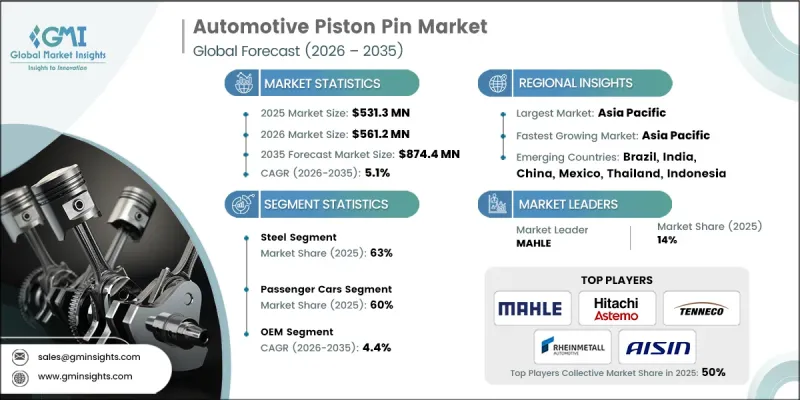
피스톤 핀은 피스톤과 커넥팅로드를 연결하고 연소에 의한 힘을 크랭크샤프트에 전달하는 엔진에 있으며, 매우 중요한 부품입니다. 이 시장은 승용차와 상용차 모두에서 엔진의 내구성 향상, 연비 개선 및 성능 향상에 대한 수요에 힘입어 지속적으로 확대되고 있습니다. 현대의 피스톤 핀 설계는 고성능 합금강, 다이아몬드 유사 탄소(DLC) 코팅 및 정밀 가공 기술을 활용하여 높은 기계적 및 열적 하중을 견딜 수 있도록 설계되었습니다. 야금 공정, 표면 처리, 경량화 설계의 혁신을 통해 기존 솔리드 핀은 중공형, 코팅형, 초강력형으로 변모하여 마찰 감소, 내마모성 향상 및 더 높은 엔진 회전수를 실현할 수 있도록 지원합니다. 세계 자동차 생산량 증가, 저연비 엔진의 보급, 엄격한 배기가스 규제, 하이브리드 및 터보차저 장착 파워트레인의 성장이 시장의 지속적인 성장을 촉진하는 주요 요인으로 작용하고 있습니다. 상용차 교체 부품 부문도 고품질 피스톤 핀에 대한 안정적인 수요에 기여하고 있습니다.
| 시장 범위 | |
|---|---|
| 시작연도 | 2025년 |
| 예측 기간 | 2026-2035년 |
| 개시 금액 | 5억 3,130만 달러 |
| 예측액 | 8억 7,440만 달러 |
| CAGR | 5.1% |
이 시장은 OEM 및 Tier 1 엔진 부품 제조업체에 공급되는 중실 및 중공 피스톤 핀, 코팅 제품, 경량 고강도 강종 및 정밀 가공된 핀으로 구성됩니다. 기술의 발전으로 시장은 마찰을 최소화하고 엔진의 수명을 연장하며 높은 연소 압력을 견딜 수 있는 중공 및 표면 처리된 설계로 전환하고 있습니다. 이러한 혁신은 피스톤 핀이 더 높은 기계적 및 열적 스트레스를 견뎌야 하는 다운사이징 및 터보차저 엔진에서 특히 중요합니다.
2025년에는 철강 부문이 63%의 점유율을 차지하며, 2026-2035년 연평균 복합 성장률(CAGR) 4.5%를 나타낼 것으로 예측됩니다. 강재는 강도, 내구성, 비용 효율성, 그리고 확립된 제조 공정을 결합하여 시장에서 선도적인 위치를 유지하고 있습니다. SAE 8620, SAE 52100과 같은 고탄소강 합금은 열처리 후 1,000 MPa 이상의 인장강도와 58-62 HRC의 경도를 달성하여 내연기관에서의 신뢰성을 확보하고 있습니다. 내구성과 비용에 대한 고려가 경량화에 대한 요구를 능가하는 상용차에서 스틸 피스톤 핀은 여전히 선호되는 선택입니다.
승용차 부문은 2025년 60%의 점유율을 차지하며, 2035년까지 연평균 복합 성장률(CAGR) 4.2%로 성장할 것으로 전망됩니다. 이 부문에는 총 차량 무게가 6,000파운드 미만인 세단, 해치백, SUV, 크로스오버가 포함됩니다. 승용차용 피스톤 핀은 15만-20만 마일의 일반적인 주행거리를 반영하여 경량화, 마찰 감소, 성능 개선에 중점을 두고 궁극적인 내구성보다 경량화, 마찰 감소, 성능 개선을 우선시합니다. 알루미늄 합금과 첨단 코팅, 특히 DLC(다이아몬드와 같은 탄소)가 점점 더 많이 채택되고 있으며, 프리미엄 부문에서는 DLC의 보급률이 50%를 초과하여 내마모성과 성능을 향상시키고 있습니다.
중국의 자동차 피스톤 핀 시장은 2025년에 375억 달러 규모에 달할 것으로 예상되며, 2026-2035년 연평균 4.3%의 연평균 복합 성장률(CAGR)을 유지할 것으로 예측됩니다. 중국의 탄탄한 자동차 제조거점, 광범위한 공급망 관리, 배터리 생산 및 원자재 조달의 수직적 통합을 통해 비용을 절감하고 해외 공급업체에 대한 의존도를 낮출 수 있습니다. 승용차 및 상용차 생산 증가와 고성능 내연기관 및 하이브리드 파워트레인 부품에 대한 수요 증가는 이 지역의 지속적인 성장을 촉진하고 있습니다. 중국의 상용차 부문, 특히 인프라 개발 및 화물 물류를 지원하는 대형 트럭은 디젤 엔진 부품 및 피스톤 핀에 대한 지속적인 수요를 보장합니다. 또한 지역 제조업체들도 틈새 시장으로 진출하여 시장에서의 경쟁과 혁신을 촉진하고 있습니다.
자주 묻는 질문
목차
제1장 조사 방법
제2장 개요
제3장 업계 인사이트
제4장 경쟁 구도
제5장 시장 추산·예측 : 재료별, 2022-2035
제6장 시장 추산·예측 : 코팅별, 2022-2035
제7장 시장 추산·예측 : 차량별, 2022-2035
제8장 시장 추산·예측 : 연료별, 2022-2035
제9장 시장 추산·예측 : 판매 채널별, 2022-2035
제10장 시장 추산·예측 : 지역별, 2022-2035
제11장 기업 개요
KSA 26.04.20The Global Automotive Piston Pin Market was valued at USD 531.3 million in 2025 and is estimated to grow at a CAGR of 5.1% to reach USD 874.4 million by 2035.
Piston pins, also referred to as gudgeon pins, are critical engine components that link pistons to connecting rods, transferring combustion forces to the crankshaft. The market is increasingly driven by demand for higher engine durability, improved fuel efficiency, and enhanced performance in both passenger and commercial vehicles. Modern piston pin designs leverage high-performance alloy steels, diamond-like carbon (DLC) coatings, and precision machining to withstand high mechanical and thermal loads. Innovations in metallurgical processes, surface treatments, and lightweight design have transformed conventional solid pins into hollow, coated, and ultra-strong variants, reducing friction, boosting wear resistance, and supporting higher engine speeds. Rising global vehicle production, adoption of fuel-efficient engines, stringent emission standards, and growth in hybrid and turbocharged powertrains are major factors driving sustained market expansion. The commercial vehicle replacement segment also contributes to consistent demand for high-quality piston pins.
| Market Scope | |
|---|---|
| Start Year | 2025 |
| Forecast Year | 2026-2035 |
| Start Value | $531.3 Million |
| Forecast Value | $874.4 Million |
| CAGR | 5.1% |
The market comprises solid and hollow piston pins, coated variants, lightweight high-strength steel grades, and precision-finished pins supplied to OEMs and Tier 1 engine component manufacturers. Technological advances are shifting the market toward hollow and surface-treated designs, which minimize friction, extend engine life, and handle elevated combustion pressures. These innovations are especially relevant for downsized and turbocharged engines, where piston pins must sustain higher mechanical and thermal stresses.
The steel segment held a 63% share in 2025 and is expected to grow at a CAGR of 4.5% from 2026 to 2035. Steel retains market leadership due to its combination of strength, durability, cost efficiency, and established manufacturing processes. High-carbon steel alloys such as SAE 8620 and SAE 52100, after heat treatment, achieve tensile strengths exceeding 1,000 MPa and hardness levels of 58-62 HRC, ensuring reliability in internal combustion engines. Steel piston pins remain the preferred choice for commercial vehicles where durability and cost considerations outweigh weight reduction imperatives.
The passenger cars segment accounted for 60% share in 2025, growing at a CAGR of 4.2% through 2035. These vehicles include sedans, hatchbacks, SUVs, and crossovers under 6,000 pounds gross vehicle weight. Piston pins for passenger cars prioritize lightweight materials, friction reduction, and refinement rather than ultimate durability, reflecting typical service cycles of 150,000-200,000 miles. Aluminum alloys and advanced coatings, particularly DLC, are increasingly used, with DLC penetration exceeding 50% in premium segments, offering enhanced wear resistance and performance.
China Automotive Piston Pin Market accounted for USD 37.5 billion in 2025 and is forecasted to maintain a CAGR of 4.3% from 2026 to 2035. Its robust automotive manufacturing base, extensive supply chain control, and vertical integration of battery production and raw material sourcing reduce costs and reliance on international suppliers. Rising production of both passenger and commercial vehicles, combined with demand for high-performance internal combustion and hybrid powertrain components, fuels sustained growth in the region. China's commercial vehicle sector, particularly heavy-duty trucks supporting infrastructure development and freight logistics, ensures continuous demand for diesel engine components and piston pins. Regional manufacturers are also expanding into niche segments, increasing competition and innovation in the market.
Major players operating in the Global Automotive Piston Pin Market include Hitachi Astemo, Burgess-Norton, Kolbenschmidt Pistons, Aisin Seiki, Shriram Pistons & Rings, Art Metal, MAHLE, Elgin Industries, Bohai Piston, and Tenneco. Companies in the Global Automotive Piston Pin Market focus on strategies such as research and development of lightweight, hollow, and coated pins, integration of advanced alloy steels, and development of DLC and other surface treatments to enhance performance. Expanding production capacity and establishing localized manufacturing hubs in high-growth regions, particularly Asia-Pacific, helps reduce costs and improve supply chain reliability. Strategic collaborations with OEMs and Tier 1 engine manufacturers allow firms to integrate their components into new vehicle models early in the design process. Mergers, acquisitions, and partnerships also help companies expand technological capabilities and product portfolios, while aftermarket and replacement-focused strategies ensure recurring revenue streams. Additionally, marketing initiatives highlighting enhanced fuel efficiency, reduced wear, and engine longevity help strengthen brand recognition and market penetration.
Table of Contents
Chapter 1 Methodology
- 1.1 Research approach
- 1.2 Quality commitments
- 1.3 Research trail and confidence scoring
- 1.3.1 Research trail components
- 1.3.2 Scoring components
- 1.4 Data collection
- 1.4.1 Partial list of primary sources
- 1.5 Data mining sources
- 1.5.1 Paid sources
- 1.6 Best estimates and calculations
- 1.6.1 Base year calculation for any one approach
- 1.7 Forecast model
- 1.8 Research transparency addendum
Chapter 2 Executive Summary
- 2.1 Industry 360° synopsis, 2022 - 2035
- 2.2 Key market trends
- 2.2.1 Regional
- 2.2.2 Material
- 2.2.3 Coating
- 2.2.4 Vehicle
- 2.2.5 Fuel
- 2.2.6 Sales Channel
- 2.3 TAM Analysis, 2026-2035
- 2.4 CXO perspectives: Strategic imperatives
Chapter 3 Industry Insights
- 3.1 Industry ecosystem analysis
- 3.1.1 Supplier landscape
- 3.1.2 Profit margin analysis
- 3.1.3 Cost structure
- 3.1.4 Value addition at each stage
- 3.1.5 Factor affecting the value chain
- 3.1.6 Disruptions
- 3.2 Industry impact forces
- 3.2.1 Growth drivers
- 3.2.1.1 Growing global automotive production and vehicle parc expansion
- 3.2.1.2 Increasing demand for fuel-efficient and lightweight engine components
- 3.2.1.3 Rising aftermarket demand driven by vehicle aging and maintenance cycles
- 3.2.1.4 Technological advancements in coating technologies (DLC, PVD)
- 3.2.1.5 Stringent emission regulations driving engine efficiency improvements
- 3.2.2 Industry pitfalls and challenges
- 3.2.2.1 High raw material costs and price volatility of specialty alloys
- 3.2.2.2 Shift toward electric vehicles reducing ICE component demand
- 3.2.2.3 Complex manufacturing requirements and quality control challenges
- 3.2.2.4 Design constraints and pin distortion issues in high-performance applications
- 3.2.3 Market opportunities
- 3.2.3.1 Development of advanced composite and exotic alloy materials
- 3.2.3.2 Expansion in emerging markets with growing vehicle production
- 3.2.3.3 Increasing adoption of hybrid powertrains extending ICE component demand
- 3.2.3.4 Growing performance and racing segment requiring premium products
- 3.2.3.5 Digitalization and smart manufacturing reducing production costs
- 3.2.1 Growth drivers
- 3.3 Growth potential analysis
- 3.4 Regulatory landscape
- 3.4.1 North America
- 3.4.1.1 US- EPA GHG phase 3 & CAFE standards
- 3.4.1.2 Canada - Emissions-based regulatory framework
- 3.4.2 Europe
- 3.4.2.1 Germany- Euro 7 Emission Standards
- 3.4.2.2 UK- Post-brexit vehicle type approval
- 3.4.2.3 France- Decarbonization roadmap
- 3.4.2.4 Italy- Low-Emission zone compliance
- 3.4.3 Asia Pacific
- 3.4.3.1 China- China VI-b & Emerging China VII standards
- 3.4.3.2 India- BS-VI Stage II & bharat stage VII transition
- 3.4.3.3 Japan- Fuel efficiency standards (2030 Targets)
- 3.4.3.4 Australia- Fuel quality & ADR 79/05 standards
- 3.4.4 LATAM
- 3.4.4.1 Mexico- NOM-194-SE-2021 & USMCA rules of origin
- 3.4.4.2 Argentina- Law 24.449 & environmental amendments
- 3.4.5 MEA
- 3.4.5.1 South Africa- National road traffic act (1996)
- 3.4.5.2 Saudi Arabia- Traffic law & vision 2030 transport initiatives
- 3.4.1 North America
- 3.5 Porter's analysis
- 3.6 PESTEL analysis
- 3.7 Technology and innovation landscape
- 3.7.1 Current technological trends
- 3.7.2 Emerging technologies
- 3.8 Patent landscape (Driven by Primary Research)
- 3.9 Pricing analysis
- 3.9.1 Historical price trend analysis
- 3.9.2 Pricing strategy by player type (premium / value / cost-plus)
- 3.9.3 Total cost of ownership (TCO) analysis
- 3.10 Trade data analysis (Driven by Paid Database)
- 3.10.1 Import/export volume & value trends
- 3.10.2 Key trade corridors & tariff impact
- 3.11 Use cases & success stories
- 3.12 Impact of AI & generative AI on the market
- 3.12.1 AI-driven disruption of existing business models
- 3.12.2 GenAI use cases & adoption roadmap by segment
- 3.12.3 Risks, limitations & regulatory considerations
- 3.13 Capacity & production landscape (Driven by Primary Research)
- 3.13.1 Installed capacity by region & key producer
- 3.13.2 Capacity utilization rates & expansion pipelines
- 3.14 Sustainability and environmental aspects
- 3.14.1 Sustainable practices
- 3.14.2 Waste reduction strategies
- 3.14.3 Energy efficiency in production
- 3.14.4 Eco-friendly Initiatives
- 3.14.5 Carbon footprint considerations
- 3.15 Forecast assumptions & scenario analysis (Driven by Primary Research)
- 3.15.1 Base Case - key macro & industry variables driving CAGR
- 3.15.2 Optimistic Scenarios - Favorable macro and industry tailwinds
- 3.15.3 Pessimistic Scenario - Macroeconomic slowdown or industry headwinds
Chapter 4 Competitive Landscape, 2025
- 4.1 Introduction
- 4.2 Company market share analysis
- 4.2.1 North America
- 4.2.2 Europe
- 4.2.3 Asia Pacific
- 4.2.4 LATAM
- 4.2.5 MEA
- 4.3 Competitive analysis of major market players
- 4.4 Competitive positioning matrix
- 4.5 Company Tier Benchmarking
- 4.5.1 Tier Classification Criteria & Qualifying Thresholds
- 4.5.2 Tier Positioning Matrix by Revenue, Geography & Innovation
- 4.6 Key developments
- 4.6.1 Mergers & acquisitions
- 4.6.2 Partnerships & collaborations
- 4.6.3 New product launches
- 4.6.4 Expansion plans and funding
Chapter 5 Market Estimates & Forecast, By Material, 2022 - 2035 ($Mn, Units)
- 5.1 Key trends
- 5.2 Steel
- 5.3 Aluminum alloy
- 5.4 Titanium alloy
Chapter 6 Market Estimates & Forecast, By Coating, 2022 - 2035 ($Mn, Units)
- 6.1 Key trends
- 6.2 Diamond-Like Carbon (DLC)
- 6.3 Physical Vapor Deposition (PVD)
- 6.4 Others
Chapter 7 Market Estimates & Forecast, By Vehicle, 2022 - 2035 ($Mn, Units)
- 7.1 Key trends
- 7.2 Passenger cars
- 7.2.1 Hatchback
- 7.2.2 Sedan
- 7.2.3 SUV
- 7.3 Commercial vehicles
- 7.3.1 Light commercial vehicles (LCVs)
- 7.3.2 Medium commercial vehicles (MCVs)
- 7.3.3 Heavy commercial vehicles (HCVs)
Chapter 8 Market Estimates & Forecast, By Fuel, 2022 - 2035 ($Mn, Units)
- 8.1 Key trends
- 8.2 Gasoline engines
- 8.3 Diesel engines
- 8.4 Alternative fuel engines
Chapter 9 Market Estimates & Forecast, By Sales Channel, 2022 - 2035 ($Mn, Units)
- 9.1 Key trends
- 9.2 OEM
- 9.3 Aftermarket
Chapter 10 Market Estimates & Forecast, By Region, 2022 - 2035 ($Bn)
- 10.1 Key trends
- 10.2 North America
- 10.2.1 US
- 10.2.2 Canada
- 10.3 Europe
- 10.3.1 Germany
- 10.3.2 UK
- 10.3.3 France
- 10.3.4 Italy
- 10.3.5 Spain
- 10.3.6 Russia
- 10.3.7 Netherlands
- 10.3.8 Sweden
- 10.3.9 Denmark
- 10.3.10 Poland
- 10.4 Asia Pacific
- 10.4.1 China
- 10.4.2 India
- 10.4.3 Japan
- 10.4.4 Australia
- 10.4.5 South Korea
- 10.4.6 Singapore
- 10.4.7 Thailand
- 10.4.8 Indonesia
- 10.4.9 Vietnam
- 10.5 Latin America
- 10.5.1 Brazil
- 10.5.2 Mexico
- 10.5.3 Argentina
- 10.5.4 Colombia
- 10.6 MEA
- 10.6.1 South Africa
- 10.6.2 Saudi Arabia
- 10.6.3 UAE
- 10.6.4 Israel
Chapter 11 Company Profiles
- 11.1 Global Players
- 11.1.1 Aisin Seiki
- 11.1.2 Art Metal
- 11.1.3 Burgess-Norton
- 11.1.4 Elgin Industries
- 11.1.5 Hitachi Astemo
- 11.1.6 MAHLE
- 11.1.7 Tenneco
- 11.2 Regional Players
- 11.2.1 Arias Pistons
- 11.2.2 Bohai Piston
- 11.2.3 Chuxiong Piston Pin
- 11.2.4 CP-Carrillo
- 11.2.5 JE Pistons
- 11.2.6 Kolbenschmidt Pistons (Comitans Capital)
- 11.2.7 Ming Shun Industrial
- 11.2.8 Ross Racing Pistons
- 11.2.9 Shriram Pistons & Rings
- 11.3 Emerging Players
- 11.3.1 Art-Serina Piston
- 11.3.2 Garima Global
- 11.3.3 Hai Yen Industrial
- 11.3.4 Power Industries