

|
시장보고서
상품코드
1998752
아마씨 제품 시장 기회, 성장요인, 업계 동향 분석 및 예측(2026-2035년)Flaxseed Products Market Opportunity, Growth Drivers, Industry Trend Analysis, and Forecast 2026 - 2035 |
||||||

세계의 아마씨 제품 시장은 2025년에 45억 달러로 평가되며, CAGR 4.9%로 성장하며, 2035년까지 73억 달러에 달할 것으로 추정되고 있습니다.
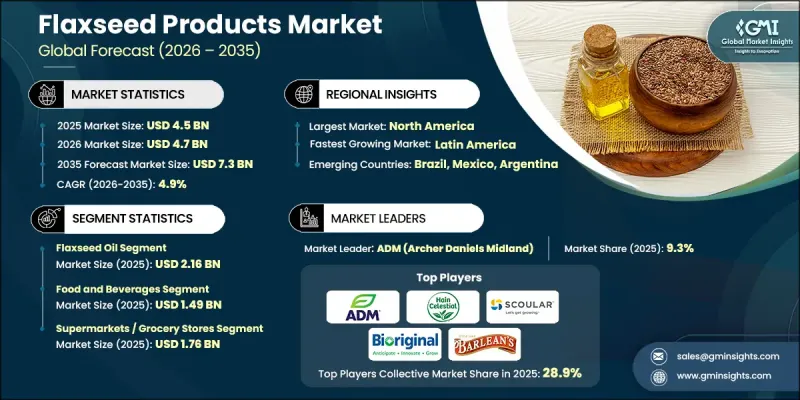
세계에서 식물성 영양에 대한 수요가 지속적으로 증가함에 따라 이 산업은 꾸준히 발전하고 있습니다. 비건과 지속가능한 라이프스타일을 추구하는 소비자들은 오메가 3 지방산이 풍부하고 단백질 함량이 높은 아마씨를 식단에 추가하는 경향이 증가하고 있습니다. 이러한 영양학적 매력으로 인해 아마씨는 다양한 식품 및 음료 카테고리에서 선호되는 원료로 자리매김하고 있습니다. 또한 아마인유는 심장 건강 유지와 염증 관리에 기여하는 것으로 알려지면서 기능성 식품 및 건강기능식품 분야에서의 역할이 강화되고 있습니다. 각 제조업체들은 클린 라벨과 식물성 원료에 대한 높아진 기대에 부응하기 위해 아마 유래 성분을 혁신적인 배합에 적극적으로 도입하고 있습니다. 식품 용도뿐만 아니라 퍼스널케어 분야에서도 아마 추출물의 항산화 작용과 컨디셔닝 효과에 대한 가치가 인정받고 있습니다. 선진국과 신흥 국가 모두에서 소화기 건강과 심혈관 건강에 대한 인식이 높아지면서 세계 수요가 지속적으로 확대되고 있습니다. 투명성과 천연 원료에 대한 소비자의 관심이 높아짐에 따라 아마 제품 시장은 장기적인 성장 모멘텀을 유지하고 있습니다.
| 시장 범위 | |
|---|---|
| 시작연도 | 2025 |
| 예측 기간 | 2026-2035년 |
| 개시 금액 | 45억 달러 |
| 예측액 | 73억 달러 |
| CAGR | 4.9% |
아마인유 부문은 2025년 21억 6,000만 달러의 시장 규모를 기록했습니다. 오메가 3 지방산이 풍부하게 함유되어 있으며, 뉴트리슈티컬 및 기능성 제품 개발에서 그 매력이 높아지면서 이 부문에 대한 수요가 확대되고 있습니다. 또한 아마씨 분말은 풍부한 식이섬유와 단백질을 함유하고 있으며, 클린 라벨 배합 동향에 부합하므로 특히 곡물 기반 제품 제조에서 빠르게 채택되고 있습니다.
슈퍼마켓 및 식료품점 부문은 2025년 17억 6,000만 달러를 차지했습니다. 이들 소매점은 다양한 제품 라인과 소비자 편의성을 제공하며, 아마씨 제품을 구매하는 주요 장소로 자리매김하고 있습니다. 편의점 등 소매 채널도 매출에 지속적으로 기여하고 있지만, 그 유형은 상대적으로 제한적입니다. 한편, 디지털 커머스 플랫폼은 식물성 식품을 찾는 건강 지향적 쇼핑객을 끌어들이고 있으며, 택배 및 정기 구매 모델이 꾸준히 인기를 끌고 있습니다.
북미 아마씨 제품 시장은 2025년 14억 9,000만 달러에서 2035년까지 23억 5,000만 달러로 성장할 것으로 예상되며, 이는 이 지역 전체에서 유망한 성장세를 반영하고 있습니다. 기능성 영양과 식물성 식습관에 대한 소비자의 관심이 높아지면서 지역 수요를 견인하고 있습니다. 미국에서는 예방적 건강 솔루션과 클린 라벨 원료에 대한 소비자의 선호에 힘입어 아마씨 오일, 아마씨 분말 및 관련 파생 제품이 식품 응용 분야와 건강 보조 식품 배합에 점점 더 많이 사용되고 있습니다.
자주 묻는 질문
목차
제1장 조사 방법과 범위
제2장 개요
제3장 업계 인사이트
제4장 경쟁 구도
제5장 시장 추산·예측 : 유형별, 2022-2035
제6장 시장 추산·예측 : 용도별, 2022-2035
제7장 시장 추산·예측 : 유통 채널별, 2022-2035
제8장 시장 추산·예측 : 지역별, 2022-2035
제9장 기업 개요
KSA 26.04.20The Global Flaxseed Products Market was valued at USD 4.5 billion in 2025 and is estimated to grow at a CAGR of 4.9% to reach USD 7.3 billion by 2035.
The industry is advancing steadily as demand for plant-based nutrition continues to accelerate worldwide. Consumers embracing vegan and sustainable lifestyles are increasingly incorporating flaxseed into their diets due to its rich omega-3 fatty acid content and strong protein profile. This nutritional appeal is positioning flaxseed as a preferred ingredient across a broad range of food and beverage categories. In addition, flaxseed oil is gaining recognition for its contribution to heart health support and inflammation management, strengthening its role in the functional food and dietary supplement segments. Manufacturers are actively integrating flaxseed derivatives into innovative formulations to meet rising expectations for clean-label and plant-based ingredients. Beyond food applications, the personal care sector is also recognizing the value of flaxseed extracts for their antioxidant and conditioning properties. Growing awareness of digestive wellness and cardiovascular health across both developed and emerging economies is reinforcing consistent global demand. As consumer focus on transparency and naturally sourced ingredients intensifies, the flaxseed product market continues to build long-term growth momentum.
| Market Scope | |
|---|---|
| Start Year | 2025 |
| Forecast Year | 2026-2035 |
| Start Value | $4.5 Billion |
| Forecast Value | $7.3 Billion |
| CAGR | 4.9% |
The flaxseed oil segment generated USD 2.16 billion in 2025. Demand for this segment is expanding due to its high concentration of omega-3 fatty acids, which enhances its appeal in nutraceutical and functional product development. Flaxseed meal is also witnessing strong adoption, particularly within grain-based product manufacturing, as it delivers substantial fiber and protein content while aligning with clean-label formulation trends.
The supermarkets and grocery stores segment accounted for USD 1.76 billion in 2025. These retail outlets remain the primary purchasing destination for flaxseed-based products, offering broad product availability and consumer accessibility. Convenience retail channels continue to contribute to sales, although their assortments are comparatively narrower. At the same time, digital commerce platforms are attracting health-focused shoppers seeking plant-based options, with home delivery and subscription purchasing models gaining consistent traction.
North America Flaxseed Products Market is forecast to grow from USD 1.49 billion in 2025 to USD 2.35 billion by 2035, reflecting promising expansion across the region. Rising consumer emphasis on functional nutrition and plant-forward eating habits is fueling regional demand. In the United States, flaxseed oil, flaxseed meal, and related derivatives are increasingly incorporated into food applications and dietary formulations, supported by consumer preference for preventive wellness solutions and clean-label ingredients.
Key participants in the Global Flaxseed Products Market include Barlean's, Hain Celestial, ADM, AgMotion, AG Organica, Bioriginal, Connoils, Fengchen, GFR Ingredients, Linwoods Health Foods, Scoular, Silverline Chemicals, and Spack International. Companies operating in the Global Flaxseed Products Market are reinforcing their competitive position through innovation, supply chain integration, and strategic expansion. Industry leaders are investing in research and development to introduce high-purity flaxseed oils, specialty ingredients, and value-added formulations that meet evolving consumer expectations. Partnerships with food manufacturers and nutraceutical brands are strengthening distribution networks and broadening application areas. Firms are also expanding processing capacities to ensure consistent quality and traceability. Geographic diversification into high-growth regions is enabling companies to capture emerging demand.
Table of Contents
Chapter 1 Methodology & Scope
- 1.1 Market scope and definition
- 1.2 Research design
- 1.2.1 Research approach
- 1.2.2 Data collection methods
- 1.3 Data mining sources
- 1.3.1 Global
- 1.3.2 Regional/Country
- 1.4 Base estimates and calculations
- 1.4.1 Base year calculation
- 1.4.2 Key trends for market estimation
- 1.5 Primary research and validation
- 1.5.1 Primary sources
- 1.6 Forecast model
- 1.7 Research assumptions and limitations
Chapter 2 Executive Summary
- 2.1 Industry 360° synopsis
- 2.2 Key market trends
- 2.2.1 Type
- 2.2.2 Application
- 2.2.3 Distribution Channel
- 2.2.4 Regional
- 2.3 TAM Analysis, 2026-2035
- 2.4 CXO perspectives: Strategic imperatives
- 2.5 Future outlook and strategic recommendations
Chapter 3 Industry Insights
- 3.1 Industry ecosystem analysis
- 3.1.1 Supplier landscape
- 3.1.2 Profit margin
- 3.1.3 Value addition at each stage
- 3.1.4 Factor affecting the value chain
- 3.1.5 Disruptions
- 3.2 Industry impact forces
- 3.2.1 Growth drivers
- 3.2.1.1 Rising demand for plant-based foods
- 3.2.1.2 Increasing health consciousness
- 3.2.1.3 Versatility in food products
- 3.2.2 Industry pitfalls and challenges
- 3.2.2.1 Digestive discomfort
- 3.2.2.2 Oxidation and rancidity
- 3.2.3 Market opportunities
- 3.2.3.1 Expansion into functional foods
- 3.2.3.2 Growing demand for sustainable ingredients
- 3.2.3.3 Health and wellness trends
- 3.2.1 Growth drivers
- 3.3 Growth potential analysis
- 3.4 Regulatory landscape
- 3.4.1 North America
- 3.4.2 Europe
- 3.4.3 Asia Pacific
- 3.4.4 Latin America
- 3.4.5 Middle East & Africa
- 3.5 Porter's analysis
- 3.6 PESTEL analysis
- 3.7 Technology and innovation landscape
- 3.7.1 Current technological trends
- 3.7.2 Emerging technologies
- 3.8 Price trends
- 3.8.1 By region
- 3.8.2 By type
- 3.9 Future market trends
- 3.10 Technology and innovation landscape
- 3.10.1 Current technological trends
- 3.10.2 Emerging technologies
- 3.11 Patent landscape
- 3.12 Trade statistics (HS code)
- 3.12.1 Major importing countries
- 3.12.2 Major exporting countries
- 3.13 Sustainability and environmental aspects
- 3.13.1 Sustainable practices
- 3.13.2 Waste reduction strategies
- 3.13.3 Energy efficiency in production
- 3.13.4 Eco-friendly initiatives
- 3.14 Carbon footprint consideration
Chapter 4 Competitive Landscape, 2025
- 4.1 Introduction
- 4.2 Company market share analysis
- 4.2.1 By region
- 4.2.1.1 North America
- 4.2.1.2 Europe
- 4.2.1.3 Asia Pacific
- 4.2.1.4 LATAM
- 4.2.1.5 MEA
- 4.2.1 By region
- 4.3 Company matrix analysis
- 4.4 Competitive analysis of major market players
- 4.5 Competitive positioning matrix
- 4.6 Key developments
- 4.6.1 Mergers & acquisitions
- 4.6.2 Partnerships & collaborations
- 4.6.3 New product launches
- 4.6.4 Expansion plans
Chapter 5 Market Estimates and Forecast, By Type, 2022-2035 (USD Billion) (Kilo Tons)
- 5.1 Key trends
- 5.2 Flaxseed oil
- 5.3 Flaxseed meal
- 5.4 Flaxseed flour
- 5.5 Flaxseed flakes
- 5.6 Others
Chapter 6 Market Estimates and Forecast, By Application, 2022-2035 (USD Billion) (Kilo Tons)
- 6.1 Key trends
- 6.2 Food and beverages
- 6.3 Dietary supplements
- 6.4 Cosmetics and personal care
- 6.5 Pharmaceuticals
- 6.6 Animal feed
- 6.7 Others
Chapter 7 Market Estimates and Forecast, By Distribution Channel, 2022-2035 (USD Billion) (Kilo Tons)
- 7.1 Key trends
- 7.2 Supermarkets / Grocery stores
- 7.3 Convenience stores
- 7.4 Online marketplaces
- 7.5 Direct sales / Brand website
- 7.6 Wholesale distributors
- 7.7 Others
Chapter 8 Market Estimates and Forecast, By Region, 2022-2035 (USD Billion) (Kilo Tons)
- 8.1 Key trends
- 8.2 North America
- 8.2.1 U.S.
- 8.2.2 Canada
- 8.3 Europe
- 8.3.1 Germany
- 8.3.2 UK
- 8.3.3 France
- 8.3.4 Spain
- 8.3.5 Italy
- 8.3.6 Rest of Europe
- 8.4 Asia Pacific
- 8.4.1 China
- 8.4.2 India
- 8.4.3 Japan
- 8.4.4 Australia
- 8.4.5 South Korea
- 8.4.6 Rest of Asia Pacific
- 8.5 Latin America
- 8.5.1 Brazil
- 8.5.2 Mexico
- 8.5.3 Argentina
- 8.5.4 Rest of Latin America
- 8.6 Middle East and Africa
- 8.6.1 Saudi Arabia
- 8.6.2 South Africa
- 8.6.3 UAE
- 8.6.4 Rest of Middle East and Africa
Chapter 9 Company Profiles
- 9.1 ADM
- 9.2 AG Organica
- 9.3 AgMotion
- 9.4 Barlean's
- 9.5 Bioriginal
- 9.6 Connoils
- 9.7 Fengchen
- 9.8 GFR Ingredients
- 9.9 Hain Celestial
- 9.10 Linwoods Health Foods
- 9.11 Scoular
- 9.12 Silverline Chemicals
- 9.13 Spack International


