
|
시장보고서
상품코드
1998756
산업용 가스 레귤레이터 시장 기회, 성장요인, 업계 동향 분석 및 예측(2026-2035년)Industrial Gas Regulator Market Opportunity, Growth Drivers, Industry Trend Analysis, and Forecast 2026 - 2035 |
||||||

세계의 산업용 가스 레귤레이터 시장은 2025년에 172억 달러로 평가되며, CAGR 4.3%로 성장하며, 2035년까지 293억 달러에 달할 것으로 추정되고 있습니다.
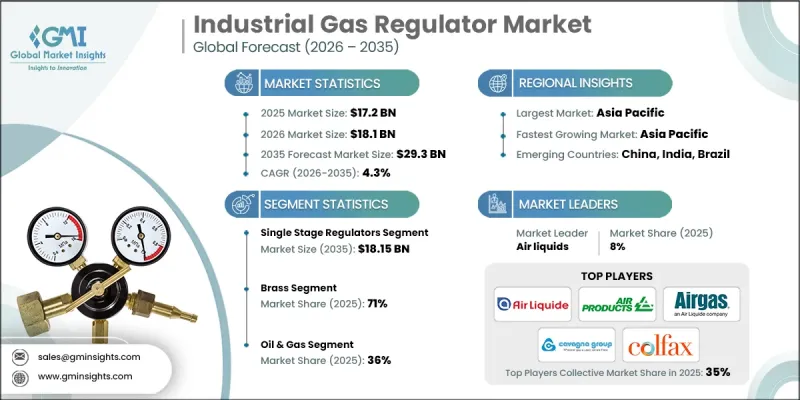
산업용 가스 레귤레이터 시장의 확대는 현대 산업 활동 전반에 걸쳐 고정밀 가스 압력 제어 시스템에 대한 수요가 증가함에 따라 주도되고 있습니다. 산업 분야에서 첨단 자동화 기술이 도입됨에 따라 효율적이고 안전한 생산 환경을 유지하기 위해 정확한 가스 유량 제어의 필요성이 점점 더 중요해지고 있습니다. 동시에 가스 취급 및 공급에 대한 국제 안전 기준이 강화됨에 따라 산업 분야에서는 보다 신뢰할 수 있고 기술적으로 진보된 레귤레이터 시스템으로 업데이트가 진행되고 있습니다. 또한 가스 제어 기기 제조업체 간의 인수합병(M&A) 건수가 증가하면서 시장 성장에 힘을 보태고 있습니다. 기업은 업계 재편과 전략적 제휴를 통해 제품 포트폴리오를 강화하고 사업 운영 역량을 강화하고 있습니다. 이러한 움직임은 재료공학, 시스템 설계 및 압력 제어 기술의 혁신을 가속화하고 있습니다. 그 결과, 산업용 가스 레귤레이터는 에너지, 화학 처리, 의료, 첨단 제조 등의 분야에서 신뢰성과 운영 안전성을 향상시키는 데 기여하고 있습니다.
| 시장 범위 | |
|---|---|
| 시작연도 | 2025년 |
| 예측 기간 | 2026-2035년 |
| 개시 금액 | 172억 달러 |
| 예측액 | 293억 달러 |
| CAGR | 4.3% |
고정 제어 메커니즘으로 작동하는 기존의 기계식 가스 레귤레이터는 디지털 모니터링 기능과 자동 압력 관리 기능을 통합한 보다 진보된 시스템으로 점차 대체되고 있습니다. 현대의 레귤레이터 기술은 스마트 센서, 커넥티드 모니터링 플랫폼 및 자동 압력 조절 메커니즘을 통합하여 보다 정확한 가스 유량 측정과 시스템 안정성을 실현합니다. 이러한 기능을 통해 작업자는 가스 사용량을 보다 효과적으로 모니터링하고, 이상을 감지하며, 복잡한 산업 환경에서도 일관된 성능을 유지할 수 있습니다. 이러한 지능형 시스템의 도입은 효율성, 안전 기준 준수, 프로세스 최적화가 중요한 운영 우선순위가 되고 있는 산업 분야 전반에 걸쳐 진행 중인 변화를 반영하고 있습니다. 지속적인 산업 확장, 선진국의 에너지 전환 노력, 신흥 지역 전반의 제조 인프라에 대한 투자 증가는 첨단 가스 레귤레이터 기술의 상업적 잠재력을 더욱 강화시키고 있습니다.
단단식 레귤레이터 시장은 2025년에 104억 1,000만 달러 규모를 기록하며, 2035년에는 181억 5,000만 달러에 달할 것으로 예측됩니다. 이 레귤레이터는 단일 조정 단계를 통해 가스 압력을 제어하므로 다단계 감압을 수행하는 시스템에 비해 더 단순하게 설계되어 있습니다. 비교적 간단한 구조는 비용 효율성과 설치의 용이성에 기여하고 있으며, 다양한 산업 환경에서 널리 사용되고 있습니다. 정밀도를 중시하는 산업 활동에 대한 관심이 높아지면서 이러한 레귤레이터의 보급이 증가하고 있으며, 특히 연구 중심 산업과 기술적으로 진보된 제조 부문이 빠르게 성장하고 있는 지역에서 더욱 두드러지게 나타나고 있습니다.
2025년에는 황동 부문이 71%의 점유율을 차지했습니다. 황동은 내구성, 가공성, 비용 효율성의 균형이 뛰어나기 때문에 계속해서 주요 재료로 선택되고 있습니다. 황동 레귤레이터는 적당한 압력과 온도 조건에서 안정적으로 작동하므로 광범위한 산업용 가스 제어 응용 분야에 적합합니다. 이 소재의 저렴한 비용과 기능적 신뢰성으로 인해 제조업체는 시스템 비용을 크게 증가시키지 않고도 신뢰할 수 있는 가스 조절 솔루션을 제공할 수 있습니다. 이러한 장점으로 인해 황동은 시장에서 확고한 위치를 유지하고 있습니다.
미국 산업용 가스 레귤레이터 시장은 2025년 34억 달러에 달했습니다. 미국의 성장은 운영의 안전성과 효율성을 유지하기 위해 첨단 가스 제어 시스템을 필요로 하는 기존 산업 부문의 존재에 의해 지원되고 있습니다. 산업 안전 기준을 규정하는 엄격한 규제 프레임워크도 고품질 가스 조절 장비에 대한 지속적인 수요를 더욱 촉진하고 있습니다. 또한 자동화 기술과 첨단 산업 인프라에 대한 투자가 증가함에 따라 미국 전역에 고성능 가스 레귤레이터의 도입이 증가하고 있으며, 이는 시장의 지속적인 발전을 지원하고 있습니다.
자주 묻는 질문
목차
제1장 조사 방법과 범위
제2장 개요
제3장 업계 인사이트
제4장 경쟁 구도
제5장 시장 추산·예측 : 제품 유형별, 2022-2035
제6장 시장 추산·예측 : 재료별, 2022-2035
제7장 시장 추산·예측 : 최종 용도별, 2022-2035
제8장 시장 추산·예측 : 지역별, 2022-2035
제9장 기업 개요
KSA 26.04.20The Global Industrial Gas Regulator Market was valued at USD 17.2 billion in 2025 and is estimated to grow at a CAGR of 4.3% to reach USD 29.3 billion by 2035.
Expansion of the industrial gas regulator market is driven by increasing demand for highly precise gas pressure control systems across modern industrial operations. As industries adopt advanced automation technologies, the need for accurate gas flow regulation has become more critical for maintaining efficient and safe production environments. In parallel, stricter international safety standards governing gas handling and distribution are encouraging industries to upgrade to more reliable and technologically advanced regulator systems. The market is also benefiting from a rising number of mergers and acquisitions among manufacturers of gas control equipment. Through consolidation and strategic partnerships, companies are strengthening their product portfolios and enhancing operational capabilities. These developments are accelerating innovation in materials engineering, system design, and pressure control technologies. As a result, industrial gas regulators are becoming increasingly sophisticated, supporting improved reliability and operational safety across sectors such as energy, chemical processing, healthcare, and advanced manufacturing.
| Market Scope | |
|---|---|
| Start Year | 2025 |
| Forecast Year | 2026-2035 |
| Start Value | $17.2 Billion |
| Forecast Value | $29.3 Billion |
| CAGR | 4.3% |
Traditional mechanical gas regulators that operate with fixed control mechanisms are gradually being replaced by more advanced systems that integrate digital monitoring and automated pressure management capabilities. Modern regulator technologies now incorporate smart sensors, connected monitoring platforms, and automated pressure adjustment mechanisms that enable more accurate gas flow measurement and system stability. These features allow operators to monitor gas usage more effectively, detect irregularities, and maintain consistent performance in complex industrial environments. The adoption of these intelligent systems reflects the broader transformation occurring within the industrial sector, where efficiency, safety compliance, and process optimization are becoming critical operational priorities. Continued industrial expansion, energy transition initiatives in developed economies, and increasing investments in manufacturing infrastructure across emerging regions are further strengthening the commercial potential of advanced gas regulator technologies.
The single stage regulators segment generated USD 10.41 billion in 2025 and is projected to reach USD 18.15 billion by 2035. These regulators control gas pressure through a single adjustment step, offering a simpler design when compared with systems that perform multi-step pressure reduction. Their relatively straightforward construction contributes to cost efficiency and ease of installation, making them widely used across multiple industrial environments. The increasing focus on precision-based industrial operations has also encouraged broader adoption of these regulators, particularly in regions experiencing rapid growth in research-driven industries and technologically advanced manufacturing sectors.
The brass segment accounted for 71% share in 2025. Brass continues to dominate as a preferred material due to its balance of durability, machinability, and cost efficiency. Regulators manufactured from brass can perform reliably under moderate pressure and temperature conditions, making them suitable for a wide range of industrial gas control applications. The material's affordability and functional reliability allow manufacturers to deliver dependable gas regulation solutions without significantly increasing system costs. These advantages have helped brass maintain a strong presence in the market.
U.S. Industrial Gas Regulator Market reached USD 3.4 billion in 2025. Growth in the United States is supported by the presence of well-established industrial sectors that require advanced gas control systems to maintain operational safety and efficiency. Strict regulatory frameworks governing industrial safety standards further contribute to the sustained demand for high-quality gas regulation equipment. In addition, increasing investments in automation technologies and advanced industrial infrastructure are strengthening the adoption of high-performance gas regulators across the country, supporting continued market development.
Major companies operating in the Global Industrial Gas Regulator Market include Air Liquide, Air Products and Chemical, Airgas Inc, Cavagna Group, Colfax Corporation, Emerson Electric, GCE Group, Iceblick Ltd, Itron Inc, Iwatani, Linde Group, Matheson Tri-Gas, Messer Group, Praxair Inc, and Rotarex. Companies in the Industrial Gas Regulator Market are strengthening their competitive position by focusing on technological innovation, strategic collaborations, and global expansion initiatives. Many manufacturers are investing heavily in research and development to create advanced gas regulation systems equipped with digital monitoring capabilities, enhanced safety features, and improved pressure control accuracy. Strategic mergers, acquisitions, and partnerships allow companies to expand their product portfolios and gain access to new technologies and markets. Firms are also increasing their presence in high-growth industrial regions by establishing local manufacturing facilities and distribution networks.
Table of Contents
Chapter 1 Methodology and Scope
- 1.1 Market scope and definition
- 1.2 Research design
- 1.2.1 Research approach
- 1.2.2 Data collection methods
- 1.3 Data mining sources
- 1.3.1 Global
- 1.3.2 Regional/Country
- 1.4 Base estimates and calculations
- 1.4.1 Base year calculation
- 1.4.2 Key trends for market estimation
- 1.5 Primary research and validation
- 1.5.1 Primary sources
- 1.6 Forecast model
- 1.7 Research assumptions and limitations
Chapter 2 Executive Summary
- 2.1 Industry 360° synopsis
- 2.2 Key market trends
- 2.2.1 Regional
- 2.2.2 Product Type
- 2.2.3 Material
- 2.2.4 End User
- 2.3 CXO perspectives: Strategic imperatives
- 2.3.1 Key decision points for industry executives
- 2.3.2 Critical success factors for market players
- 2.4 Future outlook and strategic recommendations
Chapter 3 Industry Insights
- 3.1 Industry ecosystem analysis
- 3.1.1 Supplier landscape
- 3.1.2 Profit margin
- 3.1.3 Value addition at each stage
- 3.1.4 Factor affecting the value chain
- 3.2 Industry impact forces
- 3.2.1 Growth drivers
- 3.2.1.1 Labor shortages & reshoring
- 3.2.1.2 Energy transition & stricter safety regulations
- 3.2.2 Industry pitfalls & challenges
- 3.2.2.1 High integration complexity
- 3.2.2.2 Increasing risks related to data privacy & cybersecurity
- 3.2.3 Opportunities
- 3.2.3.1 Rising demand for Regulator-as-a-Service (RaaS)
- 3.2.3.2 Shift toward hydrogen economy & renewable-energy gases
- 3.2.1 Growth drivers
- 3.3 Growth potential analysis
- 3.4 Future market trends
- 3.5 Technology and innovation landscape
- 3.5.1 Current technological trends
- 3.5.2 Emerging technologies
- 3.6 Price trends
- 3.6.1 By region
- 3.6.2 By Product type
- 3.7 Regulatory landscape
- 3.7.1 Standards and compliance requirements
- 3.7.2 Regional regulatory frameworks
- 3.7.3 Certification standards
- 3.8 Porter's analysis
- 3.9 PESTEL analysis
Chapter 4 Competitive Landscape, 2025
- 4.1 Introduction
- 4.2 Company market share analysis
- 4.2.1 By region
- 4.2.1.1 North America
- 4.2.1.2 Europe
- 4.2.1.3 Asia Pacific
- 4.2.1.4 Latin America
- 4.2.1.5 Middle East and Africa
- 4.2.1 By region
- 4.3 Company matrix analysis
- 4.4 Competitive analysis of major market players
- 4.5 Competitive positioning matrix
- 4.6 Key developments
- 4.6.1 Mergers & acquisitions
- 4.6.2 Partnerships & collaborations
- 4.6.3 New product launches
- 4.6.4 Expansion plans
Chapter 5 Market Estimates & Forecast, By Product Type, 2022 - 2035, (USD Billion) (Million Units)
- 5.1 Key trends
- 5.2 Single Stage regulators
- 5.3 Dual Stage regulators
Chapter 6 Market Estimates & Forecast, By Material, 2022 - 2035, (USD Billion) (Million Units)
- 6.1 Key trends
- 6.2 Brass
- 6.3 Stainless Steel
Chapter 7 Market Estimates & Forecast, By End Use, 2022 - 2035, (USD Billion) (Million Units)
- 7.1 Key trends
- 7.2 Metallurgy
- 7.3 Food & Beverage
- 7.4 Pharmaceuticals
- 7.5 Chemical
- 7.6 Electric power
- 7.7 Oil & Gas
- 7.8 Others
Chapter 8 Market Estimates and Forecast, By Region, 2022 - 2035 (USD Billion) (Thousand Units)
- 8.1 Key trends
- 8.2 North America
- 8.2.1 U.S.
- 8.2.2 Canada
- 8.3 Europe
- 8.3.1 Germany
- 8.3.2 UK
- 8.3.3 France
- 8.3.4 Italy
- 8.3.5 Spain
- 8.4 Asia Pacific
- 8.4.1 China
- 8.4.2 Japan
- 8.4.3 India
- 8.4.4 Australia
- 8.4.5 South Korea
- 8.5 Latin America
- 8.5.1 Brazil
- 8.5.2 Mexico
- 8.5.3 Argentina
- 8.6 Middle East and Africa
- 8.6.1 South Africa
- 8.6.2 Saudi Arabia
- 8.6.3 UAE
Chapter 9 Company Profiles
- 9.1 Air Liquide
- 9.2 Air products and Chemical
- 9.3 Airgas Inc
- 9.4 Cavagna Group
- 9.5 Colfax Corporation
- 9.6 Emerson Electric
- 9.7 GCE Group
- 9.8 Iceblick Ltd
- 9.9 Itron Inc
- 9.10 Iwatani
- 9.11 Linde Group
- 9.12 Matheson Tri-gas
- 9.13 Messer Group
- 9.14 Praxair Inc
- 9.15 Rotarex