|
시장보고서
상품코드
1998757
요격 미사일 시장 기회, 성장요인, 업계 동향 분석 및 예측(2026-2035년)Interceptor Missiles Market Opportunity, Growth Drivers, Industry Trend Analysis, and Forecast 2026 - 2035 |
||||||

세계의 요격 미사일 시장은 2025년에 123억 달러로 평가되며, CAGR 6.2%로 성장하며, 2035년까지 223억 달러에 달할 것으로 추정되고 있습니다.
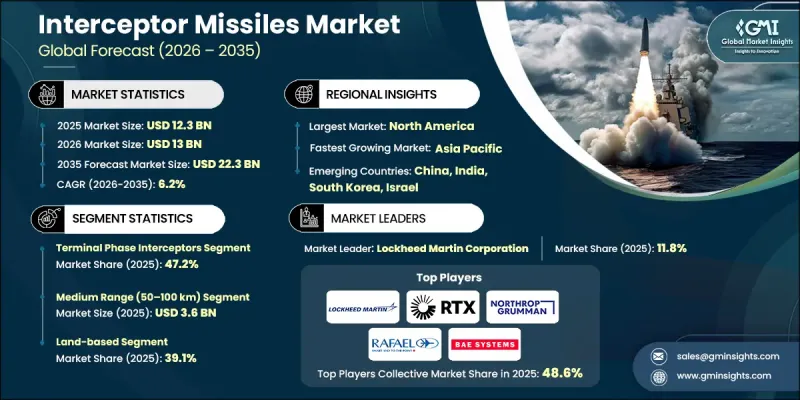
시장 확대는 세계 국방 예산 증가, 탄도미사일과 극초음속 미사일의 위협 증가, 미사일 요격 기술의 지속적인 발전으로 인해 주도되고 있습니다. 각국 정부는 중장거리 탄도미사일, 순항미사일, 극초음속 활공체 등 새로운 위협에 대응하기 위해 방공 및 미사일 방어체계의 현대화를 우선순위에 두고 있습니다. 종말단계, 중간단계, 부스터 단계의 요격기를 결합한 다층형 미사일 방어 아키텍처의 채택으로 전 세계의 방어 전략이 재편되고 있습니다. AI를 활용한 유도 시스템, 레이더, 적외선 센서 및 예측 알고리즘의 통합으로 위협의 실시간 추적이 가능해져 요격 성공률이 향상되고 있습니다. 대외 군사 판매(FMS) 및 동맹국과의 방위 프로그램 확대가 시장 수요를 더욱 강화하는 한편, 감지, 협력 및 운영 효율성을 향상시키기 위해 우주 및 항공기 탑재형 조기 경보 시스템이 점점 더 통합되고 있습니다. 지정학적 긴장이 고조되고 자국 및 동맹국의 안보에 대한 전략적 투자로 인해 예측 기간 중 업계의 견고한 성장이 유지될 것으로 예측됩니다.
| 시장 범위 | |
|---|---|
| 시작연도 | 2025년 |
| 예측 기간 | 2026-2035 |
| 개시 금액 | 123억 달러 |
| 예측액 | 223억 달러 |
| CAGR | 6.2% |
2025년 기준 종말단계 요격기 부문은 47.2%의 점유율을 차지하고 있으며, 이는 단거리 및 중거리 탄도미사일 위협을 무력화시키는 데 있으며, 이 부문이 매우 중요한 역할을 할 것임을 반영합니다. 종말단계 요격기는 신속한 대응 능력, 검증된 신뢰성, 다층 방어망에서의 운용 유연성 등으로 높은 평가를 받고 있습니다. 실전 훈련에서 높은 성공률로 인해 각국 및 동맹국 프로그램에서 널리 보급되고 있습니다. 추진 시스템, 유도 정확도, 탄두 효율의 지속적인 개발로 그 운용 효과가 향상되어 현대 미사일 방어 전략의 핵심을 이루고 있습니다. 각국 정부는 중간 및 부스터 단계 시스템을 보완하기 위해 종말단계 요격 시스템에 대한 의존도를 높이고 있으며, 여러 위협 벡터에 걸친 위험을 완화하는 다층적인 항공 및 미사일 방어 접근 방식을 보장하고 있습니다.
중거리 요격 미사일(50-100km)은 비용, 사정거리, 작전상 유연성의 균형이 뛰어나 2025년 36억 달러의 시장 규모를 차지했습니다. 이러한 시스템은 지역 미사일 방어 프로그램에 널리 채택되어 진화하는 미사일 위협으로부터 자국과 동맹국 모두를 보호하고 있습니다. 다층 방어 네트워크에 통합되어 단거리 및 중거리 요격 미사일과의 원활한 연계를 통해 대응 시간과 위협 무력화를 최적화할 수 있습니다. AI를 활용한 표적 포착, 네트워크화된 센서 융합, 자동화된 지휘통제센터에 대한 투자 증가로 중거리 요격 미사일의 효율성이 더욱 향상되고 있습니다. 이러한 시스템은 중요 인프라, 군사 자산 및 도시 지역을 보호하기 위해 비용 효율적이고 기술적으로 진보된 솔루션을 찾는 국가들에게 최적의 선택이 되고 있습니다.
북미 요격 미사일 시장은 다층적인 항공 및 미사일 방어 프로그램에 대한 전략적 투자에 힘입어 2025년 41.7%의 점유율을 차지했습니다. 지정학적 긴장이 고조되고 자국과 동맹국의 이익을 보호해야 할 필요성에 따라 국방 예산이 대폭 증액되고 있습니다. 첨단 연구개발(R&D) 노력은 기술적 우위를 유지하기 위해 AI를 통한 유도 표적 포착, 다중 센서 융합, 상황 인식 능력 향상에 초점을 맞추었습니다. 우주 및 네트워크 기반 조기 경보 시스템 통합을 통해 신속한 대응, 협업 강화, 정확한 위협 평가가 가능합니다. 대외군사판매(FMS) 및 방산협력 프로그램의 확대는 지역내 우위를 지원하고 시스템 업그레이드, 훈련 프로그램, 전략적 파트너십의 기회를 창출하고 있습니다. 탄탄한 방위산업 기반과 기술 리더십을 바탕으로 북미는 요격 미사일 혁신의 세계 거점으로 남을 수 있습니다.
자주 묻는 질문
목차
제1장 조사 방법과 범위
제2장 개요
제3장 업계 인사이트
제4장 경쟁 구도
제5장 시장 추산·예측 : 요격 단계별, 2022-2035
제6장 시장 추산·예측 : 위협 유형별, 2022-2035
제7장 시장 추산·예측 : 발사 플랫폼별, 2022-2035
제8장 시장 추산·예측 : 항속거리별, 2022-2035
제9장 시장 추산·예측 : 유도 시스템별, 2022-2035
제10장 시장 추산·예측 : 지역별, 2022-2035
제11장 기업 개요
KSA 26.04.20The Global Interceptor Missiles Market was valued at USD 12.3 billion in 2025 and is estimated to grow at a CAGR of 6.2% to reach USD 22.3 billion by 2035.
Market expansion is driven by increasing global defense budgets, rising threats from ballistic and hypersonic missiles, and continuous advancements in missile interception technologies. Governments are prioritizing modernization of air and missile defense systems to counter emerging threats, including medium- and long-range ballistic missiles, cruise missiles, and hypersonic glide vehicles. The adoption of multi-layered missile defense architectures, which combine terminal, midcourse, and boost-phase interceptors, is reshaping defense strategies worldwide. Integration of AI-driven guidance, radar, and infrared sensing, and predictive algorithms allows real-time threat tracking, enhancing interception success rates. Expansion of foreign military sales and allied defense programs further strengthens market demand, while space- and airborne-based early warning systems are increasingly being integrated to improve detection, coordination, and operational efficiency. Rising geopolitical tensions, coupled with strategic investments in homeland and allied security, are expected to maintain strong industry growth throughout the forecast period.
| Market Scope | |
|---|---|
| Start Year | 2025 |
| Forecast Year | 2026-2035 |
| Start Value | $12.3 Billion |
| Forecast Value | $22.3 Billion |
| CAGR | 6.2% |
The terminal phase interceptors segment held a 47.2% share in 2025, reflecting their critical role in neutralizing short- and medium-range ballistic missile threats. Terminal interceptors are valued for rapid response capabilities, proven reliability, and operational flexibility in layered defense networks. Their deployment is widespread across national and allied programs due to high success rates in real-world exercises. Continuous development in propulsion systems, guidance accuracy, and warhead efficiency enhances their operational effectiveness, making them central to modern missile defense strategies. Governments are increasingly relying on terminal interceptors to complement midcourse and boost-phase systems, ensuring a multi-layered approach to air and missile defense that mitigates risk across multiple threat vectors.
The Medium-range interceptors (50-100 km) accounted for USD 3.6 billion in 2025, owing to their ability to balance cost, coverage, and operational flexibility. These systems are widely adopted for regional missile defense programs, providing both homeland and allied protection against evolving missile threats. Their integration into multi-tiered defense networks allows seamless coordination with terminal and midcourse interceptors, optimizing response times and threat neutralization. Increasing investment in AI-assisted targeting, networked sensor fusion, and automated command centers is further enhancing medium-range interceptor efficiency. These systems are becoming the preferred choice for countries seeking cost-effective yet technologically advanced solutions to protect critical infrastructure, military assets, and urban centers.
North America Interceptor Missiles Market held 41.7% share in 2025, driven by strategic investments in multi-layered air and missile defense programs. Rising geopolitical tensions and the need to protect both homeland and allied interests are prompting significant defense budget allocations. Advanced R&D initiatives focus on AI-guided targeting, multi-sensor fusion, and enhanced situational awareness to maintain technological superiority. Integration of space- and network-based early warning systems enables rapid response, improved coordination, and accurate threat assessment. The expansion of foreign military sales and cooperative defense programs supports regional dominance and creates opportunities for system upgrades, training programs, and strategic partnerships. Strong defense industrial bases and technological leadership ensure that North America remains a global hub for interceptor missile innovation.
Prominent players in the Global Interceptor Missiles Market include Lockheed Martin Corporation, RTX Corporation, Northrop Grumman Corporation, Boeing Defense Space & Security, BAE Systems plc, Thales Group, MBDA, Rafael Advanced Defense Systems Ltd., Israel Aerospace Industries, Aselsan A.S., Saab AB, Mitsubishi Heavy Industries, Hanwha Aerospace, Anduril Industries, BlueHalo, and Dynetics. Companies in the Global Interceptor Missiles Market are strengthening their positions through continuous innovation in propulsion systems, guidance technologies, and sensor integration. Firms are expanding their presence in emerging markets via strategic alliances, joint ventures, and foreign military sales. Investments in AI-assisted targeting, predictive algorithms, and networked command-and-control systems are enhancing operational efficiency and effectiveness. Companies are also focusing on modular and upgradeable systems to extend product lifecycles and meet evolving threat scenarios. Marketing collaborations with governments, military exercises, and training programs help build trust and demonstrate technological superiority. By prioritizing R&D, global footprint expansion, and strategic partnerships, companies are ensuring sustained competitiveness and long-term market leadership.
Table of Contents
Chapter 1 Methodology and Scope
- 1.1 Market scope and definition
- 1.2 Research design
- 1.2.1 Research approach
- 1.2.2 Data collection methods
- 1.3 Data mining sources
- 1.3.1 Global
- 1.3.2 Regional/Country
- 1.4 Base estimates and calculations
- 1.4.1 Base year calculation
- 1.4.2 Key trends for market estimation
- 1.5 Primary research and validation
- 1.5.1 Primary sources
- 1.6 Forecast model
- 1.7 Research assumptions and limitations
Chapter 2 Executive Summary
- 2.1 Industry 360° synopsis, 2022 - 2035
- 2.2 Key market trends
- 2.2.1 Intercept phase trends
- 2.2.2 Threat type trends
- 2.2.3 Launch platform trends
- 2.2.4 Range trends
- 2.2.5 Guidance system trends
- 2.2.6 Region trends
- 2.3 TAM Analysis, 2026-2035
- 2.4 CXO perspectives: Strategic imperatives
Chapter 3 Industry Insights
- 3.1 Industry ecosystem analysis
- 3.1.1 Supplier Landscape
- 3.1.2 Profit Margin
- 3.1.3 Cost structure
- 3.1.4 Value addition at each stage
- 3.1.5 Factor affecting the value chain
- 3.1.6 Disruptions
- 3.2 Industry impact forces
- 3.2.1 Growth drivers
- 3.2.1.1 Increasing global defense spending on missile defense systems
- 3.2.1.2 Rising ballistic and hypersonic missile threats
- 3.2.1.3 Advancements in interceptor missile technologies and guidance systems
- 3.2.1.4 Growing adoption of multi-layered missile defense architectures
- 3.2.1.5 Expansion of foreign military sales and allied defense programs
- 3.2.2 Industry pitfalls and challenges
- 3.2.2.1 High development and procurement costs of interceptor missile systems
- 3.2.2.2 Strict regulatory and export control restrictions on missile technologies
- 3.2.3 Market opportunities
- 3.2.3.1 Integration of interceptor missiles with space-based and early warning systems
- 3.2.3.2 Modernization and replacement of legacy air and missile defense systems
- 3.2.1 Growth drivers
- 3.3 Growth potential analysis
- 3.4 Regulatory landscape
- 3.4.1 North America
- 3.4.2 Europe
- 3.4.3 Asia Pacific
- 3.4.4 Latin America
- 3.4.5 Middle East & Africa
- 3.5 Porter's analysis
- 3.6 PESTEL analysis
- 3.7 Technology and Innovation landscape
- 3.7.1 Current technological trends
- 3.7.2 Emerging technologies
- 3.8 Emerging business models
- 3.9 Compliance requirements
- 3.10 Patent and IP analysis
- 3.11 Pricing analysis (Driven by Primary Research)
- 3.11.1 Historical price trend analysis
- 3.11.2 Pricing strategy by player type
- 3.12 Trade Data Analysis (Based on Paid Databases)
- 3.12.1 Import/export volume & value trends
- 3.12.2 Key trade corridors & tariff impact
- 3.13 Impact of AI & generative AI on the market (Driven by Primary Research)
- 3.13.1 AI-driven disruption of existing business models
- 3.13.2 GenAI use cases & adoption roadmap by segment
- 3.13.3 Risks, limitations & regulatory considerations
- 3.14 Capacity & production landscape (Driven by Primary Research)
- 3.14.1 Production capacity by region & key producer
- 3.14.2 Capacity utilization rates & expansion pipelines
- 3.15 Defense budget analysis
- 3.16 Global defense spending trends
- 3.17 Regional defense budget allocation
- 3.17.1 North America
- 3.17.2 Europe
- 3.17.3 Asia Pacific
- 3.17.4 Middle East and Africa
- 3.17.5 Latin America
- 3.18 Key defense modernization programs
- 3.19 Budget forecast (2025-2034)
- 3.19.1 Impact on industry growth
- 3.19.2 Defense budgets by country
- 3.19.3 Defense budget allocation by segment
- 3.19.3.1 Personnel
- 3.19.3.2 Operations and maintenance
- 3.19.3.3 Procurement
- 3.19.3.4 Research, development, test and evaluation
- 3.19.3.5 Infrastructure and construction
- 3.19.3.6 Technology and innovation
- 3.20 Supply chain resilience
- 3.21 Geopolitical analysis
- 3.22 Workforce analysis
- 3.23 Digital transformation
- 3.24 Mergers, acquisitions, and strategic partnerships landscape
- 3.25 Risk assessment and management
- 3.26 Major contract awards (2021-2024)
Chapter 4 Competitive Landscape, 2025
- 4.1 Introduction
- 4.2 Company market share analysis
- 4.2.1 By region
- 4.2.1.1 North America
- 4.2.1.2 Europe
- 4.2.1.3 Asia Pacific
- 4.2.1.4 Latin America
- 4.2.1.5 Middle East & Africa
- 4.2.2 Market concentration analysis
- 4.2.1 By region
- 4.3 Competitive benchmarking of key players
- 4.3.1 Financial performance comparison
- 4.3.1.1 Revenue
- 4.3.1.2 Profit margin
- 4.3.1.3 R&D
- 4.3.2 Product portfolio comparison
- 4.3.2.1 Product range breadth
- 4.3.2.2 Technology
- 4.3.2.3 Innovation
- 4.3.3 Geographic presence comparison
- 4.3.3.1 Global footprint analysis
- 4.3.3.2 Service network coverage
- 4.3.3.3 Market penetration by region
- 4.3.4 Competitive positioning matrix
- 4.3.4.1 Leaders
- 4.3.4.2 Challengers
- 4.3.4.3 Followers
- 4.3.4.4 Niche players
- 4.3.1 Financial performance comparison
- 4.4 Key developments
- 4.4.1 Mergers and acquisitions
- 4.4.2 Partnerships and collaborations
- 4.4.3 Technological advancements
- 4.4.4 Expansion and investment strategies
- 4.4.5 Digital transformation initiatives
- 4.5 Emerging/ startup competitors landscape
Chapter 5 Market Estimates and Forecast, By Intercept Phase, 2022 - 2035 (USD Billion)
- 5.1 Key trends
- 5.2 Terminal phase interceptors
- 5.3 Midcourse phase interceptors
- 5.4 Boost phase interceptors
Chapter 6 Market Estimates and Forecast, By Threat Type, 2022 - 2035 (USD Billion)
- 6.1 Key trends
- 6.2 Ballistic missile interceptors
- 6.3 Cruise missile interceptors
- 6.4 Hypersonic threat interceptors
- 6.5 Aircraft / aerial threat interceptors
Chapter 7 Market Estimates and Forecast, By Launch Platform, 2022 - 2035 (USD Billion)
- 7.1 Key trends
- 7.2 Land-based
- 7.3 Naval / ship-based
- 7.4 Airborne
- 7.5 Space-based
Chapter 8 Market Estimates and Forecast, By Range, 2022 - 2035 (USD Billion)
- 8.1 Key trends
- 8.2 Short range (<50 km)
- 8.3 Medium range (50-100 km)
- 8.4 Long range (100-1,000 km)
- 8.5 Extended range (>1,000 km)
Chapter 9 Market Estimates and Forecast, By Guidance System, 2022 - 2035 (USD Billion)
- 9.1 Key trends
- 9.2 Radar-guided systems
- 9.3 Infrared / heat-seeking systems
- 9.4 Command-guided systems
- 9.5 Gps-guided systems
- 9.6 Multi-sensor / hybrid guidance systems
Chapter 10 Market Estimates and Forecast, By Region, 2022 - 2035 (USD Billion)
- 10.1 Key trends
- 10.2 North America
- 10.2.1 U.S.
- 10.2.2 Canada
- 10.3 Europe
- 10.3.1 Germany
- 10.3.2 UK
- 10.3.3 France
- 10.3.4 Spain
- 10.3.5 Italy
- 10.3.6 Netherlands
- 10.4 Asia Pacific
- 10.4.1 China
- 10.4.2 India
- 10.4.3 Japan
- 10.4.4 Australia
- 10.4.5 South Korea
- 10.5 Latin America
- 10.5.1 Brazil
- 10.5.2 Mexico
- 10.5.3 Argentina
- 10.6 Middle East and Africa
- 10.6.1 South Africa
- 10.6.2 Saudi Arabia
- 10.6.3 UAE
Chapter 11 Company Profiles
- 11.1 Global Key Players
- 11.1.1 RTX Corporation
- 11.1.2 Lockheed Martin Corporation
- 11.1.3 Northrop Grumman Corporation
- 11.1.4 Boeing Defense, Space & Security
- 11.1.5 BAE Systems plc
- 11.1.6 MBDA
- 11.1.7 Thales Group
- 11.2 Regional Players
- 11.2.1 Rafael Advanced Defense Systems Ltd.
- 11.2.2 Israel Aerospace Industries
- 11.2.3 Aselsan A.
- 11.2.4 Saab AB
- 11.2.5 Mitsubishi Heavy Industries
- 11.2.6 Hanwha Aerospace
- 11.3 Niche Players
- 11.3.1 Anduril Industries
- 11.3.2 BlueHalo
- 11.3.3 Dynetics
- 11.3.4 Bharat Dynamics Limited