
|
시장보고서
상품코드
1998778
스텐트 시장 기회, 성장요인, 업계 동향 분석 및 예측(2026-2035년)Stents Market Opportunity, Growth Drivers, Industry Trend Analysis, and Forecast 2026 - 2035 |
||||||

세계의 스텐트 시장은 2025년에 101억 달러로 평가되었고, CAGR 8.4%로 성장하여 2035년까지 223억 달러에 달할 것으로 예측됩니다.
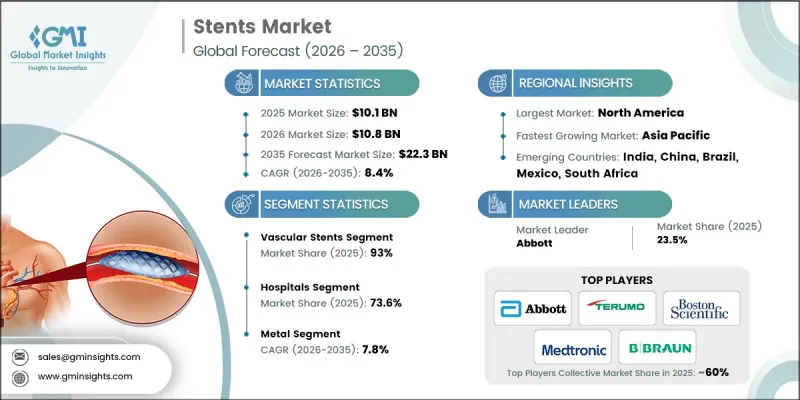
시장 성장은 심혈관 질환의 유병률 증가, 최소침습 수술의 보급 확대, 스텐트 설계의 기술적 진보, 신흥 지역의 의료 인프라 확충에 힘입어 성장하고 있습니다. 스텐트는 좁아지거나 막힌 혈관의 개통성을 유지하여 안정적인 혈류를 보장하고 혈관의 막힘을 방지하는 소형 관상동맥용 의료기기입니다. 관상동맥질환, 말초동맥질환, 동맥류 발생률 증가와 더불어 좌식생활, 부적절한 식습관, 흡연과 같은 생활습관 요인이 복합적으로 작용하여 스텐트 치료에 대한 수요를 촉진하고 있습니다. 약물 용출형 스텐트, 생체 흡수성 스텐트, 생분해성 폴리머 코팅 등의 기술 혁신으로 환자의 예후를 개선하고 재협착을 감소시키며 시술의 안전성을 높이고 있습니다. 또한, 환자 중심 솔루션, 디지털 헬스와의 통합, 스마트 스텐트 개발이 시장을 견인하고 있으며, 이러한 요소들이 결합되어 전 세계적으로 치료 옵션과 보급이 확대되고 있습니다.
| 시장 범위 | |
|---|---|
| 개시 연도 | 2025년 |
| 예측 기간 | 2026-2035년 |
| 개시 연도 시장 규모 | 101억 달러 |
| 예측액 | 223억 달러 |
| CAGR | 8.4% |
2025년에는 관상동맥 질환의 유병률 증가와 저침습적 심혈관 치료에 대한 수요 증가를 배경으로 혈관 스텐트 부문이 시장 점유율의 93%를 차지했습니다. 혈관내 스텐트삽입술은 회복기간이 짧고, 합병증 위험이 낮으며, 입원기간이 짧아 개흉술보다 선호되고 있습니다. 심혈관 치료 센터의 확대, 숙련된 전문의의 확보, 특히 아시아태평양, 라틴아메리카, 중동에서 조기 발견에 대한 인식이 높아지면서 혈관 스텐트 채택이 확대되고 있습니다.
2025년에는 병원 부문이 73.6%의 점유율을 차지하여 160억 달러에 달했습니다. 스텐트 삽입으로 회복 기간이 단축되고, 시술 위험이 감소하며, 환자의 처리 능력이 향상되어 병원에서 경피적 관상동맥 중재술과 혈관 내 시술이 점점 더 많이 시행되고 있습니다. 고령화 및 생활습관 관련 위험요인으로 인한 심혈관 질환 환자 증가는 심장 및 말초혈관 중재시술 모두에서 스텐트에 대한 수요 증가를 견인하고 있습니다.
미국 스텐트 시장은 2025년 35억 달러에 달했습니다. 관상동맥질환 및 말초동맥질환의 유병률 증가와 더불어 고령화 및 비만, 고혈압, 당뇨 등 생활습관병 관련 위험이 시술 건수 증가를 견인하고 있습니다. 첨단 의료시설, 전문 심장센터, 카테터 검사실의 존재는 스텐트 삽입의 고빈도 시행을 가능하게 합니다. 또한, 미국과 캐나다의 보험 적용 범위와 상환 정책은 환자가 선택적 수술과 응급 수술을 받도록 유도하여 시장 성장을 더욱 촉진하고 있습니다.
자주 묻는 질문
목차
제1장 조사 방법
제2장 주요 요약
제3장 업계 인사이트
제4장 경쟁 구도
제5장 시장 추산 및 예측 : 제품별, 2022-2035
제6장 시장 추산 및 예측 : 재료별, 2022-2035
제7장 시장 추산 및 예측 : 유형별, 2022-2035
제8장 시장 추산 및 예측 : 최종 용도별, 2022-2035
제9장 시장 추산 및 예측 : 지역별, 2022-2035
제10장 기업 개요
LSH 26.04.23The Global Stents Market was valued at USD 10.1 billion in 2025 and is estimated to grow at a CAGR of 8.4% to reach USD 22.3 billion by 2035.
Market growth is driven by the rising prevalence of cardiovascular diseases, increasing adoption of minimally invasive procedures, technological advancements in stent design, and expanding healthcare infrastructure in emerging regions. Stents are small, tubular medical devices that maintain the patency of narrowed or blocked blood vessels, ensuring consistent blood flow and preventing vessel collapse. The growing incidence of coronary artery disease, peripheral artery disease, and aneurysms, combined with lifestyle factors such as sedentary behavior, poor diet, and smoking, fuels demand for stent procedures. Innovations, including drug-eluting stents, bioresorbable stents, and biodegradable polymer coatings, enhance patient outcomes, reduce restenosis, and improve procedural safety. The market is further propelled by patient-centric solutions, digital health integration, and the development of smart stents, which collectively expand treatment options and adoption globally.
| Market Scope | |
|---|---|
| Start Year | 2025 |
| Forecast Year | 2026-2035 |
| Start Value | $10.1 Billion |
| Forecast Value | $22.3 Billion |
| CAGR | 8.4% |
The vascular stents segment held a share of 93% in 2025, driven by the widespread prevalence of coronary artery disease and preference for minimally invasive cardiovascular interventions. Endovascular stenting is favored over open surgical bypass due to shorter recovery times, lower complication risks, and reduced hospital stays. Expansion of cardiovascular care centers, availability of trained specialists, and growing awareness of early detection, particularly in Asia-Pacific, Latin America, and the Middle East, contribute to increasing adoption of vascular stents.
The hospitals segment accounted for 73.6% share in 2025, reaching USD 16 billion. Hospitals are increasingly performing percutaneous coronary interventions and endovascular procedures, as stent implantation shortens recovery periods, reduces procedural risks, and improves patient throughput. The rising number of patients with cardiovascular conditions due to aging populations and lifestyle-related risk factors is driving higher demand for stents in both cardiac and peripheral interventions.
U.S. Stents Market reached USD 3.5 billion in 2025. The increasing prevalence of coronary artery disease and peripheral artery disease, combined with aging demographics and lifestyle-related risks such as obesity, hypertension, and diabetes, drives procedural volumes. The presence of advanced hospitals, specialized cardiac centers, and catheterization labs facilitates high-volume stent implantation. Insurance coverage and reimbursement policies in the U.S. and Canada also encourage patients to undergo both elective and emergency procedures, further supporting market growth.
Prominent players in the Global Stents Market include Abbott, Medtronic, Boston Scientific, Biotronik, MicroPort Scientific, Stryker, W.L Gore & Associates, B. Braun, Biosensors International Group, Terumo, Veryan Medical, Elixir Medical, Johnson & Johnson, and SLTL Group. Companies in the Global Stents Market strengthen their presence by focusing on continuous research and development to improve stent design, durability, and safety features. They are expanding production capacities, forming strategic partnerships with hospitals and healthcare providers, and entering emerging markets to reach underserved populations. Firms emphasize minimally invasive and patient-specific solutions, integrate digital health technologies with smart stents, and launch drug-eluting and bioresorbable products to enhance clinical outcomes. Marketing initiatives, training programs for clinicians, and collaborations with key cardiovascular centers help companies build brand trust, drive adoption, and maintain a competitive edge in the global market.
Table of Contents
Chapter 1 Research Methodology
- 1.1 Research approach
- 1.2 Quality commitments
- 1.2.1 GMI AI policy & data integrity commitment
- 1.2.1.1 Source consistency protocol
- 1.2.1 GMI AI policy & data integrity commitment
- 1.3 Research trail & confidence scoring
- 1.3.1 Research trail components
- 1.3.2 Scoring components
- 1.4 Data collection
- 1.4.1 Partial list of primary sources
- 1.5 Data mining sources
- 1.5.1 Paid sources
- 1.5.1.1 Sources, by region
- 1.5.1 Paid sources
- 1.6 Base estimates and calculations
- 1.6.1 Base year calculation for any one approach
- 1.7 Forecast model
- 1.7.1 Quantified market impact analysis
- 1.7.1.1 Mathematical impact of growth parameters on forecast
- 1.7.1 Quantified market impact analysis
- 1.8 Research transparency addendum
- 1.8.1 Source attribution framework
- 1.8.2 Quality assurance metrics
- 1.8.3 Our commitment to trust
Chapter 2 Executive Summary
- 2.1 Industry 3600 synopsis
- 2.2 Key market trends
- 2.2.1 Regional trends
- 2.2.2 Product trends
- 2.2.3 Material trends
- 2.2.4 Type trends
- 2.2.5 End use trends
- 2.3 CXO perspectives: Strategic imperatives
Chapter 3 Industry Insights
- 3.1 Industry ecosystem analysis
- 3.2 Industry impact forces
- 3.2.1 Growth drivers
- 3.2.1.1 Rising prevalence of cardiovascular diseases
- 3.2.1.2 Advancements in stent technology
- 3.2.1.3 Increasing number of minimally invasive procedures
- 3.2.1.4 Growing awareness about early diagnosis and treatment
- 3.2.2 Industry pitfalls and challenges
- 3.2.2.1 High cost of stent procedures
- 3.2.2.2 Risk of complications and restenosis
- 3.2.3 Market opportunities
- 3.2.3.1 Development of bioresorbable and next-gen stents
- 3.2.3.2 Increasing adoption of digital health and AI in diagnostics
- 3.2.1 Growth drivers
- 3.3 Growth potential analysis
- 3.4 Regulatory landscape (Driven by primary research)
- 3.4.1 North America
- 3.4.2 Europe
- 3.4.3 Asia Pacific
- 3.5 Technology landscape
- 3.5.1 Current technological trends
- 3.5.2 Emerging technologies
- 3.6 Reimbursement scenario (Driven by primary research)
- 3.7 Future market trends
- 3.8 Value chain analysis
- 3.9 Consumer insights (Driven by primary research)
- 3.10 Porter's analysis
- 3.11 PESTEL analysis
- 3.12 Gap analysis
Chapter 4 Competitive Landscape, 2025
- 4.1 Introduction
- 4.2 Company matrix analysis
- 4.3 Company market share analysis (Driven by primary research)
- 4.3.1 Global
- 4.3.2 North America
- 4.3.3 Europe
- 4.3.4 Asia Pacific
- 4.4 Competitive positioning matrix
- 4.5 Competitive analysis of major market players
- 4.6 Key developments
- 4.6.1 Mergers & acquisitions
- 4.6.2 Partnerships & collaborations
- 4.6.3 New product launches
- 4.6.4 Expansion plans
Chapter 5 Market Estimates and Forecast, By Product, 2022 - 2035 ($ Mn)
- 5.1 Key trends
- 5.2 Vascular stents
- 5.2.1 Coronary stents
- 5.2.1.1 Drug eluting stent
- 5.2.1.2 Bioresorbable vascular scaffold (BVS)
- 5.2.1.3 Bare metal stent
- 5.2.2 Peripheral stents
- 5.2.2.1 Renal
- 5.2.2.2 Iliac
- 5.2.2.3 Femoral-popliteal
- 5.2.2.4 Carotid
- 5.2.3 Neurovascular stents
- 5.2.1 Coronary stents
- 5.3 Non-vascular stents
Chapter 6 Market Estimates and Forecast, By Material, 2022 - 2035 ($ Mn)
- 6.1 Key trends
- 6.2 Metal
- 6.3 Polymer
Chapter 7 Market Estimates and Forecast, By Type, 2022 - 2035 ($ Mn)
- 7.1 Key trends
- 7.2 Balloon expandable
- 7.3 Self expandable
Chapter 8 Market Estimates and Forecast, By End Use, 2022 - 2035 ($ Mn)
- 8.1 Key trends
- 8.2 Hospitals
- 8.3 Ambulatory surgical centers
- 8.4 Other end users
Chapter 9 Market Estimates and Forecast, By Region, 2022 - 2035 ($ Mn)
- 9.1 Key trends
- 9.2 North America
- 9.2.1 U.S.
- 9.2.2 Canada
- 9.3 Europe
- 9.3.1 Germany
- 9.3.2 UK
- 9.3.3 France
- 9.3.4 Spain
- 9.3.5 Italy
- 9.3.6 Netherlands
- 9.4 Asia Pacific
- 9.4.1 China
- 9.4.2 Japan
- 9.4.3 India
- 9.4.4 Australia
- 9.4.5 South Korea
- 9.5 Latin America
- 9.5.1 Brazil
- 9.5.2 Mexico
- 9.5.3 Argentina
- 9.6 Middle East and Africa
- 9.6.1 South Africa
- 9.6.2 Saudi Arabia
- 9.6.3 UAE
Chapter 10 Company Profiles
- 10.1 Abbott
- 10.2 B. Braun
- 10.3 Becton, Dickinson and Company
- 10.4 Biosensors International Group
- 10.5 Biotronik
- 10.6 Boston Scientific
- 10.7 Elixir Medical
- 10.8 Medtronic
- 10.9 Meril Life Science
- 10.10 MicroPort Scientific
- 10.11 SLTL Group
- 10.12 Stryker
- 10.13 Terumo
- 10.14 Veryan Medical
- 10.15 W.L Gore & Associates