

|
시장보고서
상품코드
1998790
동물사료 방부제 시장 기회, 성장 촉진요인, 업계 동향 분석 및 예측(2026-2035년)Animal Feed Preservatives Market Opportunity, Growth Drivers, Industry Trend Analysis, and Forecast 2026 - 2035 |
||||||

세계의 동물사료 방부제 시장은 2025년에 64억 달러로 평가되었고, CAGR 4.6%로 성장하여 2035년까지 102억 달러에 달할 것으로 예측됩니다.
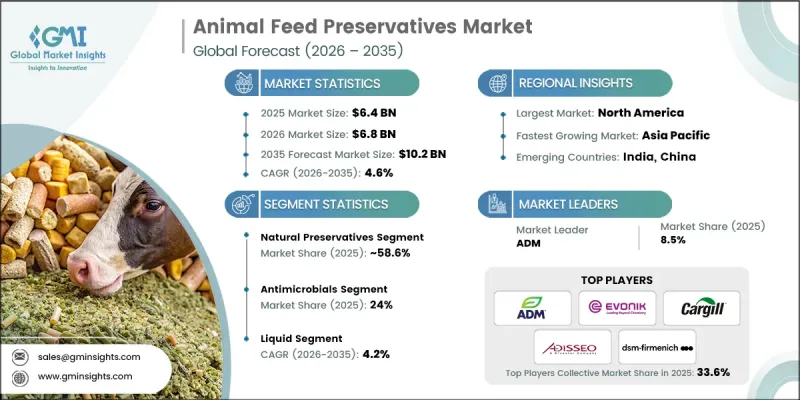
동물사료 방부제 시장은 전체 사료 및 축산 밸류체인에서 필수적인 요소로 발전해 왔습니다. 보존제는 초기에는 주로 사료의 저장 기간을 연장하기 위해 도입되었지만, 그 역할이 크게 확대되어 사료의 품질 유지, 필수 영양소 유지, 축산 농가의 생산 위험 최소화까지 포함하게 되었습니다. 현대의 축산 경영은 다양한 환경, 보관, 운송 조건에서 사료의 안정성을 유지하기 위해 보존제에 의존하고 있으며, 이는 현대 사료 관리 전략에서 필수적인 요소로 자리 잡고 있습니다. 동물 건강, 식품 안전 및 신뢰할 수 있는 공급망에 대한 관심이 높아짐에 따라 사료 제조업체들은 더 높은 성능의 보존 기술을 채택하고 있습니다. 그 결과, 기업들은 오염과 부패를 억제하는 항균 보호 기능을 제공하면서 클린 라벨링 노력을 지원하는 동시에 항균 보호 기능을 제공하도록 고안된 배합을 개발하고 있습니다. 또한, 이해관계자들은 폐기물을 줄이고, 원료 취급을 개선하며, 보관 및 유통 중인 사료 원료의 사용 가능 기간을 연장하여 업무 효율성을 향상시키는 첨단 보존 솔루션에 투자하고 있습니다.
| 시장 범위 | |
|---|---|
| 개시 연도 | 2025년 |
| 예측 기간 | 2026-2035년 |
| 개시 금액 | 64억 달러 |
| 예측 금액 | 102억 달러 |
| CAGR | 4.6% |
천연 방부제 부문은 2025년 58.6%의 점유율을 차지했으며, 2035년까지 연평균 4.7%의 성장률을 보일 것으로 전망됩니다. 축산 농가들이 보다 안전하고 지속 가능한 사료 원료를 우선시하는 경향이 강해짐에 따라 이 부문의 중요성이 커지고 있습니다. 천연 방부제 솔루션은 책임감 있는 축산업에 대한 규제 기준의 발전과 높아진 소비자 기대치에 부합하기 때문에 널리 채택되고 있습니다. 이러한 방부제는 미생물 오염에 대한 효과적인 방어를 제공하는 동시에 투명성, 지속가능성, 합성 첨가제에 대한 의존도 감소를 중시하는 사료 제품에 대한 수요 증가를 뒷받침하고 있습니다.
항균 부문은 2025년 24%의 점유율을 차지했으며, 2026년부터 2035년까지 연평균 복합 성장률(CAGR) 4.7%를 나타낼 것으로 예측됩니다. 항균 방부제는 사료의 품질과 동물의 건강을 해칠 수 있는 유해 미생물로부터 사료 제품을 보호하는 데 도움이 되기 때문에 널리 사용되고 있습니다. 보관, 운송 및 취급 중 미생물의 증식을 방지하는 효과로 인해 사료 보존 전략의 중요한 요소로 자리 잡았습니다. 이러한 솔루션은 위생 상태를 유지하고 집약적 및 대규모 축산 사업에서 오염 위험을 줄임으로써 안전한 사료 관리를 실천할 수 있도록 돕습니다.
2025년 북미 동물사료 방부제 시장은 31.5%의 점유율을 차지했습니다. 이 지역은 고도로 발달된 축산 시스템과 품질 및 규정 준수를 중시하는 확립된 사료 제조 산업의 혜택을 누리고 있습니다. 사료의 안전성, 오염 관리 및 바이오 보안에 대한 엄격한 업계 표준으로 인해 첨단 보존 기술에 대한 수요가 증가하고 있습니다. 축산농가들이 사료의 품질을 안정적으로 유지하고 업무 효율을 높이는 데 주력하는 가운데, 이 지역의 대규모 사료 생산 시스템에서 첨단 보존 솔루션의 도입이 지속적으로 증가하고 있습니다.
자주 묻는 질문
목차
제1장 조사 방법과 범위
제2장 주요 요약
제3장 업계 인사이트
제4장 경쟁 구도
제5장 시장 추산 및 예측 : 방부제 유형별, 2022년-2035년
제6장 시장 추산 및 예측 : 화합물 유형별, 2022년-2035년
제7장 시장 추산 및 예측 : 형태별, 2022년-2035년
제8장 시장 추산 및 예측 : 사료 유형별, 2022년-2035년
제9장 시장 추산 및 예측 : 동물 유형별, 2022년-2035년
제10장 시장 추산 및 예측 : 지역별, 2022년-2035년
제11장 기업 개요
LSH 26.04.23The Global Animal Feed Preservatives Market was valued at USD 6.4 billion in 2025 and is estimated to grow at a CAGR of 4.6% to reach USD 10.2 billion by 2035.
The animal feed preservatives market has evolved into a vital component of the broader feed and livestock value chain. While preservatives were originally introduced primarily to extend feed shelf life, their role has significantly expanded to include maintaining feed quality, preserving essential nutrients, and minimizing production risks for livestock producers. Modern livestock operations rely on preservatives to maintain feed stability across diverse environmental, storage, and transportation conditions, making them an essential element of contemporary feed management strategies. Increasing focus on animal health, food safety, and reliable supply chains is encouraging feed manufacturers to adopt higher-performance preservation technologies. As a result, companies are developing formulations designed to support clean labeling practices while providing antimicrobial protection that helps limit contamination and spoilage. Industry stakeholders are also investing in advanced preservation solutions that improve operational efficiency by reducing waste, improving ingredient handling, and extending the usability of feed materials during storage and distribution.
| Market Scope | |
|---|---|
| Start Year | 2025 |
| Forecast Year | 2026-2035 |
| Start Value | $6.4 Billion |
| Forecast Value | $10.2 Billion |
| CAGR | 4.6% |
The natural preservatives segment accounted for 58.6% share in 2025 and is projected to grow at a CAGR of 4.7% through 2035. This segment has gained prominence as livestock producers increasingly prioritize safer and more sustainable feed ingredients. Natural preservative solutions are being widely adopted because they align well with evolving regulatory standards and rising consumer expectations regarding responsible livestock production. These preservatives offer effective protection against microbial contamination while supporting the growing demand for feed products that emphasize transparency, sustainability, and reduced reliance on synthetic additives.
The antimicrobial segment held 24% share in 2025 and is expected to grow at a CAGR of 4.7% between 2026 and 2035. Antimicrobial preservatives are widely utilized because they help protect feed products from harmful microorganisms that can compromise both feed quality and animal health. Their effectiveness in preventing microbial growth during storage, transportation, and handling makes them a critical component of feed preservation strategies. These solutions support safe feed management practices by maintaining hygienic conditions and reducing the risk of contamination across both intensive and large-scale livestock operations.
North America Animal Feed Preservatives Market held 31.5% share in 2025. The region benefits from highly developed livestock production systems and a well-established feed manufacturing industry that emphasizes quality and regulatory compliance. Strong industry standards related to feed safety, contamination control, and biosecurity have increased the demand for advanced preservation technologies. As livestock producers focus on maintaining consistent feed quality and improving operational efficiency, adoption of advanced preservative solutions continues to rise across large-scale feed production systems in the region.
Major companies operating in the Global Animal Feed Preservatives Market include BASF SE, Cargill, Incorporated, ADM, Evonik Industries AG, DSM-Firmenich AG, Kemin Industries, IFF, Nutreco N.V., Adisseo, Novus International, Alltech, Inc., Phibro Animal Health, Solvay S.A., and Novonesis Group. Companies active in the Animal Feed Preservatives Market are strengthening their competitive position through innovation, strategic collaborations, and expanded production capabilities. Leading firms are investing in research and development to create advanced preservative formulations that improve feed stability while meeting evolving regulatory standards and sustainability expectations. Many companies are also focusing on developing naturally derived preservation solutions to address the growing demand for clean-label livestock feed products. Strategic partnerships with feed manufacturers and livestock producers are helping companies expand their product applications and strengthen market reach. In addition, organizations are enhancing their global distribution networks and improving supply chain capabilities to support consistent product availability.
Table of Contents
Chapter 1 Methodology & Scope
- 1.1 Market scope and definition
- 1.2 Research design
- 1.2.1 Research approach
- 1.2.2 Data collection methods
- 1.3 Data mining sources
- 1.3.1 Global
- 1.3.2 Regional/Country
- 1.4 Base estimates and calculations
- 1.4.1 Base year calculation
- 1.4.2 Key trends for market estimation
- 1.5 Primary research and validation
- 1.5.1 Primary sources
- 1.6 Forecast model
- 1.7 Research assumptions and limitations
Chapter 2 Executive Summary
- 2.1 Industry 360° synopsis
- 2.2 Key market trends
- 2.2.1 Regional
- 2.2.2 Preservative Type
- 2.2.3 Compound Type
- 2.2.4 Form
- 2.2.5 Feed Type
- 2.2.6 Animal Type
- 2.3 TAM Analysis, 2026-2035
- 2.4 CXO perspectives: Strategic imperatives
- 2.4.1 Executive decision points
- 2.4.2 Critical success factors
- 2.5 Future Outlook and Strategic Recommendations
Chapter 3 Industry Insights
- 3.1 Industry ecosystem analysis
- 3.1.1 Supplier landscape
- 3.1.2 Profit margin
- 3.1.3 Value addition at each stage
- 3.1.4 Factor affecting the value chain
- 3.1.5 Disruptions
- 3.2 Industry impact forces
- 3.2.1 Growth drivers
- 3.2.1.1 Increasing demand for high-quality animal nutrition
- 3.2.1.2 Rising awareness and adoption
- 3.2.1.3 Stringent regulations and food safety concerns
- 3.2.2 Industry pitfalls and challenges
- 3.2.2.1 Cost concerns
- 3.2.2.2 Environmental and health concerns
- 3.2.3 Market opportunities
- 3.2.3.1 Rising demand for natural & organic preservatives
- 3.2.3.2 Advances in precision nutrition & digital formulation
- 3.2.1 Growth drivers
- 3.3 Growth potential analysis
- 3.4 Regulatory landscape
- 3.4.1 North America
- 3.4.2 Europe
- 3.4.3 Asia Pacific
- 3.4.4 Latin America
- 3.4.5 Middle East & Africa
- 3.5 Porter's analysis
- 3.6 PESTEL analysis
- 3.7 Price trends
- 3.7.1 By region
- 3.7.2 By preservative type
- 3.8 Future market trends
- 3.9 Technology and Innovation landscape
- 3.9.1 Current technological trends
- 3.9.2 Emerging technologies
- 3.10 Patent Landscape
- 3.11 Trade statistics (HS code)
- 3.11.1 Major importing countries
- 3.11.2 Major exporting countries
- 3.12 Sustainability and environmental aspects
- 3.12.1 Sustainable practices
- 3.12.2 Waste reduction strategies
- 3.12.3 Energy efficiency in production
- 3.12.4 Eco-friendly initiatives
- 3.13 Carbon footprint consideration
Chapter 4 Competitive Landscape, 2025
- 4.1 Introduction
- 4.2 Company market share analysis
- 4.2.1 By region
- 4.2.1.1 North America
- 4.2.1.2 Europe
- 4.2.1.3 Asia Pacific
- 4.2.1.4 LATAM
- 4.2.1.5 MEA
- 4.2.1 By region
- 4.3 Company matrix analysis
- 4.4 Competitive analysis of major market players
- 4.5 Competitive positioning matrix
- 4.6 Key developments
- 4.6.1 Mergers & acquisitions
- 4.6.2 Partnerships & collaborations
- 4.6.3 New Product Launches
- 4.6.4 Expansion Plans
Chapter 5 Market Estimates and Forecast, By Preservative Type, 2022-2035 (USD Million) (Kilo Tons)
- 5.1 Key trends
- 5.2 Natural preservatives
- 5.2.1 Plant extracts
- 5.2.2 Essential oils
- 5.2.3 Organic acids
- 5.2.4 Tocopherols (Vitamin E)
- 5.3 Synthetic preservatives
- 5.3.1 BHA
- 5.3.2 BHT
- 5.3.3 Ethoxyquin
- 5.3.4 Propionic acid
- 5.3.5 Formic acid
Chapter 6 Market Estimates and Forecast, By Compound Type, 2022-2035 (USD Million) (Kilo Tons)
- 6.1 Key trends
- 6.2 Feed acidifiers
- 6.3 Antioxidants
- 6.4 Antimicrobials
- 6.5 Mold inhibitors
- 6.6 Mycotoxin binders
- 6.7 Anti-caking agents
Chapter 7 Market Estimates and Forecast, By Form, 2022-2035 (USD Million) (Kilo Tons)
- 7.1 Key trends
- 7.2 Liquid
- 7.2.1 Aqueous Solutions
- 7.2.2 Oil-Based Suspensions
- 7.3 Dry
- 7.3.1 Powders
- 7.3.2 Granules
- 7.3.3 Pellets
Chapter 8 Market Estimates and Forecast, By Feed Type, 2022-2035 (USD Million) (Kilo Tons)
- 8.1 Key trends
- 8.2 Compound Feed
- 8.3 Feed Premix
- 8.4 Silage
- 8.5 Feed Meal
Chapter 9 Market Estimates and Forecast, By Animal Type, 2022-2035 (USD Million) (Kilo Tons)
- 9.1 Key trends
- 9.2 Poultry
- 9.2.1 Broiler
- 9.2.2 Layer
- 9.2.3 Turkey
- 9.3 Swine
- 9.3.1 Starter
- 9.3.2 Grower
- 9.3.3 Sow
- 9.4 Cattle
- 9.4.1 Dairy
- 9.4.2 Beef
- 9.4.3 Calf
- 9.5 Aquaculture
- 9.5.1 Salmon
- 9.5.2 Trout
- 9.5.3 Shrimp
- 9.5.4 Carp
- 9.5.5 Tilapia
- 9.6 Pet Food
- 9.6.1 Dog
- 9.6.2 Cat
- 9.6.3 Other Pets
- 9.7 Equine
- 9.8 Others
Chapter 10 Market Estimates and Forecast, By Region, 2022-2035 (USD Million) (Kilo Tons)
- 10.1 Key trends
- 10.2 North America
- 10.2.1 U.S.
- 10.2.2 Canada
- 10.3 Europe
- 10.3.1 Germany
- 10.3.2 UK
- 10.3.3 France
- 10.3.4 Spain
- 10.3.5 Italy
- 10.3.6 Rest of Europe
- 10.4 Asia Pacific
- 10.4.1 China
- 10.4.2 India
- 10.4.3 Japan
- 10.4.4 Australia
- 10.4.5 South Korea
- 10.4.6 Rest of Asia Pacific
- 10.5 Latin America
- 10.5.1 Brazil
- 10.5.2 Mexico
- 10.5.3 Argentina
- 10.5.4 Rest of Latin America
- 10.6 Middle East and Africa
- 10.6.1 Saudi Arabia
- 10.6.2 South Africa
- 10.6.3 UAE
- 10.6.4 Rest of Middle East and Africa
Chapter 11 Company Profiles
- 11.1 Cargill, Incorporated
- 11.2 ADM
- 11.3 BASF SE
- 11.4 Evonik Industries AG
- 11.5 IFF
- 11.6 Kemin Industries
- 11.7 DSM-Firmenich AG
- 11.8 Nutreco N.V.
- 11.9 Adisseo
- 11.10 Novus International
- 11.11 Alltech, Inc.
- 11.12 Phibro Animal Health
- 11.13 Solvay S.A.
- 11.14 Novonesis Group


