

|
시장보고서
상품코드
1998793
차량 스마트 키 시장 기회, 성장요인, 업계 동향 분석 및 예측(2026-2035년)Automotive Smart Key Market Opportunity, Growth Drivers, Industry Trend Analysis, and Forecast 2026 - 2035 |
||||||

세계의 차량 스마트 키 시장은 2025년에 32억 달러로 평가되었고, CAGR 5.3%로 성장하여 2035년까지 53억 달러에 달할 것으로 예측됩니다.자동차 업계가 기존 기계식 키잉시스템으로부터, 디지털 접속된 차량 액세스 기술로 이동 계속 하는 중, 차량 스마트 키 업계는 급속히 진화하고 있습니다.부품 비용 저하와 편리성이나 커넥티비티에 대한 소비자 기대 증가가 보다 폭넓은 차종 부문 스마트 키 솔루션 도입을 가속시키고 있습니다.현대 자동차 액세스 시스템은 이미 단순한 락 해제 기능에 머무르지 않고, 차량과 스마트폰, 모바일 애플리케이션, 클라우드 기반 플랫폼을 접속하는 광범위한 디지털 에코시스템과의 통합이 진행되고 있습니다.이 변혁은 제품 개발 전략 뿐만이 아니라, 자동차 기술 전체적인 동향에도 영향을 미치고 있습니다.차량이 더욱 더 소프트웨어 주도형이 되는 것에 따라, 디지털 액세스 시스템은 원활한 사용자 체험을 실현해, 차량 전체 보안을 향상시키는데 있어서, 보다 큰 역할을 완수한다고 기대되고 있습니다.제조업체 각사는 진화하는 사이버 보안 위 우려에 대처하기 위해(때문에), 첨단인증 메커니즘이나 안전한 통신 프로토콜 개발을 더욱 더 우선하고 있습니다.무선통신 기술, 암호화된 신호 전송 및 지능형인 차량 액세스 플랫폼 지속적진보는 차량 스마트 키 시장 성장을 한층 더 지지하고 있습니다. 또한 차량 편리성 기능이나 디지털 모빌리티 서비스에 대한 수요 증가에 의해 자동차 제조업체는 다양한 차종에 스마트 키 솔루션을 도입하도록(듯이) 촉구받고 있습니다.
차량이 소프트웨어 정의 기술에 대한 의존도가 높아지는 가운데, 차량 스마트키 시장에서 시스템의 보안과 운영 신뢰성을 유지하기 위해서는 컴플라이언스 표준과 인증 프레임워크가 필수적입니다. 이러한 규제 요건은 차량 접근 기술이 엄격한 사이버 보안 프로토콜과 안전 기준을 충족하도록 보장하는 데 도움이 됩니다. 민감한 사용자 데이터를 보호하고 무단 차량 접근을 방지하기 위해 강력한 암호화 프레임워크와 안전한 인증 메커니즘은 스마트키 시스템의 필수적인 구성요소가 되고 있습니다. 또한, 첨단 기술 개발도 차량 스마트키 산업의 미래를 형성하고 있습니다. 초광대역 측위(UWB), 근거리 무선 통신(NFC), 고급 암호화 통신 프로토콜과 같은 새로운 무선 기술은 스마트키 솔루션의 기능과 보안을 향상시키고 있습니다. 이러한 혁신을 통해 차량은 주요 장치의 근접 상태와 위치를 정확하게 감지할 수 있어 신호 가로채기 및 무단 액세스의 위험을 크게 줄일 수 있습니다. 동시에 보안 하드웨어 인프라에 대한 관심이 높아지면서 반도체 제조업체와 자동차 부품 공급업체들은 차량 액세스 시스템용으로 특별히 설계된 고급 보안 요소 칩의 생산을 확대되고 있습니다.
| 시장 범위 | |
|---|---|
| 개시 연도 | 2025년 |
| 예측 기간 | 2026-2035년 |
| 개시 연도 시장 규모 | 32억 달러 |
| 예측액 | 53억 달러 |
| CAGR | 5.3% |
패시브 키리스 엔트리 & 스타트(PKES) 부문은 59%의 점유율을 차지하며 2025년 19억 달러 시장 규모를 형성했습니다. 패시브 키리스 엔트리 & 스타트 시스템은 차량 소유자에게 제공하는 편의성 때문에 널리 채택되고 있습니다. 이러한 시스템을 통해 운전자는 키 장치가 특정 근접 범위 내에 있을 때 도어의 잠금을 해제하고 엔진을 자동으로 시동할 수 있으며, 수동으로 키를 조작할 필요가 없습니다. 이러한 기능은 일상적인 차량 접근을 간소화하고 전반적인 운전 경험을 향상시킵니다. PKES 시스템은 편의성 외에도 다층적인 보안 기능을 내장하여 무단 접근으로부터 차량을 보호합니다. 고도의 암호화 통신 프로토콜을 통해 차량과 스마트키 간에 교환되는 신호의 안전성이 보장됩니다. 또한, 이러한 시스템은 저주파 및 무선 주파수 통신 방식에 의한 근접 감지 기술에 의존하고 있으며, 이를 통해 차량은 인증된 키 장치의 존재를 정확하게 식별할 수 있습니다.
단일 기능 부문은 2025년 65.6%의 점유율을 차지했으며, 2035년까지 33억 달러에 달할 것으로 전망됩니다. 단일 기능의 자동차 스마트 키는 일반적으로 키리스 진입 또는 엔진 시동 중 하나의 주요 작업을 수행하도록 설계되었습니다. 이러한 핵심은 여러 고급 기능을 통합하지 않고 기본적인 편의성을 제공하는 데 중점을 둔 단순하고 사용자 친화적인 솔루션입니다. 컴팩트한 디자인으로 휴대가 간편하고 일상 생활에 실용적입니다. 또한, 이 스마트 키는 배터리 수명을 연장하고 기기의 효율성을 향상시키는 저전력 대기 모드를 탑재하고 있습니다. 소비자들은 비교적 합리적인 가격에 신뢰할 수 있는 차량 접근 기능을 제공하기 때문에 단일 기능의 스마트키를 선호하는 경향이 있습니다. 단순함 때문에 다양한 차종, 특히 엔트리 모델과 미들급 모델에 적합합니다. 이 키는 일반적으로 기본적인 방범 기능을 유지하면서 도어의 원격 잠금 및 잠금 해제와 같은 기본적인 차량 접근 기능을 지원합니다.
미국의 차량 스마트키 시장은 2025년 7억 4,040만 달러 규모에 달할 것으로 예상되며, 2026년부터 2035년까지 연평균 4.6% 성장할 것으로 예측됩니다. 미국은 커넥티드카 기술과 첨단 자동차 전자기기 채택이 증가함에 따라 북미 차량 스마트키 산업의 주요 시장으로 부상하고 있습니다. 이 지역에서 사업을 전개하는 자동차 제조업체들은 광범위한 디지털 모빌리티 전략의 일환으로 스마트 액세스 시스템을 차량 플랫폼에 통합하려는 움직임을 강화하고 있습니다. 차량 편의성 향상, 안전 기능 강화, 통합 디지털 서비스에 대한 소비자 수요가 증가함에 따라 자동차 제조업체들은 여러 차종에 걸쳐 스마트키 기술 적용을 확대되고 있습니다. 그 결과, 스마트키는 고급차뿐만 아니라 중급차 카테고리에서도 점점 더 보편화되고 있습니다. 초광대역 통신, 근거리 통신, 무선 인증 기술 등의 기술 혁신으로 이러한 시스템의 기능성과 신뢰성이 더욱 향상되고 있습니다.
자주 묻는 질문
목차
제1장 조사 방법
제2장 주요 요약
제3장 업계 인사이트
제4장 경쟁 구도
제5장 시장 추산 및 예측 : 기술별, 2022-2035
제6장 시장 추산 및 예측 : 기능별, 2022-2035
제7장 시장 추산 및 예측 : 차량별, 2022-2035
제8장 시장 추산 및 예측 : 차종별, 2022-2035
제9장 시장 추산 및 예측 : 차량 파워트레인별, 2022-2035
제10장 시장 추산 및 예측 : 유통 채널별, 2022-2035
제11장 시장 추산 및 예측 : 지역별, 2022-2035
제12장 기업 개요
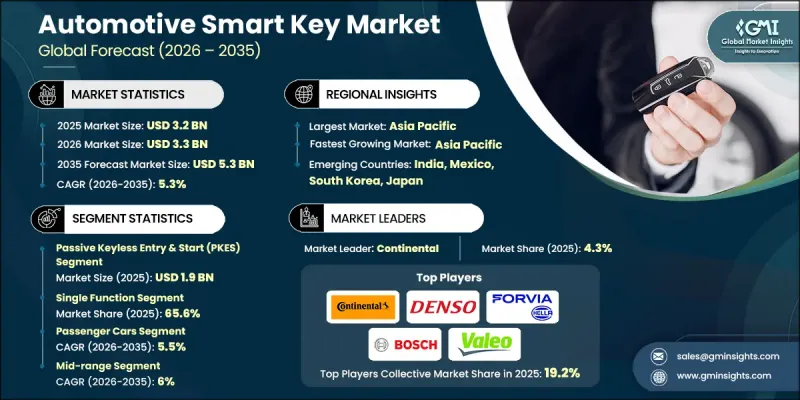
LSH 26.04.23The Global Automotive Smart Key Market was valued at USD 3.2 billion in 2025 and is estimated to grow at a CAGR of 5.3% to reach USD 5.3 billion by 2035. The automotive smart key industry is evolving rapidly as the automotive sector continues shifting from traditional mechanical key systems toward digitally connected vehicle access technologies. Declining component costs and rising consumer expectations for convenience and connectivity are accelerating the integration of smart key solutions across a wider range of vehicle segments. Modern automotive access systems are no longer limited to simple unlocking functions, as they are increasingly integrated with broader digital ecosystems that connect vehicles with smartphones, mobile applications, and cloud-based platforms. This transformation is influencing both product development strategies and the broader automotive technology landscape. As vehicles become more software-driven, digital access systems are expected to play a larger role in enabling seamless user experiences and improving overall vehicle security. Manufacturers are increasingly prioritizing the development of advanced authentication mechanisms and secure communication protocols to address evolving cybersecurity concerns. Continuous advancements in wireless communication technologies, encrypted signal transmission, and intelligent vehicle access platforms are further strengthening the growth of the automotive smart key market. In addition, the rising demand for enhanced vehicle convenience features and digital mobility services is encouraging automakers to incorporate smart key solutions across various vehicle categories.
As vehicles continue to rely more heavily on software-defined technologies, compliance standards and certification frameworks have become essential to maintaining system security and operational reliability within the automotive smart key market. These regulatory requirements help ensure that vehicle access technologies meet strict cybersecurity protocols and safety benchmarks. Strong encryption frameworks and secure authentication mechanisms are becoming essential components of smart key systems to protect sensitive user data and prevent unauthorized vehicle access. Advanced technological developments are also shaping the future of the automotive smart key industry. Emerging wireless technologies such as ultra-wideband positioning, near-field communication, and advanced encrypted communication protocols are enhancing the functionality and security of smart key solutions. These innovations allow vehicles to accurately detect the proximity and location of a key device, significantly reducing the risk of signal interception and unauthorized access. At the same time, the increasing focus on secure hardware infrastructure is encouraging semiconductor manufacturers and automotive suppliers to expand the production of advanced secure element chips designed specifically for vehicle access systems.
| Market Scope | |
|---|---|
| Start Year | 2025 |
| Forecast Year | 2026-2035 |
| Start Value | $3.2 Billion |
| Forecast Value | $5.3 Billion |
| CAGR | 5.3% |
The passive keyless entry and start (PKES) segment held 59% share, generating USD 1.9 billion in 2025. Passive keyless entry and start systems are widely adopted due to the convenience they provide to vehicle owners. These systems allow drivers to unlock doors and start the engine automatically when the key device is within a specific proximity, eliminating the need for manual key usage. Such features simplify everyday vehicle access and improve the overall driving experience. In addition to convenience, PKES systems incorporate multiple layers of security to protect vehicles from unauthorized access. Advanced encrypted communication protocols ensure that signals exchanged between the vehicle and the smart key remain secure. These systems also rely on proximity detection technologies supported by low-frequency and radio-frequency communication methods that allow vehicles to identify the presence of an authorized key device accurately.
The single-function segment accounted for 65.6% share in 2025 and is projected to reach USD 3.3 billion by 2035. A single-function automotive smart key is designed to perform one primary operation, typically enabling either keyless entry or engine ignition. These keys provide a straightforward and user-friendly solution that focuses on delivering basic convenience without integrating multiple advanced features. Their compact design makes them easy to carry and practical for daily use. In addition, these smart keys are engineered with low-power standby modes that help extend battery life and improve device efficiency. Consumers often prefer single-function smart keys because they offer reliable vehicle access capabilities at a relatively affordable cost. Their simplicity also makes them suitable for a wide range of vehicles, particularly entry-level and mid-range models. These keys typically support fundamental vehicle access functions such as locking and unlocking doors remotely while maintaining essential anti-theft protections.
United States Automotive Smart Key Market generated USD 740.4 million in 2025 and is projected to grow at a CAGR of 4.6% between 2026 and 2035. The United States represents a key market within the North America automotive smart key industry due to the growing adoption of connected vehicle technologies and advanced automotive electronics. Automotive manufacturers operating in the region are increasingly integrating smart access systems into their vehicle platforms as part of broader digital mobility strategies. Consumer demand for improved vehicle convenience, enhanced safety features, and integrated digital services is encouraging automakers to expand the use of smart key technologies across multiple vehicle segments. As a result, smart keys are becoming increasingly common not only in premium vehicles but also in mid-range automobile categories. Technological innovations such as ultra-wideband communication, near-field connectivity, and wireless authentication technologies are further improving the functionality and reliability of these systems.
Key companies operating in the Global Automotive Smart Key Market include Alps Alpine, Bosch, Continental, Denso, Forvia HELLA, Huf Hulsbeck & Furst, Lear, Tokai Rika, Valeo, and ZF Friedrichshafen. Companies participating in the Global Automotive Smart Key Market are focusing on multiple strategic initiatives to strengthen their market presence and maintain technological competitiveness. Many organizations are increasing investments in research and development to design more secure and intelligent vehicle access systems. Technology innovation is a major priority, with companies developing advanced encryption technologies, wireless authentication systems, and integrated digital key platforms that improve both security and user convenience. Strategic collaborations with automotive manufacturers are also becoming increasingly common, allowing technology providers to integrate their solutions directly into next-generation vehicle platforms. In addition, companies are working to expand their semiconductor and electronic component capabilities to support the growing demand for secure hardware solutions.
Table of Contents
Chapter 1 Methodology
- 1.1 Research approach
- 1.2 Quality commitments
- 1.2.1 GMI AI policy & data integrity commitment
- 1.3 Research trail & confidence scoring
- 1.3.1 Research trail components
- 1.3.2 Scoring components
- 1.4 Data collection
- 1.4.1 Partial list of primary sources
- 1.5 Data mining sources
- 1.5.1 Paid sources
- 1.6 Base estimates and calculations
- 1.6.1 Base year calculation
- 1.7 Forecast model
- 1.8 Research transparency addendum
Chapter 2 Executive Summary
- 2.1 Industry 360° synopsis
- 2.2 Key market trends
- 2.2.1 Regional
- 2.2.2 Technology
- 2.2.3 Function
- 2.2.4 Vehicle
- 2.2.5 Vehicle Class
- 2.2.6 Vehicle Powertrain
- 2.2.7 Distribution Channel
- 2.3 TAM analysis, 2026-2035
- 2.4 CXO perspectives: Strategic imperatives
Chapter 3 Industry Insights
- 3.1 Industry ecosystem analysis
- 3.1.1 Supplier landscape
- 3.1.2 Profit margin
- 3.1.3 Cost structure
- 3.1.4 Value addition at each stage
- 3.1.5 Factor affecting the value chain
- 3.1.6 Disruptions
- 3.2 Industry impact forces
- 3.2.1 Growth drivers
- 3.2.1.1 Rising Consumer Demand For Vehicle Security & Convenience Features
- 3.2.1.2 OEM integration of keyless entry systems in mid-range & economy segments
- 3.2.1.3 Proliferation of electric vehicles driving smart key adoption
- 3.2.1.4 Government mandates on vehicle safety & anti-theft technologies
- 3.2.2 Industry pitfalls and challenges
- 3.2.2.1 Cybersecurity vulnerabilities & relay attack concerns
- 3.2.2.2 Aftermarket installation challenges & compatibility issues
- 3.2.3 Market opportunities
- 3.2.3.1 Ultra-Wideband (UWB) technology adoption for enhanced security
- 3.2.3.2 Integration with smart city & mobility-as-a-service (MaaS) ecosystems
- 3.2.3.3 Biometric authentication feature upgrades in luxury segment
- 3.2.3.4 Smartphone penetration enabling mobile-based digital key solutions
- 3.2.1 Growth drivers
- 3.3 Growth potential analysis
- 3.4 Regulatory landscape
- 3.4.1 North America
- 3.4.1.1 National Highway Traffic Safety Administration (NHTSA)
- 3.4.1.2 Federal Motor Vehicle Safety Standards (FMVSS)
- 3.4.2 Europe
- 3.4.2.1 European Commission
- 3.4.2.2 WP.29 / UNECE
- 3.4.2.3 Cyber Resilience Act (EU)
- 3.4.3 Asia Pacific
- 3.4.3.1 India Connected Vehicle Cybersecurity Framework
- 3.4.3.2 China GB 44495 - Vehicle Cybersecurity Standard
- 3.4.3.3 Japan Automotive Cybersecurity Guidelines (JAMA / JAPIA)
- 3.4.4 Latin America
- 3.4.4.1 Brazil Rota 2030 Automotive Policy
- 3.4.4.2 National Data Protection Regulations
- 3.4.5 Middle East & Africa
- 3.4.5.1 GCC Regulatory Framework on Vehicle Safety & Cybersecurity
- 3.4.5.2 Saudi Standards, Metrology and Quality Organization (SASO)
- 3.4.1 North America
- 3.5 Investment & Funding Analysis
- 3.6 Porter's analysis
- 3.7 PESTEL analysis
- 3.8 Technology and innovation landscape
- 3.8.1 Current technological trends
- 3.8.1.1 Passive Keyless Entry (PKE) Systems
- 3.8.1.2 Over-the-Air (OTA) Firmware Updates
- 3.8.1.3 Multi-Function Smart Key Platforms
- 3.8.2 Emerging technologies
- 3.8.2.1 Smartphone-Based Digital Key Solutions
- 3.8.2.2 Ultra-Wideband (UWB)
- 3.8.2.3 Integrated Biometric Authentication
- 3.8.2.4 Wearable and Auxiliary Device Integration
- 3.8.1 Current technological trends
- 3.9 Pricing analysis (Driven by Primary Research)
- 3.9.1 Historical Price Trend Analysis
- 3.9.2 Pricing Strategy by Player Type (Premium / Value / Cost-plus)
- 3.10 Patent landscape (Driven by Primary Research)
- 3.11 Impact of AI & Generative AI on the Market
- 3.11.1 AI-driven disruption of existing business models
- 3.11.2 GenAI use cases & adoption roadmap by segment
- 3.11.3 Risks, limitations & regulatory considerations
- 3.12 Integration with Connected Vehicle & IoT Ecosystems
- 3.12.1 V2X Communication Protocol Integration
- 3.12.2 Cloud Platform & Data Analytics Integration
- 3.12.3 Smart & Digital Ecosystem Interoperability
- 3.13 Mitigation of Wireless Signal Interception Threats
- 3.13.1 Relay Attack Prevention Technologies
- 3.13.2 Encryption & Authentication Protocol Evolution
- 3.13.3 Ultra-Wideband (UWB) & Secure Ranging Solutions
- 3.14 Case studies
- 3.15 Future outlook & opportunities
- 3.16 Forecast assumptions & scenario analysis (Driven by Primary Research)
- 3.16.1 Base Case - key macro & industry variables driving CAGR
- 3.16.2 Optimistic Scenarios - Favorable macro and industry tailwinds
- 3.16.3 Pessimistic Scenario - Macroeconomic slowdown or industry headwinds
Chapter 4 Competitive Landscape, 2025
- 4.1 Introduction
- 4.2 Company market share analysis
- 4.2.1 North America
- 4.2.2 Europe
- 4.2.3 Asia Pacific
- 4.2.4 LATAM
- 4.2.5 MEA
- 4.3 Competitive analysis of major market players
- 4.4 Competitive positioning matrix
- 4.5 Key developments
- 4.5.1 Mergers & acquisitions
- 4.5.2 Partnerships & collaborations
- 4.5.3 New product launches
- 4.5.4 Expansion plans and funding
- 4.6 Company tier benchmarking
- 4.6.1 Tier classification criteria & qualifying thresholds
- 4.6.2 Tier positioning matrix by revenue, geography & innovation
Chapter 5 Market Estimates & Forecast, By Technology, 2022 - 2035 ($Mn, Thousand Units)
- 5.1 Key trends
- 5.2 Remote Keyless Entry (RKE)
- 5.3 Passive Keyless Entry & Start (PKES)
- 5.4 Biometric Entry Systems
- 5.5 Mobile/Digital Key
- 5.6 Others
Chapter 6 Market Estimates & Forecast, By Function, 2022 - 2035 ($Mn, Thousand Units)
- 6.1 Key trends
- 6.2 Single Function
- 6.3 Multi-Function
Chapter 7 Market Estimates & Forecast, By Vehicle, 2022 - 2035 ($Mn, Thousand Units)
- 7.1 Key trends
- 7.2 Passenger cars
- 7.2.1 Hatchback
- 7.2.2 Sedan
- 7.2.3 SUV
- 7.3 Commercial vehicles
- 7.3.1 LCV
- 7.3.2 MCV
- 7.3.3 HCV
Chapter 8 Market Estimates & Forecast, By Vehicle Class, 2022 - 2035 ($Mn, Thousand Units)
- 8.1 Key trends
- 8.2 Economy/entry-level
- 8.3 Mid-range
- 8.4 Premium/luxury
Chapter 9 Market Estimates & Forecast, By Vehicle Powertrain, 2022 - 2035 ($Mn, Thousand Units)
- 9.1 Key trends
- 9.2 ICE
- 9.3 EV/Hybrid
Chapter 10 Market Estimates & Forecast, By Distribution Channel, 2022 - 2035 ($Mn, Thousand Units)
- 10.1 Key trends
- 10.2 OEM
- 10.3 Aftermarket
Chapter 11 Market Estimates & Forecast, By Region, 2022 - 2035 ($Mn, Thousand Units)
- 11.1 Key trends
- 11.2 North America
- 11.2.1 US
- 11.2.2 Canada
- 11.3 Europe
- 11.3.1 Germany
- 11.3.2 UK
- 11.3.3 France
- 11.3.4 Italy
- 11.3.5 Spain
- 11.3.6 Belgium
- 11.3.7 Russia
- 11.3.8 Netherlands
- 11.4 Asia Pacific
- 11.4.1 China
- 11.4.2 India
- 11.4.3 Japan
- 11.4.4 South Korea
- 11.4.5 Australia
- 11.4.6 Singapore
- 11.4.7 Malaysia
- 11.4.8 Vietnam
- 11.4.9 Thailand
- 11.5 Latin America
- 11.5.1 Brazil
- 11.5.2 Mexico
- 11.5.3 Argentina
- 11.5.4 Colombia
- 11.6 MEA
- 11.6.1 South Africa
- 11.6.2 Saudi Arabia
- 11.6.3 UAE
Chapter 12 Company Profiles
- 12.1 Global players
- 12.1.1 Continental
- 12.1.2 Denso
- 12.1.3 Valeo
- 12.1.4 ZF Friedrichshafen
- 12.1.5 Forvia HELLA
- 12.1.6 Tokai Rika
- 12.1.7 Huf Hulsbeck & Furst
- 12.1.8 Lear
- 12.1.9 Bosch
- 12.1.10 Alps Alpine
- 12.2 Regional players
- 12.2.1 Minda
- 12.2.2 Alpha
- 12.2.3 Honda Lock
- 12.2.4 U-Shin
- 12.2.5 Strattec Security
- 12.2.6 Marquardt
- 12.3 Emerging players
- 12.3.1 TEQ
- 12.3.2 Thales
- 12.3.3 Automotive Key Solutions
- 12.3.4 Infineon


