|
시장보고서
상품코드
1998812
자동차 점화 시스템 시장 기회, 성장요인, 업계 동향 분석 및 예측(2026-2035년)Automotive Ignition System Market Opportunity, Growth Drivers, Industry Trend Analysis, and Forecast 2026 - 2035 |
||||||

세계의 자동차 점화 시스템 시장은 2025년에 137억 달러로 평가되었고, CAGR 7.8%로 성장하여 2035년까지 288억 달러에 달할 것으로 예측됩니다.
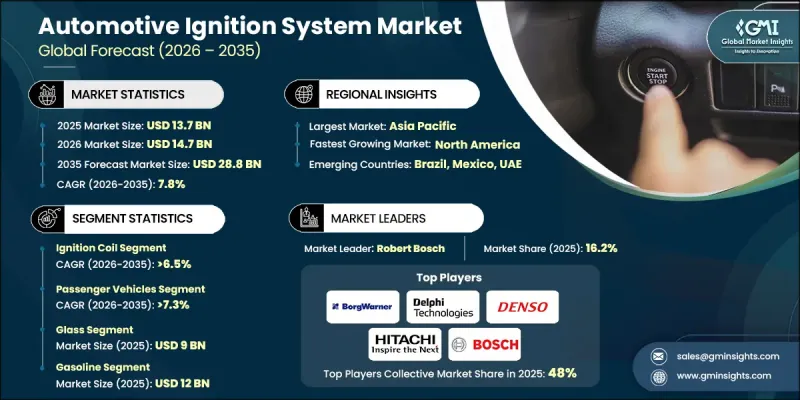
시장 확대는 고급차에 대한 소비자 선호도 증가, 엔진 성능, 연비, 신뢰성 향상에 대한 수요 증가, 그리고 전 세계 SUV, 크로스오버 차량, 전기차의 급속한 보급에 의해 주도되고 있습니다. 자동차 제조업체, Tier 1 공급업체 및 차량 운영업체들은 엔진 시동 효율 향상, 배기가스 배출량 감소, 엄격한 안전 및 규제 기준 준수를 통해 차량을 차별화해야 한다는 압박을 점점 더 많이 받고 있습니다. 이러한 요구사항을 충족시키기 위해서는 첨단 점화 시스템 기술이 필수 불가결한 요소가 되고 있습니다. 또한, 이 분야는 엔진의 전동화, 커넥티드카 기술, 그리고 이코노미, 중형차, 프리미엄 차량 전반에 걸쳐 비용 최적화된 고성능 점화 부품을 가능하게 하는 모듈식 확장형 플랫폼과 같은 트렌드에 의해 형성되고 있으며, 전 세계 승용차, 중형차, 프리미엄 자동차, SUV, EV SUV, EV 부문에 장기적인 가치를 창출하고 있습니다.
| 시장 범위 | |
|---|---|
| 개시 연도 | 2025년 |
| 예측 기간 | 2026-2035년 |
| 개시 연도 시장 규모 | 137억 달러 |
| 예측액 | 288억 달러 |
| CAGR | 7.8% |
점화 코일 부문은 2025년 36%의 점유율을 차지했으며, 2035년까지 연평균 복합 성장률(CAGR) 6.5%를 나타낼 것으로 예측됩니다. 점화코일은 스파크 발생과 효율적인 연소에 필요한 고전압을 발생시키기 위한 기본 부품으로 현대 가솔린 엔진에 없어서는 안 될 존재입니다. 승용차, SUV, 하이브리드 차량에 코일 온 플러그(COP) 점화 시스템을 채택함으로써 전 세계 OEM 및 애프터마켓 채널에서 지속적인 수요를 확보하고 있습니다. 고에너지 코일과 통합형 전자식 점화 모듈의 조합은 연비 향상, 엔진 작동의 부드러움, 배기가스 배출 감소에 기여하고 있습니다.
승용차 부문은 2025년 76%의 점유율을 차지했으며, 2026년부터 2035년까지 연평균 복합 성장률(CAGR) 7.3%로 성장할 것으로 전망됩니다. 가솔린차, 하이브리드차, SUV 모델의 대량 생산이 이 부문을 주도하고 있습니다. 보다 부드러운 엔진 성능, 연비 향상, 배출가스 규제 준수에 대한 소비자의 요구로 인해 COP 시스템, 고에너지 점화 코일, 장수명 점화 플러그의 채택이 가속화되고 있습니다. 다양한 승용차 부문에서 전자식 점화 시스템의 OEM 표준화를 통해 북미, 유럽 및 아시아태평양 전체에서 이러한 우위를 더욱 공고히 하고 있습니다.
중국의 자동차 점화 시스템 시장은 51%의 점유율을 차지하며 2025년 25억 달러 시장 규모를 기록했습니다. 이러한 선도적 지위는 가솔린 및 하이브리드 자동차의 대량 생산, 첨단 점화 기술의 빠른 도입, OEM, Tier 1 공급업체 및 전문 점화 시스템 제조업체의 강력한 존재감에서 기인합니다. 중국의 탄탄한 자동차 인프라, 광범위한 공급망 네트워크, 방대한 차량 보유량은 승용차, SUV 및 소형 상용차에서 고출력 점화 코일, COP 시스템, 점화 플러그 및 전자식 점화 모듈에 대한 견고한 수요를 뒷받침하고 있습니다.
자주 묻는 질문
목차
제1장 조사 방법과 범위
제2장 주요 요약
제3장 업계 인사이트
제4장 경쟁 구도
제5장 시장 추산 및 예측 : 구성부품별, 2022-2035
제6장 시장 추산 및 예측 : 차종별, 2022-2035
제7장 시장 추산 및 예측 : 점화 방식별, 2022-2035
제8장 시장 추산 및 예측 : 엔진별, 2022-2035
제9장 시장 추산 및 예측 : 판매채널별, 2022-2035
제10장 시장 추산 및 예측 : 지역별, 2022-2035
제11장 기업 개요
LSH 26.04.23The Global Automotive Ignition System Market was valued at USD 13.7 billion in 2025 and is estimated to grow at a CAGR of 7.8% to reach USD 28.8 billion by 2035.
The market expansion is fueled by the rising consumer preference for premium vehicles, growing demand for enhanced engine performance, fuel efficiency, and reliability, and the rapid proliferation of SUVs, crossovers, and electric vehicles worldwide. Automotive OEMs, Tier-1 suppliers, and fleet operators are under increasing pressure to differentiate vehicles through improved engine start efficiency, lower emissions, and compliance with stringent safety and regulatory standards. Advanced ignition system technologies are becoming essential to meet these requirements. The sector is also being shaped by trends in engine electrification, connected vehicle technology, and modular scalable platforms that allow for cost-optimized, high-performance ignition components across economy, mid-range, and premium vehicles, creating long-term value for passenger car, SUV, and EV segments globally.
| Market Scope | |
|---|---|
| Start Year | 2025 |
| Forecast Year | 2026-2035 |
| Start Value | $13.7 Billion |
| Forecast Value | $28.8 Billion |
| CAGR | 7.8% |
The ignition coil segment held a 36% share in 2025 and is expected to grow at a CAGR of 6.5% through 2035. Ignition coils are fundamental for generating the high voltage needed for spark creation and efficient combustion, making them critical for modern gasoline engines. The adoption of coil-on-plug (COP) ignition systems across passenger cars, SUVs, and hybrid vehicles ensures sustained demand in OEM and aftermarket channels worldwide. High-energy coils, coupled with integrated electronic ignition modules, contribute to better fuel efficiency, smoother engine operation, and reduced emissions.
The passenger vehicles segment held 76% share in 2025 and is anticipated to grow at a CAGR of 7.3% from 2026 to 2035. High production volumes of gasoline, hybrid, and SUV models drive this segment. Consumer demand for smoother engine performance, improved fuel economy, and adherence to emission regulations has accelerated the adoption of COP systems, high-energy ignition coils, and long-life spark plugs. OEM standardization of electronically controlled ignition systems across various passenger vehicle segments reinforces this dominance across North America, Europe, and Asia Pacific.
China Automotive Ignition System Market held a 51% share, generating USD 2.5 billion in 2025. This leadership is attributed to the country's high production of gasoline and hybrid vehicles, rapid integration of advanced ignition technologies, and robust presence of OEMs, Tier-1 suppliers, and specialized ignition system manufacturers. China's well-established automotive infrastructure, extensive supply chain networks, and large vehicle parc support strong demand for high-energy ignition coils, COP systems, spark plugs, and electronic ignition modules across passenger vehicles, SUVs, and light commercial vehicles.
Key players operating in the Global Automotive Ignition System Market include Denso, BorgWarner, NGK Spark Plug, Hitachi Automotive Systems, Mitsubishi Electric, Delphi Technologies, Webasto, Robert Bosch, Magna International, and Inalfa Roof Systems. Companies in the automotive ignition system market are adopting multiple strategies to enhance their market presence. They are investing in R&D to develop high-performance, energy-efficient, and emission-compliant ignition systems. Strategic partnerships with OEMs and Tier-1 suppliers help expand distribution and integration into new vehicle models. Firms are also diversifying product portfolios to include coil-on-plug systems, electronic ignition modules, and hybrid vehicle-compatible solutions. Geographic expansion into emerging automotive markets ensures a broader customer base. Additionally, companies focus on improving after-sales support, extended warranties, and digital monitoring capabilities to enhance brand loyalty.
Table of Contents
Chapter 1 Methodology & Scope
- 1.1 Research approach
- 1.2 Quality commitments
- 1.2.1 GMI AI policy & data integrity commitment
- 1.3 Research trail & confidence scoring
- 1.3.1 Research trail components
- 1.3.2 Scoring components
- 1.4 Data collection
- 1.4.1 Partial list of primary sources
- 1.5 Data mining sources
- 1.5.1 Paid sources
- 1.6 Base estimates and calculations
- 1.6.1 Base year calculation
- 1.7 Forecast model
- 1.8 Research transparency addendum
Chapter 2 Executive Summary
- 2.1 Industry 360° synopsis, 2022 - 2035
- 2.2 Key market trends
- 2.2.1 Regional
- 2.2.2 Component
- 2.2.3 Vehicle
- 2.2.4 Engine
- 2.2.5 Ignition
- 2.2.6 Sales channel
- 2.3 TAM Analysis, 2026-2035
- 2.4 CXO perspectives: Strategic imperatives
- 2.4.1 Executive decision points
- 2.4.2 Critical success factors
- 2.5 Future outlook and strategic recommendations
Chapter 3 Industry Insights
- 3.1 Industry ecosystem analysis
- 3.1.1 Supplier Landscape
- 3.1.2 Profit Margin
- 3.1.3 Cost structure
- 3.1.4 Value addition at each stage
- 3.1.5 Factor affecting the value chain
- 3.1.6 Disruptions
- 3.2 Industry impact forces
- 3.2.1 Growth drivers
- 3.2.1.1 Stringent Emission Regulations
- 3.2.1.2 Growth in Passenger Vehicles & SUVs
- 3.2.1.3 Technological Advancements
- 3.2.1.4 Expansion of Hybrid Powertrains
- 3.2.2 Industry pitfalls and challenges
- 3.2.2.1 Rapid shift toward battery electric vehicles (BEVs)
- 3.2.2.2 High cost of advanced ignition electronics
- 3.2.3 Market opportunities
- 3.2.3.1 Aftermarket replacement demand
- 3.2.3.2 Emerging markets & hybrid vehicle growth
- 3.2.3.3 Connected & smart vehicle integration
- 3.2.3.4 Lightweight & energy-efficient components
- 3.2.1 Growth drivers
- 3.3 Growth potential analysis
- 3.4 Regulatory landscape
- 3.4.1 North America
- 3.4.1.1 U.S.: EPA, CARB, NHTSA Standards
- 3.4.1.2 Canada: Transport Canada, CMVSS 305
- 3.4.2 Europe
- 3.4.2.1 Germany: BMDV, Euro 6/7 Regulations
- 3.4.2.2 France: Ministry of Transport, Euro 6/7
- 3.4.2.3 UK: Department for Transport, Euro 6/7
- 3.4.2.4 Italy: Ministry of Infrastructure & Transport, Emission Compliance
- 3.4.3 Asia Pacific
- 3.4.3.1 China: MIIT, China 6/7 Standards
- 3.4.3.2 Japan: MLIT, JIS Regulations
- 3.4.3.3 South Korea: MOLIT, KS Emission Standards
- 3.4.3.4 India: MoRTH, BS6 Norms
- 3.4.4 Latin America
- 3.4.4.1 Brazil: DENATRAN, CONAMA Standards
- 3.4.4.2 Mexico: Ministry of Communications & Transport
- 3.4.5 Middle East and Africa
- 3.4.5.1 UAE: RTA, ESMA Regulations
- 3.4.5.2 Saudi Arabia: Ministry of Transport, SASO Emission Standards
- 3.4.1 North America
- 3.5 Porter's analysis
- 3.6 PESTEL analysis
- 3.7 Technology and Innovation Landscape
- 3.7.1 Current technological trends
- 3.7.2 Emerging technologies
- 3.8 Pricing analysis (Driven by Primary Research)
- 3.8.1 Historical Price Trend Analysis
- 3.8.2 Pricing Strategy by Player Type (Premium / Value / Cost-Plus)
- 3.8.3 Regional Price Variation Analysis
- 3.9 Cost breakdown analysis
- 3.10 Patent landscape (Driven by Primary Research)
- 3.11 Impact of Artificial Intelligence (AI)
- 3.11.1 Predictive maintenance of electric karts
- 3.11.2 Optimized scheduling & track utilization
- 3.11.3 Personalization & dynamic pricing
- 3.11.4 Gamification and leaderboards
- 3.11.5 Real-time collision detection
- 3.11.6 Automated race analytics & coaching
- 3.12 Sustainability and Environmental Aspects
- 3.12.1 Sustainable practices
- 3.12.2 Waste reduction strategies
- 3.12.3 Energy efficiency in production
- 3.12.4 Eco-friendly initiatives
- 3.12.5 Carbon footprint considerations
- 3.13 Capacity & production landscape (Driven by Primary Research)
- 3.13.1 Installed capacity by region & key producer
- 3.13.2 Capacity utilization rates & expansion pipelines
- 3.14 Use case scenarios
Chapter 4 Competitive Landscape, 2025
- 4.1 Introduction
- 4.2 Company market share analysis
- 4.2.1 North America
- 4.2.2 Europe
- 4.2.3 Asia Pacific
- 4.2.4 Latin America
- 4.2.5 Middle East & Africa
- 4.3 Competitive analysis of major market players
- 4.4 Competitive positioning matrix
- 4.5 Strategic outlook matrix
- 4.6 Key developments
- 4.6.1 Mergers & acquisitions
- 4.6.2 Partnerships & collaborations
- 4.6.3 New product launches
- 4.6.4 Expansion plans and funding
Chapter 5 Market Estimates & Forecast, By Component, 2022 - 2035 ($Bn, Units)
- 5.1 Key trends
- 5.2 Ignition Coil
- 5.3 Spark Plug
- 5.4 Glow Plug
- 5.5 Ignition switch
- 5.6 Others
Chapter 6 Market Estimates & Forecast, By Vehicle, 2022 - 2035 ($Bn, Units)
- 6.1 Key trends
- 6.2 Passenger vehicles
- 6.2.1 Hatchbacks
- 6.2.2 Sedans
- 6.2.3 SUV
- 6.3 Commercial vehicles
- 6.3.1 Light commercial vehicles (LCV)
- 6.3.2 Medium commercial vehicles (MCV)
- 6.3.3 Heavy commercial vehicles (HCV)
Chapter 7 Market Estimates & Forecast, By Ignition, 2022 - 2035 ($Bn, Units)
- 7.1 Key trends
- 7.2 Coil-on-Plug (COP) Ignition
- 7.3 Simultaneous Ignition
- 7.4 Compression Ignition
Chapter 8 Market Estimates & Forecast, By Engine, 2022 - 2035 ($Bn, Units)
- 8.1 Key trends
- 8.2 Gasoline
- 8.3 Diesel
Chapter 9 Market Estimates & Forecast, By Sales Channel, 2022 - 2035 ($Bn, Units)
- 9.1 Key trends
- 9.2 OEM
- 9.3 Aftermarket
Chapter 10 Market Estimates & Forecast, By Region, 2022 - 2035 ($Bn, Units)
- 10.1 Key trends
- 10.2 North America
- 10.2.1 US
- 10.2.2 Canada
- 10.3 Europe
- 10.3.1 UK
- 10.3.2 Germany
- 10.3.3 France
- 10.3.4 Italy
- 10.3.5 Spain
- 10.3.6 Belgium
- 10.3.7 Netherlands
- 10.3.8 Sweden
- 10.4 Asia Pacific
- 10.4.1 China
- 10.4.2 India
- 10.4.3 Japan
- 10.4.4 Australia
- 10.4.5 Singapore
- 10.4.6 South Korea
- 10.4.7 Vietnam
- 10.4.8 Indonesia
- 10.5 Latin America
- 10.5.1 Brazil
- 10.5.2 Mexico
- 10.5.3 Argentina
- 10.6 MEA
- 10.6.1 UAE
- 10.6.2 South Africa
- 10.6.3 Saudi Arabia
Chapter 11 Company Profiles
- 11.1 Global Player
- 11.1.1 BorgWarner
- 11.1.2 Delphi Technologies
- 11.1.3 Denso
- 11.1.4 Hitachi Automotive Systems
- 11.1.5 Inalfa Roof Systems
- 11.1.6 Magna International
- 11.1.7 Mitsubishi Electric
- 11.1.8 NGK Spark Plug
- 11.1.9 Robert Bosch
- 11.1.10 Webasto
- 11.2 Regional Player
- 11.2.1 Aisin Seiki
- 11.2.2 CIE Automotive
- 11.2.3 Continental
- 11.2.4 Hitachi Metals
- 11.2.5 Hyundai Mobis
- 11.2.6 Inteva Products
- 11.2.7 Mahle
- 11.2.8 Mando
- 11.2.9 Valeo
- 11.2.10 Yachiyo Industry