
|
시장보고서
상품코드
1998814
하이브리드 마이크로그리드 시장 기회, 성장요인, 업계 동향 분석 및 예측(2026-2035년)Hybrid Microgrid Market Opportunity, Growth Drivers, Industry Trend Analysis, and Forecast 2026 - 2035 |
||||||

세계의 하이브리드 마이크로그리드 시장은 2025년에 40억 달러로 평가되었고, CAGR 18.8%로 성장하여 2035년까지 242억 달러에 달할 것으로 예측됩니다.
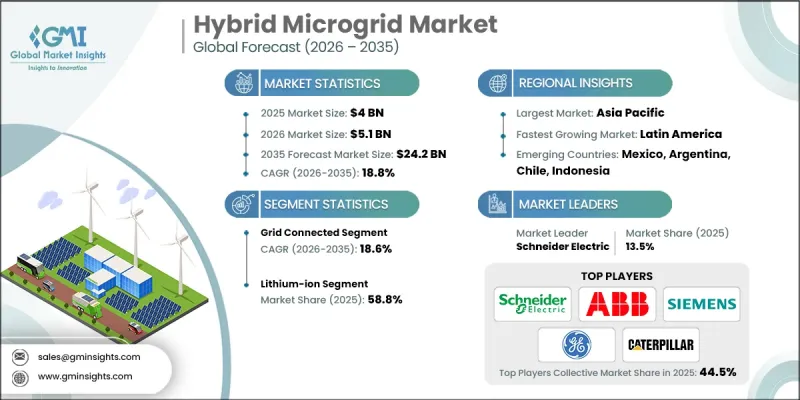
하이브리드 마이크로그리드는 재생에너지원, 저장 장치 및 효율적인 예비 전력을 통합하여 상업, 산업 및 원격지의 시설에서 전력 사용을 최적화하고 연료 소비를 최소화하며 장기적으로 에너지 비용을 절감할 수 있도록 합니다. 이상기후, 자연재해, 잦은 전력망 정전 등으로 인해 중요 인프라 및 Off-grid 지역에서 안정적이고 강력한 전력 솔루션에 대한 요구가 증가하고 있습니다. 정부의 인센티브, 보조금, 재생가능 에너지 프로그램이 도입을 가속화하고 있으며, 디지털화, 스마트 그리드 기술, 예측 분석, 첨단 제어 시스템이 운영 효율성을 향상시키고 있습니다. 또한, 지속적인 연구 개발 노력과 오지 지역의 에너지 자립에 대한 수요 증가로 인해 하이브리드 마이크로그리드 도입 기회가 확대되고 있으며, 하이브리드 마이크로그리드는 전 세계적으로 지속 가능한 에너지 관리를 위한 전략적 솔루션이 되고 있습니다.
| 시장 범위 | |
|---|---|
| 개시 연도 | 2025년 |
| 예측 기간 | 2026-2035년 |
| 개시 연도 시장 규모 | 40억 달러 |
| 예측액 | 242억 달러 |
| CAGR | 18.8% |
계통 연계 시스템 부문은 71.8%의 점유율을 차지하고 있으며, 2035년까지 연평균 복합 성장률(CAGR) 18.6%를 나타낼 것으로 예측됩니다. 스마트 그리드 기술, 그리드 엣지 솔루션 및 고급 디지털 제어와의 통합을 통해 보다 높은 수준의 도입이 가능해졌습니다. 이러한 시스템은 정전, 이상기후, 자연재해가 발생하기 쉬운 지역에서 특히 가치가 높으며, 중요한 시설에 안정적인 백업 전원과 지속적인 전력 공급을 제공합니다.
플로우 배터리 부문은 모듈식 설계, 확장성, 몇 시간에서 며칠에 걸친 에너지 저장 능력으로 인해 2035년까지 연평균 20.3%의 성장률을 보일 것으로 예측됩니다. 이 배터리는 전력 변동성을 평준화하여 재생에너지 통합을 지원하며, 높은 에너지 효율과 긴 사이클 수명으로 성능 저하를 최소화하면서 빈번한 충방전 작업이 가능합니다.
북미의 하이브리드 마이크로그리드 시장은 2025년 81.6%의 점유율을 차지하며 2035년까지 13억 달러 규모에 달했습니다. 이 시장의 성장은 청정 에너지로의 전환, 기후 변화 완화 노력, 재생에너지 비용의 하락, 그리고 강력하고 지속 가능한 전력 솔루션에 대한 수요 증가에 의해 주도되고 있습니다. 재생에너지 활용, 신뢰성 확보, 운영 비용 절감에 초점을 맞춘 하이브리드 솔루션을 제공하는 기업들이 시장 성장을 주도하고 있습니다. 이러한 추세는 에너지 자립성, 지속가능성 및 첨단 에너지 관리 기술에 대한 요구를 반영하고 있습니다.
자주 묻는 질문
목차
제1장 조사 방법과 범위
제2장 주요 요약
제3장 업계 인사이트
제4장 경쟁 구도
제5장 시장 규모와 예측 : 접속 형태별, 2022-2035
제6장 시장 규모와 예측 : 전력별, 2022-2035
제7장 시장 규모와 예측 : 에너지 저장 디바이스별, 2022-2035
제8장 시장 규모와 예측 : 용도별, 2022-2035
제9장 시장 규모와 예측 : 지역별, 2022-2035
제10장 기업 개요
LSH 26.04.23The Global Hybrid Microgrid Market was valued at USD 4 billion in 2025 and is estimated to grow at a CAGR of 18.8% to reach USD 24.2 billion by 2035.
Hybrid microgrids, which integrate renewable energy sources, storage, and efficient backup generation, enable commercial, industrial, and remote facilities to optimize power usage, minimize fuel consumption, and reduce long-term energy costs. Rising frequency of extreme weather events, natural disasters, and grid outages has heightened the need for dependable, resilient power solutions for critical infrastructure and off-grid locations. Government incentives, subsidies, and renewable energy programs are accelerating adoption, while digitalization, smart grid technologies, predictive analytics, and advanced control systems enhance operational efficiency. Additionally, ongoing R&D efforts and the growing demand for energy autonomy in remote regions are expanding deployment opportunities, making hybrid microgrids a strategic solution for sustainable energy management worldwide.
| Market Scope | |
|---|---|
| Start Year | 2025 |
| Forecast Year | 2026-2035 |
| Start Value | $4 Billion |
| Forecast Value | $24.2 Billion |
| CAGR | 18.8% |
The grid-connected systems segment held 71.8% share and is expected to grow at a CAGR of 18.6% through 2035. Integration with smart grid technologies, grid-edge solutions, and advanced digital controls is enabling more sophisticated deployments. These systems are especially valuable in regions prone to outages, extreme weather, and natural disasters, providing reliable backup power and continuous electricity supply to essential facilities.
The flow battery segment is projected to grow at a CAGR of 20.3% by 2035, owing to its modular design, scalability, and ability to store energy for hours or even days. These batteries support renewable energy integration by leveling fluctuations, while their high energy efficiency and long cycle life allow frequent charge-discharge operations with minimal performance degradation.
North America Hybrid Microgrid Market held 81.6% share in 2025, generating USD 1.3 billion by 2035. The market is fueled by the country's transition to clean energy, climate change mitigation efforts, declining renewable energy costs, and rising demand for resilient, sustainable power solutions. Companies focusing on hybrid solutions to harness renewable energy, ensure reliability, and reduce operational costs are shaping the growth of the market. The trend reflects the need for energy autonomy, sustainability, and advanced energy management technologies.
Key players operating in the Global Hybrid Microgrid Market include ABB, Ameresco, BoxPower Inc., Caterpillar Inc., Clarke Energy, EnSync Energy Systems, Elum, FlexGen Power Systems, General Electric Company, Gridscape, HOMER Energy, Jakson, MTU Solution, Piller Power Systems, S&C Electric Company, Saft, Schneider Electric, Siemens, Tesla Energy, and Yanmar Holdings Co., Ltd. Companies in the Global Hybrid Microgrid Market are adopting multiple strategies to strengthen market presence and competitive positioning. Many are investing heavily in R&D to improve energy storage efficiency, system reliability, and integration with renewable energy sources. Strategic partnerships and joint ventures with industrial, commercial, and utility clients are expanding deployment opportunities and creating long-term contracts. Firms are also pursuing geographic expansion to enter emerging markets with high energy vulnerability, while developing modular and scalable solutions to cater to diverse customer needs.
Table of Contents
Chapter 1 Methodology & Scope
- 1.1 Research design
- 1.2 Quality commitment
- 1.2.1 GMI AI policy & data integrity commitment
- 1.2.1.1 Source consistency protocol
- 1.2.1 GMI AI policy & data integrity commitment
- 1.3 Research trail & confidence scoring
- 1.3.1 Research trail components
- 1.3.2 Scoring components
- 1.4 Data Collection
- 1.4.1 Partial list of primary sources
- 1.5 Data mining sources
- 1.5.1 Paid sources
- 1.5.1.1 Sources, by region
- 1.5.1 Paid sources
- 1.6 Base estimates and calculations
- 1.6.1 Base year calculation for any one approach
- 1.7 Forecast model
- 1.8 Research transparency addendum
- 1.8.1 Source attribution framework
- 1.8.2 Quality assurance metrics
- 1.8.3 Our commitment to trust
- 1.9 Market definitions
Chapter 2 Executive Summary
- 2.1 Industry synopsis, 2022 - 2035
- 2.2 Business trends
- 2.3 Connectivity trends
- 2.4 Power source trends
- 2.5 Storage device trends
- 2.6 Application trends
- 2.7 Regional trends
Chapter 3 Industry Insights
- 3.1 Industry ecosystem
- 3.1.1 Raw material availability & sourcing analysis
- 3.1.2 Manufacturing capacity assessment
- 3.1.3 Supply chain resilience & risk factors
- 3.1.4 Distribution network analysis
- 3.2 Regulatory landscape
- 3.3 Industry impact forces
- 3.3.1 Growth drivers
- 3.3.2 Industry pitfalls & challenges
- 3.4 Growth potential analysis
- 3.5 Porter's analysis
- 3.5.1 Bargaining power of suppliers
- 3.5.2 Bargaining power of buyers
- 3.5.3 Threat of new entrants
- 3.5.4 Threat of substitutes
- 3.6 PESTEL analysis
- 3.6.1 Political factors
- 3.6.2 Economic factors
- 3.6.3 Social factors
- 3.6.4 Technological factors
- 3.6.5 Legal factors
- 3.6.6 Environmental factors
- 3.7 Cost structure analysis
- 3.8 Price trend analysis (USD/MW)
- 3.8.1 By connectivity
- 3.8.2 By region
- 3.9 Emerging opportunities & trends
- 3.9.1 Digitalization & IoT integration
- 3.9.2 Emerging market penetration
- 3.10 Investment analysis and future outlook
Chapter 4 Competitive landscape, 2026
- 4.1 Introduction
- 4.2 Company market share analysis, by region, 2025
- 4.2.1 North America
- 4.2.2 Europe
- 4.2.3 Asia Pacific
- 4.2.4 Latin America
- 4.2.5 Middle East & Africa
- 4.3 Competitive benchmarking
- 4.4 Key developments
- 4.4.1 Mergers & acquisitions
- 4.4.2 Partnerships & collaborations
- 4.4.3 New product launches
- 4.4.4 Expansion plans and funding
Chapter 5 Market Size and Forecast, By Connectivity, 2022 - 2035 (USD Billion & MW)
- 5.1 Key trends
- 5.2 Grid connected
- 5.3 Off grid
Chapter 6 Market Size and Forecast, By Power Source, 2022 - 2035 (USD Billion & MW)
- 6.1 Key trends
- 6.2 Diesel generators
- 6.3 Natural gas
- 6.4 Solar PV
- 6.5 CHP
- 6.6 Others
Chapter 7 Market Size and Forecast, By Storage Device, 2022 - 2035 (USD Billion & MW)
- 7.1 Key trends
- 7.2 Lithium-ion
- 7.3 Lead acid
- 7.4 Flow battery
- 7.5 Flywheels
- 7.6 Others
Chapter 8 Market Size and Forecast, By Application, 2022 - 2035 (USD Billion & MW)
- 8.1 Key trends
- 8.2 Healthcare
- 8.3 Educational institutes
- 8.4 Military
- 8.5 Utility
- 8.6 Industrial/ commercial
- 8.7 Remote
- 8.8 Others
Chapter 9 Market Size and Forecast, By Region, 2022 - 2035 (USD Billion & MW)
- 9.1 Key trends
- 9.2 North America
- 9.2.1 U.S.
- 9.2.2 Canada
- 9.2.3 Mexico
- 9.3 Europe
- 9.3.1 Germany
- 9.3.2 France
- 9.3.3 UK
- 9.3.4 Russia
- 9.3.5 Spain
- 9.3.6 Italy
- 9.3.7 Denmark
- 9.4 Asia Pacific
- 9.4.1 China
- 9.4.2 Japan
- 9.4.3 South Korea
- 9.4.4 India
- 9.4.5 Australia
- 9.4.6 Malaysia
- 9.4.7 Indonesia
- 9.5 Middle East and Africa
- 9.5.1 Saudi Arabia
- 9.5.2 UAE
- 9.5.3 South Africa
- 9.5.4 Iran
- 9.5.5 Nigeria
- 9.6 Latin America
- 9.6.1 Brazil
- 9.6.2 Argentina
- 9.6.3 Chile
Chapter 10 Company Profiles
- 10.1 ABB
- 10.2 Ameresco
- 10.3 BoxPower Inc
- 10.4 Caterpillar Inc.
- 10.5 Clarke Energy
- 10.6 EnSync Energy Systems
- 10.7 Elum
- 10.8 FlexGen Power Systems
- 10.9 General Electric Company
- 10.10 Gridscape
- 10.11 HOMER Energy
- 10.12 Jakson
- 10.13 MTU Solution
- 10.14 Piller Power Systems
- 10.15 S&C Electric Company
- 10.16 Saft
- 10.17 Schneider Electric
- 10.18 Siemens
- 10.19 Tesla Energy
- 10.20 Yanmar Holdings Co., Ltd