
|
시장보고서
상품코드
1998824
차량 스캐너 시장 기회, 성장요인, 업계 동향 분석 및 예측(2026-2035년)Vehicle Scanner Market Opportunity, Growth Drivers, Industry Trend Analysis, and Forecast 2026 - 2035 |
||||||

세계의 차량 스캐너 시장은 2025년에 31억 달러로 평가되었고, CAGR 7.2%로 성장하여 2035년까지 61억 달러에 달할 것으로 예측됩니다.
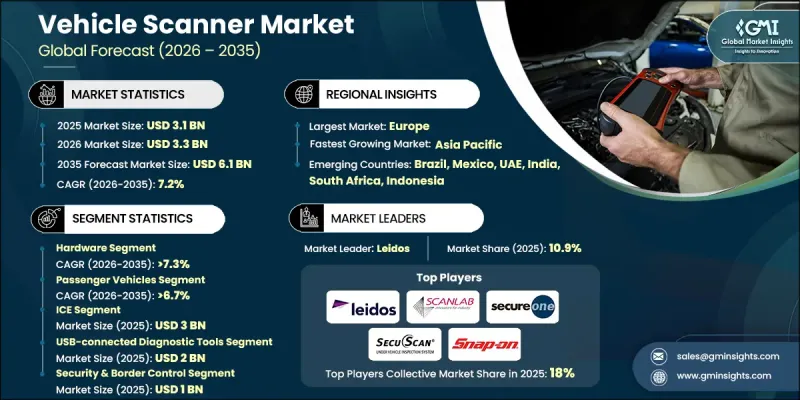
이 시장의 성장은 세계 보안에 대한 관심 증가, 물류 인프라 확대, 밀수, 테러, 차량 탑재형 폭발물 등의 위협에 대응해야 할 필요성이 증가하면서 성장세를 보이고 있습니다. 정부, 방위 기관, 주요 인프라 사업자 및 민간 기업은 안전성을 높이고, 규정 준수를 강화하며, 검문소 운영의 효율성을 높이기 위해 첨단 차량 검사 기술에 투자하고 있습니다. 스마트 시티, 도시 교통 네트워크, 고도의 보안을 갖춘 상업시설의 급속한 발전은 자동화 및 AI 기반 차량 스캐닝 시스템의 도입을 더욱 촉진하고 있습니다. 위협 감지 정확도 향상, 검사 시간 단축, 그리고 업무에 대한 지장을 최소화하기 위해 국경 관리, 국토 안보, 공항, 물류 사업자에 대한 압박이 가중되고 있는 것이 수요를 가속화하고 있습니다. 최신 차량 스캐너는 비침습적 검사, 차량 하부 위협 감지, 자동 번호판 인식(ALPR) 및 실시간 분석 기능을 제공합니다. 고에너지 엑스레이 이미징, 3D 플랫폼, AI를 활용한 이상 감지, 클라우드 연결, 통합 지휘 통제 소프트웨어 등의 혁신은 전 세계적으로 전통적인 검사 프로세스를 재정의하고 있습니다.
| 시장 범위 | |
|---|---|
| 개시 연도 | 2025년 |
| 예측 기간 | 2026-2035년 |
| 개시 연도 시장 규모 | 31억 달러 |
| 예측액 | 61억 달러 |
| CAGR | 7.2% |
하드웨어 부문은 2025년 59%의 점유율을 차지했으며, 2035년까지 연평균 복합 성장률(CAGR) 7.3%를 나타낼 것으로 예측됩니다. 하드웨어는 여전히 고해상도 이미지 처리, 정확한 위협 감지 및 운영 효율성 향상에 필수적인 역할을 하고 있습니다. 국경, 항만, 물류 허브 및 주요 인프라에 설치된 고정식, 이동식 및 드라이브 스루 스캐닝 시스템은 X-Ray 스캐너, UVSS, 멀티센서 이미징 유닛, 드라이브 스루 플랫폼과 같은 구성 요소에 의존하여 안정적인 성능과 규제 준수를 보장합니다. 규정 준수를 실현하고 있습니다.
승용차 부문은 2025년 76%의 점유율을 차지했으며, 2035년까지 연평균 6.7%의 성장률을 보일 것으로 전망됩니다. 승용차, SUV, 하이브리드 차량용 보안 및 검사 시스템은 국경 보안 문제 및 비침습적 검사 요건에 대응하기 위해 널리 도입되고 있습니다. 고정식 엑스레이 스캐너, UVSS, AI를 활용한 분석과 같은 첨단 기술 도입과 더불어 표준화된 스캔 프로토콜을 통해 북미, 유럽, 아시아태평양의 승용차 용도에서 선도적인 입지를 강화하고 있습니다.
유럽 차량용 스캐너 시장은 2025년 2억 4,890만 달러에 달했으며, 21%의 점유율을 차지할 것으로 예측됩니다. 이 지역의 성숙한 보안 인프라, 탄탄한 물류 네트워크, 이동식, 고정식, 드라이브 스루 방식의 스캔 솔루션 도입이 높은 수요를 뒷받침하고 있습니다. 정부 및 중요 인프라 운영자들은 운영 효율성, 위협 감지 정확도, 규제 준수, AI를 활용한 분석 기능 통합에 집중하고 있습니다. 엄격한 보안 규제, 선진적인 연구 개발 및 표준화 노력으로 유럽 시장에서의 입지를 더욱 공고히 하고 있습니다.
자주 묻는 질문
목차
제1장 조사 방법과 범위
제2장 주요 요약
제3장 업계 인사이트
제4장 경쟁 구도
제5장 시장 추산 및 예측 : 제공별, 2022-2035
제6장 시장 추산 및 예측 : 차량별, 2022-2035
제7장 시장 추산 및 예측 : 접속 방식별, 2022-2035
제8장 시장 추산 및 예측 : 추진력별, 2022-2035
제9장 시장 추산 및 예측 : 용도별, 2022-2035
제10장 시장 추산 및 예측 : 지역별, 2022-2035
제11장 기업 개요
LSH 26.04.24The Global Vehicle Scanner Market was valued at USD 3.1 billion in 2025 and is estimated to grow at a CAGR of 7.2% to reach USD 6.1 billion by 2035.
The market growth is driven by rising global security concerns, the expansion of logistics infrastructure, and the growing need to counter threats such as smuggling, terrorism, and vehicle-borne explosives. Governments, defense organizations, critical infrastructure operators, and private enterprises are investing in advanced vehicle inspection technologies to enhance safety, improve regulatory compliance, and streamline checkpoint operations. The rapid development of smart cities, urban transportation networks, and high-security commercial facilities is further boosting the adoption of automated and AI-enabled vehicle scanning systems. Increasing pressure on border control, homeland security, airports, and logistics operators to improve threat detection accuracy, reduce inspection times, and minimize operational disruption is accelerating demand. Modern vehicle scanners offer non-intrusive inspection, under-vehicle threat detection, automated license plate recognition (ALPR), and real-time analytics. Innovations such as high-energy X-ray imaging, 3D platforms, AI-powered anomaly detection, cloud connectivity, and integrated command-and-control software are redefining traditional inspection processes worldwide.
| Market Scope | |
|---|---|
| Start Year | 2025 |
| Forecast Year | 2026-2035 |
| Start Value | $3.1 Billion |
| Forecast Value | $6.1 Billion |
| CAGR | 7.2% |
The hardware segment held 59% share in 2025 and is expected to grow at a CAGR of 7.3% through 2035. Hardware remains critical for high-resolution imaging, accurate threat detection, and operational efficiency. Fixed, mobile, and drive-through scanning systems deployed at borders, ports, logistics hubs, and critical infrastructure rely on components like X-ray scanners, UVSS, multi-sensor imaging units, and drive-through platforms to deliver reliable performance and regulatory compliance.
The passenger vehicles segment held 76% share in 2025 and is projected to grow at a CAGR of 6.7% through 2035. Security and inspection systems for personal cars, SUVs, and hybrid vehicles are widely deployed to address border security concerns and non-intrusive inspection requirements. The adoption of advanced technologies such as fixed X-ray scanners, UVSS, and AI-enabled analytics, along with standardized scanning protocols, reinforces the leadership of passenger vehicle applications in North America, Europe, and Asia Pacific.
Europe Vehicle Scanner Market reached USD 248.9 million in 2025, holding 21% share. The region's mature security infrastructure, robust logistics networks, and adoption of mobile, fixed, and drive-through scanning solutions support high demand. Governments and critical infrastructure operators focus on operational efficiency, threat detection accuracy, regulatory compliance, and AI-enabled analytics integration. Strong security regulations, advanced R&D, and standardization efforts further strengthen Europe's market position.
Key companies driving the Global Vehicle Scanner Market include BorgWarner, Denso Corporation, Robert Bosch, Leidos, Gatekeeper Security, Omnitec, Snap-On, Scanlab, SecureOne, and SecuScan. Companies in the Vehicle Scanner Market are implementing several strategies to strengthen their presence and market foothold. They are investing heavily in AI, machine learning, and advanced sensor technologies to improve threat detection and real-time analytics. Partnerships with governments, defense agencies, and critical infrastructure operators enable collaboration on custom scanning solutions and integrated security platforms. Firms are also focusing on developing scalable, modular systems suitable for different vehicle types and operational scenarios. Expanding geographically, enhancing after-sales support, and offering cloud-connected monitoring services are key strategies.
Table of Contents
Chapter 1 Methodology & Scope
- 1.1 Market scope and definition
- 1.2 Research design
- 1.2.1 Research approach
- 1.2.2 Data collection methods
- 1.3 Data mining sources
- 1.3.1 Global
- 1.3.2 Regional/Country
- 1.4 Base estimates and calculations
- 1.4.1 Base year calculation
- 1.4.2 Key trends for market estimation
- 1.5 Primary research and validation
- 1.5.1 Primary sources
- 1.6 Forecast
- 1.7 Research assumptions and limitations
Chapter 2 Executive Summary
- 2.1 Industry 360° synopsis, 2022 - 2035
- 2.2 Key market trends
- 2.2.1 Regional
- 2.2.2 Offering
- 2.2.3 Vehicle
- 2.2.4 Connectivity
- 2.2.5 Propulsion
- 2.2.6 Application
- 2.3 TAM Analysis, 2026-2035
- 2.4 CXO perspectives: Strategic imperatives
- 2.4.1 Executive decision points
- 2.4.2 Critical success factors
- 2.5 Future outlook and strategic recommendations
Chapter 3 Industry Insights
- 3.1 Industry ecosystem analysis
- 3.1.1 Supplier Landscape
- 3.1.2 Profit Margin
- 3.1.3 Cost structure
- 3.1.4 Value addition at each stage
- 3.1.5 Factor affecting the value chain
- 3.1.6 Disruptions
- 3.2 Industry impact forces
- 3.2.1 Growth drivers
- 3.2.1.1 Rising Border Security & Anti-Smuggling Measures
- 3.2.1.2 Growth in Critical Infrastructure Protection
- 3.2.1.3 Expansion of Global Trade & Logistics Networks
- 3.2.1.4 Technological Advancements in AI & Imaging
- 3.2.2 Industry pitfalls and challenges
- 3.2.2.1 High Installation & Maintenance Costs
- 3.2.2.2 Regulatory & Radiation Compliance Concerns
- 3.2.3 Market opportunities
- 3.2.3.1 Rapid Adoption of Mobile & Portable Scanners
- 3.2.3.2 Smart City & AI-Based Integrated Security Platforms
- 3.2.3.3 Mobile and portable scanning solutions
- 3.2.3.4 Electric and hybrid vehicle adaptation
- 3.2.1 Growth drivers
- 3.3 Growth potential analysis
- 3.4 Regulatory landscape
- 3.4.1 North America
- 3.4.1.1 U.S.: EPA, CARB, NHTSA Standards
- 3.4.1.2 Canada: Transport Canada, CBSA Standards
- 3.4.2 Europe
- 3.4.2.1 Germany: BMI, BMDV Standards
- 3.4.2.2 France: Ministry of the Interior Standards
- 3.4.2.3 UK: Home Office, DfT Standards
- 3.4.2.4 Italy: Ministry of Infrastructure & Transport Standards
- 3.4.3 Asia Pacific
- 3.4.3.1 China: Ministry of Public Security, MIIT Standards
- 3.4.3.2 Japan: MLIT Standards
- 3.4.3.3 South Korea: Ministry of the Interior and Safety Standards
- 3.4.3.4 India: MoRTH Guidelines
- 3.4.4 Latin America
- 3.4.4.1 Brazil: DENATRAN Standards
- 3.4.4.2 Mexico: Ministry of Communications & Transport Standards
- 3.4.5 Middle East and Africa
- 3.4.5.1 UAE: RTA, ESMA Standards
- 3.4.5. 2 Saudi Arabia: Ministry of Transport, SASO Standards
- 3.4.1 North America
- 3.5 Porter's analysis
- 3.6 PESTEL analysis
- 3.7 Technology and Innovation Landscape
- 3.7.1 Current technological trends
- 3.7.2 Emerging technologies
- 3.8 Pricing analysis (Driven by Primary Research)
- 3.8.1 Historical Price Trend Analysis
- 3.8.2 Pricing Strategy by Player Type (Premium / Value / Cost-Plus)
- 3.8.3 Regional Price Variation Analysis
- 3.9 Cost breakdown analysis
- 3.10 Patent landscape (Driven by Primary Research)
- 3.11 Impact of Artificial Intelligence (AI)
- 3.11.1 AI-driven disruption of existing business models
- 3.11.2 Predictive maintenance & fleet management AI
- 3.11.3 Automated design optimization
- 3.11.4 Supply chain AI for demand forecasting
- 3.12 Impact of AI & Generative AI on the Market
- 3.12.1 AI-driven disruption of existing business models
- 3.12.2 GenAI use cases & adoption roadmap by segment
- 3.12.3 Risks, limitations & regulatory considerations
- 3.13 Sustainability and Environmental Aspects
- 3.13.1 Sustainable practices
- 3.13.2 Waste reduction strategies
- 3.13.3 Energy efficiency in production
- 3.13.4 Eco-friendly initiatives
- 3.13.5 Carbon footprint considerations
- 3.14 Use case scenarios
Chapter 4 Competitive Landscape, 2025
- 4.1 Introduction
- 4.2 Company market share analysis
- 4.2.1 North America
- 4.2.2 Europe
- 4.2.3 Asia Pacific
- 4.2.4 Latin America
- 4.2.5 Middle East & Africa
- 4.3 Competitive analysis of major market players
- 4.4 Competitive positioning matrix
- 4.5 Strategic outlook matrix
- 4.6 Key developments
- 4.6.1 Mergers & acquisitions
- 4.6.2 Partnerships & collaborations
- 4.6.3 New product launches
- 4.6.4 Expansion plans and funding
Chapter 5 Market Estimates & Forecast, By Offering, 2022 - 2035 ($Bn, Units)
- 5.1 Key trends
- 5.2 Hardware
- 5.2.1 Scanners
- 5.2.2 Code Readers
- 5.2.3 TPMS Tools
- 5.2.4 Battery Analyzers
- 5.2.5 Digital Pressure Testers
- 5.2.6 Multimeters & Electrical Testers
- 5.2.7 Others
- 5.3 Software
- 5.3.1 ECU Diagnosis & Programming Software
- 5.3.2 Vehicle Tracking & Fleet Management Software
- 5.3.3 Emission Analysis Software
- 5.3.4 Vehicle System Testing & Calibration Software
- 5.3.5 Cloud-Based Diagnostic Platforms
- 5.4 Services
- 5.4.1 Vehicle Maintenance & Repair Services
- 5.4.2 Custom Training & Technician Certification
- 5.4.3 Technical Support & Integration Services
- 5.4.4 Subscription-Based Software Update Services
Chapter 6 Market Estimates & Forecast, By Vehicle, 2022 - 2035 ($Bn, Units)
- 6.1 Key trends
- 6.2 Passenger vehicles
- 6.2.1 Hatchbacks
- 6.2.2 Sedans
- 6.2.3 SUV
- 6.3 Commercial vehicles
- 6.3.1 Light commercial vehicles (LCV)
- 6.3.2 Medium commercial vehicles (MCV)
- 6.3.3 Heavy commercial vehicles (HCV)
Chapter 7 Market Estimates & Forecast, By Connectivity, 2022 - 2035 ($Bn, Units)
- 7.1 Key trends
- 7.2 USB-Connected Diagnostic Tools
- 7.3 Bluetooth-Enabled Diagnostic Tools
- 7.4 Wi-Fi-Enabled Diagnostic Tools
Chapter 8 Market Estimates & Forecast, By Propulsion, 2022 - 2035 ($Bn, Units)
- 8.1 Key trends
- 8.2 ICE
- 8.3 Hybrid Vehicles
- 8.4 Electric Vehicles (EVs)
Chapter 9 Market Estimates & Forecast, By Application, 2022 - 2035 ($Bn, Units)
- 9.1 Key trends
- 9.2 Security & border control
- 9.3 Critical infrastructure protection
- 9.4 Commercial
- 9.4.1 Parking facilities
- 9.4.2 Logistics hubs
- 9.4.3 Entertainment centers
- 9.4.4 Others
- 9.5 Event management
Chapter 10 Market Estimates & Forecast, By Region, 2022 - 2035 ($Bn, Units)
- 10.1 Key trends
- 10.2 North America
- 10.2.1 US
- 10.2.2 Canada
- 10.3 Europe
- 10.3.1 UK
- 10.3.2 Germany
- 10.3.3 France
- 10.3.4 Italy
- 10.3.5 Spain
- 10.3.6 Belgium
- 10.3.7 Netherlands
- 10.3.8 Sweden
- 10.4 Asia Pacific
- 10.4.1 China
- 10.4.2 India
- 10.4.3 Japan
- 10.4.4 Australia
- 10.4.5 Singapore
- 10.4.6 South Korea
- 10.4.7 Vietnam
- 10.4.8 Indonesia
- 10.5 Latin America
- 10.5.1 Brazil
- 10.5.2 Mexico
- 10.5.3 Argentina
- 10.6 MEA
- 10.6.1 UAE
- 10.6.2 South Africa
- 10.6.3 Saudi Arabia
Chapter 11 Company Profiles
- 11.1 Global Player
- 11.1.1 BorgWarner
- 11.1.2 Denso
- 11.1.3 Gatekeeper Security
- 11.1.4 Leidos
- 11.1.5 Omnitec
- 11.1.6 Robert Bosch
- 11.1.7 Scanlab
- 11.1.8 SecureOne
- 11.1.9 SecuScan
- 11.1.10 Snap-On
- 11.2 Regional Player
- 11.2.1 Artec Security Systems
- 11.2.2 Astrophysics
- 11.2.3 Autoscope Technologies
- 11.2.4 EvoScan Technologies
- 11.2.5 Nuctech Company
- 11.2.6 ProVision Systems
- 11.2.7 Rapiscan Systems
- 11.2.8 Smith Detection
- 11.2.9 Votex Security
- 11.2.10 VTI Security Solutions