
|
시장보고서
상품코드
1998833
바이오 잉크 시장 기회, 성장요인, 업계 동향 분석 및 예측(2026-2035년)Bioink Market Opportunity, Growth Drivers, Industry Trend Analysis, and Forecast 2026 - 2035 |
||||||

세계의 바이오 잉크 시장은 2025년에 8,810만 달러로 평가되며, 2035년까지 CAGR 13.2%로 성장하며, 3억 320만 달러에 달할 것으로 추정되고 있습니다.
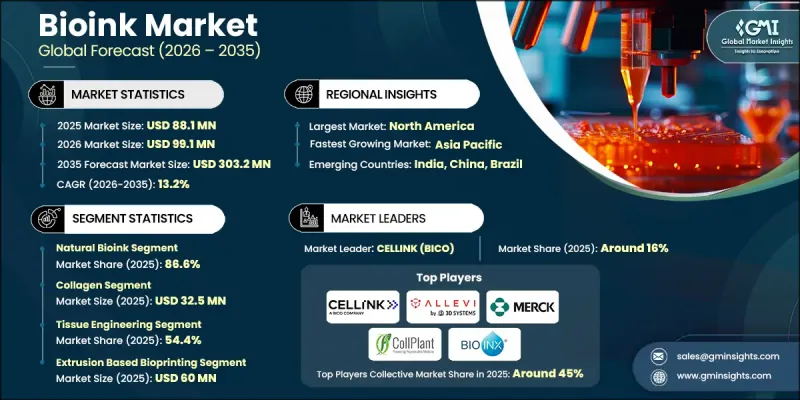
바이오 잉크 시장의 성장은 바이오프린팅 분야의 확대와 조직공학 및 재생의학 연구를 지원할 수 있는 첨단 솔루션에 대한 수요 증가와 밀접한 관련이 있습니다. 바이오 잉크는 자연 조직의 구조를 모방한 복잡한 생물학적 구조를 개발하기 위한 3차원 바이오프린팅에서 필수적인 재료로 작용합니다. 의료 분야가 손상된 생물학적 구조를 복구하거나 대체할 수 있는 혁신적인 접근법을 지속적으로 모색하는 가운데, 바이오 잉크는 기능성 조직 구조물 개발에 필수적인 요소로 자리 잡고 있습니다. 연구기관, 생명공학 기업 및 의료센터는 조직 재생을 촉진할 수 있는 인공 생체 구조물 개발을 지원하기 위해 바이오프린팅 기술을 채택하고 있습니다. 개인 맞춤형 치료 솔루션에 대한 관심이 높아지면서 특정 세포 환경에 맞게 조정된 맞춤형 바이오잉크 배합에 대한 수요도 가속화되고 있습니다. 또한 전 세계에서 만성질환 및 장기부전 유병률이 증가함에 따라 대체 치료 접근법에 대한 요구가 더욱 커지고 있습니다. 이러한 요인들로 인해 바이오 잉크는 생물 의학 연구, 재생 의학 개발 및 첨단 조직 공학 분야에서 점점 더 많이 사용되고 있습니다.
| 시장 범위 | |
|---|---|
| 시작연도 | 2025년 |
| 예측 기간 | 2026-2035년 |
| 개시 금액 | 8,810만 달러 |
| 예측액 | 3억 320만 달러 |
| CAGR | 13.2% |
바이오 잉크 시장에서 합성 바이오 잉크 부문 시장 규모는 2025년에 1,180만 달러로 평가되었습니다. 합성 소재 유래 바이오 잉크는 기계적 특성을 정밀하게 제어할 수 있다는 장점이 있으며, 연구자들은 특수한 용도에 맞게 예측 가능한 성능을 가진 재료를 설계할 수 있습니다. 과학자들은 다양한 성분의 구성과 농도를 조정하여 구조적 강도, 분해 속도, 가교 거동 등의 특성을 변경하여 특정 조직 공학 응용 분야의 요구 사항을 충족시킬 수 있습니다. 합성 바이오 잉크는 천연 유래 재료에 비해 구조적 일관성과 재현성이 높은 경우가 많습니다. 이러한 특성으로 인해 높은 기계적 안정성과 매우 세밀한 구조적 정밀도가 요구되는 복잡한 생물학적 구조물의 제조에 특히 적합합니다.
바이오 잉크 시장의 콜라겐 분야는 2025년 3,250만 달러에 달했습니다. 콜라겐은 생체 시스템과의 친화력 및 생체 세포외 기질과의 구조적 유사성으로 널리 알려져 있습니다. 이러한 유사성으로 인해 콜라겐 기반 바이오 잉크는 세포의 부착, 이동 및 성숙을 촉진하는 지지적인 3차원 프레임워크를 제공할 수 있습니다. 그 결과, 콜라겐은 인공 조직 구조물 개발에 널리 이용되는 재료가 되었습니다. 콜라겐에 의해 형성된 섬유질 구조는 세포가 생리학적으로 적절한 환경에서 증식할 수 있도록 하며, 바이오프린팅 과정에서 조직의 발달과 구조적 조직화 향상에 기여합니다.
2025년 미국 바이오 잉크 시장은 3,530만 달러 규모에 달했습니다. 재생 피부과학 및 첨단 상처 관리 분야에서 바이오 잉크의 채용 확대는 미국 전역의 지속적인 성장을 지원할 것으로 예측됩니다. 북미는 탄탄한 생명공학 기반과 생물의학 공학 분야의 활발한 연구 활동으로 인해 바이오프린팅 기술 개발 및 상용화를 선도하는 지역으로 자리매김하고 있습니다. 미국은 공동 연구 네트워크, 첨단인 학술기관, 그리고 치료법 개발 및 생물의학 연구 분야에서의 바이오프린팅 기술의 조기 도입에 힘입어 이러한 성장에 있어서도 여전히 중심적인 역할을 담당하고 있습니다.
자주 묻는 질문
목차
제1장 조사 방법
제2장 개요
제3장 업계 인사이트
제4장 경쟁 구도
제5장 시장 추산·예측 : 유형별, 2022-2035
제6장 시장 추산·예측 : 재료별, 2022-2035
제7장 시장 추산·예측 : 용도별, 2022-2035
제8장 시장 추산·예측 : 인쇄 방식별, 2022-2035
제9장 시장 추산·예측 : 최종 용도별, 2022-2035
제10장 시장 추산·예측 : 지역별, 2022-2035
제11장 기업 개요
KSA 26.04.20The Global Bioink Market was valued at USD 88.1 million in 2025 and is estimated to grow at a CAGR of 13.2% to reach USD 303.2 million by 2035.
Growth in the bioink market is strongly linked to the expanding field of bioprinting and the increasing demand for advanced solutions capable of supporting tissue engineering and regenerative medicine research. Bioinks serve as critical materials used in three-dimensional bioprinting to develop complex biological structures that mimic the architecture of natural tissues. As the healthcare sector continues to explore innovative approaches to repair or replace damaged biological structures, bioinks are becoming essential components in the development of functional tissue constructs. Research institutions, biotechnology organizations, and medical centers are adopting bioprinting technologies to support the development of engineered biological structures that can facilitate tissue regeneration. The growing interest in personalized therapeutic solutions is also accelerating demand for customized bioink formulations tailored to specific cellular environments. In addition, the increasing prevalence of chronic health conditions and organ failure worldwide is creating a stronger need for alternative therapeutic approaches. These factors collectively support the expanding adoption of bioinks across biomedical research, regenerative medicine development, and advanced tissue engineering initiatives.
| Market Scope | |
|---|---|
| Start Year | 2025 |
| Forecast Year | 2026-2035 |
| Start Value | $88.1 Million |
| Forecast Value | $303.2 Million |
| CAGR | 13.2% |
The synthetic bioink segment within the bioink market was valued at USD 11.8 million in 2025. Bioinks derived from synthetic materials offer the advantage of precise control over mechanical characteristics, allowing researchers to engineer materials with predictable performance for specialized applications. By adjusting the composition and concentration of different components, scientists can modify properties such as structural strength, degradation rate, and crosslinking behavior to meet the requirements of specific tissue engineering applications. Synthetic bioinks often demonstrate greater structural consistency and reproducibility when compared with naturally derived materials. These characteristics make them particularly suitable for producing complex biological constructs that require strong mechanical stability and highly detailed structural precision.
The collagen segment of the bioink market reached USD 32.5 million in 2025. Collagen is widely recognized for its compatibility with biological systems and structural similarity to the body's extracellular matrix. This similarity allows collagen-based bioinks to provide a supportive three-dimensional framework that encourages cellular attachment, movement, and maturation. As a result, collagen has become a widely utilized material in the development of engineered tissue structures. The fibrillar architecture formed by collagen enables cells to grow in a physiologically relevant environment, which contributes to improved tissue development and structural organization during the bioprinting process.
U.S. Bioink Market generated USD 35.3 million in 2025. The adoption of bioinks in regenerative dermatology and advanced wound management applications is expected to support continued growth across the country. North America remains a leading region for the development and commercialization of bioprinting technologies due to strong biotechnology infrastructure and significant research activity in biomedical engineering. The United States continues to play a central role in this growth, supported by collaborative research networks, advanced academic institutions, and early integration of bioprinting technologies across therapeutic development and biomedical research fields.
Key companies operating in the Global Bioink Market include 3D Biotechnology Solutions (3DBS), ALLEVI (3D Systems), AXOLOTL BIOSCIENCES, BIO INX, CELLINK (BICO), CollPlant, Foldink, Humabiologics, innoregen, MERCK, The Well BIOSCIENCE, and VoxCell. Companies participating in the Bioink Market are strengthening their competitive position through innovation, strategic partnerships, and expanded research capabilities. Many organizations are investing heavily in the development of advanced bioink formulations designed to support improved cell viability, structural stability, and compatibility with emerging bioprinting technologies. Firms are also forming collaborations with biotechnology companies, research institutes, and academic laboratories to accelerate product development and expand application areas in regenerative medicine and tissue engineering. Strategic investments in research infrastructure and bioprinting platforms allow companies to refine material performance and broaden their product portfolios. Additionally, several market participants are expanding global distribution networks and entering new geographic markets to increase accessibility and strengthen brand presence within the rapidly evolving biofabrication industry.
Table of Contents
Chapter 1 Research Methodology
- 1.1 Research approach
- 1.2 Quality commitments
- 1.2.1 GMI AI policy & data integrity commitment
- 1.2.1.1 Source consistency protocol
- 1.2.1 GMI AI policy & data integrity commitment
- 1.3 Research trail & confidence scoring
- 1.3.1 Research trail components
- 1.3.2 Scoring components
- 1.4 Data collection
- 1.4.1 Partial list of primary sources
- 1.5 Data mining sources
- 1.5.1 Paid sources
- 1.5.1.1 Sources, by region
- 1.5.1 Paid sources
- 1.6 Base estimates and calculations
- 1.6.1 Base year calculation
- 1.7 Forecast model
- 1.7.1 Quantified market impact analysis
- 1.7.1.1 Mathematical impact of growth parameters on forecast
- 1.7.1 Quantified market impact analysis
- 1.8 Research transparency addendum
- 1.8.1 Source attribution framework
- 1.8.2 Quality assurance metrics
- 1.8.3 Our commitment to trust
Chapter 2 Executive Summary
- 2.1 Industry 360° synopsis
- 2.2 Key market trends
- 2.2.1 Regional trends
- 2.2.2 Type trends
- 2.2.3 Material trends
- 2.2.4 Application trends
- 2.2.5 Printing modality trends
- 2.2.6 End use trends
- 2.3 CXO perspectives: Strategic imperatives
Chapter 3 Industry Insights
- 3.1 Industry ecosystem analysis
- 3.2 Industry impact forces
- 3.2.1 Growth drivers
- 3.2.1.1 Rising application in regenerative medicine
- 3.2.1.2 Increase in demand for 3D printed tissue and organs
- 3.2.1.3 Rise in prevalence of chronic disease and organ failure
- 3.2.1.4 Advancement in bioprinting technologies
- 3.2.2 Industry pitfalls and challenges
- 3.2.2.1 Stringent approval filing process
- 3.2.2.2 High manufacturing cost
- 3.2.3 Opportunities
- 3.2.3.1 Innovations in nanomaterial-based bioinks
- 3.2.3.2 AI-driven optimization of bioink formulations
- 3.2.1 Growth drivers
- 3.3 Growth potential analysis
- 3.4 Regulatory landscape
- 3.4.1 North America
- 3.4.2 Europe
- 3.4.3 Asia Pacific
- 3.5 Technology and innovation landscape
- 3.5.1 Current technological trends
- 3.5.2 Emerging technologies
- 3.6 Policy landscape
- 3.7 Supply chain analysis
- 3.8 Environmental and sustainability initiatives
- 3.9 Porter's analysis
- 3.10 PESTEL analysis
- 3.11 Gap analysis
- 3.12 Future market trends
- 3.13 Impact of AI and generative AI on the market
Chapter 4 Competitive Landscape, 2025
- 4.1 Introduction
- 4.2 Company matrix analysis
- 4.3 Company market share analysis
- 4.4 Competitive analysis of major market players
- 4.5 Competitive positioning matrix
- 4.6 Key developments
- 4.6.1 Mergers & acquisitions
- 4.6.2 Partnerships & collaborations
- 4.6.3 New product launches
- 4.6.4 Expansion plans
Chapter 5 Market Estimates and Forecast, By Type, 2022 - 2035 ($ Mn)
- 5.1 Key trends
- 5.2 Natural bioink
- 5.3 Synthetic bioink
Chapter 6 Market Estimates and Forecast, By Material, 2022 - 2035 ($ Mn)
- 6.1 Key trends
- 6.2 Collagen
- 6.3 Alginate
- 6.4 Gelatin
- 6.5 Agarose
- 6.6 Chitosan
- 6.7 Pluronic
- 6.8 Other materials
Chapter 7 Market Estimates and Forecast, By Application, 2022 - 2035 ($ Mn)
- 7.1 Key trends
- 7.2 Tissue engineering
- 7.3 Medical application
- 7.4 Drug discovery & delivery
- 7.5 Other applications
Chapter 8 Market Estimates and Forecast, By Printing Modality, 2022 - 2035 ($ Mn)
- 8.1 Key trends
- 8.2 Extrusion based bioprinting
- 8.3 Ink-jet based bioprinting
- 8.4 Laser-based bioprinting
Chapter 9 Market Estimates and Forecast, By End Use, 2022 - 2035 ($ Mn)
- 9.1 Key trends
- 9.2 Pharmaceutical & biotechnology companies
- 9.3 Academic & research institutes
- 9.4 Hospitals and clinics
- 9.5 Other end users
Chapter 10 Market Estimates and Forecast, By Region, 2022 - 2035 ($ Mn)
- 10.1 Key trends
- 10.2 North America
- 10.2.1 U.S.
- 10.2.2 Canada
- 10.3 Europe
- 10.3.1 Germany
- 10.3.2 UK
- 10.3.3 France
- 10.3.4 Spain
- 10.3.5 Italy
- 10.3.6 Netherlands
- 10.4 Asia Pacific
- 10.4.1 China
- 10.4.2 Japan
- 10.4.3 India
- 10.4.4 Australia
- 10.4.5 South Korea
- 10.5 Latin America
- 10.5.1 Brazil
- 10.5.2 Mexico
- 10.5.3 Argentina
- 10.6 MEA
- 10.6.1 South Africa
- 10.6.2 Saudi Arabia
- 10.6.3 UAE
Chapter 11 Company Profiles
- 11.1 3D Biotechnology Solutions (3DBS)
- 11.2 ALLEVI (3D SYSTEMS)
- 11.3 AXOLOTL BIOSCIENCES
- 11.4 BIO INX
- 11.5 CELLINK (BICO)
- 11.6 CollPlant
- 11.7 Foldink
- 11.8 Humabiologics
- 11.9 innoregen
- 11.10 MERCK
- 11.11 The Well BIOSCIENCE
- 11.12 VoxCell