

|
시장보고서
상품코드
1998835
환자 모니터링 기기 시장 기회, 성장요인, 업계 동향 분석 및 예측(2026-2035년)Patient Monitoring Devices Market Opportunity, Growth Drivers, Industry Trend Analysis, and Forecast 2026 - 2035 |
||||||

세계의 환자 모니터링 기기 시장은 2025년에 517억 달러로 평가되며, CAGR 9.1%로 성장하며, 2035년까지 1,221억 달러에 달할 것으로 추정되고 있습니다.
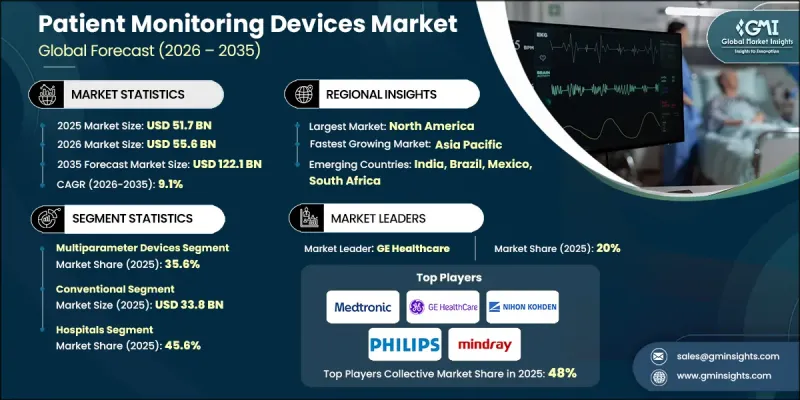
이 시장은 만성질환 유병률 증가, 고령 인구 증가, 기술 발전, 신흥 국가의 의료비 증가로 인해 강력한 성장세를 보이고 있습니다. 고령화가 진행되면서 고령층에서 지속적인 모니터링이 필요한 심혈관질환, 호흡기질환, 대사성 질환의 발병률이 증가하고 있으며, 이것이 수요를 견인하고 있습니다. 환자 모니터링 기기의 혁신, 특히 IoT 및 AI 기술의 통합으로 실시간 건강 데이터 수집, 예측 분석 및 자동화된 의사결정이 가능해졌습니다. 이러한 발전은 임상의가 위험을 조기에 감지하고 개인화된 치료를 제공할 수 있도록 돕습니다. 최신 장비는 무선 연결, 클라우드 기반 데이터 관리, 모듈식 설계 및 휴대성을 향상시켜 중환자실, 수술 및 재택 치료 현장의 워크플로우 효율성을 높이고 있습니다. 첨단 모니터는 열악한 환경에서도 신뢰할 수 있는 측정값을 제공하여 의료진이 보다 신속하고 정확한 임상적 판단을 내릴 수 있도록 지원하며, 전 세계에서 환자 결과를 개선하고 있습니다.
| 시장 범위 | |
|---|---|
| 시작연도 | 2025년 |
| 예측 기간 | 2026-2035년 |
| 개시 금액 | 517억 달러 |
| 예측액 | 1,221억 달러 |
| CAGR | 9.1% |
멀티파라미터 장비 부문은 2025년 184억 달러로 전체 시장의 35.6%를 차지할 것으로 예측됩니다. 멀티-파라미터 모니터는 여러 바이탈 사인을 동시에 추적하고 데이터를 단일 플랫폼으로 통합합니다. 이 제품은 중환자실, 수술실, 응급의료 현장에서 널리 사용되고 있으며, 맞춤형 설정, 고해상도 디스플레이 및 환자 맞춤형 모니터링을 위한 모듈식 구성을 제공합니다.
전통적 부문은 2025년 338억 달러를 차지했습니다. 기존의 침대 옆 모니터링 기기는 심박수, 혈압, 산소포화도, 체온 등 주요 생리적 파라미터를 추적하는 고정형 장치입니다. 이 장비들은 중환자실, 일반 병동, 수술실에서 지속적인 모니터링에 있으며, 병원의 표준 장비가 되어 신뢰할 수 있는 기본 활력 징후 평가를 제공합니다.
미국 환자 모니터링 기기 시장은 지속적인 모니터링이 필요한 심혈관 및 호흡기 질환과 같은 만성질환의 유병률 증가에 힘입어 2025년 202억 달러 규모에 달했습니다. 첨단화된 의료 인프라, 높은 수술 건수, 디지털 헬스 솔루션에 대한 투자가 전통적 모니터에서 중앙 집중식 모니터링 기능과 전자건강기록(EHR)과 호환되는 통합 무선 시스템으로의 전환을 지원하여 시장 성장을 더욱 가속화하고 있습니다.
자주 묻는 질문
목차
제1장 조사 방법과 범위
제2장 개요
제3장 업계 인사이트
제4장 경쟁 구도
제5장 시장 추산·예측 : 제품별, 2022-2035
제6장 시장 추산·예측 : 유형별, 2022-2035
제7장 시장 추산·예측 : 최종 용도별, 2022-2035
제8장 시장 추산·예측 : 지역별, 2022-2035
제9장 기업 개요
KSA 26.04.20The Global Patient Monitoring Devices Market was valued at USD 51.7 billion in 2025 and is estimated to grow at a CAGR of 9.1% to reach USD 122.1 billion by 2035.
The market is witnessing strong expansion owing to the rising prevalence of chronic diseases, increasing geriatric populations, technological advancements, and higher healthcare spending in emerging economies. Aging demographics are driving demand, as older populations face a growing incidence of cardiovascular, respiratory, and metabolic conditions that require continuous monitoring. Innovations in patient monitoring devices, particularly the integration of IoT and AI technologies, allow real-time health data collection, predictive analytics, and automated decision-making. These advancements enable clinicians to detect risks early and deliver personalized care. Modern devices now offer wireless connectivity, cloud-based data management, modular designs, and improved portability, enhancing workflow efficiency in critical care, surgical, and home care settings. Advanced monitors provide reliable measurements even under challenging conditions, helping healthcare professionals make faster, accurate clinical decisions while improving patient outcomes globally.
| Market Scope | |
|---|---|
| Start Year | 2025 |
| Forecast Year | 2026-2035 |
| Start Value | $51.7 Billion |
| Forecast Value | $122.1 Billion |
| CAGR | 9.1% |
The multiparameter devices segment reached USD 18.4 billion in 2025, representing 35.6%. Multiparameter monitors track multiple vital signs simultaneously, consolidating data on a single platform. They are widely used in ICUs, operating rooms, and emergency care settings, offering customizable settings, high-resolution displays, and modular configurations for tailored patient monitoring.
The conventional segment accounted for USD 33.8 billion in 2025. Conventional bedside monitoring devices are stationary units that track core physiological parameters such as heart rate, blood pressure, oxygen saturation, and temperature. These devices are standard in hospitals for continuous monitoring in ICUs, general wards, and operating rooms, offering reliable and basic vital sign assessment.
U.S. Patient Monitoring Devices Market reached USD 20.2 billion in 2025, driven by the rising prevalence of chronic illnesses, including cardiovascular and respiratory diseases, which necessitate ongoing monitoring. The country's advanced healthcare infrastructure, high surgical volumes, and investment in digital health solutions support the transition from conventional monitors to integrated, wireless systems with centralized monitoring and EHR compatibility, further accelerating market growth.
Key players in the Global Patient Monitoring Devices Market include Medtronic, Koninklijke Philips, GE Healthcare, Fukuda Denshi, Becton Dickinson and Company, Nihon Kohden Corporation, HILLROM & WELCH ALLYN, OSI Systems, Shenzhen Mindray Bio-Medical Electronics, Skanray Technologies, Medion, EPSIMED, Natus Medical, and Cerba Healthcare. Companies in the Global Patient Monitoring Devices Market are focusing on several strategies to strengthen their market presence. They are investing in AI, IoT, and wireless technologies to develop advanced, real-time monitoring solutions. Partnerships with hospitals, healthcare providers, and research institutions help in co-developing devices that meet clinical needs. Expanding distribution networks, enhancing after-sales services, and offering cloud-based data management platforms ensure customer retention. Firms are also focusing on modular, portable, and cost-effective solutions for homecare and remote monitoring. Continuous innovation in multiparameter and wearable devices, along with compliance with regulatory standards, helps maintain competitive advantage and expand global market share.
Table of Contents
Chapter 1 Methodology and Scope
- 1.1 Research approach
- 1.2 Quality commitments
- 1.2.1 GMI AI policy & data integrity commitment
- 1.2.1.1 Source consistency protocol
- 1.2.1 GMI AI policy & data integrity commitment
- 1.3 Research trail & confidence scoring
- 1.3.1 Research trail components
- 1.3.2 Scoring components
- 1.4 Data collection
- 1.4.1 Partial list of primary sources
- 1.5 Data mining sources
- 1.5.1 Paid sources
- 1.5.1.1 Sources, by region
- 1.5.1 Paid sources
- 1.6 Base estimates and calculations
- 1.6.1 Base year calculation for any one approach
- 1.7 Forecast model
- 1.7.1 Quantified market impact analysis
- 1.7.1.1 Mathematical impact of growth parameters on forecast
- 1.7.2 Research transparency addendum
- 1.7.3 Source attribution framework
- 1.7.4 Quality assurance metrics
- 1.7.1 Quantified market impact analysis
- 1.8 Our commitment to trust
Chapter 2 Executive Summary
- 2.1 Industry 360° synopsis
- 2.2 Key market trends
- 2.2.1 Regional trends
- 2.2.2 Product trends
- 2.2.3 Type trends
- 2.2.4 End use trends
- 2.3 CXO perspectives: Strategic imperatives
Chapter 3 Industry Insights
- 3.1 Industry ecosystem analysis
- 3.2 Industry impact forces
- 3.2.1 Growth drivers
- 3.2.1.1 Increasing prevalence of chronic diseases
- 3.2.1.2 Growing disposable income and healthcare expenditure in emerging countries
- 3.2.1.3 Technological advancement in patient monitoring devices
- 3.2.1.4 Growing geriatric population base
- 3.2.2 Industry pitfalls and challenges
- 3.2.2.1 High cost of devices
- 3.2.2.2 Stringent regulatory scenario
- 3.2.3 Market opportunities
- 3.2.3.1 Increasing adoption for AI-powered predictive monitoring tools
- 3.2.1 Growth drivers
- 3.3 Growth potential analysis
- 3.4 Regulatory landscape (Driven by Primary Research)
- 3.4.1 North America
- 3.4.2 Europe
- 3.4.3 Asia Pacific
- 3.5 Technological advancements
- 3.5.1 Current technological trends
- 3.5.2 Emerging technologies
- 3.6 Future market trends
- 3.7 Porter's analysis
- 3.8 PESTEL analysis
Chapter 4 Competitive Landscape, 2025
- 4.1 Introduction
- 4.2 Company market share analysis
- 4.3 Company matrix analysis
- 4.4 Competitive analysis of major market players
- 4.5 Competitive positioning matrix
- 4.6 Key developments
- 4.6.1 Mergers and acquisitions
- 4.6.2 Partnerships and collaborations
- 4.6.3 New product launches
- 4.6.4 Expansion plans
Chapter 5 Market Estimates and Forecast, By Product, 2022 - 2035 ($ Mn)
- 5.1 Key trends
- 5.2 Cardiac monitoring devices
- 5.2.1 ECG devices
- 5.2.2 Implantable loop recorders
- 5.2.3 Mobile cardiac telemetry monitors
- 5.2.4 Smart wearable ECG patches
- 5.3 Neuromonitoring devices
- 5.3.1 EEG devices
- 5.3.2 Cerebral oximeters
- 5.3.3 Intracranial pressure monitors
- 5.3.4 EMG devices
- 5.4 Respiratory monitoring devices
- 5.4.1 Pulse oximeters
- 5.4.2 Spirometers
- 5.4.3 Capnographs
- 5.4.4 Peak flow meters
- 5.5 Anesthesia monitor
- 5.6 Hemodynamic monitoring devices
- 5.7 Fetal and neonatal monitoring
- 5.8 Multiparameter devices
- 5.9 Other products
Chapter 6 Market Estimates and Forecast, By Type, 2022 - 2035 ($ Mn)
- 6.1 Key trends
- 6.2 Conventional
- 6.3 Wireless
Chapter 7 Market Estimates and Forecast, By End Use, 2022 - 2035 ($ Mn)
- 7.1 Key trends
- 7.2 Hospitals
- 7.3 Ambulatory surgical centers
- 7.4 Homecare settings
- 7.5 Other end users
Chapter 8 Market Estimates and Forecast, By Region, 2022 - 2035 ($ Mn)
- 8.1 Key trends
- 8.2 North America
- 8.2.1 U.S.
- 8.2.2 Canada
- 8.3 Europe
- 8.3.1 Germany
- 8.3.2 UK
- 8.3.3 France
- 8.3.4 Spain
- 8.3.5 Italy
- 8.3.6 Netherlands
- 8.4 Asia Pacific
- 8.4.1 China
- 8.4.2 India
- 8.4.3 Japan
- 8.4.4 Australia
- 8.4.5 South Korea
- 8.5 Latin America
- 8.5.1 Brazil
- 8.5.2 Mexico
- 8.5.3 Argentina
- 8.6 Middle East and Africa
- 8.6.1 Saudi Arabia
- 8.6.2 South Africa
- 8.6.3 UAE
Chapter 9 Company Profiles
- 9.1 Becton Dickinson and Company
- 9.2 Biotronik
- 9.3 EPSIMED
- 9.4 Fukuda Denshi
- 9.5 GE Healthcare
- 9.6 HILLROM & WELCH ALLYN
- 9.7 Koninklijke Philips
- 9.8 Medion
- 9.9 Medtronic
- 9.10 Natus Medical
- 9.11 Nihon Kohden Corporation
- 9.12 OMRON Corporation
- 9.13 OSI Systems
- 9.14 Shenzhen Mindray Bio-Medical Electronics
- 9.15 Skanray Technologies


