
|
시장보고서
상품코드
1998844
수성 아크릴 수지 시장 기회, 성장요인, 업계 동향 분석 및 예측(2026-2035년)Waterborne Acrylic Resin Market Opportunity, Growth Drivers, Industry Trend Analysis, and Forecast 2026 - 2035 |
||||||

세계의 수성 아크릴 수지 시장은 2025년에 67억 달러로 평가되며, 2035년까지 CAGR 4.7%로 성장하며, 106억 달러에 달할 것으로 추정되고 있습니다.
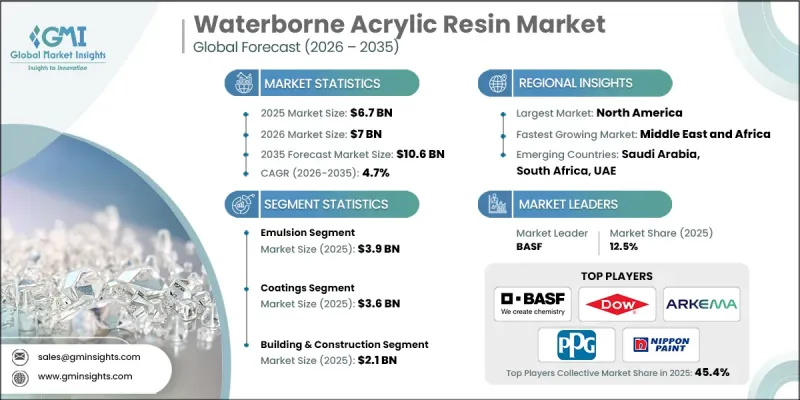
시장 성장은 코팅, 접착제, 페인트 제조 분야에서 친환경 고분자 솔루션에 대한 수요가 증가함에 따라 주도되고 있습니다. 수성 아크릴 수지는 기존 용제계 제품에 비해 휘발성 유기화합물(VOC) 배출량이 적은 수성 폴리머 시스템으로 배합되어 환경 기준 및 실내 공기질 기준의 개선이 요구되는 용도에 적합합니다. 이 수지는 아크릴 모노머의 유화 중합에 의해 제조되며, 강한 접착력, 유연성, 내구성을 갖춘 안정된 수성 분산액으로 만들어집니다. 이러한 성능 특성으로 인해 규정 준수와 장기적인 신뢰성이 요구되는 보호 표면, 장식용 가공제 및 산업 용도에 이상적입니다. 각 산업계가 지속가능한 생산 방식을 더욱 중시함에 따라 수성 아크릴 기술은 현대의 배합 전략에서 점점 더 중심적인 역할을 하고 있습니다. 수지 화학 분야의 지속적인 혁신으로 제품 성능이 더욱 강화되어 제조업체는 여러 최종 사용 분야에 걸쳐 진화하는 기술 및 환경적 요구 사항을 충족할 수 있게 되었습니다.
| 시장 범위 | |
|---|---|
| 시작연도 | 2025년 |
| 예측 기간 | 2026-2035 |
| 개시 금액 | 67억 달러 |
| 예측액 | 106억 달러 |
| CAGR | 4.7% |
페인트 업계에서는 용제 기반 기술에서 수성 아크릴 수지 시스템으로 뚜렷한 전환이 진행되고 있습니다. 이 전환을 통해 제조업체는 배출량을 최소화하고 경쟁력 있는 페인트 성능을 유지하면서 점점 더 강화되는 환경 기준을 준수할 수 있습니다. 입자 공학, 가교 방법 및 하이브리드 수지 개발의 발전으로 경도, 내화학성 및 내후성이 향상되었습니다. 그 결과, 수성 아크릴 시스템은 현재 기존 배합에 필적하거나 능가하는 성능 수준을 달성하여 산업 전반에 걸쳐 보급을 촉진하고 있습니다.
에멀전 부문은 2025년 39억 달러에 달했습니다. 이러한 성장은 배합의 다양성과 다양한 용도에 대한 적합성이 지원하고 있습니다. 에멀전 수지 기술의 지속적인 개선으로 건조 효율, 표면 보호 성능 및 전반적인 서비스 수명이 향상되어 지속가능한 제품 개발에서 그 역할이 강화되고 있습니다.
페인트 응용 분야는 2025년 36억 달러의 시장 규모를 기록할 것으로 예측됩니다. 이러한 확대는 환경 규제를 준수하는 저 VOC 건축 및 산업용 페인트에 대한 수요 증가에 힘입은 것입니다. 건설 활동의 활성화와 솔벤트 기반 시스템에서 수성 대체품으로의 꾸준한 전환이 이 부문의 성장에 기여하고 있습니다. 각 제조업체들은 엄격한 장식 및 보호 기준을 충족시키기 위해 내구성, 내화학성 및 장기적인 성능 향상을 우선순위로 삼고 있습니다.
북미 수성 아크릴 수지 시장은 2025년 24억 달러에서 2035년까지 37억 달러로 성장할 것으로 예측됩니다. 이 지역 수요는 엄격한 환경 정책, 개보수 공사, 지속가능한 산업 생산에 의해 지원되고 있습니다. 미국에서는 인프라 투자, 주택 개조 및 지속적인 산업 정비로 인해 저배출 페인트 재료의 안정적인 소비가 유지되고 있습니다.
자주 묻는 질문
목차
제1장 조사 방법과 범위
제2장 개요
제3장 업계 인사이트
제4장 경쟁 구도
제5장 시장 추산·예측 : 유형별, 2022-2035
제6장 시장 추산·예측 : 용도별, 2022-2035
제7장 시장 추산·예측 : 최종 용도별, 2022-2035
제8장 시장 추산·예측 : 지역별, 2022-2035
제9장 기업 개요
KSA 26.04.20The Global Waterborne Acrylic Resin Market was valued at USD 6.7 billion in 2025 and is estimated to grow at a CAGR of 4.7% to reach USD 10.6 billion by 2035.
Market growth is driven by increasing demand for environmentally responsible polymer solutions across coatings, adhesives, and paint manufacturing. Waterborne acrylic resins are formulated as aqueous polymer systems that offer reduced volatile organic compound emissions compared to conventional solvent-based alternatives, making them suitable for applications that require improved environmental and indoor air quality standards. These resins are produced through emulsion polymerization of acrylic monomers, resulting in stable water-based dispersions with strong adhesion, flexibility, and durability. Their performance characteristics make them well suited for protective surfaces, decorative finishes, and industrial applications that require both regulatory compliance and long-term reliability. As industries place greater emphasis on sustainable production methods, waterborne acrylic technologies are becoming increasingly central to modern formulation strategies. Ongoing innovation in resin chemistry is further strengthening product performance, enabling manufacturers to meet evolving technical and environmental requirements across multiple end-use sectors.
| Market Scope | |
|---|---|
| Start Year | 2025 |
| Forecast Year | 2026-2035 |
| Start Value | $6.7 Billion |
| Forecast Value | $10.6 Billion |
| CAGR | 4.7% |
The coatings sector is undergoing a clear transition from solvent-based technologies toward waterborne acrylic resin systems. This shift allows manufacturers to comply with tightening environmental standards while minimizing emissions and maintaining competitive coating performance. Advances in particle engineering, crosslinking methods, and hybrid resin development have enhanced hardness, chemical resistance, and weather durability. As a result, waterborne acrylic systems now deliver performance levels comparable to or exceeding traditional formulations, driving broader industrial acceptance.
The emulsion segment reached USD 3.9 billion in 2025. Its growth is supported by formulation versatility and compatibility with a wide range of applications. Continuous improvements in emulsion resin technology are enhancing drying efficiency, surface protection, and overall service life, reinforcing their role in sustainable product development.
The coatings application segment generated USD 3.6 billion in 2025. Expansion is fueled by rising demand for low-VOC architectural and industrial coatings aligned with environmental regulations. Increased construction activity and the steady replacement of solvent-borne systems with water-based alternatives are contributing to segment growth. Manufacturers are prioritizing improvements in durability, chemical resistance, and long-term performance to meet stringent decorative and protective standards.
North America Waterborne Acrylic Resin Market is projected to grow from USD 2.4 billion in 2025 to USD 3.7 billion by 2035. Regional demand is supported by strict environmental policies, renovation activities, and sustained industrial output. In the United States, infrastructure investments, housing upgrades, and ongoing industrial maintenance are sustaining consistent consumption of low-emission coating materials.
Major companies operating in the Global Waterborne Acrylic Resin Market include BASF, Dow Chemical, AkzoNobel, Arkema, PPG Industries, Eastman Chemical, Evonik Industries, Nippon Paint, Huntsman, and Nippon Shokubai. Companies in the Global Waterborne Acrylic Resin Market are strengthening their market position through innovation, sustainability initiatives, and strategic expansion. Leading manufacturers are investing in advanced polymer research to enhance durability, weather resistance, and chemical stability while maintaining low VOC performance. Capacity expansion and modernization of production facilities are improving operational efficiency and supply reliability. Strategic collaborations with coatings and adhesive formulators are broadening application reach and accelerating product commercialization. Firms are also focusing on regulatory compliance and eco-certifications to align with global environmental standards.
Table of Contents
Chapter 1 Methodology & Scope
- 1.1 Market scope and definition
- 1.2 Research design
- 1.2.1 Research approach
- 1.2.2 Data collection methods
- 1.3 Data mining sources
- 1.3.1 Global
- 1.3.2 Regional/Country
- 1.4 Base estimates and calculations
- 1.4.1 Base year calculation
- 1.4.2 Key trends for market estimation
- 1.5 Primary research and validation
- 1.5.1 Primary sources
- 1.6 Forecast model
- 1.7 Research assumptions and limitations
Chapter 2 Executive Summary
- 2.1 Industry 360° synopsis
- 2.2 Key market trends
- 2.2.1 Type
- 2.2.2 Application
- 2.2.3 End Use
- 2.2.4 Regional
- 2.3 TAM Analysis, 2026-2035
- 2.4 CXO perspectives: Strategic imperatives
- 2.5 Future outlook and strategic recommendations
Chapter 3 Industry Insights
- 3.1 Industry ecosystem analysis
- 3.1.1 Supplier landscape
- 3.1.2 Profit margin
- 3.1.3 Value addition at each stage
- 3.1.4 Factor affecting the value chain
- 3.1.5 Disruptions
- 3.2 Industry impact forces
- 3.2.1 Growth drivers
- 3.2.1.1 Strict environmental regulations boosting resin adoption
- 3.2.1.2 Rising demand in architectural and decorative coatings
- 3.2.1.3 Technological advancements improving resin performance
- 3.2.2 Industry pitfalls and challenges
- 3.2.2.1 High production costs limiting
- 3.2.2.2 Performance limitations in extreme conditions
- 3.2.3 Market opportunities
- 3.2.3.1 Innovation in hybrid and high-performance formulations
- 3.2.3.2 Expanding applications in adhesives and specialty coatings
- 3.2.3.3 Strategic collaborations to accelerate market growth
- 3.2.1 Growth drivers
- 3.3 Growth potential analysis
- 3.4 Regulatory landscape
- 3.4.1 North America
- 3.4.2 Europe
- 3.4.3 Asia Pacific
- 3.4.4 Latin America
- 3.4.5 Middle East & Africa
- 3.5 Porter's analysis
- 3.6 PESTEL analysis
- 3.7 Technology and innovation landscape
- 3.7.1 Current technological trends
- 3.7.2 Emerging technologies
- 3.8 Price trends
- 3.8.1 By region
- 3.8.2 By type
- 3.9 Future market trends
- 3.10 Patent landscape
- 3.11 Trade statistics (HS code)
- 3.11.1 Major importing countries
- 3.11.2 Major exporting countries
- 3.12 Sustainability and environmental aspects
- 3.12.1 Sustainable practices
- 3.12.2 Waste reduction strategies
- 3.12.3 Energy efficiency in production
- 3.12.4 Eco-friendly initiatives
- 3.13 Carbon footprint consideration
Chapter 4 Competitive Landscape, 2025
- 4.1 Introduction
- 4.2 Company market share analysis
- 4.2.1 By region
- 4.2.1.1 North America
- 4.2.1.2 Europe
- 4.2.1.3 Asia Pacific
- 4.2.1.4 LATAM
- 4.2.1.5 MEA
- 4.2.1 By region
- 4.3 Company matrix analysis
- 4.4 Competitive analysis of major market players
- 4.5 Competitive positioning matrix
- 4.6 Key developments
- 4.6.1 Mergers & acquisitions
- 4.6.2 Partnerships & collaborations
- 4.6.3 New product launches
- 4.6.4 Expansion plans
Chapter 5 Market Estimates and Forecast, By Type, 2022-2035 (USD Billion) (Kilo Tons)
- 5.1 Key trends
- 5.2 Emulsion
- 5.3 Solution
- 5.4 Urethane-acrylic
- 5.5 Others
Chapter 6 Market Estimates and Forecast, By Application, 2022-2035 (USD Billion) (Kilo Tons)
- 6.1 Key trends
- 6.2 Coating
- 6.3 Adhesives
- 6.4 Textile finishes
- 6.5 Others
Chapter 7 Market Estimates and Forecast, By End Use, 2022-2035 (USD Billion) (Kilo Tons)
- 7.1 Key trends
- 7.2 Building & construction
- 7.3 Automotive
- 7.4 Furniture
- 7.5 packaging
- 7.6 Textile
- 7.7 Adhesives & sealants
- 7.8 Others
Chapter 8 Market Estimates and Forecast, By Region, 2022-2035 (USD Billion) (Kilo Tons)
- 8.1 Key trends
- 8.2 North America
- 8.2.1 U.S.
- 8.2.2 Canada
- 8.3 Europe
- 8.3.1 Germany
- 8.3.2 UK
- 8.3.3 France
- 8.3.4 Spain
- 8.3.5 Italy
- 8.3.6 Rest of Europe
- 8.4 Asia Pacific
- 8.4.1 China
- 8.4.2 India
- 8.4.3 Japan
- 8.4.4 Australia
- 8.4.5 South Korea
- 8.4.6 Rest of Asia Pacific
- 8.5 Latin America
- 8.5.1 Brazil
- 8.5.2 Mexico
- 8.5.3 Argentina
- 8.5.4 Rest of Latin America
- 8.6 Middle East and Africa
- 8.6.1 Saudi Arabia
- 8.6.2 South Africa
- 8.6.3 UAE
- 8.6.4 Rest of Middle East and Africa
Chapter 9 Company Profiles
- 9.1 AkzoNobel
- 9.2 Arkema
- 9.3 BASF
- 9.4 Dow Chemical
- 9.5 Eastman Chemical
- 9.6 Evonik Industries
- 9.7 Huntsman
- 9.8 Nippon Paint
- 9.9 Nippon Shokubai
- 9.10 PPG Industries