

|
시장보고서
상품코드
1998847
의약품용 플라스틱병 시장 기회, 성장요인, 업계 동향 분석 및 예측(2026-2035년)Pharmaceutical Plastic Bottles Market Opportunity, Growth Drivers, Industry Trend Analysis, and Forecast 2026 - 2035 |
||||||

세계의 의약품용 플라스틱병 시장은 2025년에 98억 달러로 평가되며, CAGR 3.9%로 성장하며, 2035년에는 144억 달러에 달할 것으로 추정되고 있습니다.
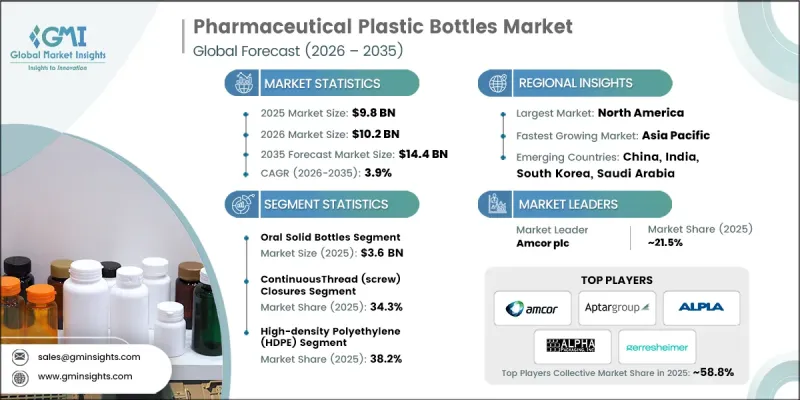
이러한 시장 확대는 제네릭 의약품의 세계 생산량 증가, 경구용 고형제제의 지속적인 성장, 일반의약품(OTC) 소비 확대에 기인합니다. 유리에서 경량 고밀도 폴리에틸렌(HDPE) 패키지로의 전환이 진행되고 있으며, CMO(Contract Manufacturing Organization)에 대한 아웃소싱 증가도 수요를 견인하고 있습니다. 어린이 안전 포장 및 변조 방지 포장에 대한 규제 요건과 더불어, 재활용 가능한 PCR(Post-Consumer Recycled) 소재의 병을 사용하는 지속가능성 구상도 성장의 원동력이 되고 있습니다. 북미와 아시아태평양에서는 셀프 메디케이션 동향, 약국 네트워크의 확대, 뉴트리슈티컬(기능성 식품) 부문의 성장에 힘입어 OTC 의약품에 대한 수요가 증가하고 있습니다. 플라스틱병의 사용은 안전성, 변조 방지 기능, 경량 설계와 같은 중요한 이점을 가지고 있으며, 이는 전 세계 소매 및 약국 채널에서 높은 회전율과 안정적인 수요를 지속적으로 지원하고 있습니다.
| 시장 범위 | |
|---|---|
| 시작연도 | 2025년 |
| 예측 기간 | 2026-2035년 |
| 개시 금액 | 98억 달러 |
| 예측액 | 144억 달러 |
| CAGR | 3.9% |
경구용 고형제 병 시장은 2025년 36억 달러에 달했습니다. 정제 및 캡슐은 특히 만성질환에서 전 세계에서 가장 많이 처방되는 약품으로, 이 병은 여전히 중요한 역할을 하고 있습니다. 습기로부터의 보호, 대량 포장의 효율성 및 어린이용 캡과의 호환성으로 인해 대규모 의약품 생산 및 유통 네트워크에서 없어서는 안 될 존재가 되었습니다.
고밀도 폴리에틸렌(HDPE) 부문은 2025년 38.2%의 점유율을 차지했습니다. HDPE는 우수한 방습성, 내화학성, 내구성, 경량성으로 인해 선호되고 있으며, 정제, 캡슐, 분말 포장에 매우 적합합니다. 낮은 운송 비용과 의약품의 안정성 요구 사항에 대한 적합성으로 인해 북미, 유럽 및 아시아 규제 시장에서 HDPE는 최적의 소재입니다.
2025년 북미 의약품 플라스틱병 시장은 39.7%의 점유율을 차지했습니다. 이 지역의 성장은 처방약 소비 증가, 의약품 안전 규제 강화, 가볍고 깨지지 않는 포장으로의 전환에 힘입어 성장세를 보이고 있습니다. FDA와 캐나다 보건부의 규제 감독은 어린이 안전 기준과 변조 방지 기준을 준수하도록 요구하고 있으며, 이는 HDPE 및 폴리프로필렌으로 만든 의약품 병에 대한 수요를 주도하고 있습니다.
자주 묻는 질문
목차
제1장 조사 방법과 범위
제2장 개요
제3장 업계 인사이트
제4장 경쟁 구도
제5장 시장 추산·예측 : 보틀 유형별, 2022-2035
제6장 시장 추산·예측 : 소재 유형별, 2022-2035
제7장 시장 추산·예측 : 보틀 용량별, 2022-2035
제8장 시장 추산·예측 : 캡 유형별, 2022-2035
제9장 시장 추산·예측 : 최종사용자별, 2022-2035
제10장 시장 추산·예측 : 지역별, 2022-2035
제11장 기업 개요
KSA 26.04.20The Global Pharmaceutical Plastic Bottles Market was valued at USD 9.8 billion in 2025 and is estimated to grow at a CAGR of 3.9% to reach USD 14.4 billion in 2035.
The market is expanding due to rising global production of generic drugs, continuous growth of oral solid dosage forms, and increasing consumption of over-the-counter (OTC) medicines. The ongoing transition from glass to lightweight high-density polyethylene (HDPE) packaging, coupled with rising outsourcing to contract manufacturing organizations (CMOs), is also driving demand. Regulatory mandates for child-resistant and tamper-evident packaging, along with sustainability initiatives promoting recyclable and PCR-based bottles, are further stimulating growth. North America and Asia-Pacific are experiencing heightened OTC demand driven by self-medication trends, pharmacy network expansion, and growth in the nutraceutical segment. The use of plastic bottles provides key advantages, including safety, tamper evidence, and lightweight design, which continues to support high turnover and consistent demand in retail and pharmacy channels worldwide.
| Market Scope | |
|---|---|
| Start Year | 2025 |
| Forecast Year | 2026-2035 |
| Start Value | $9.8 Billion |
| Forecast Value | $14.4 Billion |
| CAGR | 3.9% |
The oral solid bottles segment reached USD 3.6 billion in 2025. These bottles remain critical as tablets and capsules account for the highest prescription volumes globally, particularly for chronic conditions. They offer moisture protection, bulk packaging efficiency, and compatibility with child-resistant closures, making them essential for large-scale pharmaceutical production and distribution networks.
The high-density polyethylene (HDPE) segment accounted for 38.2% share in 2025. HDPE is preferred for its excellent moisture barrier properties, chemical resistance, durability, and lightweight nature, making it highly suitable for packaging tablets, capsules, and powders. Its cost-effective transport and compliance with pharmaceutical stability requirements make it the material of choice in regulated markets across North America, Europe, and Asia.
North America Pharmaceutical Plastic Bottles Market held 39.7% share in 2025. Growth in this region is supported by rising prescription drug consumption, stricter drug safety regulations, and the shift to lightweight, shatter-resistant packaging. Regulatory oversight from the FDA and Health Canada requires adherence to child-resistant and tamper-evident standards, which drives demand for HDPE and polypropylene pharmaceutical bottles.
Prominent players in the Global Pharmaceutical Plastic Bottles Market include ALPLA Group, Amcor plc, Alpha Packaging, Inc., AptarGroup, Inc., COMAR LLC, Drug Plastics & Glass Company, Inc., C.L. Smith Company, Frapak Packaging B.V., Gerresheimer AG, Gil Plastic Products Ltd, Mykron Plus India Pvt. Ltd., O.Berk Company LLC, Origin Pharma Packaging Ltd, Plastipak Holdings, Inc., Pretium Packaging, LLC, Pro-Pac Packaging Ltd, Silgan Holdings Inc., United States Plastic Corporation, Weener Plastics Group BV, and Zhejiang B.I. Industrial Co., Ltd. Companies in the Global Pharmaceutical Plastic Bottles Market are employing multiple strategies to strengthen their foothold and expand their global presence. These include investing in R&D to develop child-resistant, tamper-evident, and PCR-based packaging solutions that align with sustainability trends. Firms are forming strategic alliances with CMOs and pharmaceutical companies to secure long-term contracts and increase production capacity. Expansion of regional manufacturing facilities ensures faster delivery and cost optimization. Companies are also implementing advanced quality control systems and regulatory compliance protocols to meet international standards, enhancing brand reliability.
Table of Contents
Chapter 1 Methodology and Scope
- 1.1 Market scope and definition
- 1.2 Research design
- 1.2.1 Research approach
- 1.2.2 Data collection methods
- 1.3 Data mining sources
- 1.3.1 Global
- 1.3.2 Regional/Country
- 1.4 Base estimates and calculations
- 1.4.1 Base year calculation
- 1.4.2 Key trends for market estimation
- 1.5 Primary research and validation
- 1.5.1 Primary sources
- 1.6 Forecast model
- 1.7 Research assumptions and limitations
Chapter 2 Executive Summary
- 2.1 Industry 360° synopsis, 2022 - 2035
- 2.2 Key market trends
- 2.2.1 Bottle type trends
- 2.2.2 Material type trends
- 2.2.3 Bottle capacity trends
- 2.2.4 Closure type trends
- 2.2.5 End-user trends
- 2.2.6 Regional trends
- 2.3 TAM Analysis, 2026-2035
- 2.4 CXO perspectives: Strategic imperatives
- 2.4.1 Executive decision points
- 2.4.2 critical success factors
- 2.5 Future outlook and strategic recommendations
Chapter 3 Industry Insights
- 3.1 Industry ecosystem analysis
- 3.1.1 Supplier Landscape
- 3.1.2 Profit Margin
- 3.1.3 Cost structure
- 3.1.4 Value addition at each stage
- 3.1.5 Factor affecting the value chain
- 3.1.6 Disruptions
- 3.2 Industry impact forces
- 3.2.1 Growth drivers
- 3.2.1.1 Rising global generic drug production volumes
- 3.2.1.2 Growth in oral solid dosage consumption
- 3.2.1.3 Increasing OTC medicine demand globally
- 3.2.1.4 Shift from glass to lightweight HDPE bottles
- 3.2.1.5 Expansion of contract manufacturing organizations (CMOs)
- 3.2.2 Industry pitfalls and challenges
- 3.2.2.1 Volatile resin prices (HDPE, PET, PP)
- 3.2.2.2 Stringent extractables and leachables compliance
- 3.2.3 Market opportunities
- 3.2.3.1 Bio-based polymer adoption in pharma packaging
- 3.2.3.2 Smart packaging with anti-counterfeit features
- 3.2.1 Growth drivers
- 3.3 Growth potential analysis
- 3.4 Regulatory landscape
- 3.4.1 North America
- 3.4.2 Europe
- 3.4.3 Asia Pacific
- 3.4.4 Latin America
- 3.4.5 Middle East & Africa
- 3.5 Porter's analysis
- 3.6 PESTEL analysis
- 3.7 Technology and Innovation landscape
- 3.7.1 Current technological trends
- 3.7.2 Emerging technologies
- 3.8 Price trends
- 3.8.1 By region
- 3.8.2 By product
- 3.9 Pricing Strategies
- 3.10 Emerging Business Models
- 3.11 Compliance Requirements
- 3.12 Patent and IP analysis
- 3.13 Geopolitical and trade dynamics
Chapter 4 Competitive Landscape, 2025
- 4.1 Introduction
- 4.2 Company market share analysis
- 4.2.1 By region
- 4.2.1.1 North America
- 4.2.1.2 Europe
- 4.2.1.3 Asia Pacific
- 4.2.1.4 Latin America
- 4.2.1.5 Middle East & Africa
- 4.2.2 Market concentration analysis
- 4.2.1 By region
- 4.3 Competitive benchmarking of key players
- 4.3.1 Financial performance comparison
- 4.3.1.1 Revenue
- 4.3.1.2 Profit margin
- 4.3.1.3 R&D
- 4.3.2 Product portfolio comparison
- 4.3.2.1 Product range breadth
- 4.3.2.2 Technology
- 4.3.2.3 Innovation
- 4.3.3 Geographic presence comparison
- 4.3.3.1 Global footprint analysis
- 4.3.3.2 Service network coverage
- 4.3.3.3 Market penetration by region
- 4.3.4 Competitive positioning matrix
- 4.3.4.1 Leaders
- 4.3.4.2 Challengers
- 4.3.4.3 Followers
- 4.3.4.4 Niche players
- 4.3.5 Strategic outlook matrix
- 4.3.1 Financial performance comparison
- 4.4 Key developments
- 4.4.1 Mergers and acquisitions
- 4.4.2 Partnerships and collaborations
- 4.4.3 Technological advancements
- 4.4.4 Expansion and investment strategies
- 4.4.5 Digital transformation initiatives
- 4.5 Emerging/ startup competitors landscape
Chapter 5 Market Estimates and Forecast, By Bottle Type, 2022 - 2035 (USD Million)
- 5.1 Key trends
- 5.2 Oral solid bottles
- 5.3 Oral liquid bottles
- 5.4 Ophthalmic bottles
- 5.5 Parenteral/injectable vials
- 5.6 Nasal spray bottles
- 5.7 Topical/dermal bottles
Chapter 6 Market Estimates and Forecast, By Material Type, 2022 - 2035 (USD Million)
- 6.1 Key trends
- 6.2 High-density polyethylene (HDPE)
- 6.3 Low-density polyethylene (LDPE)
- 6.4 Polypropylene (PP)
- 6.5 Polyethylene terephthalate (PET)
- 6.6 Polyethylene terephthalate glycol (PETG)
- 6.7 Cyclic olefin polymer (COP) & cyclic olefin copolymer (COC)
Chapter 7 Market Estimates and Forecast, By Bottle Capacity, 2022 - 2035 (USD Million)
- 7.1 Key trends
- 7.2 Micro bottles (5ml - 20ml)
- 7.3 Small bottles (30ml - 100ml)
- 7.4 Medium bottles (120ml - 300ml)
- 7.5 Large bottles (500ml - 1000ml)
- 7.6 Extra-large bottles (>1000ml)
Chapter 8 Market Estimates and Forecast, By Closure Type, 2022 - 2035 (USD Million)
- 8.1 Key trends
- 8.2 Continuous thread (screw) closures
- 8.3 Snap-on closures
- 8.4 Dispensing closures
- 8.5 Specialty closures
Chapter 9 Market Estimates and Forecast, By End-User, 2022 - 2035 (USD Million)
- 9.1 Key trends
- 9.2 Pharmaceutical manufacturers (in-house production)
- 9.3 Contract manufacturing organizations (CMO/CDMO)
- 9.4 Nutraceutical & dietary supplement manufacturers
- 9.5 Healthcare institutions
- 9.6 Compounding pharmacies
Chapter 10 Market Estimates and Forecast, By Region, 2022 - 2035 (USD Million)
- 10.1 Key trends
- 10.2 North America
- 10.2.1 U.S.
- 10.2.2 Canada
- 10.3 Europe
- 10.3.1 Germany
- 10.3.2 UK
- 10.3.3 France
- 10.3.4 Spain
- 10.3.5 Italy
- 10.3.6 Russia
- 10.4 Asia Pacific
- 10.4.1 China
- 10.4.2 India
- 10.4.3 Japan
- 10.4.4 Australia
- 10.4.5 South Korea
- 10.5 Latin America
- 10.5.1 Brazil
- 10.5.2 Mexico
- 10.5.3 Argentina
- 10.6 Middle East and Africa
- 10.6.1 South Africa
- 10.6.2 Saudi Arabia
- 10.6.3 UAE
Chapter 11 Company Profiles
- 11.1 Global Key Players
- 11.1.1 Gerresheimer AG
- 11.1.2 Amcor plc
- 11.1.3 AptarGroup, Inc.
- 11.1.4 ALPLA Group
- 11.1.5 Silgan Holdings Inc.
- 11.1.6 Plastipak Holdings, Inc.
- 11.2 Regional key players
- 11.2.1 North America
- 11.2.1.1 Alpha Packaging, Inc.
- 11.2.1.2 COMAR LLC
- 11.2.1.3 Drug Plastics & Glass Company, Inc.
- 11.2.1.4 Pretium Packaging, LLC
- 11.2.1.5 C.L. Smith Company
- 11.2.1.6 O.Berk Company LLC
- 11.2.1.7 United States Plastic Corporation
- 11.2.2 Asia Pacific
- 11.2.2.1 Mykron Plus India Pvt. Ltd.
- 11.2.2.2 Zhejiang B.I. Industrial Co., Ltd.
- 11.2.2.3 Pro-Pac Packaging Ltd
- 11.2.3 Europe
- 11.2.3.1 Frapak Packaging B.V.
- 11.2.3.2 Origin Pharma Packaging Ltd
- 11.2.3.3 Weener Plastics Group BV
- 11.2.3.4 Gil Plastic Products Ltd
- 11.2.1 North America


