

|
시장보고서
상품코드
1998848
셀룰로오스 섬유 시장 기회, 성장요인, 업계 동향 분석 및 예측(2026-2035년)Cellulose Fiber Market Opportunity, Growth Drivers, Industry Trend Analysis, and Forecast 2026 - 2035 |
||||||

세계의 셀룰로오스 섬유 시장은 2025년에 401억 달러로 평가되며, 2035년까지 CAGR 4.3%로 성장하며, 620억 달러에 달할 것으로 추정되고 있습니다.
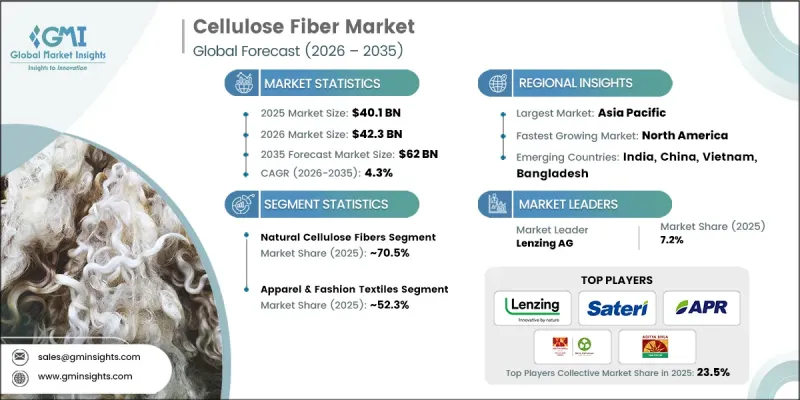
다양한 산업 분야에서 지속가능하고 친환경적인 섬유 솔루션에 대한 수요가 증가함에 따라 이 시장은 꾸준히 성장하고 있습니다. 면, 대마, 아마 등의 천연섬유와 비스코스, 리오셀, 모달 등의 재생 섬유를 포함한 셀룰로오스 섬유는 생분해성, 착용감, 다용도성 등으로 주목받고 있습니다. 패션 및 의류 업계에서는 소비자와 제조업체 모두 친환경적인 선택을 우선시하고 지속가능한 소재와 순환 경제의 실천으로 점점 더 많이 전환하고 있습니다. 의류 분야에서 셀룰로오스 섬유는 통기성, 흡습성, 부드러운 감촉으로 평가받고 있으며, 일상복부터 기능성 의류까지 폭넓게 활용되고 있습니다. 재생섬유는 드레이프성, 광택, 염색성 등의 특성을 향상시켜 합성섬유에 대한 지속가능한 대안을 제공합니다. 의류 분야 외에도 셀룰로오스 섬유는 가정용 섬유, 부직포, 기능성 섬유, 침구, 타월, 가구용 직물, 위생용품, 물티슈 등에서 편안함, 내구성, 흡수성, 생분해성 등을 제공하는 등 다양한 용도로 사용되고 있습니다.
| 시장 범위 | |
|---|---|
| 시작연도 | 2025년 |
| 예측 기간 | 2026-2035년 |
| 개시 금액 | 401억 달러 |
| 예측액 | 620억 달러 |
| CAGR | 4.3% |
천연 셀룰로오스 섬유 부문은 2025년 70.5%의 점유율을 차지하며, 2035년까지 연평균 4.5%의 성장률을 보일 것으로 예측됩니다. 면, 대마, 아마 등 식물성 섬유는 천연 생분해성, 편안한 착용감, 그리고 소비자 친화성으로 인해 시장을 계속 독점하고 있습니다. 면은 여전히 주요 천연섬유로, 그 부드러움, 통기성, 그리고 의류, 홈텍스타일, 산업 응용 분야에서 다용도한 면의 활용도를 높이 평가받고 있습니다. 대마와 아마는 환경에 미치는 영향이 적고, 물과 농약의 사용량이 적으며, 내구성이 높아 테크니컬 텍스타일과 지속가능한 패션에 적합하다는 점에서 다시금 주목받고 있습니다.
의류 및 패션 섬유 부문은 2025년 52.3%의 점유율을 차지하며, 2035년까지 연평균 4.2%의 성장률을 보일 것으로 전망됩니다. 셀룰로오스 섬유의 편안함, 통기성 및 미적 다양성으로 인해 이 부문이 선도적인 위치를 차지하고 있습니다. 일상복은 주로 면에 의존하고 있지만, 리요셀, 모달 등 재생 섬유는 우수한 드레이프성, 흡습성, 부드러운 촉감으로 인해 프리미엄 패션, 액티브웨어, 애슬레저에서 채용이 확대되고 있습니다. 생분해성 및 재생한 섬유에 대한 소비자의 선호도가 높아지면서 지속가능한 패션 동향을 주도하고 있습니다.
2025년 기준 북미 셀룰로오스 섬유 시장은 16.7%의 점유율을 차지했습니다. 이 지역의 성장은 지속가능성에 대한 소비자의 인식이 높아지고 천연 및 생분해성 섬유로의 전환에 힘입어 성장하고 있습니다. 기존 섬유, 의류, 인테리어 산업은 순환 경제, 섬유 재활용 프로그램, 공급망 투명성을 배경으로 지속가능한 섬유를 적극적으로 도입하고 있습니다. 수요는 테크니컬 텍스타일, 부직포, 의료, 자동차, 특수 포장 용도로 더욱 확대되고 있으며, 시장은 전통적 섬유의 틀을 넘어서고 있습니다.
자주 묻는 질문
목차
제1장 조사 방법과 범위
제2장 개요
제3장 업계 인사이트
제4장 경쟁 구도
제5장 시장 추산·예측 : 섬유 유형별, 2022-2035
제6장 시장 추산·예측 : 용도별, 2022-2035
제7장 시장 추산·예측 : 지역별, 2022-2035
제8장 기업 개요
KSA 26.04.20The Global Cellulose Fiber Market was valued at USD 40.1 billion in 2025 and is estimated to grow at a CAGR of 4.3% to reach USD 62 billion by 2035.
The market is experiencing steady growth due to rising demand for sustainable and eco-friendly textile solutions across various industries. Cellulose fibers, including natural fibers such as cotton, hemp, and flax, as well as regenerated fibers like viscose, lyocell, and modal, are gaining traction for their biodegradability, comfort, and versatility. The fashion and apparel industry is increasingly shifting toward sustainable materials and circular economy practices, with both consumers and manufacturers prioritizing environmentally responsible options. In clothing, cellulose fibers are favored for their breathability, moisture absorption, and soft texture, suitable for everyday wear as well as performance garments. Regenerated fibers enhance properties like drape, luster, and dyeability, providing sustainable alternatives to synthetic textiles. Beyond apparel, cellulose fibers are widely used in home textiles, nonwovens, and technical textiles, offering comfort, durability, absorbency, and biodegradability across bedding, towels, upholstery, hygiene products, and wipes.
| Market Scope | |
|---|---|
| Start Year | 2025 |
| Forecast Year | 2026-2035 |
| Start Value | $40.1 Billion |
| Forecast Value | $62 Billion |
| CAGR | 4.3% |
The natural cellulose fibers segment held 70.5% share in 2025 and is expected to grow at a CAGR of 4.5% by 2035. Plant-based fibers like cotton, hemp, and flax continue to dominate the market due to their natural biodegradability, comfort, and consumer familiarity. Cotton remains the primary natural fiber, appreciated for softness, breathability, and versatility across apparel, home textiles, and industrial applications. Hemp and flax are witnessing renewed interest due to their low environmental impact, minimal water and pesticide requirements, and high durability, making them suitable for technical textiles and sustainable fashion.
The apparel and fashion textiles segment accounted for 52.3% share in 2025 and is projected to grow at a CAGR of 4.2% through 2035. This segment dominates due to cellulose fibers' comfort, breathability, and aesthetic versatility. Everyday garments largely rely on cotton, while regenerated fibers such as lyocell and modal are increasingly adopted in premium fashion, activewear, and athleisure for superior drape, moisture management, and soft hand feel. Rising consumer preference for biodegradable, renewable fibers is boosting the sustainable fashion trend.
North America Cellulose Fiber Market held a 16.7% share in 2025. Growth in the region is driven by increased consumer awareness of sustainability and a shift toward natural, biodegradable fibers. Established textile, apparel, and home furnishing industries are actively incorporating sustainable fibers, supported by circular economy initiatives, textile recycling programs, and supply chain transparency. Demand is further expanding across technical textiles, nonwovens, medical, automotive, and specialty packaging applications, broadening the market beyond conventional textiles.
Leading companies in the Global Cellulose Fiber Market include Lenzing AG, Sateri Holdings Limited, Aditya Birla Group / Birla Cellulose, Thai Rayon Public Company, Asia Pacific Rayon (APR), Kelheim Fibres GmbH, Eastman Chemical Company, Asahi Kasei Corporation, Cargill Cotton, Olam Agri, Bracell, Tangshan Sanyou Group, HempFlax Group B.V., The Flax Company, and Libeco NV. Key strategies adopted by cellulose fiber companies to strengthen market presence include investing in sustainable fiber production, including organic cotton and low-impact hemp or flax. Firms are developing regenerated fibers with enhanced properties such as improved drape, luster, and dyeability to capture premium apparel and technical textile segments. Strategic partnerships with fashion brands, home textile manufacturers, and industrial users help expand distribution and adoption. Companies are also focusing on circular economy initiatives, recycling programs, and supply chain traceability to meet rising sustainability standards.
Table of Contents
Chapter 1 Methodology & Scope
- 1.1 Market scope and definition
- 1.2 Research design
- 1.2.1 Research approach
- 1.2.2 Data collection methods
- 1.3 Data mining sources
- 1.3.1 Global
- 1.3.2 Regional/Country
- 1.4 Base estimates and calculations
- 1.4.1 Base year calculation
- 1.4.2 Key trends for market estimation
- 1.5 Primary research and validation
- 1.5.1 Primary sources
- 1.6 Forecast model
- 1.7 Research assumptions and limitations
Chapter 2 Executive Summary
- 2.1 Industry 360° synopsis
- 2.2 Key market trends
- 2.2.1 Fiber type
- 2.2.2 Application
- 2.2.3 Regional
- 2.3 TAM Analysis, 2026-2035
- 2.4 CXO perspectives: Strategic imperatives
Chapter 3 Industry Insights
- 3.1 Industry ecosystem analysis
- 3.1.1 Supplier landscape
- 3.1.2 Profit margin
- 3.1.3 Value addition at each stage
- 3.1.4 Factor affecting the value chain
- 3.1.5 Disruptions
- 3.2 Industry impact forces
- 3.2.1 Growth drivers
- 3.2.2 Industry pitfalls and challenges
- 3.2.3 Market opportunities
- 3.3 Growth potential analysis
- 3.4 Regulatory landscape
- 3.4.1 North America
- 3.4.2 Europe
- 3.4.3 Asia Pacific
- 3.4.4 Latin America
- 3.4.5 Middle East & Africa
- 3.5 Porter's analysis
- 3.6 PESTEL analysis
- 3.7 Price trends
- 3.7.1 By region
- 3.7.2 By type
- 3.8 Future market trends
- 3.9 Technology and Innovation landscape
- 3.9.1 Current technological trends
- 3.9.2 Emerging technologies
- 3.10 Patent Landscape
- 3.11 Trade statistics (HS code)
- 3.11.1 Major importing countries
- 3.11.2 Major exporting countries
- 3.12 Sustainability and environmental aspects
- 3.12.1 Sustainable practices
- 3.12.2 Waste reduction strategies
- 3.12.3 Energy efficiency in production
- 3.12.4 Eco-friendly initiatives
Chapter 4 Competitive Landscape, 2025
- 4.1 Introduction
- 4.2 Company market share analysis
- 4.2.1 By region
- 4.2.1.1 North America
- 4.2.1.2 Europe
- 4.2.1.3 Asia Pacific
- 4.2.1.4 LATAM
- 4.2.1.5 MEA
- 4.2.1 By region
- 4.3 Competitive analysis of major market players
- 4.4 Competitive positioning matrix
- 4.5 Key developments
- 4.5.1 Mergers & acquisitions
- 4.5.2 Partnerships & collaborations
- 4.5.3 New Product Launches
- 4.5.4 Expansion Plans
Chapter 5 Market Estimates and Forecast, By Fiber Type, 2022-2035 (USD Billion) (Kilo Tons)
- 5.1 Key trends
- 5.2 Natural cellulose fibers
- 5.2.1 Cotton
- 5.2.2 Flax (linen)
- 5.2.3 Hemp (industrial hemp)
- 5.2.4 Jute
- 5.2.5 Other bast & leaf fibers (kenaf, ramie, sisal, abaca)
- 5.3 Regenerated / man-made cellulose fibers (MMCFs)
- 5.3.1 Viscose / rayon
- 5.3.2 Lyocell
- 5.3.3 Modal
- 5.3.4 Cellulose acetate
- 5.3.5 Others
Chapter 6 Market Estimates and Forecast, By Application, 2022-2035 (USD Billion) (Kilo Tons)
- 6.1 Key trends
- 6.2 Apparel & fashion textiles
- 6.3 Home furnishings & household textiles
- 6.4 Nonwovens
- 6.5 Industrial & technical textiles
- 6.6 Automotive textiles
- 6.7 Packaging materials
- 6.8 Medical & healthcare
- 6.9 Agriculture
- 6.10 Others
Chapter 7 Market Estimates and Forecast, By Region, 2022-2035 (USD Billion) (Kilo Tons)
- 7.1 Key trends
- 7.2 North America
- 7.2.1 U.S.
- 7.2.2 Canada
- 7.3 Europe
- 7.3.1 Germany
- 7.3.2 UK
- 7.3.3 France
- 7.3.4 Spain
- 7.3.5 Italy
- 7.3.6 Rest of Europe
- 7.4 Asia Pacific
- 7.4.1 China
- 7.4.2 India
- 7.4.3 Japan
- 7.4.4 Australia
- 7.4.5 South Korea
- 7.4.6 Rest of Asia Pacific
- 7.5 Latin America
- 7.5.1 Brazil
- 7.5.2 Mexico
- 7.5.3 Argentina
- 7.5.4 Rest of Latin America
- 7.6 Middle East and Africa
- 7.6.1 Saudi Arabia
- 7.6.2 South Africa
- 7.6.3 UAE
- 7.6.4 Rest of Middle East and Africa
Chapter 8 Company Profiles
- 8.1 Sateri Holdings Limited
- 8.2 Aditya Birla Group / Birla Cellulose
- 8.3 Lenzing AG
- 8.4 Thai Rayon Public Company
- 8.5 Asia Pacific Rayon (APR)
- 8.6 Kelheim Fibres GmbH
- 8.7 Eastman Chemical Company
- 8.8 Asahi Kasei Corporation
- 8.9 Cargill Cotton
- 8.10 Olam Agri
- 8.11 Bracell
- 8.12 Tangshan Sanyou Group
- 8.13 HempFlax Group B.V.
- 8.14 The Flax Company
- 8.15 Libeco NV


