
|
시장보고서
상품코드
1998849
점착부여제 시장 기회, 성장요인, 업계 동향 분석 및 예측(2026-2035년)Tackifier Market Opportunity, Growth Drivers, Industry Trend Analysis, and Forecast 2026 - 2035 |
||||||

세계의 점착부여제 시장은 2025년에 73억 달러로 평가되며, CAGR 5.2%로 성장하며, 2035년까지 122억 달러에 달할 것으로 추정되고 있습니다.
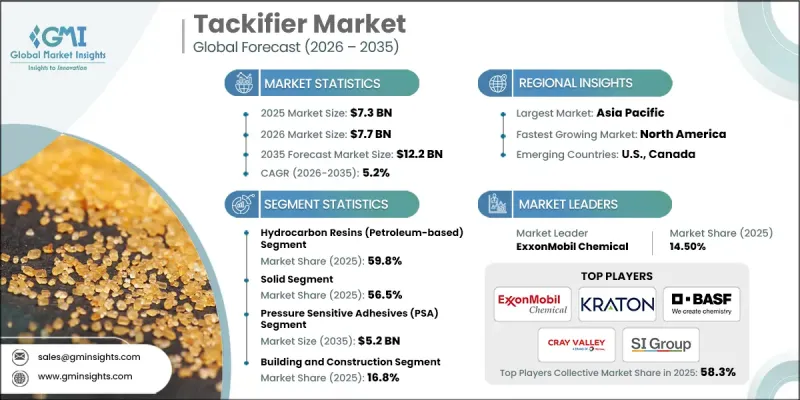
점착부여제 시장의 성장은 제품의 성능과 내구성을 높이기 위해 접착 기술에 의존하는 여러 산업 분야 수요 증가에 의해 주도되고 있습니다. 점착 섬유는 제조 환경 전반에 걸쳐 사용되는 다양한 접착제 배합에서 접착 강도, 유연성 및 장기 안정성을 향상시키는 데 중요한 역할을 합니다. 최종 사용 분야 중 포장 분야가 가장 큰 소비량을 차지하고 있으며, 건축 및 건설, 자동차 생산, 부직포, 목공 및 가구 제조가 그 뒤를 잇고 있습니다. 환경 지속가능성과 규제 준수에 대한 관심이 높아지면서 각 제조업체들은 배출량을 줄이고 환경 성능을 향상시킨 수지를 개발하고 있습니다. 환경 규제가 강화됨에 따라 업계는 변화하는 표준을 충족시키기 위해 저 VOC(휘발성 유기 화합물) 및 바이오 점착제 재료를 점점 더 많이 채택하고 있습니다. 지역별로는 아시아태평양이 광범위한 제조 인프라, 강력한 산업 생산 능력, R&D 활동에 대한 지속적인 투자로 인해 전 세계 매출에서 가장 큰 비중을 차지하고 있습니다. 한편, 유럽의 택파이어 시장은 환경 친화적인 고성능 수지 기술 개발을 통해 발전하고 있습니다. 북미는 산업 활동의 확대, 도시 개발의 발전, 포장 및 부직포에 사용되는 접착제 제품의 소비 증가에 힘입어 가장 빠른 성장세를 보이고 있습니다. 라틴아메리카와 중동 및 아프리카는 세계 시장에서 상대적으로 작은 비중을 차지하고 있지만, 두 지역 모두 예측 기간 중 꾸준하고 완만한 성장을 보일 것으로 예측됩니다.
| 시장 범위 | |
|---|---|
| 시작연도 | 2025년 |
| 예측 기간 | 2026-2035년 |
| 개시 금액 | 73억 달러 |
| 예측액 | 122억 달러 |
| CAGR | 5.2% |
로진 수지 부문은 2025년 27억 달러의 시장 규모를 기록하며, 접착제 배합에 사용되는 가장 중요한 천연 수지 카테고리 중 하나입니다. 로진계 재료는 우수한 접착 특성과 다양한 산업 응용 분야에 대한 적응성으로 인해 널리 활용되고 있습니다. 이러한 재료의 성능 특성을 향상시키기 위해 안정성과내 산화성을 향상시키는 화학적 개질을 포함한 여러 가공 기술이 적용되고 있습니다. 또한 다양한 폴리머 시스템 및 접착제 조성물과의 호환성을 향상시키기 위해 다양한 유도체 배합이 개발되고 있으며, 이를 통해 제조업체는 다양한 산업 분야에서 접착 성능 향상과 배합의 유연성을 실현할 수 있습니다.
2025년에는 고체 택 섬유 부문이 56.5%의 점유율을 차지하며 2026-2035년 연평균 복합 성장률(CAGR) 4.9%를 나타낼 것으로 예측됩니다. 고체 점착 섬유는 접착제의 제조 과정에서 일관된 성능을 유지하면서 보관 및 취급시 안정성이 높기 때문에 여전히 널리 선호되고 있습니다. 물리적 특성으로 인해 제조업체는 열처리 과정에서 점도 수준과 연화 특성을 보다 효과적으로 제어할 수 있습니다. 그 결과, 이들 재료는 신뢰할 수 있는 접착 강도와 예측 가능한 가공 거동이 요구되는 핫멜트 접착제 시스템에 널리 채택되고 있습니다. 내구성과 산업 생산 방식과의 적합성은 여러 제조 분야에서 폭넓게 채택되고 있습니다.
북미의 점착성 섬유 시장은 2025년 18억 달러 규모에 달했습니다. 탄탄한 산업 인프라와 주요 화학업체들의 연구개발에 대한 지속적인 투자는 이 지역의 지속적인 혁신을 지원하고 있습니다. 각 업체들은 제품의 안정성과 내구성을 향상시키기 위해 수소화 수지, 고성능 배합 기술 등 특수 수지 기술 개발에 점점 더 집중하고 있습니다. 그러나 이 지역 시장은 특히 수지 제조에 사용되는 석유 유래 원료와 관련된 가격 변동에 영향을 받기 쉬운 상황이 지속되고 있습니다. 원자재 비용의 변동은 제조 비용에 영향을 미치고, 궁극적으로 지역 전체 시장 역학에도 영향을 미칠 수 있습니다.
자주 묻는 질문
목차
제1장 조사 방법과 범위
제2장 개요
제3장 업계 인사이트
제4장 경쟁 구도
제5장 시장 추산·예측 : 화학적 성질별, 2022-2035
제6장 시장 추산·예측 : 형태별, 2022-2035
제7장 시장 추산·예측 : 용도별, 2022-2035
제8장 시장 추산·예측 : 최종사용자별, 2022-2035
제9장 시장 추산·예측 : 지역별, 2022-2035
제10장 기업 개요
KSA 26.04.20The Global Tackifier Market was valued at USD 7.3 billion in 2025 and is estimated to grow at a CAGR of 5.2% to reach USD 12.2 billion by 2035.
Growth in the tackifier market is driven by rising demand from multiple industrial sectors that rely on adhesive technologies to enhance product performance and durability. Tackifiers play an important role in improving adhesion strength, flexibility, and long-term stability within various adhesive formulations used across manufacturing environments. Among end-use sectors, packaging represents the largest share of consumption, followed by building and construction, automotive production, non-woven materials, and woodworking or furniture manufacturing. Increasing focus on environmental sustainability and regulatory compliance is encouraging manufacturers to develop resins with reduced emissions and improved ecological profiles. As environmental regulations become stricter, industries are increasingly adopting low-VOC and bio-based tackifying materials to meet evolving standards. Regionally, Asia Pacific generates the largest share of global revenue due to its extensive manufacturing infrastructure, strong industrial production capacity, and continuous investment in research and development activities. Meanwhile, the European tackifier market is advancing through the development of environmentally responsible high-performance resin technologies. North America is witnessing the fastest growth, supported by expanding industrial activities, increasing urban development, and rising consumption of adhesive products used in packaging and non-woven materials. Although Latin America and the Middle East & Africa represent comparatively smaller portions of the global market, both regions are anticipated to demonstrate consistent and gradual growth over the forecast period.
| Market Scope | |
|---|---|
| Start Year | 2025 |
| Forecast Year | 2026-2035 |
| Start Value | $7.3 Billion |
| Forecast Value | $12.2 Billion |
| CAGR | 5.2% |
The rosin resins segment generated USD 2.7 billion in 2025 and remains one of the most important natural resin categories used in adhesive formulations. Rosin-based materials are widely utilized due to their effective bonding properties and adaptability in numerous industrial applications. Several processing techniques are applied to improve the performance characteristics of these materials, including chemical modifications that enhance stability and resistance to oxidation. In addition, various derivative formulations are developed to improve compatibility with different polymer systems and adhesive compositions, allowing manufacturers to achieve improved bonding performance and formulation flexibility across multiple industries.
The solid tackifier segment accounted for 56.5% share in 2025 and is projected to grow at a CAGR of 4.9% between 2026 and 2035. Solid-form tackifiers remain widely preferred because they offer greater stability during storage and handling while maintaining consistent performance during adhesive production. Their physical properties allow manufacturers to control viscosity levels and softening characteristics more effectively during thermal processing. As a result, these materials are commonly incorporated into hot-melt adhesive systems that require dependable bonding strength and predictable processing behavior. Their durability and compatibility with industrial production methods continue to support widespread adoption across multiple manufacturing sectors.
North America Tackifier Market generated USD 1.8 billion in 2025. Strong industrial infrastructure and consistent investment in research and development by major chemical manufacturers support ongoing innovation within the region. Companies are increasingly focusing on developing specialized resin technologies, including hydrogenated and advanced performance formulations designed to improve product stability and durability. However, the regional market remains sensitive to fluctuations in raw material pricing, particularly those associated with petroleum-derived inputs used in resin production. Variability in feedstock costs can influence manufacturing expenses and ultimately affect market dynamics across the region.
Major companies operating in the Global Tackifier Market include BASF SE, Eastman Chemical Company, ExxonMobil Chemical, Kraton Corporation, SI Group Inc., Kolon Industries Inc., ZEON Corporation, Arakawa Chemical Industries Ltd., Yasuhara Chemical Co. Ltd., Lawter Inc., Neville Chemical Company, DRT (Derives Resiniques et Terpeniques), Cray Valley, Foreverest Resources Ltd., and Resin Solutions LLC. Companies competing in the Tackifier Market are strengthening their market presence through continuous innovation, strategic partnerships, and capacity expansion initiatives. Many manufacturers are investing in research and development to create advanced tackifying resins that offer improved bonding performance while meeting evolving environmental standards. The development of bio-based and low-VOC resin technologies has become a key strategic priority as industries shift toward sustainable production practices. Firms are also expanding production facilities and strengthening supply chain networks to support growing global demand for adhesive materials. Strategic collaborations with adhesive manufacturers enable companies to develop customized resin solutions tailored to specific industrial applications.
Table of Contents
Chapter 1 Methodology & Scope
- 1.1 Research approach
- 1.2 Quality Commitments
- 1.2.1 GMI AI policy & data integrity commitment
- 1.2.1.1 Source consistency protocol
- 1.2.1 GMI AI policy & data integrity commitment
- 1.3 Research Trail & Confidence Scoring
- 1.3.1 Research Trail Components
- 1.3.2 Scoring Components
- 1.4 Data Collection
- 1.4.1 Partial list of primary sources
- 1.5 Data mining sources
- 1.5.1 Paid sources
- 1.5.1.1 Sources, by region
- 1.5.1 Paid sources
- 1.6 Base estimates and calculations
- 1.6.1 Base year calculation for any one approach
- 1.7 Forecast model
- 1.7.1 Quantified market impact analysis
- 1.7.1.1 Mathematical impact of growth parameters on forecast
- 1.7.1 Quantified market impact analysis
- 1.8 Research transparency addendum
- 1.8.1 Source attribution framework
- 1.8.2 Quality assurance metrics
- 1.8.3 Our commitment to trust
Chapter 2 Executive Summary
- 2.1 Industry 360° synopsis
- 2.2 Key market trends
- 2.2.1 Regional
- 2.2.2 Chemistry Type
- 2.2.3 Form
- 2.2.4 Application
- 2.2.5 End User
- 2.3 TAM Analysis, 2025-2034
- 2.4 CXO perspectives: Strategic imperatives
Chapter 3 Industry Insights
- 3.1 Industry ecosystem analysis
- 3.1.1 Supplier landscape
- 3.1.2 Profit margin
- 3.1.3 Value addition at each stage
- 3.1.4 Factor affecting the value chain
- 3.1.5 Disruptions
- 3.2 Industry impact forces
- 3.2.1 Growth drivers
- 3.2.1.1 Rising Demand for Pressure Sensitive Adhesives (PSA)
- 3.2.1.2 Growth in Packaging & E-commerce Industries
- 3.2.1.3 Expansion of Construction & Automotive Sectors
- 3.2.2 Industry pitfalls and challenges
- 3.2.2.1 Volatility in Crude Oil & Raw Material Prices
- 3.2.2.2 Stringent Environmental & VOC Regulations
- 3.2.2.3 Availability of Alternative Adhesive Technologies
- 3.2.3 Market opportunities
- 3.2.3.1 Increasing Demand for Bio-Based & Sustainable Resins
- 3.2.3.2 Rapid Industrialization in Asia Pacific
- 3.2.3.3 Advancements in Hydrogenated & Specialty Resins
- 3.2.1 Growth drivers
- 3.3 Growth potential analysis
- 3.4 Regulatory landscape
- 3.4.1 North America
- 3.4.2 Europe
- 3.4.3 Asia Pacific
- 3.4.4 Latin America
- 3.4.5 Middle East & Africa
- 3.5 Porter's analysis
- 3.6 PESTEL analysis
- 3.7 Price trends
- 3.7.1 By region
- 3.7.2 By chemistry type
- 3.8 Future market trends
- 3.9 Technology and Innovation landscape
- 3.9.1 Current technological trends
- 3.9.2 Emerging technologies
- 3.10 Patent Landscape
- 3.11 Trade statistics (HS code)
- 3.11.1 Major importing countries
- 3.11.2 Major exporting countries
- 3.12 Sustainability and environmental aspects
- 3.12.1 Sustainable practices
- 3.12.2 Waste reduction strategies
- 3.12.3 Energy efficiency in production
- 3.12.4 Eco-friendly initiatives
- 3.13 Carbon footprint consideration
Chapter 4 Competitive Landscape, 2025
- 4.1 Introduction
- 4.2 Company market share analysis
- 4.2.1 By region
- 4.2.1.1 North America
- 4.2.1.2 Europe
- 4.2.1.3 Asia Pacific
- 4.2.1.4 Latin America
- 4.2.1.5 Middle East & Africa
- 4.2.1 By region
- 4.3 Company matrix analysis
- 4.4 Competitive analysis of major market players
- 4.5 Competitive positioning matrix
- 4.6 Key developments
- 4.6.1 Mergers & acquisitions
- 4.6.2 Partnerships & collaborations
- 4.6.3 New Product Launches
- 4.6.4 Expansion Plans
Chapter 5 Market Estimates and Forecast, By Chemistry Type, 2022-2035 (USD Million) (Kilo Tons)
- 5.1 Key trends
- 5.2 Hydrocarbon Resins (Petroleum-Based)
- 5.2.1 C5 Aliphatic Resins
- 5.2.2 C9 Aromatic Resins
- 5.2.3 C5/C9 Mixed Aliphatic/Aromatic Resins
- 5.2.4 DCPD (Dicyclopentadiene) Resins
- 5.2.5 Hydrogenated Hydrocarbon Resins
- 5.3 Rosin Resins (Natural)
- 5.3.1 Rosin Acids
- 5.3.2 Rosin Esters
- 5.4 Terpene Resins
- 5.4.1 Polyterpene Resins
- 5.4.2 Hydrogenated Terpene Resins
- 5.4.3 Styrenated Terpene Resins
- 5.4.4 Terpene Phenolic Resins
Chapter 6 Market Estimates and Forecast, By Form, 2022-2035 (USD Million) (Kilo Tons)
- 6.1 Key trends
- 6.2 Solid
- 6.3 Liquid
- 6.4 Resin Dispersion
Chapter 7 Market Estimates and Forecast, By Application, 2022-2035 (USD Million) (Kilo Tons)
- 7.1 Key trends
- 7.2 Pressure Sensitive Adhesives (PSA)
- 7.3 Hot Melt Adhesives (HMA)
- 7.4 Assembly Adhesives
- 7.5 Bookbinding Adhesives
- 7.6 Footwear, Leather & Rubber Adhesives
- 7.7 Others
Chapter 8 Market Estimates and Forecast, By End User, 2022-2035 (USD Million) (Kilo Tons)
- 8.1 Key trends
- 8.2 Packaging
- 8.3 Building & Construction
- 8.4 Automotive
- 8.5 Non-Wovens
- 8.6 Woodworking & Furniture
- 8.7 Footwear
- 8.8 Others
Chapter 9 Market Estimates and Forecast, By Region, 2022-2035 (USD Million) (Kilo Tons)
- 9.1 Key trends
- 9.2 North America
- 9.2.1 U.S.
- 9.2.2 Canada
- 9.3 Europe
- 9.3.1 Germany
- 9.3.2 UK
- 9.3.3 France
- 9.3.4 Spain
- 9.3.5 Italy
- 9.3.6 Rest of Europe
- 9.4 Asia Pacific
- 9.4.1 China
- 9.4.2 India
- 9.4.3 Japan
- 9.4.4 Australia
- 9.4.5 South Korea
- 9.4.6 Rest of Asia Pacific
- 9.5 Latin America
- 9.5.1 Brazil
- 9.5.2 Mexico
- 9.5.3 Argentina
- 9.5.4 Rest of Latin America
- 9.6 Middle East and Africa
- 9.6.1 Saudi Arabia
- 9.6.2 South Africa
- 9.6.3 UAE
- 9.6.4 Rest of Middle East and Africa
Chapter 10 Company Profiles
- 10.1 Arakawa Chemical Industries Ltd.
- 10.2 BASF SE
- 10.3 Cray Valley
- 10.4 DRT (Derives Resiniques et Terpeniques)
- 10.5 Eastman Chemical Company
- 10.6 ExxonMobil Chemical
- 10.7 Foreverest Resources Ltd.
- 10.8 Kolon Industries Inc.
- 10.9 Kraton Corporation
- 10.10 Lawter Inc.
- 10.11 Neville Chemical Company
- 10.12 Resin Solutions LLC
- 10.13 SI Group Inc.
- 10.14 Yasuhara Chemical Co. Ltd.
- 10.15 ZEON Corporation