
|
시장보고서
상품코드
1998855
말토덱스트린 시장 기회, 성장요인, 업계 동향 분석 및 예측(2026-2035년)Maltodextrin Market Opportunity, Growth Drivers, Industry Trend Analysis, and Forecast 2026 - 2035 |
||||||

세계의 말토덱스트린 시장은 2025년에 41억 달러로 평가되며, 2035년까지 CAGR 4.3%로 성장하며, 61억 달러에 달할 것으로 추정되고 있습니다.
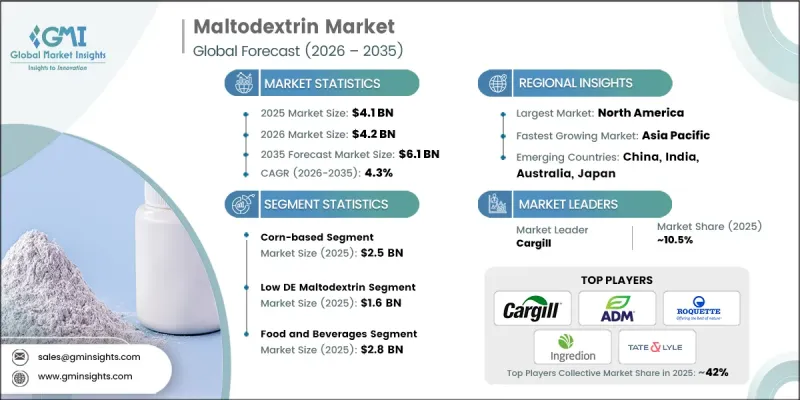
말토덱스트린 시장의 성장은 다양한 기능적 다양성과 다양한 제품 제형에서 다기능 원료로서의 역할에 힘입어 성장하고 있습니다. 말토덱스트린은 증량제, 증점제, 식감 개선제, 향료 및 영양소 운반체로서 기능하는 능력으로 인해 널리 활용되고 있으며, 수많은 제조 공정에서 필수적인 성분으로 사용되고 있습니다. 중성적인 맛, 높은 소화율 및 제품의 입맛을 개선하는 능력은 다양한 음료 및 영양 제품 배합에 광범위하게 채택되는 데 기여하고 있습니다. 편의성을 중시하는 제품의 소비 증가는 말토덱스트린 시장의 꾸준한 성장을 지속적으로 지원하고 있습니다. 식품 가공에서 전통적 역할을 넘어 말토덱스트린은 안정화, 결합 및 필름 형성 능력으로 인해 의약품, 퍼스널케어 및 산업 응용 분야에서 점점 더 많이 사용되고 있습니다. 또한 이 원료는 비용 효율적인 제조 특성을 유지하면서 다른 배합 성분과의 높은 호환성을 가지고 있습니다. 동시에 업계는 클린 라벨링 노력과 다양한 원재료 조달을 지원하는 대체 탄수화물 공급원 및 개선된 가공 기술 탐색을 통해 변화하는 소비자의 기대에 점차 부응하고 있습니다. 이러한 요인들은 세계 말토덱스트린 시장의 제품 혁신, 제형 개발 및 경쟁력에 지속적으로 영향을 미치고 있습니다.
| 시장 범위 | |
|---|---|
| 시작연도 | 2025년 |
| 예측 기간 | 2026-2035년 |
| 개시 금액 | 41억 달러 |
| 예측액 | 61억 달러 |
| CAGR | 4.3% |
옥수수 유래 부문은 2025년에 25억 달러의 시장 규모를 기록하며, 2026-2035년 연평균 4%의 성장률을 보일 것으로 예측됩니다. 다양한 원료 공급원 중 옥수수 유래 말토덱스트린은 신뢰할 수 있는 기능적 특성과 안정적인 가공 성능으로 시장에서 확고한 입지를 유지하고 있습니다. 이 원료가 제조업체들이 자주 선택하는 이유는 다양한 배합에서 중립적인 관능적 특성을 유지하면서 항상 바람직한 식감 특성을 제공할 수 있기 때문입니다. 또한 옥수수 유래 말토덱스트린을 지원하는 탄탄한 생산 인프라를 통해 안정적인 공급과 신뢰할 수 있는 품질 기준을 확보하고 있습니다. 이러한 특성으로 인해 균일한 점도, 용해성 및 부피가 제품의 일관성을 유지하는 데 필수적인 식품, 의약품, 퍼스널케어 제품 배합 등 다양한 응용 분야에서 선호되는 원료로 사용되고 있습니다.
식품 등급 부문은 2025년 27억 달러를 차지하며, 2026-2035년 연평균 3.8%의 성장률을 보일 것으로 예측됩니다. 식품용 말토덱스트린은 중성적인 맛, 신뢰할 수 있는 기능성, 엄격한 식품 안전 기준에 부합하는 특성으로 말토덱스트린 시장에서 중심적인 역할을 하고 있습니다. 제품 개발자들은 이 원료를 활용하여 다양한 가공식품의 배합에 있으며, 식감 조정, 입맛 개선, 용해성 향상, 단맛을 조정하고 있습니다. 또한 다양한 향료, 감미료, 감미료, 단백질, 색소와의 궁합이 좋아 제조업체는 안정적인 제품 배합을 유지하면서 예측 가능한 관능적 특성을 구현할 수 있습니다. 식품용 말토덱스트린은 캐리어, 증량제 및 식감 개선제로 널리 사용되고 있으며, 성능 향상, 생산 비용 최적화 및 원료의 투명성 유지를 위한 제품 배합에 대한 강력한 채택이 계속 증가하고 있습니다.
북미 말토덱스트린 시장은 2025년 15억 달러 규모에 달했습니다. 이 지역 수요는 가공식품, 특수 영양제, 의약품의 높은 소비 수준으로 인해 안정적으로 유지되고 있습니다. 미국은 제조업체들이 원료의 투명성과 변화하는 소비자 기대에 부합하는 클린 라벨 제제 개발에 점점 더 집중하고 있으므로 이 지역의 성장에 중요한 역할을 하고 있습니다. 또한 고도로 발달한 식품 제조 부문의 존재와 소화 흡수가 빠른 탄수화물 원료에 대한 지속적인 수요는 지역 전체에서 시장 확대를 지원하고 있습니다.
자주 묻는 질문
목차
제1장 조사 방법
제2장 개요
제3장 업계 인사이트
제4장 경쟁 구도
제5장 시장 추산·예측 : 소스별, 2022-2035
제6장 시장 추산·예측 : 등급별, 2022-2035
제7장 시장 추산·예측 : 용도별, 2022-2035
제8장 시장 추산·예측 : 덱스트로스 환산치(DE)의 범위별, 2022-2035
제9장 시장 추산·예측 : 지역별, 2022-2035
제10장 기업 개요
KSA 26.04.20The Global Maltodextrin Market was valued at USD 4.1 billion in 2025 and is estimated to grow at a CAGR of 4.3% to reach USD 6.1 billion by 2035.
Growth in the maltodextrin market is supported by its wide functional versatility and its role as a multifunctional ingredient in various product formulations. Maltodextrin is widely utilized for its ability to act as a bulking agent, thickener, texture modifier, and carrier for flavors and nutrients, making it an essential component in numerous production processes. Its neutral flavor profile, high digestibility, and ability to improve product mouthfeel have contributed to its broad adoption across diverse food and beverage formulations as well as nutritional products. Rising consumption of convenience-oriented products continues to support the steady expansion of the maltodextrin market. Beyond its traditional role in food processing, maltodextrin is increasingly used in pharmaceutical, personal care, and industrial applications due to its stabilizing, binding, and film-forming capabilities. The ingredient also offers strong compatibility with other formulation components while maintaining cost-efficient manufacturing characteristics. At the same time, the industry is gradually responding to evolving consumer expectations by exploring alternative carbohydrate sources and improved processing technologies that support cleaner labeling practices and diversified raw material inputs. These factors continue to influence product innovation, formulation development, and competitive dynamics across the global maltodextrin market.
| Market Scope | |
|---|---|
| Start Year | 2025 |
| Forecast Year | 2026-2035 |
| Start Value | $4.1 Billion |
| Forecast Value | $6.1 Billion |
| CAGR | 4.3% |
The corn-based segment generated USD 2.5 billion in 2025 and is expected to grow at a CAGR of 4% from 2026 to 2035. Among different raw material sources, corn-derived maltodextrin maintains a strong market position due to its reliable functional characteristics and stable processing performance. Manufacturers frequently select this source because it consistently delivers the desired textural qualities while maintaining a neutral sensory profile across various formulations. In addition, the well-established production infrastructure supporting corn-based maltodextrin enables consistent supply availability and dependable quality standards. These characteristics make it a preferred ingredient for use across numerous applications, including food, pharmaceutical, and personal care product formulations, where uniform viscosity, solubility, and bulk properties are essential for maintaining product consistency.
The food-grade segment accounted for USD 2.7 billion in 2025 and is projected to grow at a CAGR of 3.8% during 2026-2035. Food-grade maltodextrin plays a central role within the maltodextrin market because it offers a neutral taste profile, reliable functionality, and compliance with strict food safety standards. Product developers rely on this ingredient to adjust texture, improve mouthfeel, enhance solubility, and manage sweetness levels within a wide range of processed food formulations. Its compatibility with various flavors, sweeteners, proteins, and coloring agents allows manufacturers to maintain stable product formulations while achieving predictable sensory characteristics. The widespread use of food-grade maltodextrin as a carrier, bulking agent, and texture modifier continues to support its strong adoption in product reformulation efforts aimed at improving performance, optimizing production costs, and maintaining ingredient transparency.
North America Maltodextrin Market generated USD 1.5 billion in 2025. Demand in the region remains stable due to high consumption levels of processed food products, specialized nutrition formulations, and pharmaceutical applications. The United States plays a key role in regional growth as manufacturers increasingly focus on ingredient transparency and the development of clean-label formulations that align with changing consumer expectations. In addition, the presence of a highly developed food manufacturing sector and continuous demand for rapidly digestible carbohydrate ingredients support ongoing market expansion across the region.
Key companies operating in the Global Maltodextrin Market include Ingredion, Cargill, ADM, Tate & Lyle, and Roquette, along with several additional global and regional manufacturers. Companies operating in the Maltodextrin Market are focusing on strategic initiatives that strengthen their market position and support long-term growth. Leading manufacturers are investing in research and development to enhance ingredient functionality and develop improved processing techniques that meet evolving consumer expectations for transparency and quality. Many firms are also expanding their product portfolios by introducing maltodextrin variants derived from different raw materials to diversify supply options and address changing formulation requirements. Strategic collaborations with food and beverage manufacturers are helping companies expand application capabilities and accelerate product innovation. In addition, industry participants are strengthening their global distribution networks and improving production efficiency to maintain competitive pricing and ensure reliable supply.
Table of Contents
Chapter 1 Methodology
- 1.1 Market scope and definition
- 1.2 Research design
- 1.2.1 Research approach
- 1.2.2 Data collection methods
- 1.3 Data mining sources
- 1.3.1 Global
- 1.3.2 Regional/Country
- 1.4 Base estimates and calculations
- 1.4.1 Base year calculation
- 1.4.2 Key trends for market estimation
- 1.5 Primary research and validation
- 1.5.1 Primary sources
- 1.6 Forecast model
- 1.7 Research assumptions and limitations
Chapter 2 Executive Summary
- 2.1 Industry 360° synopsis
- 2.2 Key market trends
- 2.2.1 Regional
- 2.2.2 Material Type
- 2.2.3 Aircraft Platform
- 2.2.4 Component Type
- 2.2.5 Product Type
- 2.2.6 Manufacturing Process
- 2.2.7 End-User
- 2.3 TAM Analysis, 2026-2035
- 2.4 CXO perspectives: Strategic imperatives
Chapter 3 Industry Insights
- 3.1 Industry ecosystem analysis
- 3.1.1 Supplier Landscape
- 3.1.2 Profit Margin
- 3.1.3 Value addition at each stage
- 3.1.4 Factor affecting the value chain
- 3.1.5 Disruptions
- 3.2 Industry impact forces
- 3.2.1 Growth drivers
- 3.2.2 Industry pitfalls and challenges
- 3.2.3 Market opportunities
- 3.3 Growth potential analysis
- 3.4 Regulatory landscape
- 3.4.1 North America
- 3.4.2 Europe
- 3.4.3 Asia Pacific
- 3.4.4 Latin America
- 3.4.5 Middle East & Africa
- 3.5 Porter's analysis
- 3.6 PESTEL analysis
- 3.7 Price trends
- 3.7.1 By region
- 3.7.2 By product
- 3.8 Future market trends
- 3.9 Technology and Innovation landscape
- 3.9.1 Current technological trends
- 3.9.2 Emerging technologies
- 3.10 Patent Landscape
- 3.11 Trade statistics (Note: the trade statistics will be provided for key countries only)
- 3.11.1 Major importing countries
- 3.11.2 Major exporting countries
- 3.12 Sustainability and Environmental Aspects
- 3.12.1 Sustainable Practices
- 3.12.2 Waste Reduction Strategies
- 3.12.3 Energy Efficiency in Production
- 3.12.4 Eco-friendly Initiatives
- 3.13 Carbon Footprint Considerations
Chapter 4 Competitive Landscape, 2025
- 4.1 Introduction
- 4.2 Company market share analysis
- 4.2.1 By region
- 4.2.1.1 North America
- 4.2.1.2 Europe
- 4.2.1.3 Asia Pacific
- 4.2.1.4 LATAM
- 4.2.1.5 MEA
- 4.2.1 By region
- 4.3 Company matrix analysis
- 4.4 Competitive analysis of major market players
- 4.5 Competitive positioning matrix
- 4.6 Key developments
- 4.6.1 Mergers & acquisitions
- 4.6.2 Partnerships & collaborations
- 4.6.3 New Product Launches
- 4.6.4 Expansion Plans
Chapter 5 Market Estimates and Forecast, By Source, 2022- 2035 (USD Billion, Kilo Tons)
- 5.1 Key trends
- 5.2 Corn-based
- 5.3 Wheat-based
- 5.4 Potato-based
- 5.5 Cassava-based
- 5.6 Others
Chapter 6 Market Estimates and Forecast, By Grade, 2022 - 2035 (USD Billion, Kilo Tons)
- 6.1 Key trends
- 6.2 Food grade
- 6.3 Pharmaceutical grade
- 6.4 Industrial grade
- 6.5 Others
Chapter 7 Market Estimates and Forecast, By Application, 2022 - 2035 (USD Billion, Kilo Tons)
- 7.1 Key trends
- 7.2 Food and beverages
- 7.2.1 Baked goods
- 7.2.2 Confectionery
- 7.2.3 Dairy products
- 7.2.4 Beverages
- 7.2.5 Convenience foods
- 7.2.6 Others
- 7.3 Pharmaceuticals
- 7.3.1 Excipient in drug formulations
- 7.3.2 Nutritional supplements
- 7.4 Cosmetics and personal care
- 7.4.1 Skincare products
- 7.4.2 Haircare products
- 7.5 Industrial applications
- 7.5.1 Adhesives
- 7.5.2 Binders
- 7.5.3 Coating and encapsulation
- 7.6 Others
- 7.6.1 Animal feed
- 7.6.2 Fermentation processes
Chapter 8 Market Estimates and Forecast, By Dextrose Equivalent (DE) Range, 2022 - 2035 (USD Billion, Kilo Tons)
- 8.1 Key trends
- 8.2 Low DE Maltodextrin
- 8.3 Mid DE Maltodextrin
- 8.4 High DE Maltodextrin
Chapter 9 Market Estimates and Forecast, By Region, 2022 - 2035 (USD Billion, Kilo Tons)
- 9.1 Key trends
- 9.2 North America
- 9.2.1 U.S.
- 9.2.2 Canada
- 9.3 Europe
- 9.3.1 Germany
- 9.3.2 UK
- 9.3.3 France
- 9.3.4 Italy
- 9.3.5 Spain
- 9.3.6 Rest of Europe
- 9.4 Asia Pacific
- 9.4.1 China
- 9.4.2 India
- 9.4.3 Japan
- 9.4.4 Australia
- 9.4.5 South Korea
- 9.4.6 Rest of Asia Pacific
- 9.5 Latin America
- 9.5.1 Brazil
- 9.5.2 Mexico
- 9.5.3 Argentina
- 9.5.4 Rest of Latin America
- 9.6 Middle East & Africa
- 9.6.1 Saudi Arabia
- 9.6.2 South Africa
- 9.6.3 UAE
- 9.6.4 Rest of Middle East & Africa
Chapter 10 Company Profiles
- 10.1 AGRANA Group
- 10.2 Archer Daniels Midland
- 10.3 Avebe
- 10.4 Cargill
- 10.5 Golden Grain Group
- 10.6 Grain Processing Corporation
- 10.7 Gulshan Polyols
- 10.8 Ingredion
- 10.9 Matsutani America
- 10.10 Mengzhou Tailijie
- 10.11 Roquette Freres
- 10.12 Tate & Lyle
- 10.13 Zhucheng Dongxiao Biotechnology