

|
시장보고서
상품코드
1998859
수질 분석기 시장 기회, 성장요인, 업계 동향 분석 및 예측(2026-2035년)Water Quality Analyzer Market Opportunity, Growth Drivers, Industry Trend Analysis, and Forecast 2026 - 2035 |
||||||

세계의 수질 분석기 시장은 2025년에 45억 달러로 평가되며, CAGR 5%로 성장하며, 2035년까지 73억 달러에 달할 것으로 추정되고 있습니다.
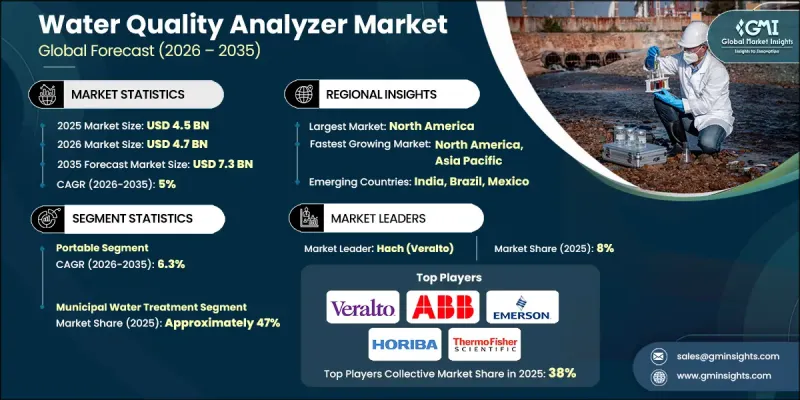
정밀한 환경 모니터링에 대한 관심 증가와 수질 안전에 대한 세계 기준의 강화는 고급 수질 분석 기술에 대한 수요를 지원하는 주요 요인이 되고 있습니다. 물 관리를 담당하는 조직은 업무 효율성 향상과 규제 준수 유지를 위해 자동 모니터링 시스템을 도입하고 있습니다. 동시에, 분석 기기 제조업체들은 센서 기술 강화 및 산업 및 지자체 용도의 제품 기능 향상을 위해 파트너십 및 사업 통합에 적극 나서고 있습니다. 이러한 움직임은 감지 기술 및 재료 공학의 혁신을 촉진하고 정확한 수질 모니터링 시스템에 크게 의존하는 여러 산업 분야에서 세계 시장 확대를 촉진하고 있습니다. 실험실 샘플링과 기본적인 화학 시약에 의존하던 기존의 수동 테스트 방법은 점차 첨단 디지털 수질 모니터링 솔루션으로 대체되고 있습니다. 지능형 센서, 자동 교정, 통합 연결 기능을 갖춘 최신 분석기는 주요 수질 파라미터를 실시간으로 분석할 수 있습니다. 운영 효율성에 대한 강조와 점점 더 엄격해지는 환경 규제 준수는 세계 수질 분석기 시장 확대의 중요한 원동력으로 작용하고 있습니다.
| 시장 범위 | |
|---|---|
| 시작연도 | 2025년 |
| 예측 기간 | 2026-2035년 |
| 개시 금액 | 45억 달러 |
| 예측액 | 73억 달러 |
| CAGR | 5% |
휴대용 부문은 2025년에 20억 달러를 창출하고 2035년까지 36억 8,000만 달러에 달할 것으로 예상되며, 연평균 6.3%의 연평균 복합 성장률(CAGR)을 보일 것으로 예측됩니다. 휴대용 수질분석기는 실험실 검사가 필요 없이 모니터링 지점에서 직접 수질 상태를 측정할 수 있다는 점에서 높은 평가를 받고 있습니다. 이 컴팩트한 장치는 경량으로 설계되어 고정 전원에 의존하지 않고 작동하므로 현장 환경 평가 및 다양한 장소에서의 신속한 수질 검사에 적합합니다. 현장에서 즉시 분석 결과를 얻을 수 있는 편리함으로 검사 지연이 크게 단축되어 의사결정 속도가 향상됩니다. 이러한 기동성과 운영상의 유연성은 효율적이고 정확한 수질 검사 솔루션을 원하는 업계와 감독 기관에서 높은 도입률을 유지하고 있습니다.
2025년에는 도시 수처리 부문이 47%의 점유율을 차지했습니다. 도시 상수도 시스템은 안전한 식수 공급을 유지하고 엄격한 공중 보건 요건을 충족시키기 위해 고급 분석 장비에 크게 의존하고 있습니다. 배수 네트워크의 지속적인 모니터링을 위해서는 대량 처리에 대응할 수 있는 정확하고 신뢰할 수 있는 측정 기술이 필요합니다. 이 부문이 차지하는 큰 시장 점유율은 도시 물 관리 시스템에서 중요한 수질 지표를 지속적으로 모니터링해야 할 필요성이 지속되고 있음을 반영합니다. 도시의 팽창과 함께 물 인프라가 복잡해짐에 따라 지자체 업무에서 신뢰할 수 있는 수질 분석 기술에 대한 수요는 꾸준히 증가하고 있습니다.
미국 수질 분석기 시장은 2025년에 11억 달러에 달했습니다. 이 국가 시장 성장은 첨단 모니터링 기술에 의존하는 성숙한 산업 부문과 상수도 시스템의 강력한 수요에 힘입어 성장하고 있습니다. 첨단 제조 공정에서 고순도 물의 필요성과 노후화된 수도 인프라의 현대화를 위한 노력이 시장의 꾸준한 성장에 기여하고 있습니다. 또한 인공지능 및 커넥티드 센서 시스템을 통합한 디지털 모니터링 기술에 대한 투자 증가로 고급 수질 분석 솔루션에 대한 수요가 증가하고 있습니다. 모니터링 정확도 및 시스템 자동화의 지속적인 개선으로 인해 조직은 물 관리 역량을 강화하기 위해 고급 온라인, 인라인 및 휴대용 분석 장비에 대한 투자를 더욱 강화하고 있습니다.
자주 묻는 질문
목차
제1장 조사 방법과 범위
제2장 개요
제3장 업계 인사이트
제4장 경쟁 구도
제5장 시장 추산·예측 : 제품 유형별, 2022-2035
제6장 시장 추산·예측 : 카테고리별, 2022-2035
제7장 시장 추산·예측 : 파라미터 유형별, 2022-2035
제8장 시장 추산·예측 : 용도별, 2022-2035
제9장 시장 추산·예측 : 유통 채널별, 2022-2035
제10장 시장 추산·예측 : 지역별, 2022-2035
제11장 기업 개요
KSA 26.04.20The Global Water Quality Analyzer Market was valued at USD 4.5 billion in 2025 and is estimated to grow at a CAGR of 5% to reach USD 7.3 billion by 2035.
Increasing attention toward precise environmental monitoring and stricter global standards for water safety are major factors supporting the demand for advanced water analysis technologies. Organizations responsible for water management are adopting automated monitoring systems to improve operational efficiency and maintain consistent regulatory compliance. At the same time, manufacturers of analytical instruments are actively engaging in partnerships and consolidation activities aimed at strengthening sensor technologies and improving product capabilities for industrial and municipal applications. These developments are encouraging innovation in sensing technologies, materials engineering, and global market expansion across several industries that depend heavily on accurate water monitoring systems. Traditional manual testing methods that relied on laboratory sampling and basic chemical reagents are gradually being replaced by advanced digital water monitoring solutions. Modern analyzers equipped with intelligent sensors, automated calibration, and integrated connectivity capabilities enable real-time analysis of key water parameters. The growing emphasis on operational efficiency and compliance with increasingly strict environmental regulations continues to act as a significant catalyst for the expansion of the global water quality analyzer market.
| Market Scope | |
|---|---|
| Start Year | 2025 |
| Forecast Year | 2026-2035 |
| Start Value | $4.5 Billion |
| Forecast Value | $7.3 Billion |
| CAGR | 5% |
The portable segment generated USD 2 billion in 2025 and is expected to reach USD 3.68 billion by 2035, growing at a CAGR of 6.3%. Portable water analyzers are widely valued for their ability to measure water quality conditions directly at monitoring locations without the need for laboratory testing. These compact devices are designed to be lightweight and operate independently of fixed power sources, which makes them suitable for on-site environmental assessments and rapid water testing in various locations. The convenience of obtaining immediate analytical results directly in the field significantly reduces testing delays and improves decision-making speed. Their mobility and operational flexibility continue to support strong adoption across industries and monitoring authorities seeking efficient and accurate water testing solutions.
The municipal water treatment segment accounted for 47% share in 2025. Municipal water systems depend heavily on advanced analytical instruments to maintain safe drinking water supplies and meet strict public health requirements. Continuous monitoring of water distribution networks requires accurate and reliable measurement technologies capable of supporting high-volume operations. The large market share held by this segment reflects the ongoing requirement for consistent monitoring of essential water quality indicators within urban water management systems. As cities expand and water infrastructure becomes more complex, the demand for dependable water analysis technologies within municipal operations continues to grow steadily.
United States Water Quality Analyzer Market reached USD 1.1 billion in 2025. Market growth in the country is supported by strong demand from mature industrial sectors and water utility systems that rely on advanced monitoring technologies. The need for highly purified water in advanced manufacturing processes and modernization efforts across aging water infrastructure is contributing to the steady expansion of the market. In addition, increased investments in digital monitoring technologies that integrate artificial intelligence and connected sensor systems are strengthening the demand for advanced water quality analysis solutions. Continuous improvements in monitoring accuracy and system automation are further encouraging organizations to invest in sophisticated online, inline, and portable analyzers to enhance water management capabilities.
Major companies operating in the Global Water Quality Analyzer Market include ABB Ltd., AppliTek (Hach), Christian Burkert GmbH, Emerson, Endress+Hauser, Hach (Veralto), Horiba Ltd., Martek Instruments, Metrohm AG, Mettler Toledo (Thornton), Shimadzu Corp., Thermo Fisher Scientific, Veralto Corporation, Xylem (Evoqua), and Xylem (YSI). Companies participating in the Global Water Quality Analyzer Market are adopting several strategic initiatives to reinforce their competitive position and expand their global reach. Industry participants are investing heavily in research and development to create more advanced sensor technologies capable of delivering faster and more precise analytical results. Many organizations are also focusing on digital integration by incorporating smart monitoring systems, cloud connectivity, and automated calibration features into their product offerings. Strategic partnerships, acquisitions, and collaborations are being used to strengthen product portfolios and expand technological expertise. Additionally, companies are increasing their presence in emerging markets by expanding distribution networks and strengthening local service capabilities.
Table of Contents
Chapter 1 Methodology and Scope
- 1.1 Market scope and definition
- 1.2 Research design
- 1.2.1 Research approach
- 1.2.2 Data collection methods
- 1.3 Data mining sources
- 1.3.1 Global
- 1.3.2 Regional/Country
- 1.4 Base estimates and calculations
- 1.4.1 Base year calculation
- 1.4.2 Key trends for market estimation
- 1.5 Primary research and validation
- 1.5.1 Primary sources
- 1.6 Forecast model
- 1.7 Research assumptions and limitations
Chapter 2 Executive Summary
- 2.1 Industry 360° synopsis
- 2.2 Key market trends
- 2.2.1 Regional
- 2.2.2 Product Type
- 2.2.3 Category
- 2.2.4 Parameter Type
- 2.2.5 Application
- 2.2.6 Distribution Channel,
- 2.3 CXO perspectives: Strategic imperatives
- 2.3.1 Key decision points for industry executives
- 2.3.2 Critical success factors for market players
- 2.4 Future outlook and strategic recommendations
Chapter 3 Industry Insights
- 3.1 Industry ecosystem analysis
- 3.1.1 Supplier landscape
- 3.1.2 Profit margin
- 3.1.3 Value addition at each stage
- 3.1.4 Factor affecting the value chain
- 3.2 Industry impact forces
- 3.2.1 Growth drivers
- 3.2.1.1 Rising demand for fresh water
- 3.2.1.2 Rapid urbanization and industrialization
- 3.2.1.3 Increasing water pollution
- 3.2.2 Industry pitfalls & challenges
- 3.2.2.1 High integration complexity
- 3.2.2.2 Stringent regulatory standards
- 3.2.3 Opportunities
- 3.2.3.1 Technological advancements
- 3.2.3.2 Water scarcity and sustainability initiatives
- 3.2.1 Growth drivers
- 3.3 Growth potential analysis
- 3.4 Future market trends
- 3.5 Technology and innovation landscape
- 3.5.1 Current technological trends
- 3.5.2 Emerging technologies
- 3.6 Price trends
- 3.6.1 By region
- 3.6.2 By Product type
- 3.7 Regulatory landscape
- 3.7.1 Standards and compliance requirements
- 3.7.2 Regional regulatory frameworks
- 3.7.3 Certification standards
- 3.8 Porter's analysis
- 3.9 PESTEL analysis
- 3.10 Trade Data Analysis
- 3.10.1 Import & Export Volume & Value Trends
- 3.10.2 Key Trade Corridors & Tariff Impact
- 3.11 Impact of AI & Generative AI on the Market
- 3.11.1 AI-Driven Disruption of Existing Business Models
- 3.11.2 Predictive Analytics for Product Development
Chapter 4 Competitive Landscape, 2025
- 4.1 Introduction
- 4.2 Company market share analysis
- 4.2.1 By region
- 4.2.1.1 North America
- 4.2.1.2 Europe
- 4.2.1.3 Asia Pacific
- 4.2.1.4 Latin America
- 4.2.1.5 Middle East and Africa
- 4.2.1 By region
- 4.3 Company matrix analysis
- 4.4 Competitive analysis of major market players
- 4.5 Competitive positioning matrix
- 4.6 Key developments
- 4.6.1 Mergers & acquisitions
- 4.6.2 Partnerships & collaborations
- 4.6.3 New product launches
- 4.6.4 Expansion plans
Chapter 5 Market Estimates & Forecast, By Product Type, 2022 - 2035, (USD Billion) (Thousand Units)
- 5.1 Key trends
- 5.2 pH meters
- 5.3 Conductivity meters
- 5.4 Turbidity meters
- 5.5 Dissolved oxygen analyzers
- 5.6 Total organic carbon analyzers
- 5.7 Oxidation-reduction potential sensors
- 5.8 Ammonia/nitrate/nitrite sensors
- 5.9 Multi-parameter water quality analyzers
- 5.10 Colorimeters and spectrometers
- 5.11 Others
Chapter 6 Market Estimates & Forecast, By Category, 2022 - 2035, (USD Billion) (Million Units)
- 6.1 Key trends
- 6.2 Portable
- 6.3 Benchtop
- 6.4 Online/Inline
Chapter 7 Market Estimates & Forecast, By Parameter Type, 2022 - 2035, (USD Billion) (Thousand Units)
- 7.1 Key trends
- 7.2 Single parameter analyzers
- 7.3 Multi-parameter analyzers
Chapter 8 Market Estimates & Forecast, By Application, 2022 - 2035, (USD Billion) (Thousand Units)
- 8.1 Key trends
- 8.2 Municipal water treatment
- 8.3 Industrial and wastewater treatment
- 8.4 Marine & offshore water systems
- 8.5 Others
Chapter 9 Market Estimates & Forecast, By Distribution Channel, 2022 - 2035, (USD Billion) (Thousand Units)
- 9.1 Key trends
- 9.2 Direct
- 9.3 Indirect
Chapter 10 Market Estimates and Forecast, By Region, 2022 - 2035 (USD Billion) (Thousand Units)
- 10.1 Key trends
- 10.2 North America
- 10.2.1 U.S.
- 10.2.2 Canada
- 10.3 Europe
- 10.3.1 Germany
- 10.3.2 UK
- 10.3.3 France
- 10.3.4 Italy
- 10.3.5 Spain
- 10.4 Asia Pacific
- 10.4.1 China
- 10.4.2 Japan
- 10.4.3 India
- 10.4.4 Australia
- 10.4.5 South Korea
- 10.5 Latin America
- 10.5.1 Brazil
- 10.5.2 Mexico
- 10.5.3 Argentina
- 10.6 Middle East and Africa
- 10.6.1 South Africa
- 10.6.2 Saudi Arabia
- 10.6.3 UAE
Chapter 11 Company Profiles
- 11.1 ABB Ltd.
- 11.2 AppliTek (Hach)
- 11.3 Christian Burkert GmbH
- 11.4 Emerson
- 11.5 Endress+Hauser
- 11.6 Hach (Veralto)
- 11.7 Horiba Ltd.
- 11.8 Martek Instruments
- 11.9 Metrohm AG
- 11.10 Mettler Toledo (Thornton)
- 11.11 Shimadzu Corp.
- 11.12 Thermo Fisher Scientific
- 11.13 Veralto Corporation
- 11.14 Xylem (Evoqua)
- 11.15 Xylem (YSI)


