

|
시장보고서
상품코드
2019074
니코틴 파우치 시장 기회, 성장 촉진요인, 업계 동향 분석 및 예측(2026-2035년)Nicotine Pouches Market Opportunity, Growth Drivers, Industry Trend Analysis, and Forecast 2026 - 2035 |
||||||

세계의 니코틴 파우치 시장은 2025년에 86억 달러로 평가되었으며, 2035년까지 CAGR 19.4%로 성장하여 567억 달러에 달할 것으로 추정됩니다.
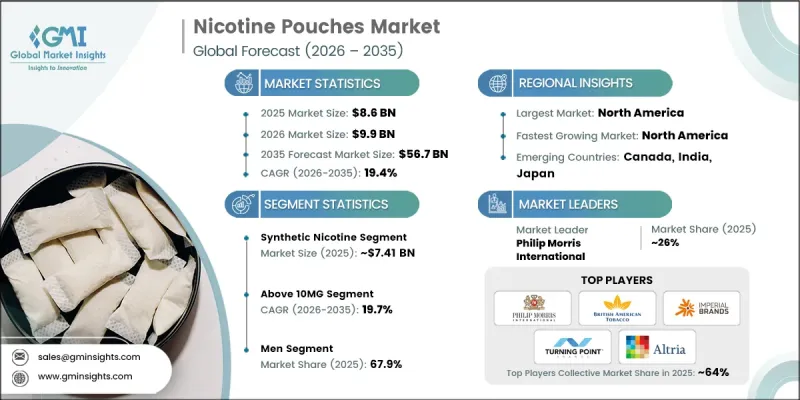
시장의 성장은 전통적인 담배 제품에서 보다 깨끗하고 편리한 니코틴 섭취 형태로 전환하는 소비자 행동의 현저한 변화에 힘입어 성장하고 있습니다. 사용자들은 연소 없이 니코틴 섭취량을 보다 세밀하게 조절할 수 있는 대안을 점점 더 많이 찾고 있습니다. 니코틴 파우치는 담배를 포함하지 않는 솔루션으로 눈에 잘 띄지 않고, 사용하기 쉽고, 현대의 라이프스타일에 적응할 수 있다는 점에서 이러한 수요에 부응하고 있습니다. 소비자의 건강에 대한 인식이 높아진 것도 무연 제품으로의 전환을 더욱 촉진하고 있습니다. 또한, 공공장소에서의 흡연에 대한 규제가 강화되면서 휴대용 무취 제품의 보급이 가속화되고 있습니다. 다양한 맛과 니코틴 함량 선택의 폭이 넓어지면서 소비자층이 확대되는 한편, 소매점에서 쉽게 구할 수 있게 되면서 시장 침투율이 높아지고 있습니다. 각 제조사들은 변화하는 소비자의 취향에 맞춰 유통망과 제품 라인업 확대에 적극 나서고 있으며, 이는 업계의 강력한 성장을 뒷받침하고 있습니다.
| 시장 범위 | |
|---|---|
| 시작 연도 | 2025년 |
| 예측 기간 | 2026-2035년 |
| 시작 시점 시장 규모 | 86억 달러 |
| 예측 규모 | 567억 달러 |
| CAGR | 19.4% |
합성 니코틴 부문은 2025년 74억 1,000만 달러의 시장 규모를 기록했으며, 2035년까지 연평균 19.5%의 성장률을 기록했습니다. 이 부문은 다양한 제품 형태에서 일관된 품질과 통제된 니코틴 농도를 제공할 수 있다는 점에서 시장을 주도하고 있습니다. 담배를 포함하지 않는다는 특성은 변화하는 규제 프레임워크와 개인 취향에 맞는 대안을 찾는 소비자들의 지지를 받고 있습니다. 제조업체는 배합의 정확도가 향상되어 여러 시장에서 표준화된 제품을 제공할 수 있게 되었습니다. 눈에 띄지 않고 편리한 니코틴 섭취 방법에 대한 수요가 전 세계적으로 증가함에 따라 이 부문은 계속해서 성장세를 이어가고 있습니다.
남성 부문은 2025년 67.9%의 점유율을 차지했으며, 2026년부터 2035년까지 CAGR 19.5%로 성장할 것으로 예측됩니다. 이러한 우위는 남성 소비자의 높은 소비 성향과 무연 니코틴 제품에 대한 강한 선호도에 기인합니다. 특히 더 강력한 배합과 일관된 제품 성능에 대한 선호도가 수요를 견인하고 있습니다. 제품 포지셔닝, 맛 개발, 접근성 등이 이 계층의 니즈에 부합하고 있으며, 선도적인 입지를 굳건히 하고 있습니다. 편의성, 휴대성, 눈에 잘 띄지 않는 사용감은 제품의 매력을 더욱 높여주며, 소매점과 온라인 플랫폼에서 폭넓은 가용성은 반복 구매와 지속적인 수요를 뒷받침합니다.
미국 니코틴 파우치 시장은 2025년에 24억 달러로 평가되며 2026년부터 2035년까지 연평균 20.3%로 성장할 것으로 예상됩니다. 이 지역의 성장은 기존 니코틴 제품의 대안을 찾는 성인 사용자들 사이에서 니코틴 대체품의 채택이 증가함에 따라 성장세를 보이고 있습니다. 규제 당국의 감독은 제품 혁신과 마케팅 전략을 형성하는 데 중요한 역할을 하고 있으며, 기업이 품질과 규정 준수에 집중하도록 장려하고 있습니다. 무연 제품에 대한 높은 인지도가 소비자의 꾸준한 전환에 기여하고 있습니다. 소매망 확대, 경쟁력 있는 가격 전략, 지속적인 제품 혁신은 시장 성장을 더욱 촉진하고 있습니다. 또한, 각 업체들은 딜리버리 시스템 개선과 사용자 경험 향상을 통해 제품 차별화에 주력하고 있습니다.
자주 묻는 질문
목차
제1장 조사 방법과 범위
제2장 주요 요약
제3장 업계 인사이트
제4장 경쟁 구도
제5장 시장 추정 및 예측 : 카테고리별, 2022-2035
제6장 시장 추정 및 예측 : 플레이버별, 2022-2035
제7장 시장 추정 및 예측 : 유형별, 2022-2035
제8장 시장 추정 및 예측 : 니코틴 함유량별, 2022-2035
제9장 시장 추정 및 예측 : 가격별, 2022-2035
제10장 시장 추정 및 예측 : 소비자층별, 2022-2035
제11장 시장 추정 및 예측 : 판매 채널별, 2022-2035
제12장 시장 추정 및 예측 : 지역별, 2022-2035
제13장 기업 개요
KSM 26.05.06The Global Nicotine Pouches Market was valued at USD 8.6 billion in 2025 and is estimated to grow at a CAGR of 19.4% to reach USD 56.7 billion by 2035.
Market growth is fueled by a noticeable shift in consumer behavior away from traditional tobacco products toward cleaner and more convenient nicotine delivery formats. Users are increasingly seeking alternatives that eliminate combustion while offering greater control over nicotine intake. Nicotine pouches meet this demand by providing a tobacco-free solution that is discreet, easy to use, and adaptable to modern lifestyles. Rising health awareness among consumers is further encouraging the transition toward smokeless options. In addition, stricter regulations on public smoking are accelerating the adoption of portable and odor-free products. The growing availability of varied flavor profiles and portion strengths is expanding the consumer base, while improved retail accessibility is strengthening market penetration. Manufacturers are actively enhancing distribution networks and product offerings to align with evolving preferences, which continues to support strong industry expansion.
| Market Scope | |
|---|---|
| Start Year | 2025 |
| Forecast Year | 2026-2035 |
| Start Value | $8.6 Billion |
| Forecast Value | $56.7 Billion |
| CAGR | 19.4% |
The synthetic nicotine segment generated USD 7.41 billion in 2025 and is expected to grow at a CAGR of 19.5% through 2035. This segment leads the market due to its ability to deliver consistent quality and controlled nicotine levels across different product formats. Its tobacco-free nature appeals to consumers looking for alternatives that align with changing regulatory frameworks and personal preferences. Manufacturers benefit from improved formulation precision, enabling them to offer standardized products across multiple markets. The segment continues to gain traction as demand for discreet and convenient nicotine consumption methods rises globally.
The men segment accounted for 67.9% share in 2025 and is projected to grow at a CAGR of 19.5% during 2026-2035. This dominance is attributed to higher consumption patterns and a strong inclination toward smokeless nicotine products among male consumers. Demand is particularly driven by preferences for stronger formulations and consistent product performance. Product positioning, flavor development, and accessibility continue to align with this demographic, reinforcing its leading position. Convenience, portability, and discreet usage further enhance product appeal, while widespread availability across retail and online platforms supports repeat purchases and sustained demand.
U.S. Nicotine Pouches Market was valued at USD 2.4 billion in 2025 and is anticipated to grow at a CAGR of 20.3% from 2026 to 2035. Growth in the region is supported by increasing adoption among adult users seeking alternatives to conventional nicotine products. Regulatory oversight plays a significant role in shaping product innovation and marketing strategies, encouraging companies to focus on quality and compliance. High awareness levels regarding smoke-free products contribute to consistent consumer transition. Expanding retail presence, competitive pricing strategies, and continuous product innovation are further strengthening market growth. Companies are also focusing on product differentiation through improved delivery systems and enhanced user experience.
Key players operating in the Global Nicotine Pouches Market include Altria Group, British American Tobacco (BAT), Dryft, Imperial Brands PLC, Swedish Match, Killa, Moxy Pouches AB, Nicoventures, Philip Morris International (PMI), Reynolds American, Rogue International, Turning Point Brands, Inc., UPROAR, White Fox, and ZERO. Companies in the nicotine pouches market are reinforcing their competitive position through continuous product innovation, strategic expansion, and targeted marketing initiatives. Manufacturers are investing in advanced formulation technologies to deliver consistent nicotine levels and improved user comfort. Expanding product portfolios with diverse flavors and strength options allows companies to appeal to a wider consumer base. Firms are also strengthening distribution networks across both physical retail and digital platforms to improve accessibility and visibility. Strategic collaborations and acquisitions are being used to enhance market reach and operational capabilities. In addition, companies are focusing on regulatory compliance and transparent product communication to build consumer trust and sustain long-term growth.
Table of Contents
Chapter 1 Methodology & Scope
- 1.1 Market scope and definition
- 1.2 Research design
- 1.2.1 Research approach
- 1.2.2 Data collection methods
- 1.3 Data mining sources
- 1.3.1 Global
- 1.3.2 Regional/Country
- 1.4 Base estimates and calculations
- 1.4.1 Base year calculation
- 1.4.2 Key trends for market estimation
- 1.5 Primary research and validation
- 1.5.1 Primary sources
- 1.6 Forecast model
- 1.7 Research assumptions and limitations
Chapter 2 Executive Summary
- 2.1 Industry 360° synopsis
- 2.2 Key market trends
- 2.2.1 Regional
- 2.2.2 Category
- 2.2.3 Flavour Type
- 2.2.4 Type
- 2.2.5 Nicotine Content
- 2.2.6 Price
- 2.2.7 Consumer Group
- 2.2.8 Distribution channel
Chapter 3 Industry Insights
- 3.1 Industry ecosystem analysis
- 3.1.1 Supplier landscape
- 3.1.2 Profit margin
- 3.1.3 Value addition at each stage
- 3.1.4 Factor affecting the value chain
- 3.2 Industry impact forces
- 3.2.1 Growth drivers
- 3.2.1.1 Increasing consumer shift from traditional tobacco products
- 3.2.1.2 Growing awareness of reduced smoke/odor products
- 3.2.1.3 Expansion of product availability and flavors
- 3.2.2 Pitfalls & Challenges
- 3.2.2.1 Regulatory restrictions and varying government policies
- 3.2.2.2 Health perception and public scrutiny
- 3.2.3 Opportunities
- 3.2.3.1 Product innovation in formulation and delivery formats
- 3.2.3.2 Growth in emerging markets with rising adult nicotine use
- 3.2.1 Growth drivers
- 3.3 Growth potential analysis
- 3.4 Future market trends
- 3.5 Technology and innovation landscape
- 3.5.1 Current technological trends
- 3.5.2 Emerging technologies
- 3.6 Price trends
- 3.6.1 By region
- 3.6.2 By product
- 3.7 Regulatory landscape
- 3.7.1 Standards and compliance requirements
- 3.7.2 Regional regulatory frameworks
- 3.7.3 Certification standards
- 3.8 Porter's analysis
- 3.9 PESTEL analysis
Chapter 4 Competitive Landscape, 2025
- 4.1 Introduction
- 4.2 Company market share analysis
- 4.2.1 By Region
- 4.2.1.1 North America
- 4.2.1.2 Europe
- 4.2.1.3 Asia Pacific
- 4.2.1.4 Latin America
- 4.2.1.5 Middle East & Africa
- 4.2.1 By Region
- 4.3 Company matrix analysis
- 4.4 Competitive analysis of major market players
- 4.5 Competitive positioning matrix
- 4.6 Key developments
- 4.6.1 Mergers & acquisitions
- 4.6.2 Partnerships & collaborations
- 4.6.3 New product launches
- 4.6.4 Expansion plans
Chapter 5 Market Estimates & Forecast, By Category, 2022 - 2035, (USD Billion) (Thousand Units)
- 5.1 Key trends
- 5.2 Tobacco-Free
- 5.3 Synthetic Nicotine
Chapter 6 Market Estimates & Forecast, By Flavour Type, 2022 - 2035, (USD Billion) (Thousand Units)
- 6.1 Key trends
- 6.2 Flavoured
- 6.2.1 Mint
- 6.2.2 Fruit
- 6.2.3 Herbal
- 6.2.4 Others
- 6.3 Non-Flavoured
Chapter 7 Market Estimates & Forecast, By Type, 2022 - 2035, (USD Billion) (Thousand Units)
- 7.1 Key trends
- 7.2 Moist pouches
- 7.3 Dry pouches
Chapter 8 Market Estimates & Forecast, By Nicotine Content, 2022 - 2035, (USD Billion) (Thousand Units)
- 8.1 Key trends
- 8.2 Up to 5 MG
- 8.3 5MG - 10MG
- 8.4 Above 10MG
Chapter 9 Market Estimates & Forecast, By Price, 2022 - 2035, (USD Billion) (Thousand Units)
- 9.1 Key trends
- 9.2 Low
- 9.3 Medium
- 9.4 High
Chapter 10 Market Estimates & Forecast, By Consumer Group, 2022 - 2035, (USD Billion) (Thousand Units)
- 10.1 Key trends
- 10.2 Men
- 10.3 Women
Chapter 11 Market Estimates & Forecast, By Distribution Channel, 2022 - 2035, (USD Billion) (Thousand Units)
- 11.1 Key trends
- 11.2 Online
- 11.3 Offline
Chapter 12 Market Estimates & Forecast, By Region, 2022 - 2035, (USD Billion) (Thousand Units)
- 12.1 Key trends
- 12.2 North America
- 12.2.1 U.S.
- 12.2.2 Canada
- 12.3 Europe
- 12.3.1 Germany
- 12.3.2 UK
- 12.3.3 France
- 12.3.4 Italy
- 12.3.5 Spain
- 12.4 Asia Pacific
- 12.4.1 China
- 12.4.2 India
- 12.4.3 Japan
- 12.4.4 South Korea
- 12.4.5 Australia
- 12.5 Latin America
- 12.5.1 Brazil
- 12.5.2 Mexico
- 12.5.3 Argentina
- 12.6 MEA
- 12.6.1 Saudi Arabia
- 12.6.2 UAE
- 12.6.3 South Africa
Chapter 13 Company Profiles
- 13.1 Altria Group
- 13.2 British American Tobacco (BAT)
- 13.3 Dryft
- 13.4 Imperial Brands PLC
- 13.5 Swedish Match
- 13.6 Killa
- 13.7 Moxy Pouches AB
- 13.8 Nicoventures
- 13.9 Philip Morris International (PMI)
- 13.10 Reynolds American
- 13.11 Rogue International
- 13.12 Turning Point Brands, Inc.
- 13.13 UPROAR
- 13.14 White Fox
- 13.15 ZERO


