|
시장보고서
상품코드
2019079
질산 마그네슘 시장 기회, 성장 촉진요인, 업계 동향 분석 및 예측(2026-2035년)Magnesium Nitrate Market Opportunity, Growth Drivers, Industry Trend Analysis, and Forecast 2026 - 2035 |
||||||

세계의 질산 마그네슘 시장은 2025년에 5억 6,110만 달러로 평가되었으며, CAGR 4%로 성장하여 2035년까지 8억 1,570만 달러에 달할 것으로 추정됩니다.
이 시장은 농업 기술의 발전과 다용도 비료 솔루션에 대한 수요 증가에 힘입어 성장하고 있습니다. 액체 질산 마그네슘 제제는 관개 시스템과의 통합이 용이하고, 잎에서 빠르게 흡수되며, 영양분을 정확하게 공급할 수 있어 지속가능한 농업을 위한 노력에 힘을 보태고 있습니다. 한편, 분말 형태는 높은 용해도, 안정성 및 운송 용이성으로 인해 제어된 사료 및 특수 산업 응용 분야에서 여전히 필수적입니다. 과립형 제품은 벌크 비료의 블렌딩 용도로 채택이 확대되고 있으며, 자동 프릴링 기술을 통해 입자 크기가 균일하고 영양분 방출이 안정적입니다. 질산마그네슘 시장은 정밀 농업, 산업용 화학 응용 분야, 기후 스마트 농업에서 유연하고 고효율적인 솔루션에 대한 수요에 힘입어 모든 형태의 질산마그네슘 시장이 강한 결속력을 보이고 있습니다.
| 시장 범위 | |
|---|---|
| 시작 연도 | 2025년 |
| 예측 기간 | 2026-2035년 |
| 시작 시점 시장 규모 | 5억 6,110만 달러 |
| 예측 규모 | 8억 1,570만 달러 |
| CAGR | 4% |
액체 질산 마그네슘 부문은 42%의 점유율을 차지하고 있으며, 2035년까지 CAGR 4.2%로 성장할 것으로 예상됩니다. 그 장점은 우수한 용해성, 균일한 살포성, 주요 농업 지역의 시비 관개 및 정밀 농업 시스템에서 채택이 확대되고 있는 데 기인합니다. 분말 및 과립 형태는 고순도 영양소 혼합, 대량 시비 및 다양한 기후 조건에서 효율적인 운송에 있어 계속해서 필수적인 역할을 하고 있습니다. 액체, 분말 및 과립형 질산 마그네슘의 공통적인 성장 추세는 진화하는 농업 및 화학 처리의 요구를 충족시키는 적응성이 높은 비료 및 산업용 등급 제품에 대한 수요를 반영합니다.
농업 부문은 2025년 61.4%의 점유율을 차지했으며, 2035년까지 연평균 4.3%의 성장률을 보일 것으로 전망됩니다. 이러한 성장은 비료 수요 증가, 영양 균형을 고려한 토양 개량 방법의 채택, 고부가가치 작물에서 수용성 질산마그네슘의 사용 확대에 의해 주도되고 있습니다. 농업 분야에서 질산 마그네슘은 영양소 흡수와 작물의 총 수확량을 향상시키기 위해 비료 혼합, 엽면 살포, 토양 개량제로 널리 사용되고 있습니다. 정밀 농업, 지속가능한 토양 관리, 기후 친화적 시비 방법의 채택이 전 세계적으로 확산되고 있는 가운데, 산업 및 신흥 응용 분야는 혁신과 기술 통합을 통해 상호보완적인 성장 궤도를 유지하고 있습니다.
2025년 북미 질산 마그네슘 시장 규모는 1억 4,620만 달러에 달했습니다. 이 지역은 첨단 비료 기술, 안정적인 산업용 화학제품 수요, 정밀 농업 도입 확대의 혜택을 누리고 있습니다. 환경 규제와 지속가능한 질산염 제형에 대한 강조는 이 지역의 성장을 더욱 촉진하고 있으며, 농업용과 산업용 모두에서 성장세를 유지하고 있습니다.
자주 묻는 질문
목차
제1장 조사 방법과 범위
제2장 주요 요약
제3장 업계 인사이트
제4장 경쟁 구도
제5장 시장 추정 및 예측 : 형태별, 2022-2035
제6장 시장 추정 및 예측 : 용도별, 2022-2035
제7장 시장 추정 및 예측 : 지역별, 2022-2035
제8장 기업 개요
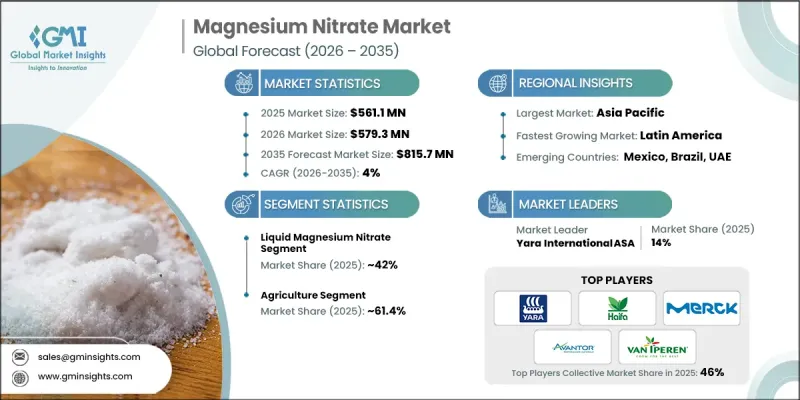
KSM 26.05.06The Global Magnesium Nitrate Market was valued at USD 561.1 million in 2025 and is estimated to grow at a CAGR of 4% to reach USD 815.7 million by 2035.
The market is propelled by evolving agricultural practices and the growing demand for versatile fertilizer solutions. Liquid magnesium nitrate formulations are gaining traction due to their ease of integration with irrigation systems, rapid absorption through foliage, and precise nutrient delivery, supporting sustainable farming initiatives. Powder forms remain essential in controlled feed and specialty industrial applications because of their high solubility, stability, and ease of transport. Granular variants are increasingly adopted for bulk fertilizer blending, with automated prilling ensuring consistent particle sizes for uniform nutrient release. Across all forms, the magnesium nitrate market demonstrates strong cohesion, driven by the need for flexible, high-efficiency solutions in precision farming, industrial chemical applications, and climate-smart agriculture.
| Market Scope | |
|---|---|
| Start Year | 2025 |
| Forecast Year | 2026-2035 |
| Start Value | $561.1 Million |
| Forecast Value | $815.7 Million |
| CAGR | 4% |
The liquid magnesium nitrate segment held 42% share and is anticipated to grow at a CAGR of 4.2% by 2035. Its dominance is attributed to superior solubility, uniform field application, and growing adoption in fertigation and precision farming systems across key agricultural regions. Powder and granular forms continue to be vital for high-purity nutrient blending, bulk fertilization, and efficient transport across diverse climatic conditions. The unified growth trend across liquid, powder, and granular magnesium nitrate reflects demand for adaptable fertilizers and industrial-grade products that meet evolving farming and chemical processing needs.
The agriculture sector accounted for 61.4% share in 2025 and is expected to grow at a CAGR of 4.3% through 2035. Growth is driven by increasing fertilizer demand, adoption of nutrient-balanced soil enhancement practices, and expanding use of water-soluble magnesium nitrate in high-value crops. In agricultural applications, magnesium nitrate is widely used in fertilizer blends, foliar sprays, and soil conditioners to improve nutrient absorption and overall crop yield. Rising adoption of precision farming, sustainable soil management, and climate-smart fertilizer practices is fueling widespread uptake globally, while industrial and emerging applications maintain complementary growth trajectories through innovation and technology integration.
North America Magnesium Nitrate Market accounted for USD 146.2 million in 2025. The region benefits from advanced fertilizer technologies, steady industrial chemical demand, and increasing adoption of precision agriculture. Environmental regulations and the emphasis on sustainable nitrate-based formulations further drive regional growth, supporting both agricultural and industrial applications.
Key players in the Global Magnesium Nitrate Market include Yara International, American Elements, Avantor Performance Materials, AKO Kasei Co. Ltd., Spectrum Chemical Manufacturing, GFS Chemicals, Haifa Mexico, Merck KGaA, Neochim PLC, Rongyu Chemical Co. Ltd., Thermo Fisher Scientific India Private Limited, Van Iperen International, Vishnupriya Chemicals Private Limited, and William Blythe. To strengthen their market presence, companies are focusing on diversifying product portfolios across liquid, powder, and granular magnesium nitrate to meet diverse agricultural and industrial needs. Strategic investments in advanced production technologies, such as automated prilling and micro-granulation, ensure consistent quality and particle uniformity. Market participants are also expanding regional distribution networks to enhance supply chain efficiency and serve high-demand agricultural regions. Emphasis on sustainable, water-efficient fertilizer formulations aligns with regulatory compliance and growing precision farming adoption. Collaborations with agritech firms, research initiatives for new applications, and value-added product innovation are further enhancing competitive positioning.
Table of Contents
Chapter 1 Methodology & Scope
- 1.1 Market scope and definition
- 1.2 Research design
- 1.2.1 Research approach
- 1.2.2 Data collection methods
- 1.3 Data mining sources
- 1.3.1 Global
- 1.3.2 Regional/Country
- 1.4 Base estimates and calculations
- 1.4.1 Base year calculation
- 1.4.2 Key trends for market estimation
- 1.5 Primary research and validation
- 1.5.1 Primary sources
- 1.6 Forecast model
- 1.7 Research assumptions and limitations
Chapter 2 Executive Summary
- 2.1 Industry 360° synopsis
- 2.2 Key market trends
- 2.2.1 Regional
- 2.2.2 Form
- 2.2.3 Application
- 2.3 TAM Analysis, 2026-2035
- 2.4 CXO perspectives: Strategic imperatives
- 2.4.1 Executive decision points
- 2.4.2 Critical success factors
- 2.5 Future Outlook and Strategic Recommendations
Chapter 3 Industry Insights
- 3.1 Industry ecosystem analysis
- 3.1.1 Supplier landscape
- 3.1.2 Profit margin
- 3.1.3 Value addition at each stage
- 3.1.4 Factor affecting the value chain
- 3.1.5 Disruptions
- 3.2 Industry impact forces
- 3.2.1 Growth drivers
- 3.2.1.1 Growing adoption in high-yield precision farming
- 3.2.1.2 Expanding role in wastewater treatment solutions
- 3.2.1.3 Rising demand from pyrotechnic manufacturing sector
- 3.2.2 Industry pitfalls and challenges
- 3.2.2.1 Dependence on ammonia and nitric acid supply
- 3.2.2.2 Stringent environmental regulations on nitrate emissions
- 3.2.3 Market opportunities
- 3.2.3.1 Shift toward organic and eco-balanced fertilizers
- 3.2.3.2 New production capacities in developing economies
- 3.2.1 Growth drivers
- 3.3 Growth potential analysis
- 3.4 Regulatory landscape
- 3.4.1 North America
- 3.4.2 Europe
- 3.4.3 Asia Pacific
- 3.4.4 Latin America
- 3.4.5 Middle East & Africa
- 3.5 Porter's analysis
- 3.6 PESTEL analysis
- 3.7 Price trends
- 3.7.1 By region
- 3.7.2 By Product type
- 3.8 Future market trends
- 3.9 Technology and Innovation landscape
- 3.9.1 Current technological trends
- 3.9.2 Emerging technologies
- 3.10 Patent Landscape
- 3.11 Trade statistics (HS code)
- 3.11.1 Major importing countries
- 3.11.2 Major exporting countries
- 3.12 Sustainability and environmental aspects
- 3.12.1 Sustainable practices
- 3.12.2 Waste reduction strategies
- 3.12.3 Energy efficiency in production
- 3.12.4 Eco-friendly initiatives
- 3.13 Carbon footprint consideration
Chapter 4 Competitive Landscape, 2025
- 4.1 Introduction
- 4.2 Company market share analysis
- 4.2.1 By region
- 4.2.1.1 North America
- 4.2.1.2 Europe
- 4.2.1.3 Asia Pacific
- 4.2.1.4 LATAM
- 4.2.1.5 MEA
- 4.2.1 By region
- 4.3 Company matrix analysis
- 4.4 Competitive analysis of major market players
- 4.5 Competitive positioning matrix
- 4.6 Key developments
- 4.6.1 Mergers & acquisitions
- 4.6.2 Partnerships & collaborations
- 4.6.3 New Product Launches
- 4.6.4 Expansion Plans
Chapter 5 Market Estimates and Forecast, By Form, 2022-2035 (USD Million) (Kilo Tons)
- 5.1 Key trends
- 5.2 Liquid
- 5.3 Powder
- 5.4 Granular
Chapter 6 Market Estimates and Forecast, By Application, 2022-2035 (USD Million) (Kilo Tons)
- 6.1 Key trends
- 6.2 Agriculture
- 6.2.1 Fertilizer blends (NPK, specialty fertilizers)
- 6.2.2 Foliar sprays and soil conditioners
- 6.2.3 Crop yield improvement and soil health
- 6.2.4 Others
- 6.3 Industrial
- 6.3.1 Pyrotechnics and explosives manufacturing
- 6.3.2 Petrochemical catalysts
- 6.3.3 Chemical intermediates production
- 6.3.4 Others
- 6.4 Other applications
- 6.4.1 Water treatment chemicals
- 6.4.2 Pharmaceutical intermediates
Chapter 7 Market Estimates and Forecast, By Region, 2022-2035 (USD Million) (Kilo Tons)
- 7.1 Key trends
- 7.2 North America
- 7.2.1 U.S.
- 7.2.2 Canada
- 7.3 Europe
- 7.3.1 Germany
- 7.3.2 UK
- 7.3.3 France
- 7.3.4 Spain
- 7.3.5 Italy
- 7.3.6 Rest of Europe
- 7.4 Asia Pacific
- 7.4.1 China
- 7.4.2 India
- 7.4.3 Japan
- 7.4.4 Australia
- 7.4.5 South Korea
- 7.4.6 Rest of Asia Pacific
- 7.5 Latin America
- 7.5.1 Brazil
- 7.5.2 Mexico
- 7.5.3 Argentina
- 7.5.4 Rest of Latin America
- 7.6 Middle East and Africa
- 7.6.1 Saudi Arabia
- 7.6.2 South Africa
- 7.6.3 UAE
- 7.6.4 Rest of Middle East and Africa
Chapter 8 Company Profiles
- 8.1 Yara International
- 8.2 American Elements
- 8.3 Avantor Performance Materials
- 8.4 AKO Kasei Co. Ltd.
- 8.5 Spectrum Chemical Manufacturing
- 8.6 GFS Chemicals
- 8.7 Haifa Mexico
- 8.8 Merck KGaA
- 8.9 Neochim PLC
- 8.10 Rongyu Chemical Co. Ltd.
- 8.11 Spectrum Chemical Manufacturing
- 8.12 Thermo Fisher Scientific India Private Limited
- 8.13 Van Iperen International
- 8.14 Vishnupriya Chemicals Private Limited
- 8.15 William Blythe