|
시장보고서
상품코드
2019085
식물성 보충제 시장 기회, 성장요인, 업계 동향 분석 및 예측(2026-2035년)Botanical Supplements Market Opportunity, Growth Drivers, Industry Trend Analysis, and Forecast 2026 - 2035 |
||||||

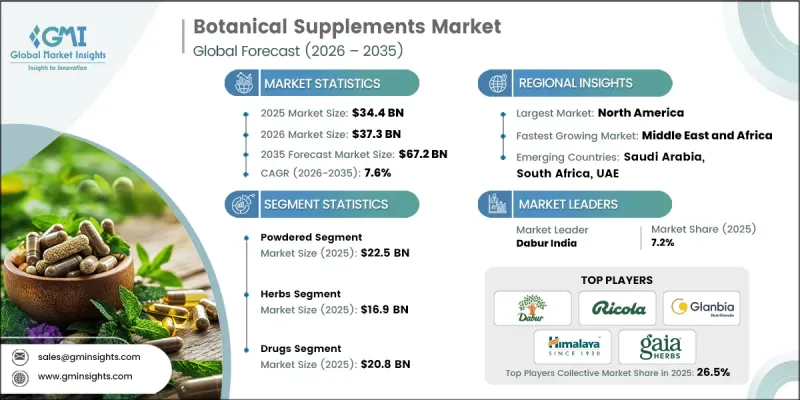
세계의 식물성 보충제 시장은 2025년에 344억 달러로 평가되고 CAGR 7.6%로 성장하며, 2035년까지 672억 달러에 달할 것으로 추정되고 있습니다.
예방 의료 및 전반적인 건강 유지를 위해 소비자들이 식물 유래 건강 솔루션을 점점 더 많이 찾으면서 시장이 확대되고 있습니다. 잎, 뿌리, 꽃, 씨앗, 추출물 등 식물 원료로 만든 식물성 보충제는 캡슐, 분말, 차, 팅크제 등의 형태로 널리 소비되고 있습니다. 이 제품들은 면역력, 소화, 스트레스 관리, 에너지 균형 등 다양한 건강 기능을 지원하는 천연 대체품으로 자리매김하고 있습니다. 클린 라벨 제품에 대한 인식이 높아지고 합성첨가제가 들어가지 않은 제품을 선호하는 경향이 주요 성장 요인으로 작용하고 있습니다. 정제 및 검증 방법의 개선을 포함한 추출 및 품질관리의 기술적 진보로 인해 제품의 일관성, 유효성, 안전성이 향상되었습니다. 디지털 전환은 시장 성장을 더욱 가속화하고 있으며, E-Commerce 플랫폼과 개인화된 영양 관리 툴을 통해 소비자들은 자신에게 맞는 보충제 솔루션을 이용할 수 있게 되었습니다. 그 결과, 제조업체들은 변화하는 소비자의 기대와 규제 기준을 충족시키기 위해 혁신, 투명성, 제품 차별화에 초점을 맞추고 있습니다.
| 시장 범위 | |
|---|---|
| 시작연도 | 2025년 |
| 예측 기간 | 2026-2035 |
| 개시 금액 | 344억 달러 |
| 예측액 | 672억 달러 |
| CAGR | 7.6% |
분말 부문은 다용도하고 일상 생활에 쉽게 적용될 수 있다는 점에서 2025년 225억 달러의 시장 규모를 차지했습니다. 분말 형태의 식물성 보충제는 음료나 기능성 영양 제품에 혼합할 수 있고, 섭취량을 유연하게 조절할 수 있으며, 간편하게 섭취할 수 있으므로 널리 선호되고 있습니다. 피트니스, 디톡스, 웰니스 등 다양한 용도에 대한 적응성이 탄탄한 수요를 지원하고 있습니다. 한편, 캡슐 유형도 정확한 용량, 장기보관성, 편의성 등으로 높은 인기를 유지하고 있으며, 정기적인 보충제 섭취와 일관된 섭취 패턴을 원하는 사람들에게 신뢰할 수 있는 선택이 되고 있습니다.
허브 분야는 2025년 169억 달러 규모에 달하며, 이는 웰니스 및 전통 의료 시스템에서 수년간의 사용 실적을 반영합니다. 허브에서 추출한 식물성 성분은 면역 기능, 소화기 건강, 스트레스 관리를 지원하는 데 널리 활용되고 있습니다. 또한 뿌리와 뿌리줄기에는 활력 증진, 염증 감소, 전반적인 건강 지원과 관련된 농축된 생리활성 성분이 함유되어 있으며, 많은 관심을 받고 있습니다. 식물 유래 원료에 대한 지속적인 의존도는 제품 혁신을 추진하는 데 있으며, 천연 성분 조달 및 제형 기술의 중요성을 강조하고 있습니다.
북미 식물성 보충제 시장은 2035년까지 211억 달러에 달할 것으로 예상됩니다. 이 지역은 높은 소비자 의식, 예방 의료 관행의 정착, 그리고 확립된 규제 프레임워크에 기반한 성숙한 시장 상황을 보여주고 있습니다. 천연 건강 제품, 기능성 식품 및 건강 보조 식품의 인기가 높아지면서 수요가 증가하고 있습니다. 미국은 가처분 소득의 증가, 웰빙을 중시하는 라이프스타일의 확산, 식물성 성분에 대한 과학적 근거의 확대에 힘입어 시장을 주도하고 있습니다. 소매 및 디지털 유통망 확대로 제품 접근성이 더욱 향상되고, 면역력 지원, 적응증 제품, 맞춤형 영양에 대한 관심이 높아지면서 다양한 소비자층을 계속 끌어들이고 있습니다.
자주 묻는 질문
목차
제1장 조사 방법과 범위
제2장 개요
제3장 업계 인사이트
제4장 경쟁 구도
제5장 시장 추산·예측 : 형태별, 2022-2035년
제6장 시장 추산·예측 : 원료별, 2022-2035년
제7장 시장 추산·예측 : 용도별, 2022-2035년
제8장 시장 추산·예측 : 유통 채널별, 2022-2035년
제9장 시장 추산·예측 : 지역별, 2022-2035년
제10장 기업 개요
KSA 26.05.13The Global Botanical Supplements Market was valued at USD 34.4 billion in 2025 and is estimated to grow at a CAGR of 7.6% to reach USD 67.2 billion by 2035.
The market is expanding as consumers increasingly turn toward plant-based health solutions for preventive care and overall wellness. Botanical supplements, derived from plant sources such as leaves, roots, flowers, seeds, and extracts, are widely consumed in formats including capsules, powders, teas, and tinctures. These products are positioned as natural alternatives that support multiple health functions, including immunity, digestion, stress management, and energy balance. Rising awareness of clean-label products and the preference for formulations free from synthetic additives are key growth drivers. Technological advancements in extraction and quality control, including enhanced purification and verification methods, have improved product consistency, potency, and safety. Digital transformation has further accelerated market growth, with e-commerce platforms and personalized nutrition tools enabling consumers to access tailored supplement solutions. As a result, manufacturers are focusing on innovation, transparency, and product differentiation to meet evolving consumer expectations and regulatory standards.
| Market Scope | |
|---|---|
| Start Year | 2025 |
| Forecast Year | 2026-2035 |
| Start Value | $34.4 Billion |
| Forecast Value | $67.2 Billion |
| CAGR | 7.6% |
The powdered segment accounted for USD 22.5 billion in 2025, driven by its versatility and ease of integration into daily routines. Powdered botanical supplements are widely preferred because they can be blended into beverages and functional nutrition products, allowing flexible dosage and convenient consumption. Their adaptability across fitness, detoxification, and wellness applications supports strong demand. In parallel, capsule-based formats remain highly popular due to their precise dosing, extended shelf life, and convenience, making them a reliable choice for regular supplementation and consistent intake patterns.
The herbs segment captured USD 16.9 billion in 2025, reflecting their longstanding use in wellness and traditional health systems. Botanical ingredients derived from herbs are widely utilized for supporting immune function, digestive health, and stress management. Additionally, roots and rhizomes are gaining strong traction due to their concentrated bioactive properties, which are associated with improved vitality, reduced inflammation, and overall health support. The continued reliance on plant-based raw materials underscores the importance of natural ingredient sourcing and formulation expertise in driving product innovation.
North America Botanical Supplements Market is projected to reach USD 21.1 billion by 2035. The region demonstrates a mature market landscape supported by high consumer awareness, strong adoption of preventive healthcare practices, and well-established regulatory frameworks. Demand is reinforced by the increasing popularity of natural health products, functional foods, and dietary supplements. The United States plays a dominant role, driven by rising disposable incomes, widespread wellness-focused lifestyles, and growing scientific validation of plant-based formulations. Expanding retail and digital distribution networks further enhance accessibility, while increasing interest in immunity support, adaptogenic products, and personalized nutrition continues to attract a broad consumer base.
Major players operating in the Global Botanical Supplements Market include Dabur India, Nature's Way Products LLC, Ricola AG., Mondelez International, Procter and Gamble, Nutraceuticals Group Europe Ltd UK, Gaia Herbs, Himalaya Wellness Company, Glanbia Nutritionals, Botanicalife International of America, Inc., and Blackmores Limited. Companies operating in the Botanical Supplements Market are adopting a range of strategic initiatives to strengthen their market position and expand their global footprint. Key strategies include investing in advanced extraction technologies and research to improve product efficacy, purity, and consistency. Firms are also focusing on product innovation by developing customized formulations aligned with consumer health trends such as immunity, stress relief, and overall wellness. Strategic partnerships with distributors, healthcare providers, and e-commerce platforms help expand reach and enhance brand visibility. Additionally, companies emphasize clean-label positioning, sustainable sourcing, and transparent supply chains to build consumer trust. Expansion into emerging markets, digital marketing initiatives, and personalized nutrition solutions further support long-term growth and competitive differentiation.
Table of Contents
Chapter 1 Methodology & Scope
- 1.1 Market scope and definition
- 1.2 Research design
- 1.2.1 Research approach
- 1.2.2 Data collection methods
- 1.3 Data mining sources
- 1.3.1 Global
- 1.3.2 Regional/Country
- 1.4 Base estimates and calculations
- 1.4.1 Base year calculation
- 1.4.2 Key trends for market estimation
- 1.5 Primary research and validation
- 1.5.1 Primary sources
- 1.6 Forecast model
- 1.7 Research assumptions and limitations
Chapter 2 Executive Summary
- 2.1 Industry 360° synopsis
- 2.2 Key market trends
- 2.2.1 Form
- 2.2.2 Sources
- 2.2.3 Application
- 2.2.4 Distribution Channel
- 2.2.5 Regional
- 2.3 TAM Analysis, 2026-2035
- 2.4 CXO perspectives: Strategic imperatives
- 2.5 Future outlook and strategic recommendations
Chapter 3 Industry Insights
- 3.1 Industry ecosystem analysis
- 3.1.1 Supplier landscape
- 3.1.2 Profit margin
- 3.1.3 Value addition at each stage
- 3.1.4 Factor affecting the value chain
- 3.1.5 Disruptions
- 3.2 Industry impact forces
- 3.2.1 Growth drivers
- 3.2.1.1 Rising health awareness
- 3.2.1.2 Scientific validation
- 3.2.1.3 Digital & e-commerce expansion
- 3.2.2 Industry pitfalls and challenges
- 3.2.2.1 Regulatory variability
- 3.2.2.2 Quality & safety concern
- 3.2.3 Market opportunities
- 3.2.3.1 Personalized nutrition
- 3.2.3.2 Innovative formulations
- 3.2.1 Growth drivers
- 3.3 Growth potential analysis
- 3.4 Regulatory landscape
- 3.4.1 North America
- 3.4.2 Europe
- 3.4.3 Asia Pacific
- 3.4.4 Latin America
- 3.4.5 Middle East & Africa
- 3.5 Porter's analysis
- 3.6 PESTEL analysis
- 3.7 Technology and innovation landscape
- 3.7.1 Current technological trends
- 3.7.2 Emerging technologies
- 3.8 Price trends
- 3.8.1 By region
- 3.8.2 By form
- 3.9 Future market trends
- 3.10 Patent landscape
- 3.11 Trade statistics (HS code)
- 3.11.1 Major importing countries
- 3.11.2 Major exporting countries
- 3.12 Sustainability and environmental aspects
- 3.12.1 Sustainable practices
- 3.12.2 Waste reduction strategies
- 3.12.3 Energy efficiency in production
- 3.12.4 Eco-friendly initiatives
- 3.13 Carbon footprint consideration
Chapter 4 Competitive Landscape, 2025
- 4.1 Introduction
- 4.2 Company market share analysis
- 4.2.1 By region
- 4.2.1.1 North America
- 4.2.1.2 Europe
- 4.2.1.3 Asia Pacific
- 4.2.1.4 LATAM
- 4.2.1.5 MEA
- 4.2.1 By region
- 4.3 Company matrix analysis
- 4.4 Competitive analysis of major market players
- 4.5 Competitive positioning matrix
- 4.6 Key developments
- 4.6.1 Mergers & acquisitions
- 4.6.2 Partnerships & collaborations
- 4.6.3 New product launches
- 4.6.4 Expansion plans
Chapter 5 Market Estimates and Forecast, By Form, 2022-2035 (USD Billion) (Kilo Tons)
- 5.1 Key trends
- 5.2 Powdered
- 5.3 Capsules
- 5.4 Liquid
- 5.5 Gummies
Chapter 6 Market Estimates and Forecast, By Sources, 2022-2035 (USD Billion) (Kilo Tons)
- 6.1 Key trends
- 6.2 Herbs
- 6.3 Roots and Rhizomes
- 6.4 Fruits and Berries
- 6.5 Others
Chapter 7 Market Estimates and Forecast, By Application, 2022-2035 (USD Billion) (Kilo Tons)
- 7.1 Key trends
- 7.2 Drugs
- 7.3 Cosmetics
- 7.4 Food and Beverage
- 7.5 Others
Chapter 8 Market Estimates and Forecast, By Distribution Channel, 2022-2035 (USD Billion) (Kilo Tons)
- 8.1 Key trends
- 8.2 Pharmacies and Specialty Stores
- 8.3 Supermarkets and Hypermarkets
- 8.4 Online Retail / E-commerce
- 8.5 Others
Chapter 9 Market Estimates and Forecast, By Region, 2022-2035 (USD Billion) (Kilo Tons)
- 9.1 Key trends
- 9.2 North America
- 9.2.1 U.S.
- 9.2.2 Canada
- 9.3 Europe
- 9.3.1 Germany
- 9.3.2 UK
- 9.3.3 France
- 9.3.4 Spain
- 9.3.5 Italy
- 9.3.6 Rest of Europe
- 9.4 Asia Pacific
- 9.4.1 China
- 9.4.2 India
- 9.4.3 Japan
- 9.4.4 Australia
- 9.4.5 South Korea
- 9.4.6 Rest of Asia Pacific
- 9.5 Latin America
- 9.5.1 Brazil
- 9.5.2 Mexico
- 9.5.3 Argentina
- 9.5.4 Rest of Latin America
- 9.6 Middle East and Africa
- 9.6.1 Saudi Arabia
- 9.6.2 South Africa
- 9.6.3 UAE
- 9.6.4 Rest of Middle East and Africa
Chapter 10 Company Profiles
- 10.1 Dabur India
- 10.2 Nature's Way Products LLC
- 10.3 Ricola AG.
- 10.4 Mondelez International
- 10.5 Procter and Gamble
- 10.6 Nutraceuticals Group Europe Ltd UK
- 10.7 Gaia Herbs
- 10.8 Himalaya Wellness Company
- 10.9 Glanbia Nutritionals
- 10.10 Botanicalife International of America, Inc.
- 10.11 Blackmores Limited