

|
시장보고서
상품코드
2019088
첨단 여행자 정보 시스템(ATIS) 시장 기회, 성장 촉진요인, 업계 동향 분석 및 예측(2026-2035년)Advanced Traveller Information System Market Opportunity, Growth Drivers, Industry Trend Analysis, and Forecast 2026 - 2035 |
||||||

세계의 첨단 여행자 정보 시스템(ATIS) 시장은 2025년에 62억 달러로 평가되었으며, CAGR 10.1%로 성장하여 2035년까지 157억 달러에 달할 것으로 추정됩니다.
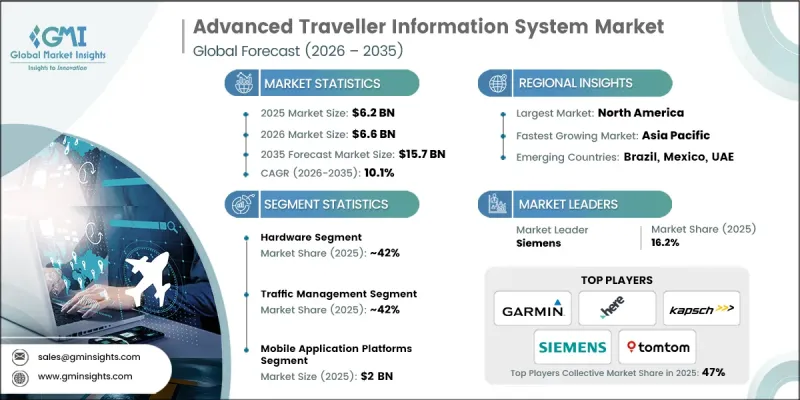
이 시장의 성장은 급속한 도시화, 실시간 교통 정보에 대한 통근자의 수요 증가, 지능형 교통 시스템(ITS)의 보급, 스마트 모빌리티 솔루션 강화를 위한 정부의 노력에 힘입어 성장하고 있습니다. 교통 당국과 모빌리티 제공업체들은 통근자 경험 개선, 네트워크 효율성 최적화, 교통 체증 완화를 위해 커넥티드 인프라, 통합 정보 플랫폼, 실시간 교통 모니터링에 많은 투자를 하고 있습니다. 대중교통 시스템의 확장, 수요 반응형 교통 및 멀티모달 모빌리티 네트워크의 확대로 인해 확장 가능한 기술 기반 여행자 정보 솔루션에 대한 요구가 증가하고 있습니다. 이 시장은 디지털화, 지속가능성 요구사항, 스마트 시티 이니셔티브에 의해 형성되고 있으며, 이해관계자들은 AI 기반 교통 예측, 예측 분석, 모바일 우선 플랫폼에 집중하여 전 세계 통근자의 경험과 네트워크 신뢰성을 향상시키기 위해 노력하고 있습니다.
| 시장 범위 | |
|---|---|
| 시작 연도 | 2025년 |
| 예측 기간 | 2026-2035년 |
| 시작 시점 시장 규모 | 62억 달러 |
| 예측 규모 | 157억 달러 |
| CAGR | 10.1% |
하드웨어 부문은 2025년 42%의 점유율을 차지했으며, 2026년부터 2035년까지 CAGR 8.7%로 성장할 것으로 예상됩니다. 하드웨어는 실시간 데이터 수집, 교통 모니터링 및 커넥티드카의 통합에 있어 여전히 필수적이며, 여행자 정보 시스템의 기반을 형성하고 있습니다. 센서, 카메라, GPS 장치, 도로변 장치, 통신 네트워크 등의 구성요소를 통해 예측 경로 안내, 교통 상황 감지 및 소프트웨어 플랫폼과의 원활한 상호 운용이 가능합니다.
교통 관리 부문은 2025년 42%의 점유율을 차지했으며, 2026년부터 2035년까지 CAGR 12.2%로 성장할 것으로 예측됩니다. 교통 관리 솔루션은 도시, 지방, 고속도로 네트워크의 차량 흐름을 모니터링, 제어 및 최적화하는 데 필수적입니다. AI를 활용한 교통 예측, 적응형 신호 제어, 실시간 교통 체증 모니터링, 모빌리티 서비스와의 통합에 대한 수요가 증가하면서 도입이 가속화되고 있습니다. 방대한 양의 데이터, 예측 가능한 인프라 구축, 플랫폼 간 상호운용성 등이 이 분야 시장에서의 선도적 지위를 뒷받침하고 있습니다.
미국의 첨단 여행자 정보 시스템(ATIS) 시장은 71%의 점유율을 차지하며, 2025년 16억 달러의 시장 규모를 기록했습니다. 북미는 성숙한 도시 교통 네트워크, 광범위한 ITS 도입, 첨단 교통 관리 인프라로 인해 전 세계적으로 선도적인 위치를 차지하고 있습니다. 탄탄한 고속도로 및 대중교통 시스템과 AI를 활용한 경로 최적화 및 예측 분석이 결합된 이 지역은 안전하고 효율적인 기술 기반 여행자 정보 서비스의 선두주자로 자리매김하고 있습니다. 북미에서는 미국이 가장 큰 점유율을 유지하고 있으며, 이는 교통 당국의 집중화, 도시와 주를 연결하는 통합된 모빌리티 네트워크, 엄격한 안전 및 환경 규제에 의해 뒷받침되고 있습니다.
자주 묻는 질문
목차
제1장 조사 방법과 범위
제2장 주요 요약
제3장 업계 인사이트
제4장 경쟁 구도
제5장 시장 추정 및 예측 : 구성요소별, 2022-2035
제6장 시장 추정 및 예측 : 기술별, 2022-2035
제7장 시장 추정 및 예측 : 용도별, 2022-2035
제8장 시장 추정 및 예측 : 최종 용도별, 2022-2035
제9장 시장 추정 및 예측 : 지역별, 2022-2035
제10장 기업 개요
KSM 26.05.06The Global Advanced Traveller Information System Market was valued at USD 6.2 billion in 2025 and is estimated to grow at a CAGR of 10.1% to reach USD 15.7 billion by 2035.
The market growth is fueled by rapid urbanization, rising commuter demand for real-time travel updates, widespread adoption of intelligent transport systems (ITS), and government efforts to enhance smart mobility solutions. Transport authorities and mobility providers are investing heavily in connected infrastructure, integrated information platforms, and real-time traffic monitoring to improve commuter experiences, optimize network efficiency, and reduce congestion. The expansion of public transit systems, demand-responsive transport, and multimodal mobility networks is increasing the need for scalable, technology-driven traveller information solutions. The market is further shaped by digitalization, sustainability mandates, and smart city initiatives, with stakeholders focusing on AI-based traffic prediction, predictive analytics, and mobile-first platforms to enhance commuter experience and network reliability globally.
| Market Scope | |
|---|---|
| Start Year | 2025 |
| Forecast Year | 2026-2035 |
| Start Value | $6.2 Billion |
| Forecast Value | $15.7 Billion |
| CAGR | 10.1% |
The hardware segment accounted for 42% share in 2025 and is expected to grow at a CAGR of 8.7% from 2026 to 2035. Hardware remains critical for real-time data collection, traffic monitoring, and connected vehicle integration, forming the backbone of traveller information systems. Components such as sensors, cameras, GPS devices, roadside units, and communication networks enable predictive routing, traffic detection, and seamless interoperability with software platforms.
The traffic management segment held a 42% share in 2025 and is projected to grow at a CAGR of 12.2% from 2026 to 2035. Traffic management solutions are essential for monitoring, controlling, and optimizing vehicle flow across urban, regional, and highway networks. The increasing demand for AI-assisted traffic forecasting, adaptive signal control, real-time congestion monitoring, and integration with mobility services is driving adoption. High data volumes, predictable infrastructure deployment, and platform interoperability support this segment's market leadership.
U.S. Advanced Traveller Information System Market held a 71% share, generating USD 1.6 billion in 2025. North America leads globally due to mature urban transport networks, extensive ITS adoption, and advanced traffic management infrastructure. Strong highway and public transit systems, combined with AI-enabled route optimization and predictive analytics, position the region as a leader in safe, efficient, and technology-driven traveller information services. Within North America, the United States maintains the largest share, supported by a concentration of transport authorities, integrated urban and interstate mobility networks, and stringent safety and environmental regulations.
Key players in the Global Advanced Traveller Information System Market include Cubic, Garmin, HERE Technologies, INRIX, Iteris, Kapsch TrafficCom, Siemens, Thales, TomTom, and Trimble. Companies in the Advanced Traveller Information System Market are strengthening their position by investing in R&D to develop AI-enabled predictive analytics, connected vehicle integration, and IoT-based traffic sensors. Strategic partnerships with transport authorities, municipal governments, and mobility service providers expand deployment and regional reach. Firms focus on software and hardware interoperability to offer end-to-end solutions and scalable platforms. Adoption of cloud-based services, mobile-first applications, and real-time traveler information solutions enhances customer engagement. Additionally, firms pursue mergers, acquisitions, and technology alliances to consolidate capabilities, enter new markets, and improve service portfolios, while participating in pilot smart city projects to showcase system reliability and efficacy.
Table of Contents
Chapter 1 Methodology & Scope
- 1.1 Research approach
- 1.2 Quality Commitments
- 1.2.1 GMI AI policy & data integrity commitment
- 1.3 Research Trail & Confidence Scoring
- 1.3.1 Research Trail Components
- 1.3.2 Scoring Components
- 1.4 Data Collection
- 1.4.1 Partial list of primary sources
- 1.5 Data mining sources
- 1.5.1 Paid sources
- 1.6 Base estimates and calculations
- 1.6.1 Base year calculation
- 1.7 Forecast model
- 1.8 Research transparency addendum
Chapter 2 Executive Summary
- 2.1 Industry 360° synopsis, 2022 - 2035
- 2.2 Key market trends
- 2.2.1 Regional
- 2.2.2 Component
- 2.2.3 Technology
- 2.2.4 Application
- 2.2.5 End Use
- 2.3 TAM Analysis, 2026-2035
- 2.4 CXO perspectives: Strategic imperatives
Chapter 3 Industry Insights
- 3.1 Industry ecosystem analysis
- 3.1.1 Supplier Landscape
- 3.1.2 Profit Margin
- 3.1.3 Cost structure
- 3.1.4 Value addition at each stage
- 3.1.5 Factor affecting the value chain
- 3.1.6 Disruptions
- 3.2 Industry impact forces
- 3.2.1 Growth drivers
- 3.2.1.1 Rising Urbanization and Commuter Demand
- 3.2.1.2 Government Initiatives and Smart City Programs
- 3.2.1.3 Technological Advancements
- 3.2.1.4 Integration of Multimodal Transport
- 3.2.2 Industry pitfalls and challenges
- 3.2.2.1 High Implementation and Maintenance Costs
- 3.2.2.2 Data Privacy and Cybersecurity Concerns
- 3.2.3 Market opportunities
- 3.2.3.1 AI-Driven Analytics and Predictive Services
- 3.2.3.2 Expansion of Mobile and Cloud-Based Traveler Platforms
- 3.2.3.3 Rising Demand for Real-Time Mobility Applications
- 3.2.3.4 Integration with Multimodal Transport Networks
- 3.2.1 Growth drivers
- 3.3 Growth potential analysis
- 3.4 Regulatory landscape
- 3.4.1 North America
- 3.4.1.1 U.S.: USDOT (U.S. Department of Transportation)
- 3.4.1.2 Canada: Transport Canada, ITS Canada Regulations
- 3.4.2 Europe
- 3.4.2.1 Germany: BMDV (Federal Ministry for Digital and Transport)
- 3.4.2.2 France: Ministry for Ecological Transition and Transport
- 3.4.2.3 UK: Department for Transport (DfT)
- 3.4.2.4 Italy: Ministry of Infrastructure and Transport
- 3.4.3 Asia Pacific
- 3.4.3.1 China: MIIT (Ministry of Industry and Information Technology)
- 3.4.3.2 Japan: MLIT (Ministry of Land, Infrastructure, Transport and Tourism)
- 3.4.3.3 South Korea: MOLIT (Ministry of Land, Infrastructure and Transport)
- 3.4.3.4 India: MoRTH (Ministry of Road Transport and Highways)
- 3.4.4 Latin America
- 3.4.4.1 Brazil: DENATRAN, National Mobility Policy
- 3.4.4.2 Mexico: Secretariat of Infrastructure
- 3.4.5 Middle East and Africa
- 3.4.5.1 UAE: Roads and Transport Authority (RTA)
- 3.4.5.2 Saudi Arabia: Ministry of Transport and Logistic Services
- 3.4.1 North America
- 3.5 Porter's analysis
- 3.6 PESTEL analysis
- 3.7 Technology and Innovation Landscape
- 3.7.1 Current technological trends
- 3.7.2 Emerging technologies
- 3.8 Pricing analysis (Driven by primary research)
- 3.8.1 Historical price trend analysis
- 3.8.2 Pricing strategy by player type (premium / value / cost-plus)
- 3.9 Cost breakdown analysis
- 3.10 Patent analysis (Driven by primary research)
- 3.11 Capacity & production landscape (Driven by primary research)
- 3.11.1 Installed capacity by region & key producer
- 3.11.2 Capacity utilization rates & expansion pipelines
- 3.12 Impact of Artificial Intelligence (AI)
- 3.12.1 AI-Driven Disruption of Existing Business Models
- 3.12.2 GenAI Use Cases & Adoption Roadmap by Segment
- 3.12.3 Risks, limitations & regulatory considerations
- 3.13 Sustainability and Environmental Aspects
- 3.13.1 Sustainable practices
- 3.13.2 Waste reduction strategies
- 3.13.3 Energy efficiency in production
- 3.13.4 Eco-friendly initiatives
- 3.13.5 Carbon footprint considerations
- 3.14 Forecast assumptions & scenario analysis (Driven by primary research)
- 3.14.1 Base Case - key macro & industry variables driving CAGR
- 3.14.2 Optimistic Scenarios - Favorable macro and industry tailwinds
- 3.14.3 Pessimistic Scenario - Macroeconomic slowdown or industry headwinds
Chapter 4 Competitive Landscape, 2025
- 4.1 Introduction
- 4.2 Company market share analysis
- 4.2.1 North America
- 4.2.2 Europe
- 4.2.3 Asia Pacific
- 4.2.4 Latin America
- 4.2.5 Middle East & Africa
- 4.3 Competitive analysis of major market players
- 4.4 Competitive positioning matrix
- 4.5 Strategic outlook matrix
- 4.6 Key developments
- 4.6.1 Mergers & acquisitions
- 4.6.2 Partnerships & collaborations
- 4.6.3 New product launches
- 4.6.4 Expansion plans and funding
Chapter 5 Market Estimates & Forecast, By Component, 2022 - 2035 ($Bn, Units)
- 5.1 Key trends
- 5.2 Software
- 5.2.1 Data Processing & Traffic Analytics Platforms
- 5.2.2 Mobile Application Software
- 5.2.3 Real-Time Routing & Navigation Algorithms
- 5.2.4 API & Data Exchange Platforms
- 5.2.5 AI-Based Predictive Traffic Modeling
- 5.3 Hardware
- 5.3.1 Sensors & Loop Detectors
- 5.3.2 GPS Devices & Navigation Units
- 5.3.3 Digital Signage & Variable Message Signs
- 5.3.4 Kiosks & Public Display Terminals
- 5.3.5 Cameras & Video Surveillance Equipment
- 5.3.6 Edge Computing & Communication Controllers
- 5.4 Services
- 5.4.1 System Integration & Implementation
- 5.4.2 Consulting & Advisory Services
- 5.4.3 Maintenance & Lifecycle Support
- 5.4.4 Data Management & Cloud Hosting Services
- 5.4.5 Managed ITS Services
Chapter 6 Market Estimates & Forecast, By Technology, 2022 - 2035 ($Bn)
- 6.1 Key trends
- 6.2 Mobile Application Platforms
- 6.3 Cloud Computing Solutions
- 6.4 GPS Navigation Systems
- 6.5 Communication Technologies
- 6.6 Digital Signage Solutions
Chapter 7 Market Estimates & Forecast, By Application, 2022 - 2035 ($Bn)
- 7.1 Key trends
- 7.2 Traffic Management
- 7.3 Route Planning & Navigation
- 7.4 Public Transport Management
- 7.5 Emergency & Road Safety Information
- 7.6 Travel Itinerary & Destination Management
Chapter 8 Market Estimates & Forecast, By End Use, 2022 - 2035 ($Bn)
- 8.1 Key trends
- 8.2 Government Agencies
- 8.3 Transport Operators
- 8.4 Individual Consumers
- 8.5 Travel & Tourism Organizations
Chapter 9 Market Estimates & Forecast, By Region, 2022 - 2035 ($Bn)
- 9.1 Key trends
- 9.2 North America
- 9.2.1 US
- 9.2.2 Canada
- 9.3 Europe
- 9.3.1 UK
- 9.3.2 Germany
- 9.3.3 France
- 9.3.4 Italy
- 9.3.5 Spain
- 9.3.6 Belgium
- 9.3.7 Netherlands
- 9.3.8 Sweden
- 9.4 Asia Pacific
- 9.4.1 China
- 9.4.2 India
- 9.4.3 Japan
- 9.4.4 Australia
- 9.4.5 Singapore
- 9.4.6 South Korea
- 9.4.7 Vietnam
- 9.4.8 Indonesia
- 9.5 Latin America
- 9.5.1 Brazil
- 9.5.2 Mexico
- 9.5.3 Argentina
- 9.6 MEA
- 9.6.1 UAE
- 9.6.2 South Africa
- 9.6.3 Saudi Arabia
Chapter 10 Company Profiles
- 10.1 Global Player
- 10.1.1 Cubic
- 10.1.2 Garmin
- 10.1.3 HERE Technologies
- 10.1.4 INRIX
- 10.1.5 Iteris
- 10.1.6 Kapsch TrafficCom
- 10.1.7 Siemens
- 10.1.8 Thales
- 10.1.9 TomTom
- 10.1.10 Trimble
- 10.2 Regional Player
- 10.2.1 Alstom
- 10.2.2 AT&T
- 10.2.3 Cisco Systems
- 10.2.4 Conduent
- 10.2.5 Denso
- 10.2.6 Hitachi
- 10.2.7 IBM
- 10.2.8 PTV
- 10.2.9 Q-Free
- 10.2.10 TransCore


