|
시장보고서
상품코드
2019091
유닛 로드 디바이스 시장 기회, 성장 촉진요인, 업계 동향 분석 및 예측(2026-2035년)Unit Load Device Market Opportunity, Growth Drivers, Industry Trend Analysis, and Forecast 2026 - 2035 |
||||||

세계의 유닛 로드 디바이스 시장은 2025년에 24억 달러로 추정되며, CAGR 5.4%로 성장하여 2035년까지 40억 달러에 달할 것으로 예측됩니다.
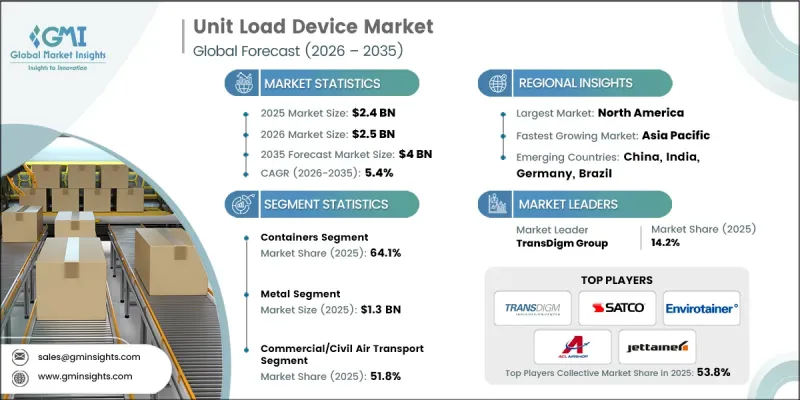
시장 확대는 항공 화물 운송의 급속한 확대와 E-Commerce 물류의 지속적인 증가에 의해 주도되고 있으며, 이 두 가지 모두 보다 빠르고 효율적인 화물 운송 시스템을 필요로 하고 있습니다. 와이드바디 항공기 및 전용 화물기 납품이 증가하고 있는 것도 수요를 더욱 촉진하고 있으며, 각 항공기에는 호환 가능한 화물 처리 솔루션이 필요하기 때문입니다. 또한, 업계에서는 첨단 소재로의 전환이 진행되고 있으며, 경량 복합재와 하이브리드 ULD(Unit Load Container)가 운영 측면과 연료 절감의 장점으로 인해 보급되고 있습니다. 또한, 항공사들은 업무 효율화와 비용 절감을 위해 아웃소싱과 서비스 공유로의 전환을 가속화하고 있습니다. 온도 관리가 필요한 물류 통합과 화물 보호 시스템의 개선도 수요 추세를 형성하고 있으며, 디지털 추적 기술은 전 세계 항공 물류 네트워크의 효율성, 가시성 및 자산 활용도를 지속적으로 향상시키고 있습니다.
| 시장 범위 | |
|---|---|
| 시작 연도 | 2025년 |
| 예측 기간 | 2026-2035년 |
| 시작 시점 시장 규모 | 24억 달러 |
| 예측 규모 | 40억 달러 |
| CAGR | 5.4% |
항공 화물 사업의 확대와 국경 간 E-Commerce의 활성화는 ULD(Unit Loaded Device)에 대한 수요에 지속적으로 큰 영향을 미치고 있습니다. 이는 수송량 증가에 따라 화물 처리의 효율화와 항공기 처리시간 단축이 요구되고 있기 때문입니다. 전용 화물기 및 여객기의 화물칸 용량에 대한 의존도가 높아짐에 따라 표준화된 컨테이너 및 팔레트에 대한 수요가 증가하고 있습니다. 동시에 전 세계 항공기 보유량 증가로 인해 공장 출고 시 장착 및 교체용 ULD 솔루션에 대한 지속적인 수요가 발생하여 항공사와 화물 운송업체 부문에서 장기적인 시장 성장을 뒷받침하고 있습니다.
항공사들이 경량화와 연료 효율을 우선시하는 가운데, 복합재와 하이브리드 소재로의 전환이 경쟁 구도를 바꾸고 있습니다. 기존 알루미늄 구조에 비해 복합재 설계는 내구성이 향상되고, 유지보수 요구사항이 감소하며, 온도 제어 화물 운송에 대한 높은 적응성을 제공합니다. 이러한 혁신은 특히 섬세하고 고가의 화물을 취급하는 데 있어 가치가 높으며, 전 세계 항공 물류 시스템 전반에 걸쳐 채택이 확대되고 있습니다.
컨테이너 부문은 유연성, 내구성, 다양한 항공기 유형에 대한 적합성으로 인해 2025년 64.1%의 점유율을 차지했습니다. 이 컨테이너는 효율적인 적재 및 하역 프로세스를 가능하게 하는 동시에 화물을 보다 안전하게 보호하고 온도 관리가 필요한 화물과 같은 특수한 운송 요구사항도 충족합니다. 표준화된 형식은 운영 효율성 향상과 항공기의 효율적 활용에 기여하고 있으며, 여객 및 화물 운항 모두에서 선호되는 선택이 되고 있습니다.
복합재료 부문은 항공 산업에서 경량화 및 연료 효율이 높은 솔루션에 대한 관심이 높아지면서 2026년부터 2035년까지 연평균 7.2%의 성장률을 보일 것으로 예상됩니다. 이러한 소재는 항공기의 경량화, 적재량 증가, 설계 유연성 향상에 기여하며, 모듈식 및 온도 제어형 구성을 가능하게 합니다. 항공사와 물류 사업자들이 비용 효율성과 지속가능성을 추구하는 가운데, 복합재료 ULD는 현대 화물 운송에 있어 필수적인 요소로 자리 잡고 있습니다.
북미 지역 유닛 로드 디바이스(ULD) 시장은 지역 전체의 탄탄한 항공 화물 인프라와 높은 여객 수송량에 힘입어 2025년 36.9%의 점유율을 차지했습니다. 지속적인 장비 확충과 E-Commerce로 인한 출하량 증가가 표준화된 화물 솔루션에 대한 수요를 견인하고 있습니다. 첨단 물류 시스템과 인프라는 ULD의 취급 효율을 향상시키고, 디지털 추적 및 IoT 지원 시스템에 대한 투자 확대는 업무 가시성과 자산 관리를 개선하고 있습니다. 또한, 이 지역에서는 운영 비용 절감과 연료 효율성 향상을 위한 경량 ULD 솔루션의 도입이 증가하고 있습니다. 또한, ULD 풀 관리 및 유지보수 서비스 아웃소싱에 대한 수요가 증가함에 따라 항공사는 자원을 최적화하고 핵심 업무에 집중할 수 있게 되었습니다.
자주 묻는 질문
목차
제1장 조사 방법과 범위
제2장 주요 요약
제3장 업계 인사이트
제4장 경쟁 구도
제5장 시장 추정 및 예측 : 제품 유형별, 2022-2035
제6장 시장 추정 및 예측 : 재료별, 2022-2035
제7장 시장 추정 및 예측 : 컨테이너 유형별, 2022-2035
제8장 시장 추정 및 예측 : 용도별, 2022-2035
제9장 시장 추정 및 예측 : 지역별, 2022-2035
제10장 기업 개요
KSM 26.05.06The Global Unit Load Device Market was estimated at USD 2.4 billion in 2025 and is estimated to grow at a CAGR of 5.4% to reach USD 4 billion by 2035.
Market expansion is fueled by the rapid acceleration of air freight activity and the continuous rise in e-commerce logistics, both of which demand faster and more efficient cargo movement systems. Increasing deliveries of wide-body aircraft and dedicated freighters are further strengthening demand, as each aircraft requires compatible cargo handling solutions. The industry is also experiencing a shift toward advanced materials, with lightweight composite and hybrid ULDs gaining traction due to their operational and fuel-saving benefits. Additionally, airlines are increasingly turning toward outsourcing and pooling services to streamline operations and reduce costs. The integration of temperature-sensitive logistics and improved cargo protection systems is also shaping demand patterns, while digital tracking technologies continue to enhance efficiency, visibility, and asset utilization across global aviation logistics networks.
| Market Scope | |
|---|---|
| Start Year | 2025 |
| Forecast Year | 2026-2035 |
| Start Value | $2.4 Billion |
| Forecast Value | $4 Billion |
| CAGR | 5.4% |
The expansion of air cargo operations and cross-border e-commerce activity continues to significantly influence demand for unit load devices, as growing shipment volumes require streamlined cargo handling and quicker aircraft turnaround times. Increasing reliance on both dedicated cargo aircraft and passenger aircraft belly capacity is driving the need for standardized containers and pallets. At the same time, the rise in global aircraft fleet size is creating sustained demand for both factory-installed and replacement ULD solutions, supporting long-term market growth across airline and cargo operator segments.
The transition toward composite and hybrid ULD materials is transforming the competitive landscape, as airlines prioritize weight reduction and fuel efficiency. Compared to traditional aluminum structures, composite designs offer improved durability, reduced maintenance requirements, and better adaptability for temperature-controlled cargo transport. These innovations are particularly valuable for handling sensitive and high-value goods, contributing to their growing adoption across global aviation logistics systems.
The containers segment accounted for 64.1% share in 2025, supported by its flexibility, durability, and compatibility across various aircraft types. These containers facilitate efficient loading and unloading processes while offering enhanced cargo protection and supporting specialized transport needs such as temperature-sensitive shipments. Their standardized formats contribute to improved operational efficiency and better utilization of airline fleets, making them a preferred choice for both passenger and cargo operations.
The composite materials segment is anticipated to grow at a CAGR of 7.2% during 2026-2035, driven by the aviation sector's increasing focus on lightweight and fuel-efficient solutions. These materials contribute to reduced aircraft weight, higher payload capacity, and improved design flexibility, enabling modular and temperature-controlled configurations. As airlines and logistics providers seek cost efficiency and sustainability, composite ULDs are becoming an essential component of modern cargo operations.
North America Unit Load Device Market accounted for 36.9% share in 2025, supported by strong air cargo infrastructure and high passenger traffic across the region. Continued fleet expansion and increasing shipment volumes from e-commerce are driving demand for standardized cargo solutions. Advanced logistics systems and infrastructure enhance ULD handling efficiency, while growing investments in digital tracking and IoT-enabled systems improve operational visibility and asset management. The region is also witnessing increased adoption of lightweight ULD solutions to reduce operational costs and improve fuel efficiency. Additionally, the rising preference for outsourced ULD pooling and maintenance services is enabling airlines to focus on core operations while ensuring optimized resource utilization.
Key players operating in the Global Unit Load Device Market include TransDigm Group, Safran Group, Unilode Aviation Solutions, Envirotainer AB, CSafe Global, Jettainer GmbH, ACL Airshop, Satco, Inc., Brambles Limited (CHEP Aerospace Solutions), DoKaSch GmbH, Nordisk Aviation Products AS, PalNet GmbH, Cargo Composites, VRR Aviation, Taiwan Fylin Industrial Co., Ltd., Wuxi Aviation Products Co., Ltd., Shanghai Avifit Co., Ltd., and AAR Corp. Companies in the Unit Load Device Market are focusing on strategic initiatives to strengthen their competitive position and expand global reach. They are investing in advanced materials such as composites to improve product performance and reduce lifecycle costs. Partnerships and long-term contracts with airlines and logistics providers are being prioritized to secure recurring revenue streams. Firms are also expanding ULD pooling and leasing services to enhance customer flexibility and operational efficiency. Digital transformation, including IoT-based tracking and fleet management systems, is becoming a key focus area to improve asset visibility and utilization.
Table of Contents
Chapter 1 Methodology and Scope
- 1.1 Market scope and definition
- 1.2 Research design
- 1.2.1 Research approach
- 1.2.2 Data collection methods
- 1.3 Data mining sources
- 1.3.1 Global
- 1.3.2 Regional/Country
- 1.4 Base estimates and calculations
- 1.4.1 Base year calculation
- 1.4.2 Key trends for market estimation
- 1.5 Primary research and validation
- 1.5.1 Primary sources
- 1.6 Forecast model
- 1.7 Research assumptions and limitations
Chapter 2 Executive Summary
- 2.1 Industry 360° synopsis, 2022 - 2035
- 2.2 Key market trends
- 2.2.1 Product Type trends
- 2.2.2 Material trends
- 2.2.3 Container Type trends
- 2.2.4 Application trends
- 2.2.5 Regional trends
- 2.3 TAM Analysis, 2026-2035
- 2.4 CXO perspectives: Strategic imperatives
Chapter 3 Industry Insights
- 3.1 Industry ecosystem analysis
- 3.1.1 Supplier Landscape
- 3.1.2 Profit Margin
- 3.1.3 Cost structure
- 3.1.4 Value addition at each stage
- 3.1.5 Factor affecting the value chain
- 3.1.6 Disruptions
- 3.2 Industry impact forces
- 3.2.1 Growth drivers
- 3.2.1.1 Expansion of air cargo and e-commerce operations
- 3.2.1.2 Growth in wide-body and freighter aircraft deliveries
- 3.2.1.3 Rising adoption of lightweight composite and temperature-controlled ULDs
- 3.2.1.4 Digitalization and IoT-enabled smart ULDs
- 3.2.1.5 Increasing airline outsourcing and pooling services
- 3.2.2 Industry pitfalls and challenges
- 3.2.2.1 High initial cost of advanced composite and smart ULDs
- 3.2.2.2 Regulatory and certification compliance requirements
- 3.2.3 Market opportunities
- 3.2.3.1 Growing ULD retrofit and replacement cycle
- 3.2.3.2 Expansion of air cargo in emerging markets
- 3.2.1 Growth drivers
- 3.3 Growth potential analysis
- 3.4 Regulatory landscape
- 3.4.1 North America
- 3.4.2 Europe
- 3.4.3 Asia Pacific
- 3.4.4 Latin America
- 3.4.5 Middle East & Africa
- 3.5 Porter's analysis
- 3.6 PESTEL analysis
- 3.7 Technology and Innovation landscape
- 3.7.1 Current technological trends
- 3.7.2 Emerging technologies
- 3.8 Price trends
- 3.8.1 By region
- 3.8.2 By product
- 3.9 Pricing strategies
- 3.10 Emerging business models
- 3.11 Compliance requirements
- 3.12 Patent and IP analysis
Chapter 4 Competitive Landscape, 2025
- 4.1 Introduction
- 4.2 Company market share analysis
- 4.2.1 By region
- 4.2.1.1 North America
- 4.2.1.2 Europe
- 4.2.1.3 Asia Pacific
- 4.2.1.4 Latin America
- 4.2.1.5 Middle East & Africa
- 4.2.2 Market concentration analysis
- 4.2.1 By region
- 4.3 Competitive benchmarking of key players
- 4.3.1 Financial performance comparison
- 4.3.1.1 Revenue
- 4.3.1.2 Profit margin
- 4.3.1.3 R&D
- 4.3.2 Product portfolio comparison
- 4.3.2.1 Product range breadth
- 4.3.2.2 Technology
- 4.3.2.3 Innovation
- 4.3.3 Geographic presence comparison
- 4.3.3.1 Global footprint analysis
- 4.3.3.2 Service network coverage
- 4.3.3.3 Market penetration by region
- 4.3.4 Competitive positioning matrix
- 4.3.4.1 Leaders
- 4.3.4.2 Challengers
- 4.3.4.3 Followers
- 4.3.4.4 Niche players
- 4.3.1 Financial performance comparison
- 4.4 Key developments
- 4.4.1 Mergers and acquisitions
- 4.4.2 Partnerships and collaborations
- 4.4.3 Technological advancements
- 4.4.4 Expansion and investment strategies
- 4.4.5 Digital transformation initiatives
- 4.5 Emerging/ startup competitors landscape
Chapter 5 Market Estimates and Forecast, By Product Type, 2022 - 2035 (USD Billion)
- 5.1 Key trends
- 5.2 Containers
- 5.2.1 LD containers
- 5.2.2 Main deck containers
- 5.3 Pallets
- 5.4 Others
Chapter 6 Market Estimates and Forecast, By Material, 2022 - 2035 (USD Billion)
- 6.1 Key trends
- 6.2 Metal
- 6.3 Composite
- 6.4 Others
Chapter 7 Market Estimates and Forecast, By Container Type, 2022 - 2035 (USD Billion)
- 7.1 Key trends
- 7.2 Standard container
- 7.3 Temperature-controlled container
- 7.4 Others
Chapter 8 Market Estimates and Forecast, By Application, 2022 - 2035 (USD Billion)
- 8.1 Key trends
- 8.2 Commercial/civil air transport
- 8.3 Cargo/freight air transport
- 8.4 Military & special mission aircraft
Chapter 9 Market Estimates and Forecast, By Region, 2022 - 2035 (USD Billion)
- 9.1 Key trends
- 9.2 North America
- 9.2.1 U.S.
- 9.2.2 Canada
- 9.3 Europe
- 9.3.1 Germany
- 9.3.2 UK
- 9.3.3 France
- 9.3.4 Spain
- 9.3.5 Italy
- 9.3.6 Netherlands
- 9.4 Asia Pacific
- 9.4.1 China
- 9.4.2 India
- 9.4.3 Japan
- 9.4.4 Australia
- 9.4.5 South Korea
- 9.5 Latin America
- 9.5.1 Brazil
- 9.5.2 Mexico
- 9.5.3 Argentina
- 9.6 Middle East and Africa
- 9.6.1 South Africa
- 9.6.2 Saudi Arabia
- 9.6.3 UAE
Chapter 10 Company Profiles
- 10.1 Global Key Players
- 10.1.1 TransDigm Group
- 10.1.2 Safran Group
- 10.1.3 Unilode Aviation Solutions
- 10.1.4 Envirotainer AB
- 10.1.5 CSafe Global
- 10.1.6 Jettainer GmbH
- 10.1.7 ACL Airshop
- 10.2 Regional Players
- 10.2.1 Satco, Inc.
- 10.2.2 Brambles Limited (CHEP Aerospace Solutions)
- 10.2.3 DoKaSch GmbH
- 10.2.4 Nordisk Aviation Products AS
- 10.2.5 PalNet GmbH
- 10.3 Niche Players
- 10.3.1 Cargo Composites
- 10.3.2 VRR Aviation
- 10.3.3 Taiwan Fylin Industrial Co., Ltd.
- 10.3.4 Wuxi Aviation Products Co., Ltd.
- 10.3.5 Shanghai Avifit Co., Ltd.
- 10.3.6 AAR Corp