

|
시장보고서
상품코드
2019119
지능형 교통 신호 시스템 시장 기회, 성장 촉진요인, 업계 동향 분석 및 예측(2026-2035년)Intelligent Traffic Signal System Market Opportunity, Growth Drivers, Industry Trend Analysis, and Forecast 2026 - 2035 |
||||||

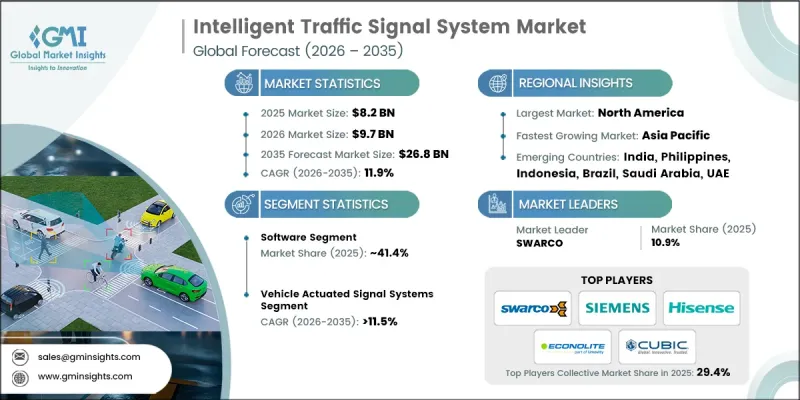
세계의 지능형 교통 신호 시스템 시장은 2025년에 82억 달러로 평가되었으며, CAGR 11.9%로 성장하여 2035년까지 268억 달러에 달할 것으로 추정됩니다.
도시의 모빌리티 네트워크가 기존의 시간제 신호등에서 완전 연결, AI 활용, 데이터 기반 교통 조정 플랫폼으로 진화함에 따라 시장도 재편되고 있습니다. 미리 설정된 타이밍이나 수동 조정에 의존하는 기존의 고정 주기 신호등은 실시간 교통 상황에 따라 반응하는 센서가 장착된 적응형 시스템으로 대체되고 있습니다. 지능형 교통 신호 시스템은 교통 흐름 최적화, 교통 체증 완화, 배기가스 배출량 감소, 보행자 안전 향상 및 여러 교통 수단의 통합을 담당하여 점점 더 필수적인 인프라가 되고 있습니다. 스마트 시티 구상, 도시화 및 디지털 인프라에 대한 정부의 투자로 인해 그 도입이 가속화되고 있습니다. 최신 ITSS 플랫폼은 클라우드 기반 분석, 예측 모델링 및 AI를 활용하여 원활한 교통 관리를 실현하고, 지자체가 증가하는 도시 인구와 차량 밀도에 대응하는 동시에 지속가능성, 효율성 및 교통 안전 목표를 달성할 수 있도록 지원합니다.
| 시장 범위 | |
|---|---|
| 시작 연도 | 2025년 |
| 예측 기간 | 2026-2035년 |
| 시작 시점 시장 규모 | 82억 달러 |
| 예측 규모 | 268억 달러 |
| CAGR | 11.9% |
기존의 전기 기계식 제어 장치와 달리 최신 ITSS는 통합된 디지털 생태계의 일부로 차량 감지 센서, 레이더 장치, 카메라, 유도 루프, GPS 데이터, 클라우드 컴퓨팅 등의 기술을 활용하여 교통 상황을 실시간으로 모니터링합니다. 적응형 알고리즘과 예측 분석을 통해 신호 타이밍을 동적으로 조정하여 공회전 시간 단축, 정지 후 이동 교통량 최소화, 도로 회랑 간 동기화 등을 가능하게 합니다. 이러한 시스템은 도시가 교통 효율성 향상, 연료 소비 감소, 통근자 안전 향상을 실현할 수 있도록 지원하며, 동시에 멀티모달 교통 통합 및 스마트 시티의 목표를 달성할 수 있도록 돕습니다.
소프트웨어 분야는 2025년 41.4%의 점유율을 차지했으며, 2035년까지 CAGR 11%로 성장할 것으로 전망됩니다. 소프트웨어 솔루션은 적응형 신호 제어, 실시간 교차로 조정, 예측 교통 분석을 가능하게 하기 때문에 현대 교통 관리에 필수적입니다. AI, 머신러닝, 클라우드 기반 분석은 의사결정을 강화하고, 도시가 하드웨어 중심의 시스템만 사용하는 것보다 훨씬 더 효율적으로 교통체증 관리, 사고 대응, 보행자 동선 최적화를 할 수 있게 해줍니다.
차량 감지형 신호 시스템 부문은 2025년 40.1%의 점유율을 차지했으며, 2026년부터 2035년까지 연평균 11.5%의 성장률을 기록할 것으로 전망됩니다. 이 시스템은 센서, 루프 감지기, 카메라 또는 레이더 기술을 이용한 실시간 차량 감지를 기반으로 신호 타이밍을 동적으로 조정합니다. 이를 통해 대기 시간이 단축되고, 교통 처리 능력이 향상되며, 교차로 운영이 더욱 원활해져 도시 계획 담당자 및 교통 당국에 최적의 선택이 될 수 있습니다.
미국 지능형 교통 신호 시스템 시장은 83.6%의 점유율을 차지하며 2025년 24억 달러의 시장 규모를 기록했습니다. 시장 성장은 도시 교통 체증 증가, 자동차 보유량 증가, 스마트 시티 인프라를 지원하는 연방 정부의 노력에 의해 주도되고 있습니다. 교통기관과 지자체는 교통 흐름을 최적화하고, 지연을 줄이고, 안전성을 높이기 위해 AI를 활용한 적응형 신호등과 IoT 지원 센서를 도입하고 있습니다. 커넥티드카 기술과 대중교통 시스템과의 통합은 수요를 더욱 강화하는 한편, 클라우드 기반 교통 관리 및 예측 분석은 중앙 집중식 모니터링과 데이터 기반 의사결정을 촉진하고 있습니다.
자주 묻는 질문
목차
제1장 조사 방법
제2장 주요 요약
제3장 업계 인사이트
제4장 경쟁 구도
제5장 시장 추정 및 예측 : 기술별, 2022-2035
제6장 시장 추정 및 예측 : 구성요소별, 2022-2035
제7장 시장 추정 및 예측 : 용도별2022-2035
제8장 시장 추정 및 예측 : 최종 용도별, 2022-2035
제9장 시장 추정 및 예측 : 지역별, 2022-2035
제10장 기업 개요
KSM 26.05.06The Global Intelligent Traffic Signal System Market was valued at USD 8.2 billion in 2025 and is estimated to grow at a CAGR of 11.9% to reach USD 26.8 billion by 2035.
The market is reshaped as urban mobility networks evolve from traditional, time-based traffic lights to fully connected, AI-enabled, data-driven traffic orchestration platforms. Conventional fixed-cycle signals, which rely on preset timing and manual adjustments, are being replaced by adaptive, sensor-equipped systems that respond to real-time traffic conditions. Intelligent traffic signal systems are increasingly essential infrastructure, tasked with optimizing traffic flow, reducing congestion, lowering emissions, enhancing pedestrian safety, and integrating multiple transport modes. Adoption is being accelerated by smart city initiatives, urbanization, and government investments in digital infrastructure. Modern ITSS platforms leverage cloud-based analytics, predictive modeling, and AI to ensure seamless traffic management, enabling municipalities to meet sustainability, efficiency, and road safety objectives while accommodating growing urban populations and vehicle density.
| Market Scope | |
|---|---|
| Start Year | 2025 |
| Forecast Year | 2026-2035 |
| Start Value | $8.2 Billion |
| Forecast Value | $26.8 Billion |
| CAGR | 11.9% |
Unlike traditional electromechanical controllers, modern ITSS operate as part of integrated digital ecosystems, using technologies such as vehicle detection sensors, radar units, cameras, inductive loops, GPS data, and cloud computing to monitor traffic in real time. Adaptive algorithms and predictive analytics allow dynamic signal timing adjustments, reducing idle times, minimizing stop-and-go traffic, and improving synchronization across road corridors. These systems help cities achieve better traffic efficiency, lower fuel consumption, and improved commuter safety, while supporting multimodal transport integration and smart city objectives.
The software segment held a 41.4% share in 2025 and is expected to grow at a CAGR of 11% through 2035. Software solutions are critical to modern traffic management, enabling adaptive signal control, real-time intersection coordination, and predictive traffic analysis. AI, machine learning, and cloud-based analytics enhance decision-making, allowing cities to manage congestion, respond to accidents, and optimize pedestrian flow far more efficiently than hardware-focused systems alone.
The vehicle actuated signal systems segment held a 40.1% share in 2025 and is anticipated to grow at a CAGR of 11.5% from 2026 to 2035. These systems adjust signal timings dynamically based on real-time vehicle detection using sensors, loop detectors, cameras, or radar technologies. This reduces waiting times, enhances traffic throughput, and ensures smoother intersection operations, making them a preferred choice for urban planners and traffic authorities.
U.S. Intelligent Traffic Signal System Market held an 83.6% share, generating USD 2.4 billion in 2025. Market growth is driven by rising urban congestion, increasing vehicle ownership, and federal initiatives supporting smart city infrastructure. Transit agencies and municipalities are deploying AI-powered adaptive signals and IoT-enabled sensors to optimize traffic flow, reduce delays, and enhance safety. Integration with connected vehicle technologies and public transit systems further strengthens demand, while cloud-based traffic management and predictive analytics facilitate centralized monitoring and data-driven decision-making.
Key players operating in the Global Intelligent Traffic Signal System Market include Siemens, Cubic, Econolite, Yunex Traffic, Sumitomo Electric Industries, Hisense TransTech, SWARCO, NoTraffic and Iteris. Companies in the Global Intelligent Traffic Signal System Market are strengthening their position by investing heavily in R&D to develop AI-driven adaptive algorithms, predictive traffic analytics, and cloud-based management platforms. They focus on expanding geographic presence through strategic partnerships with municipalities, technology integrators, and transit authorities. Many vendors differentiate by offering scalable and modular solutions compatible with existing infrastructure, reducing deployment costs and enhancing interoperability. Companies also leverage pilot programs, government contracts, and smart city collaborations to showcase system effectiveness. Investments in IoT, vehicle-to-infrastructure communication, and cybersecurity capabilities further solidify market foothold and create long-term competitive advantage.
Table of Contents
Chapter 1 Methodology
- 1.1 Research approach
- 1.2 Quality Commitments
- 1.2.1 GMI AI policy & data integrity commitment
- 1.2.1.1 Source consistency protocol
- 1.2.1 GMI AI policy & data integrity commitment
- 1.3 Research Trail & Confidence Scoring
- 1.3.1 Research Trail Components
- 1.3.2 Scoring Components
- 1.4 Data Collection
- 1.4.1 Partial list of primary sources
- 1.5 Data mining sources
- 1.5.1 Paid sources
- 1.5.1.1 Sources, by region
- 1.5.1 Paid sources
- 1.6 Base estimates and calculations
- 1.6.1 Base year calculation for any one approach
- 1.7 Forecast
- 1.7.1 Quantified market impact analysis
- 1.7.1.1 Mathematical impact of growth parameters on forecast
- 1.7.1 Quantified market impact analysis
- 1.8 Research transparency addendum
- 1.8.1 Source attribution framework
- 1.8.2 Quality assurance metrics
- 1.8.3 Our commitment to trust
Chapter 2 Executive Summary
- 2.1 Industry 360° synopsis, 2022 - 2035
- 2.2 Key market trends
- 2.2.1 Regional
- 2.2.2 Technology
- 2.2.3 Component
- 2.2.4 Application
- 2.2.5 End Use
- 2.3 TAM Analysis, 2026-2035
- 2.4 CXO perspectives: Strategic imperatives
Chapter 3 Industry Insights
- 3.1 Industry ecosystem analysis
- 3.1.1 Supplier landscape
- 3.1.2 Profit margin analysis
- 3.1.3 Cost structure
- 3.1.4 Value addition at each stage
- 3.1.5 Factor affecting the value chain
- 3.1.6 Disruptions
- 3.2 Industry impact forces
- 3.2.1 Growth drivers
- 3.2.1.1 Increasing urbanization and traffic congestion
- 3.2.1.2 Government initiatives and smart city projects
- 3.2.1.3 Technological advancements in traffic management
- 3.2.1.4 Integration with other transportation systems
- 3.2.2 Industry pitfalls and challenges
- 3.2.2.1 Integration challenges and complexity
- 3.2.2.2 Data privacy and security concerns
- 3.2.3 Market opportunities
- 3.2.3.1 Expansion in emerging markets
- 3.2.3.2 integration with smart mobility solutions
- 3.2.3.3 Adoption of AI and IoT Technologies
- 3.2.3.4 Public-private partnerships and infrastructure funding
- 3.2.1 Growth drivers
- 3.3 Growth potential analysis
- 3.4 Regulatory guidelines
- 3.4.1 North America
- 3.4.1.1 U.S.: Federal ITS Architecture & Smart City Challenge Programs
- 3.4.1.2 Canada: National ITS Strategy & C-ITS Pilot Projects
- 3.4.2 Europe
- 3.4.2.1 Germany: Cooperative ITS (C-ITS) Deployment & Mobility Data Standards
- 3.4.2.2 UK: Intelligent Transport Systems (ITS) Standards & Smart City Initiatives
- 3.4.2.3 France: Connected Mobility & Road Safety Regulations
- 3.4.2.4 Italy: National ITS Guidelines & Smart City Roadmap
- 3.4.3 Asia Pacific
- 3.4.3.1 China: C-V2X Deployment & Smart Traffic Management Standards
- 3.4.3.2 India: National Urban Transport Policy & Smart Cities Mission
- 3.4.3.3 Japan: ITS Promotion & Smart Mobility Standards
- 3.4.3.4 Australia: National ITS Architecture & Connected Vehicle Framework.
- 3.4.4 Latin America
- 3.4.4.1 Brazil: National Urban Mobility Plan & ITS Deployment Programs
- 3.4.4.2 Mexico: Intelligent Traffic Systems Standards & Pilot Projects
- 3.4.4.3 Argentina: Smart City & Traffic Optimization Policies
- 3.4.5 MEA
- 3.4.5.1 UAE: Smart City Program & ITS Framework
- 3.4.5.2 Saudi Arabia: Vision 2030 & Smart Traffic Initiatives
- 3.4.5.3 South Africa: National ITS Policy & Urban Mobility Strategy
- 3.4.1 North America
- 3.5 Porter's analysis
- 3.6 PESTEL analysis
- 3.7 Technology and Innovation landscape
- 3.7.1 Current technological trends
- 3.7.2 Emerging technologies
- 3.8 Pricing analysis (Driven by Primary Research)
- 3.8.1 Historical price trend analysis
- 3.8.2 Pricing strategy by player type (premium / value / cost-plus)
- 3.9 Patent analysis (Driven by Primary Research)
- 3.10 Cost breakdown analysis
- 3.11 Sustainability and environmental impact analysis
- 3.11.1 Sustainable practices
- 3.11.2 Waste reduction strategies
- 3.11.3 Energy efficiency in production
- 3.11.4 Eco-friendly initiatives
- 3.11.5 Carbon footprint considerations
- 3.12 Future outlook & opportunities
- 3.13 Impact of AI & Generative AI on the Market
- 3.13.1 AI-Driven Disruption of Existing Business Models
- 3.13.2 GenAI Use Cases & Adoption Roadmap by Segment
- 3.13.3 Risks, Limitations & Regulatory Considerations
- 3.14 Infrastructure & Deployment Landscape (Driven by Primary Research)
- 3.14.1 Deployment Penetration by Region & Buyer Segment (Driven by Primary Research)
- 3.14.2 Scalability Constraints & Infrastructure Investment Trends (Driven by Primary Research)
- 3.15 Forecast assumptions & scenario analysis (Driven by Primary Research)
- 3.15.1 Base Case - key macro & industry variables driving CAGR
- 3.15.2 Optimistic Scenarios - Favorable Macro and Industry Tailwinds
- 3.15.3 Pessimistic Scenario - Macroeconomic slowdown or industry headwinds
Chapter 4 Competitive Landscape, 2025
- 4.1 Introduction
- 4.2 Company market share analysis
- 4.2.1 North America
- 4.2.2 Europe
- 4.2.3 Asia Pacific
- 4.2.4 Latin America
- 4.2.5 MEA
- 4.3 Competitive analysis of major market players
- 4.4 Competitive positioning matrix
- 4.5 Key developments
- 4.5.1 Mergers & acquisitions
- 4.5.2 Partnerships & collaborations
- 4.5.3 New Product Launches
- 4.5.4 Expansion Plans and funding
- 4.6 Company Tier Benchmarking
- 4.6.1 Tier Classification Criteria & Qualifying Thresholds
- 4.6.2 Tier Positioning Matrix by Revenue, Geography & Innovation
Chapter 5 Market Estimates & Forecast, By Technology, 2022 - 2035 ($Bn)
- 5.1 Key trends
- 5.2 Fixed time signal systems
- 5.3 Vehicle actuated signal systems
- 5.4 Adaptive signal control systems
- 5.5 Artificial intelligence-based signal systems
- 5.6 Connected vehicle-based signal systems
Chapter 6 Market Estimates & Forecast, By Component, 2022 - 2035 ($Bn, Units)
- 6.1 Key trends
- 6.2 Hardware
- 6.2.1 Traffic signal controllers
- 6.2.2 Sensors
- 6.2.3 Communication devices
- 6.2.4 Power supply systems
- 6.3 Software
- 6.3.1 Traffic management software
- 6.3.2 Analytics platforms
- 6.3.3 Cloud-based solutions
- 6.4 Services
- 6.4.1 Installation
- 6.4.2 Maintenance
- 6.4.3 Consulting
- 6.4.4 Integration services
Chapter 7 Market Estimates & Forecast, By Application 2022 - 2035 ($Bn)
- 7.1 Key trends
- 7.2 Urban traffic management
- 7.3 Highway traffic management
- 7.4 Smart city initiatives
- 7.5 Public transportation management
- 7.6 Emergency vehicle management
Chapter 8 Market Estimates & Forecast, By End Use, 2022 - 2035 ($Bn)
- 8.1 Key trends
- 8.2 Government transportation departments
- 8.3 Municipal corporations
- 8.4 Highway authorities
- 8.5 Public transit agencies
- 8.6 Smart city developers
- 8.7 Private infrastructure companies
Chapter 9 Market Estimates & Forecast, By Region, 2022 - 2035 ($Bn)
- 9.1 Key trends
- 9.2 North America
- 9.2.1 US
- 9.2.2 Canada
- 9.3 Europe
- 9.3.1 Germany
- 9.3.2 UK
- 9.3.3 France
- 9.3.4 Italy
- 9.3.5 Spain
- 9.3.6 Russia
- 9.3.7 Netherlands
- 9.3.8 Belgium
- 9.4 Asia Pacific
- 9.4.1 China
- 9.4.2 India
- 9.4.3 Japan
- 9.4.4 Australia
- 9.4.5 South Korea
- 9.4.6 Philippines
- 9.4.7 Indonesia
- 9.5 Latin America
- 9.5.1 Brazil
- 9.5.2 Mexico
- 9.5.3 Argentina
- 9.6 MEA
- 9.6.1 South Africa
- 9.6.2 Saudi Arabia
- 9.6.3 UAE
Chapter 10 Company Profiles
- 10.1 Global Players
- 10.1.1 Cubic
- 10.1.2 Econolite
- 10.1.3 Hisense TransTech
- 10.1.4 Iteris
- 10.1.5 Kapsch TrafficCom
- 10.1.6 Q-Free
- 10.1.7 Siemens
- 10.1.8 Sumitomo Electric Industries
- 10.1.9 SWARCO
- 10.1.10 Yunex Traffic
- 10.2 Regional Players
- 10.2.1 Aldridge Traffic Controllers
- 10.2.2 Dahua Technology
- 10.2.3 EFKON
- 10.2.4 Hikvision Traffic Solutions
- 10.2.5 Intelight
- 10.2.6 Kyosan Electric Manufacturing
- 10.2.7 PTV
- 10.2.8 SICE
- 10.3 Emerging Players
- 10.3.1 Applied Information
- 10.3.2 LYT
- 10.3.3 Miovision
- 10.3.4 NoTraffic
- 10.3.5 Rapid Flow Technologies (Surtrac)


