|
시장보고서
상품코드
2019120
지상 지원 장비 시장 기회, 성장 촉진요인, 업계 동향 분석 및 예측(2026-2035년)Ground Support Equipment Market Opportunity, Growth Drivers, Industry Trend Analysis, and Forecast 2026 - 2035 |
||||||

세계의 지상 지원 장비 시장은 2025년에 67억 달러로 평가되었으며, CAGR 5.9%로 성장하여 2035년까지 118억 달러에 달할 것으로 추정됩니다.
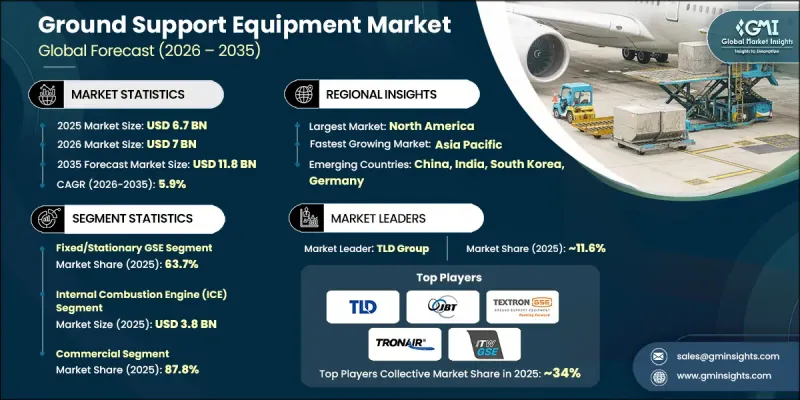
지상 지원 장비 시장은 전 세계 민간 항공기의 증가와 공항의 턴어라운드 효율성 향상에 대한 요구가 증가함에 따라 꾸준히 성장하고 있습니다. 항공사와 공항 운영사들은 운영 성능을 향상시키면서 지상 체류 시간을 단축하는 데 중점을 두고 있으며, 이는 첨단적이고 신뢰할 수 있는 장비에 대한 수요를 가속화하고 있습니다. 또한, 공항 인프라 개발 및 현대화를 위한 지속적인 투자도 시장 성장을 더욱 촉진하고 있습니다. 또한, 저가 항공사의 부상과 비용 최적화에 초점을 맞춘 저비용 항공사가 공항 전체에 표준화된 기술 주도형 솔루션 도입을 촉진하고 있습니다. 운항 가시성과 효율성을 높이는 첨단 시스템 통합은 지상 처리 프로세스의 진화에 기여하고 있으며, 이는 세계 항공 생태계 전반의 장기적인 성장 전망을 더욱 견고하게 하고 있습니다.
| 시장 범위 | |
|---|---|
| 시작 연도 | 2025년 |
| 예측 기간 | 2026-2035년 |
| 시작 시점 시장 규모 | 67억 달러 |
| 예측 규모 | 118억 달러 |
| CAGR | 5.9% |
지상 지원 장비 시장은 전 세계 항공기 보유 대수의 지속적인 확대와 에어사이드 업무 개선을 위한 공항 개보수에 대한 투자 증가로 인해 더욱 탄력을 받고 있습니다. 커넥티드 장비 및 디지털 장비 도입 확대는 유지보수 및 이용 관행을 변화시키고 있습니다. 실시간 모니터링 기능, 예지보전 및 개선된 장비 관리 기능을 통해 운영자는 다운타임을 줄이고 효율성을 높일 수 있습니다. 디지털 공항 생태계로의 전환이 진행됨에 따라 향후 몇 년 동안 첨단 지상 지원 기술의 채택이 촉진될 것으로 예상됩니다.
2025년에는 고정형 또는 고정형 지상 지원 장비 부문이 시장 점유율의 63.7%를 차지했습니다. 이는 교통량이 많은 공항 운영에서 이 부문이 수행하는 필수적인 역할에 힘입은 것입니다. 이러한 시스템은 공항 인프라에 통합되어 운영 효율성 향상, 배기가스 배출량 감소 및 항공기 정비 프로세스의 신뢰성 향상에 기여하고 있습니다.
전기 지상 지원 장비 부문은 2026년부터 2035년까지 CAGR 6.3%로 성장할 것으로 예상됩니다. 지속가능성과 배출량 감소에 대한 관심이 높아지면서 공항과 항공사는 전기 대체 장비의 도입을 촉진하고 있습니다. 이러한 솔루션은 운영 비용 절감, 소음 감소, 환경적 성능 향상을 가져다주며, 배터리 기술의 발전이 광범위한 도입을 뒷받침하고 있습니다.
북미 지상 지원 장비 시장은 항공 승객 수 증가, 공항 확장 프로젝트, 전기 에어사이드 차량 도입 확대에 힘입어 2025년 41.1%의 점유율을 차지했습니다. 이 지역에서는 지속가능한 인프라와 첨단 기술에 대한 지속적인 투자를 통해 보다 효율적이고 친환경적인 지상 업무로의 전환을 지원하고 있습니다. 현재 진행 중인 현대화 이니셔티브와 자동화 도입 확대는 이 지역 전체 시장 성장을 더욱 촉진하고 있습니다.
자주 묻는 질문
목차
제1장 조사 방법과 범위
제2장 주요 요약
제3장 업계 인사이트
제4장 경쟁 구도
제5장 시장 추정 및 예측 : 유형별, 2022-2035
제6장 시장 추정 및 예측 : 전원별, 2022-2035
제7장 시장 추정 및 예측 : 장비 종류별, 2022-2035
제8장 시장 추정 및 예측 : 자동화 레벨별, 2022-2035
제9장 시장 추정 및 예측 : 용도별, 2022-2035
제10장 시장 추정 및 예측 : 소유 형태별, 2022-2035
제11장 시장 추정 및 예측 : 지역별, 2022-2035
제12장 기업 개요
KSM 26.05.06The Global Ground Support Equipment Market was valued at USD 6.7 billion in 2025 and is estimated to grow at a CAGR of 5.9% to reach USD 11.8 billion by 2035.
The ground support equipment market is witnessing consistent expansion, driven by the increasing number of commercial aircraft worldwide and the growing need to improve airport turnaround efficiency. Airlines and airport operators are placing greater emphasis on reducing ground time while enhancing operational performance, which is accelerating demand for advanced and reliable equipment. Ongoing investments in airport infrastructure development and modernization are further supporting market growth. In addition, the rising presence of low-cost carriers and their focus on cost optimization is encouraging the use of standardized and technology-driven solutions across airports. The integration of advanced systems that enhance operational visibility and efficiency is also contributing to the evolution of ground handling processes, strengthening long-term growth prospects across the global aviation ecosystem.
| Market Scope | |
|---|---|
| Start Year | 2025 |
| Forecast Year | 2026-2035 |
| Start Value | $6.7 Billion |
| Forecast Value | $11.8 Billion |
| CAGR | 5.9% |
The ground support equipment market is further supported by the continuous expansion of the global aircraft fleet and increasing investments in airport upgrades aimed at improving airside operations. Growing adoption of connected and digitally enabled equipment is transforming maintenance and utilization practices. Real-time monitoring capabilities, predictive maintenance, and improved fleet management are enabling operators to reduce downtime and enhance efficiency. The increasing shift toward digital airport ecosystems is expected to drive the adoption of advanced ground support technologies over the coming years.
The fixed or stationary ground support equipment segment accounted for 63.7% share in 2025, supported by its essential role in high-traffic airport operations. These systems are integrated into airport infrastructure and contribute to improved operational efficiency, reduced emissions, and enhanced reliability in aircraft servicing processes.
The electric ground support equipment segment is anticipated to grow at a CAGR of 6.3% during 2026 to 2035. Rising focus on sustainability and emission reduction is encouraging airports and airlines to adopt electric alternatives. These solutions offer lower operating costs, reduced noise levels, and improved environmental performance, while advancements in battery technologies are supporting their widespread deployment.
North America Ground Support Equipment Market held a 41.1% share in 2025, driven by increasing air passenger traffic, airport expansion projects, and growing adoption of electric airside vehicles. The region continues to invest in sustainable infrastructure and advanced technologies, supporting the transition toward more efficient and environmentally friendly ground operations. Ongoing modernization initiatives and increasing adoption of automation are further strengthening market growth across the region.
Key players operating in the Global Ground Support Equipment Market include JBT Corporation, Rheinmetall AG, Textron Ground Support Equipment Inc., TLD Group, ITW GSE, Cobus Industries, Charlatte Manutention, Tronair Inc., Weihai Guangtai Airport Equipment, AERO Specialties, Air+MAK Industries Inc., ATEC Inc., Eagle Tugs, Unitron, LP, and Sinfonia Technology Co. Ltd. Companies in the Global Ground Support Equipment Market are adopting strategic initiatives to strengthen their competitive position and expand their global footprint. Investments in research and development are enabling the introduction of advanced, energy-efficient, and digitally connected equipment. Market participants are focusing on electrification and sustainable product development to align with environmental regulations and industry goals. Strategic partnerships, mergers, and acquisitions are being pursued to enhance technological capabilities and broaden market reach. Additionally, companies are expanding their distribution networks and service offerings to improve customer engagement. Continuous innovation, along with a focus on automation and smart technologies, is helping companies maintain a strong presence and drive long-term growth in the ground support equipment industry.
Table of Contents
Chapter 1 Methodology and Scope
- 1.1 Market scope and definition
- 1.2 Research design
- 1.2.1 Research approach
- 1.2.2 Data collection methods
- 1.3 Data mining sources
- 1.3.1 Global
- 1.3.2 Regional/Country
- 1.4 Base estimates and calculations
- 1.4.1 Base year calculation
- 1.4.2 Key trends for market estimation
- 1.5 Primary research and validation
- 1.5.1 Primary sources
- 1.6 Forecast model
- 1.7 Research assumptions and limitations
Chapter 2 Executive Summary
- 2.1 Industry 360° synopsis, 2022 - 2035
- 2.2 Key market trends
- 2.2.1 Type trends
- 2.2.2 Power source trends
- 2.2.3 Equipment type trends
- 2.2.4 Automation level trends
- 2.2.5 Application trends
- 2.2.6 Ownership trends
- 2.2.7 Regional trends
- 2.3 TAM Analysis, 2026-2035
- 2.4 CXO perspectives: Strategic imperatives
- 2.4.1 Executive decision points
- 2.4.2 critical success factors
- 2.5 Future outlook and strategic recommendations
Chapter 3 Industry Insights
- 3.1 Industry ecosystem analysis
- 3.1.1 Supplier Landscape
- 3.1.2 Profit Margin
- 3.1.3 Cost structure
- 3.1.4 Value addition at each stage
- 3.1.5 Factor affecting the value chain
- 3.1.6 Disruptions
- 3.2 Industry impact forces
- 3.2.1 Growth drivers
- 3.2.1.1 Global commercial aircraft fleet expansion
- 3.2.1.2 Stringent airport turnaround time requirements
- 3.2.1.3 Rising airport infrastructure modernization projects
- 3.2.1.4 Growth in low-cost carrier operations
- 3.2.1.5 Airline focus on operational efficiency
- 3.2.2 Industry pitfalls and challenges
- 3.2.2.1 Complex regulatory compliance across regions
- 3.2.2.2 Limited charging infrastructure at regional airports
- 3.2.3 Market opportunities
- 3.2.3.1 Smart GSE integration with airport automation systems
- 3.2.3.2 Aftermarket services and fleet retrofitting demand
- 3.2.1 Growth drivers
- 3.3 Growth potential analysis
- 3.4 Regulatory landscape
- 3.4.1 North America
- 3.4.2 Europe
- 3.4.3 Asia Pacific
- 3.4.4 Latin America
- 3.4.5 Middle East & Africa
- 3.5 Porter's analysis
- 3.6 PESTEL analysis
- 3.7 Technology and Innovation landscape
- 3.7.1 Current technological trends
- 3.7.2 Emerging technologies
- 3.8 Price trends
- 3.8.1 By region
- 3.8.2 By product
- 3.9 Pricing Strategies
- 3.10 Emerging Business Models
- 3.11 Compliance Requirements
- 3.12 Patent and IP analysis
- 3.13 Geopolitical and trade dynamics
Chapter 4 Competitive Landscape, 2025
- 4.1 Introduction
- 4.2 Company market share analysis
- 4.2.1 By region
- 4.2.1.1 North America
- 4.2.1.2 Europe
- 4.2.1.3 Asia Pacific
- 4.2.1.4 Latin America
- 4.2.1.5 Middle East & Africa
- 4.2.2 Market concentration analysis
- 4.2.1 By region
- 4.3 Competitive benchmarking of key players
- 4.3.1 Financial performance comparison
- 4.3.1.1 Revenue
- 4.3.1.2 Profit margin
- 4.3.1.3 R&D
- 4.3.2 Product portfolio comparison
- 4.3.2.1 Product range breadth
- 4.3.2.2 Technology
- 4.3.2.3 Innovation
- 4.3.3 Geographic presence comparison
- 4.3.3.1 Global footprint analysis
- 4.3.3.2 Service network coverage
- 4.3.3.3 Market penetration by region
- 4.3.4 Competitive positioning matrix
- 4.3.4.1 Leaders
- 4.3.4.2 Challengers
- 4.3.4.3 Followers
- 4.3.4.4 Niche players
- 4.3.5 Strategic outlook matrix
- 4.3.1 Financial performance comparison
- 4.4 Key developments
- 4.4.1 Mergers and acquisitions
- 4.4.2 Partnerships and collaborations
- 4.4.3 Technological advancements
- 4.4.4 Expansion and investment strategies
- 4.4.5 Digital transformation initiatives
- 4.5 Emerging/ startup competitors landscape
Chapter 5 Market Estimates and Forecast, By Type, 2022 - 2035 (USD Million)
- 5.1 Key trends
- 5.2 Mobile GSE
- 5.2.1 Self-propelled equipment
- 5.2.2 Towable equipment
- 5.3 Fixed/stationary GSE
- 5.3.1 Passenger boarding bridges
- 5.3.2 Fixed ground power units
- 5.3.3 Fixed pre-conditioned air systems
Chapter 6 Market Estimates and Forecast, By Power Source, 2022 - 2035 (USD Million)
- 6.1 Key trends
- 6.2 Electric
- 6.2.1 Battery-electric systems (lithium-ion)
- 6.2.2 Battery-electric systems (lead-acid)
- 6.2.3 Grid-powered systems
- 6.3 Internal combustion engine (ICE)
- 6.4 Hybrid
Chapter 7 Market Estimates and Forecast, By Equipment Type, 2022 - 2035 (USD Million)
- 7.1 Key trends
- 7.2 Aircraft movement & positioning equipment
- 7.2.1 Pushback tractors
- 7.2.2 Luggage tugs
- 7.2.3 Chocks & wheel restraints
- 7.2.4 Others
- 7.3 Cargo & baggage handling equipment
- 7.3.1 Belt loaders
- 7.3.2 Container & pallet loaders
- 7.3.3 Cargo dollies & baggage carts
- 7.3.4 Conveyor systems
- 7.3.5 Others
- 7.4 Passenger handling equipment
- 7.4.1 Passenger boarding bridges (PBBs)
- 7.4.2 Passenger stairs
- 7.4.3 Apron buses
- 7.4.4 Others
- 7.5 Aircraft servicing equipment
- 7.5.1 Ground power units (GPUs)
- 7.5.2 Pre-conditioned air units (PCAs/ACUs)
- 7.5.3 Fuel trucks & refueling systems
- 7.5.4 Others
- 7.6 Aircraft safety & maintenance equipment
- 7.6.1 Air start units (ASUs)
- 7.6.2 Deicing & anti-icing equipment
- 7.6.3 Maintenance stands & platforms
- 7.6.4 Others
- 7.7 Others
Chapter 8 Market Estimates and Forecast, By Automation Level, 2022 - 2035 (USD Million)
- 8.1 Key trends
- 8.2 Conventional/manual-operated GSE
- 8.3 Semi-automated GSE (Telematics & IoT-Enabled)
- 8.4 Autonomous GSE (AGVS)
- 8.4.1 Autonomous tugs & tractors
- 8.4.2 Autonomous baggage vehicles
- 8.4.3 Autonomous maintenance equipment
Chapter 9 Market Estimates and Forecast, By Application, 2022 - 2035 (USD Million)
- 9.1 Key trends
- 9.2 Commercial aviation
- 9.2.1 Passenger airlines
- 9.2.2 Cargo airlines
- 9.2.3 Business aviation
- 9.3 Military & defense aviation
Chapter 10 Market Estimates and Forecast, By Ownership, 2022 - 2035 (USD Million)
- 10.1 Key trends
- 10.2 Airport-owned GSE
- 10.3 Airline-owned GSE
- 10.4 Ground handling service provider-owned GSE
- 10.5 Leased GSE
Chapter 11 Market Estimates and Forecast, By Region, 2022 - 2035 (USD Million)
- 11.1 Key trends
- 11.2 North America
- 11.2.1 U.S.
- 11.2.2 Canada
- 11.3 Europe
- 11.3.1 Germany
- 11.3.2 UK
- 11.3.3 France
- 11.3.4 Spain
- 11.3.5 Italy
- 11.3.6 Netherlands
- 11.4 Asia Pacific
- 11.4.1 China
- 11.4.2 India
- 11.4.3 Japan
- 11.4.4 Australia
- 11.4.5 South Korea
- 11.5 Latin America
- 11.5.1 Brazil
- 11.5.2 Mexico
- 11.5.3 Argentina
- 11.6 Middle East and Africa
- 11.6.1 South Africa
- 11.6.2 Saudi Arabia
- 11.6.3 UAE
Chapter 12 Company Profiles
- 12.1 Global Key Players
- 12.1.1 TLD Group
- 12.1.2 JBT Corporation
- 12.1.3 Textron Ground Support Equipment Inc.
- 12.1.4 Weihai Guangtai Airport Equipment
- 12.1.5 ITW GSE
- 12.2 Regional key players
- 12.2.1 North America
- 12.2.1.1 AERO Specialties
- 12.2.1.2 Tronair Inc.
- 12.2.1.3 Eagle Tugs
- 12.2.1.4 Unitron, LP
- 12.2.2 Asia Pacific
- 12.2.2.1 Sinfonia Technology Co. Ltd.
- 12.2.2.2 Japanese GSE manufacturers
- 12.2.2.3 Air+MAK Industries Inc.
- 12.2.3 Europe
- 12.2.3.1 Charlatte Manutention
- 12.2.3.2 Cobus Industries
- 12.2.3.3 Rheinmetall AG
- 12.2.1 North America
- 12.3 Niche Players/Disruptors
- 12.3.1 ATEC Inc.