

|
시장보고서
상품코드
2019136
아몬드 추출물 시장 기회, 성장요인, 업계 동향 분석 및 예측(2026-2035년)Almond Extract Market Opportunity, Growth Drivers, Industry Trend Analysis, and Forecast 2026 - 2035 |
||||||

세계의 아몬드 추출물 시장은 2025년에 14억 1,000만 달러로 평가되고 CAGR 4.9%로 성장하며, 2035년까지 21억 4,000만 달러에 달할 것으로 추정되고 있습니다.
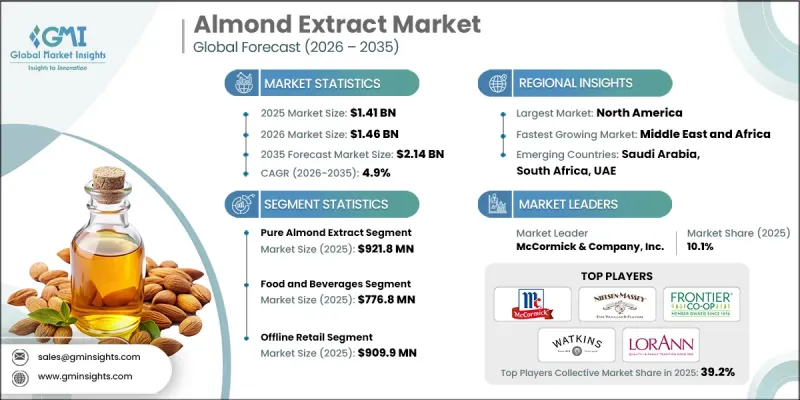
아몬드 추출물은 아몬드 특유의 맛과 향을 재현하기 위해 추출한 농축 향료 용액으로, 다양한 용도로 널리 활용되는 원료입니다. 소량으로도 강력하고 일관된 풍미를 제공할 수 있다는 점에서 높은 평가를 받고 있으며, 가정용부터 대규모 생산 수요까지 폭넓게 대응하고 있습니다. 시장에는 천연 및 합성 제품이 모두 존재하며, 제조업체는 비용, 원자재 가용성, 제품 요구 사항에 따라 선택할 수 있습니다. 천연 유형은 아몬드 유래 성분에 의존하는 반면, 합성 유형은 균일성과 장기 보관 안정성을 보장합니다. 추출 및 배합 기술의 지속적인 발전으로 제품의 전반적인 품질과 효율성이 향상되었습니다. 인캡슐레이션 기술의 고도화, 추출 공정의 개선, 첨단 품질관리 시스템 등의 혁신이 향미 유지력 향상과 보존 기간 연장에 기여하고 있습니다. 동시에 최신 생산 설비를 통해 재료의 낭비를 줄이면서 생산량을 늘릴 수 있으며, 비용 효율성이 향상되고, 모든 응용 분야에서 일관된 제품 성능을 지원합니다. 가공 방법의 기술적 진보로 인해 아몬드 추출물 생산의 확장성과 신뢰성이 향상되었습니다. 이러한 발전으로 제조업체는 배합 및 가공의 각 단계에서 생산 효율을 최적화하고, 자원 손실을 최소화하면서 맛의 일관성을 엄격하게 관리할 수 있게 되었습니다.
| 시장 규모 | |
|---|---|
| 시작연도 | 2025 |
| 예측 기간 | 2026-2035년 |
| 개시 금액 | 14억 1,000만 달러 |
| 예측액 | 21억 4,000만 달러 |
| CAGR | 4.9% |
2025년 식품 및 음료 부문은 7억 7,680만 달러를 차지했습니다. 이러한 장점은 맛 개발에 아몬드 추출물을 광범위하게 사용하여 다양한 제조 공정에서 일관성과 안정성을 보장하는 데 기인합니다. 이 배합은 다양한 가공 조건에서도 관능적 특성을 유지할 수 있으므로 대규모 제조 제품과 소매용 제품 모두에 채택이 촉진되고 있습니다. 또한 아몬드 추출물은 퍼스널 케어 제품의 향기 프로파일을 향상시키기 위해 퍼스널 케어 제품 배합에 사용되어 다양한 소비재의 관능적 매력을 향상시키는 데 기여하고 있습니다.
실점포 소매 부문은 2025년에 9억 990만 달러에 달했습니다.실물 매장은 편리함과 제품을 직접 평가할 수 있다는 점에서 꾸준히 견고한 실적을 유지하고 있습니다. 한편, 디지털 소매 플랫폼은 소비자들이 제품의 사양, 성분, 가격을 보다 효율적으로 비교할 수 있게 함으로써 소비자의 정보에 입각한 구매 결정을 돕고 있습니다. 이미 구축된 소매 네트워크가 지속적으로 존재함으로써 제품의 안정적 공급을 보장하는 동시에 자주 사용하는 식재료의 충동구매를 촉진하고 있습니다.
북미 아몬드 추출물 시장은 꾸준한 지역적 확장을 반영하여 2025년 4억 2,920만 달러에서 2035년까지 6억 6,880만 달러로 성장할 것으로 예측됩니다. 이 지역의 수요는 일관된 소비 패턴, 확립된 식품 가공 산업, 탄탄한 유통 채널에 의해 지원되고 있습니다. 미국은 여전히 주요 기여국이며, 아몬드 추출물은 가정과 상업용 모두에서 널리 사용되고 있습니다. 식품 조리 및 대규모 생산에 있으며, 그 역할은 지역 전체에서 지속적인 수요를 지원하고 있습니다.
자주 묻는 질문
목차
제1장 조사 방법과 범위
제2장 개요
제3장 업계 인사이트
제4장 경쟁 구도
제5장 시장 추산·예측 : 유형별, 2022-2035년
제6장 시장 추산·예측 : 용도별, 2022-2035년
제7장 시장 추산·예측 : 유통 채널별, 2022-2035년
제8장 시장 추산·예측 : 지역별, 2022-2035년
제9장 기업 개요
KSA 26.05.13The Global Almond Extract Market was valued at USD 1.41 billion in 2025 and is estimated to grow at a CAGR of 4.9% to reach USD 2.14 billion by 2035.
Almond extract is a concentrated flavoring solution derived to replicate the characteristic taste and aroma of almonds, making it a widely utilized ingredient across multiple applications. It is valued for its ability to deliver a strong and consistent flavor profile even in small quantities, supporting both household and large-scale production needs. The market includes both natural and synthetic variants, allowing manufacturers to select options based on cost considerations, raw material availability, and product requirements. Natural versions rely on almond-derived components, while synthetic alternatives ensure uniformity and extended shelf stability. Continuous advancements in extraction and formulation technologies are improving overall product quality and efficiency. Innovations such as enhanced encapsulation techniques, improved extraction processes, and advanced quality control systems are contributing to better flavor retention and longer shelf life. At the same time, modern production equipment enables higher output with reduced material waste, supporting cost efficiency and consistent product performance across applications. Technological improvements in processing methods are enhancing the scalability and reliability of almond extract manufacturing. These developments allow producers to maintain precise control over flavor consistency while optimizing production efficiency and minimizing resource loss during various stages of formulation and processing.
| Market Scope | |
|---|---|
| Start Year | 2025 |
| Forecast Year | 2026-2035 |
| Start Value | $1.41 Billion |
| Forecast Value | $2.14 Billion |
| CAGR | 4.9% |
The food & beverages segment accounted for USD 776.8 million in 2025. This dominance is driven by the widespread use of almond extract in flavor development, where it ensures consistency and stability across different production processes. Its formulation allows it to retain its sensory properties under varying processing conditions, supporting its integration into both large-scale manufacturing and retail-oriented products. In addition, almond extract is utilized in personal care formulations to enhance fragrance profiles, contributing to improved sensory appeal in various consumer products.
The offline retail segment reached USD 909.9 million in 2025. Physical retail formats continue to maintain strong performance due to their accessibility and ability to provide direct product evaluation. At the same time, digital retail platforms are gaining traction by enabling consumers to compare product specifications, ingredients, and pricing more efficiently, supporting informed purchasing decisions. The continued presence of established retail networks ensures steady product availability while also encouraging impulse purchases of frequently used ingredients.
North America Almond Extract Market is projected to grow from USD 429.2 million in 2025 to USD 668.8 million by 2035, reflecting steady regional expansion. Demand in this region is supported by consistent consumption patterns, established food processing industries, and strong distribution channels. The United States remains a key contributor, with widespread use of almond extract across both household and commercial applications. Its role in food preparation and large-scale production continues to support sustained demand across the region.
Key companies operating in the Global Almond Extract Market include McCormick & Company, Inc., Nielsen-Massey Vanillas, Inc., Frontier Co-op, LorAnn Oils, The Watkins Co, Rodelle Inc, Cooks Vanilla, Queen Fine Foods, Royal Nut Company, and Queen Fine Foods. Companies in the almond extract market are enhancing their competitive position through product innovation, supply chain optimization, and brand expansion strategies. They are investing in advanced extraction technologies and formulation improvements to ensure consistent flavor quality and longer shelf life. Strategic partnerships with distributors and retailers are helping expand market reach and improve product accessibility. Manufacturers are also focusing on scaling production capabilities to meet rising demand while maintaining cost efficiency. In addition, companies are strengthening their presence in both offline and digital retail channels, while emphasizing product differentiation and quality assurance to attract a broader consumer base and reinforce long-term market positioning.
Table of Contents
Chapter 1 Methodology & Scope
- 1.1 Market scope and definition
- 1.2 Research design
- 1.2.1 Research approach
- 1.2.2 Data collection methods
- 1.3 Data mining sources
- 1.3.1 Global
- 1.3.2 Regional/Country
- 1.4 Base estimates and calculations
- 1.4.1 Base year calculation
- 1.4.2 Key trends for market estimation
- 1.5 Primary research and validation
- 1.5.1 Primary sources
- 1.6 Forecast model
- 1.7 Research assumptions and limitations
Chapter 2 Executive Summary
- 2.1 Industry 360° synopsis
- 2.2 Key market trends
- 2.2.1 Type
- 2.2.2 Application
- 2.2.3 Distribution Channel
- 2.2.4 Regional
- 2.3 TAM Analysis, 2026-2035
- 2.4 CXO perspectives: Strategic imperatives
- 2.5 Future outlook and strategic recommendations
Chapter 3 Industry Insights
- 3.1 Industry ecosystem analysis
- 3.1.1 Supplier landscape
- 3.1.2 Profit margin
- 3.1.3 Value addition at each stage
- 3.1.4 Factor affecting the value chain
- 3.1.5 Disruptions
- 3.2 Industry impact forces
- 3.2.1 Growth drivers
- 3.2.1.1 Rising demand for flavored bakery and confectionery products
- 3.2.1.2 Increased home baking activities supporting extract consumption levels
- 3.2.1.3 Expanded use in dairy beverages and processed foods
- 3.2.2 Pitfalls/challenge
- 3.2.2.1 Volatile almond supply affecting raw material cost stability
- 3.2.2.2 Allergen labeling regulations increasing compliance and formulation complexity
- 3.2.3 Opportunities
- 3.2.3.1 Demand for natural clean label flavor ingredients increasing
- 3.2.3.2 Innovation in extraction technology improving consistency shelf life
- 3.2.1 Growth drivers
- 3.3 Growth potential analysis
- 3.4 Regulatory landscape
- 3.4.1 North America
- 3.4.2 Europe
- 3.4.3 Asia Pacific
- 3.4.4 Latin America
- 3.4.5 Middle East & Africa
- 3.5 Porter's analysis
- 3.6 PESTEL analysis
- 3.7 Technology and innovation landscape
- 3.7.1 Current technological trends
- 3.7.2 Emerging technologies
- 3.8 Price trends
- 3.8.1 By region
- 3.8.2 By type
- 3.9 Future market trends
- 3.10 Technology and innovation landscape
- 3.10.1 Current technological trends
- 3.10.2 Emerging technologies
- 3.11 Patent landscape
- 3.12 Trade statistics (HS code)
- 3.12.1 Major importing countries
- 3.12.2 Major exporting countries
- 3.13 Sustainability and environmental aspects
- 3.13.1 Sustainable practices
- 3.13.2 Waste reduction strategies
- 3.13.3 Energy efficiency in production
- 3.13.4 Eco-friendly initiatives
- 3.14 Carbon footprint consideration
Chapter 4 Competitive Landscape, 2025
- 4.1 Introduction
- 4.2 Company market share analysis
- 4.2.1 By region
- 4.2.1.1 North America
- 4.2.1.2 Europe
- 4.2.1.3 Asia Pacific
- 4.2.1.4 LATAM
- 4.2.1.5 MEA
- 4.2.1 By region
- 4.3 Company matrix analysis
- 4.4 Competitive analysis of major market players
- 4.5 Competitive positioning matrix
- 4.6 Key developments
- 4.6.1 Mergers & acquisitions
- 4.6.2 Partnerships & collaborations
- 4.6.3 New product launches
- 4.6.4 Expansion plans
Chapter 5 Market Estimates and Forecast, By Type, 2022-2035 (USD Billion) (Kilo Tons)
- 5.1 Key trends
- 5.2 Pure almond extract
- 5.3 Mixed almond extract
Chapter 6 Market Estimates and Forecast, By Application, 2022-2035 (USD Billion) (Kilo Tons)
- 6.1 Key trends
- 6.2 Food & beverage
- 6.3 Beauty & personal care
- 6.4 Household product
- 6.5 Others
Chapter 7 Market Estimates and Forecast, By Distribution Channel, 2022-2035 (USD Billion) (Kilo Tons)
- 7.1 Key trends
- 7.2 Online retail
- 7.3 Offline retail
Chapter 8 Market Estimates and Forecast, By Region, 2022-2035 (USD Billion) (Kilo Tons)
- 8.1 Key trends
- 8.2 North America
- 8.2.1 U.S.
- 8.2.2 Canada
- 8.3 Europe
- 8.3.1 Germany
- 8.3.2 UK
- 8.3.3 France
- 8.3.4 Spain
- 8.3.5 Italy
- 8.3.6 Rest of Europe
- 8.4 Asia Pacific
- 8.4.1 China
- 8.4.2 India
- 8.4.3 Japan
- 8.4.4 Australia
- 8.4.5 South Korea
- 8.4.6 Rest of Asia Pacific
- 8.5 Latin America
- 8.5.1 Brazil
- 8.5.2 Mexico
- 8.5.3 Argentina
- 8.5.4 Rest of Latin America
- 8.6 Middle East and Africa
- 8.6.1 Saudi Arabia
- 8.6.2 South Africa
- 8.6.3 UAE
- 8.6.4 Rest of Middle East and Africa
Chapter 9 Company Profiles
- 9.1 Cooks Vanilla.
- 9.2 Frontier Co-op
- 9.3 McCormick & Company, Inc.
- 9.4 Nielsen-Massey Vanillas, Inc.
- 9.5 Queen Fine Foods
- 9.6 Royal Nut Company
- 9.7 Queen Fine Foods
- 9.8 Royal Nut Company
- 9.9 The Watkins Co
- 9.10 LorAnn Oils
- 9.11 Frontier Co-op
- 9.12 Rodelle Inc


