



|
시장보고서
상품코드
2019140
바바수 오일 시장 기회, 성장요인, 업계 동향 분석 및 예측(2026-2035년)Babassu Oil Market Opportunity, Growth Drivers, Industry Trend Analysis, and Forecast 2026 - 2035 |
||||||

세계의 바바수 오일 시장은 2025년에 2억 3,750만 달러로 평가되었고, 2035년까지 연평균 복합 성장률(CAGR) 4.4%로 성장하여 3억 6,240만 달러에 이를 것으로 추정되고 있습니다.
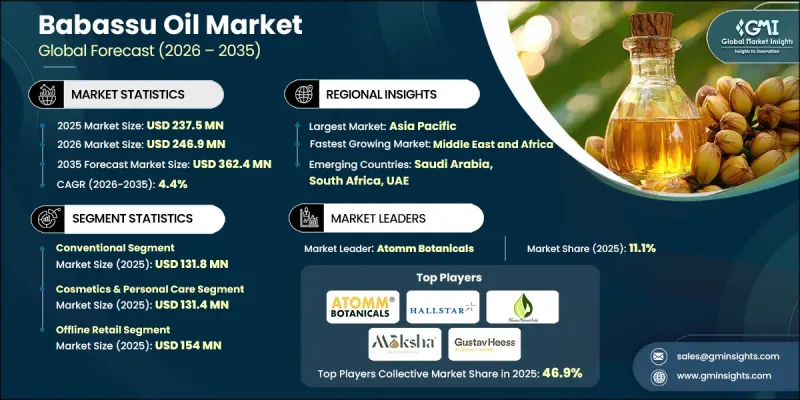
남미 원산의 바바수 야자 씨앗에서 추출한 바바수 오일은 가벼운 질감, 높은 라 우린산 함량, 은은한 향으로 높은 평가를 받고 있으며, 퍼스널케어, 식품, 산업 분야에서 다양하게 활용되는 원료로 각광받고 있습니다. 천연 성분으로 인해 성능 요구 사항을 충족시키면서 열대성 오일을 대체할 수 있는 지속 가능한 대안이 될 수 있습니다. 시장 성장은 식물 유래 제품에 대한 인식이 높아지고 다양한 용도의 천연 원료에 대한 수요가 증가함에 따라 주도되고 있습니다. 생산은 바바수 야자수가 자라는 지역에 집중되어 있으며, 특정 재배법이 필요합니다. 기계적 추출이나 콜드프레스 방식을 이용한 기존의 추출 방법은 현재 고도의 가공기술로 크게 진화하고 있습니다. 현대 기술을 통해 오일의 수율이 향상되고 필수 지방산이 유지되며 저장 기간이 연장되고 제품의 품질이 안정적입니다. 기술 향상과 소규모 기계화를 통해 높은 품질 기준을 유지하면서 폐기물을 줄이고, 전 세계적으로 증가하는 천연 기능성 오일에 대한 수요를 뒷받침하고 있습니다.
| 시장 범위 | |
|---|---|
| 개시 연도 | 2025년 |
| 예측 기간 | 2026-2035년 |
| 개시 연도 시장 규모 | 2억 3,750만 달러 |
| 예측액 | 3억 6,240만 달러 |
| CAGR | 4.4% |
전통적인 바바수 오일 부문은 광범위한 채택, 비용 효율성, 안정적인 공급으로 인해 2025년 1억 3,180만 달러의 매출을 기록할 것으로 예상되며, 여전히 가장 큰 부문으로 남아있습니다. 그 가공 방법은 이미 확립되어 있으며, 전문적인 인증이 필요하지 않은 대량 생산 용도에 적합합니다. 이 부문은 성능과 확장성이 중요한 다양한 산업에서 실용적인 편의성을 지속적으로 발휘하고 있습니다.
2025년 화장품 및 퍼스널케어 부문은 1억 3,140만 달러를 차지할 것으로 예측됩니다. 바바수 오일의 가벼운 질감과 보습력은 크림, 로션, 비누, 헤어 케어 제품에서 매우 선호되고 있습니다. 다재다능한 기능을 통해 제품 개발자는 기능적 요구 사항을 충족하기 위해 제품에 쉽게 통합할 수 있습니다. 음료 및 식품 응용 분야에서 수요는 지역별 수용도, 가공 사양, 제품 개발 목적에 따라 영향을 받고 있으며, 이에 따라 이 오일은 여러 카테고리에서 채택되고 있습니다.
북미 바바수 오일 시장은 2025년 5,280만 달러에서 2035년까지 8,190만 달러로 성장할 것으로 예측됩니다. 이 지역의 성장은 천연 성분에 대한 소비자의 선호도 증가와 퍼스널케어 제품에 대한 클린 라벨 포뮬러의 도입에 힘입어 성장세를 보이고 있습니다. 미국에서는 수요가 선별적이며, 제형 개발자들은 화장품에 대한 적합성 및 제품 성능 향상 가능성을 평가하면서 국내의 기존 유통망을 활용하고 있습니다.
자주 묻는 질문
목차
제1장 조사 방법과 범위
제2장 주요 요약
제3장 업계 인사이트
제4장 경쟁 구도
제5장 시장 추산 및 예측 : 유형별, 2022-2035
제6장 시장 추산 및 예측 : 용도별, 2022-2035
제7장 시장 추산 및 예측 : 유통 채널별, 2022-2035
제8장 시장 추산 및 예측 : 지역별, 2022-2035
제9장 기업 개요
LSHThe Global Babassu Oil Market was valued at USD 237.5 million in 2025 and is estimated to grow at a CAGR of 4.4% to reach USD 362.4 million by 2035.
Babassu oil, derived from the kernels of the babassu palm native to South America, is prized for its light texture, high lauric acid content, and subtle aroma, making it a versatile ingredient across personal care, food, and industrial sectors. Its natural composition allows it to function as a sustainable alternative to tropical oils while fulfilling performance requirements. Market growth is driven by rising awareness of plant-based products and increasing demand for natural ingredients in multiple applications. Production is concentrated in regions where babassu palms grow, requiring specific cultivation practices. Traditional extraction using mechanical and cold-press methods has largely evolved into advanced processing technologies. Modern techniques enhance oil yield, preserve essential fatty acids, extend shelf life, and ensure product consistency. Technological upgrades and small-scale mechanization reduce waste while maintaining high-quality standards, supporting the growing preference for natural, functional oils globally.
| Market Scope | |
|---|---|
| Start Year | 2025 |
| Forecast Year | 2026-2035 |
| Start Value | $237.5 Million |
| Forecast Value | $362.4 Million |
| CAGR | 4.4% |
The conventional babassu oil segment accounted for USD 131.8 million in 2025, remaining the largest segment due to its widespread adoption, cost efficiency, and steady availability. Its processing methods are well-established, making it suitable for high-volume applications that do not require specialized certifications. The segment continues to benefit from practical usability across various industries where performance and scalability are critical.
The cosmetics and personal care segment captured USD 131.4 million in 2025. Babassu oil's lightweight texture and moisturizing properties make it highly desirable for creams, lotions, soaps, and hair care formulations. Its versatility allows formulators to integrate it easily into products to meet functional requirements. In food and beverage applications, demand is influenced by regional acceptance, processing specifications, and product development objectives, ensuring the oil's adoption across multiple categories.
North American Babassu Oil Market is forecasted to grow from USD 52.8 million in 2025 to USD 81.9 million by 2035. Growth in this region is fueled by rising consumer preference for natural ingredients and the integration of clean-label formulations in personal care products. In the United States, demand is selective, with formulators assessing the oil's suitability for cosmetic products and its potential to enhance product performance while leveraging existing distribution networks across the country.
Key players operating in the Babassu Oil Market include Atomm Botanicals, Nature's Natural India, Moksha Lifestyle Products, Pioma Chemicals, Hallstar, Citroleo, Raasa Oils, Aromaaz International, Gustav Heess, and Kush Aroma Exports. Companies in the Babassu Oil Market are adopting several strategies to strengthen their position and expand their reach. They are investing in research and development to improve extraction methods, enhance product quality, and create formulations tailored for specific applications. Strategic partnerships with distributors and cosmetic formulators help expand market access and awareness. Emphasis on sustainability, including ethically sourced raw materials and eco-friendly processing, is increasing consumer trust and market appeal. Firms are also diversifying product portfolios to cater to personal care, food, and industrial applications. Investment in advanced processing equipment and mechanization ensures consistent yields, reduces waste, and supports scaling operations efficiently while maintaining high-quality standards.
Table of Contents
Chapter 1 Methodology & Scope
- 1.1 Market scope and definition
- 1.2 Research design
- 1.2.1 Research approach
- 1.2.2 Data collection methods
- 1.3 Data mining sources
- 1.3.1 Global
- 1.3.2 Regional/Country
- 1.4 Base estimates and calculations
- 1.4.1 Base year calculation
- 1.4.2 Key trends for market estimation
- 1.5 Primary research and validation
- 1.5.1 Primary sources
- 1.6 Forecast model
- 1.7 Research assumptions and limitations
Chapter 2 Executive Summary
- 2.1 Industry 360° synopsis
- 2.2 Key market trends
- 2.2.1 Nature
- 2.2.2 Application
- 2.2.3 Distribution Channel
- 2.2.4 Regional
- 2.3 TAM Analysis, 2026-2035
- 2.4 CXO perspectives: Strategic imperatives
- 2.5 Future outlook and strategic recommendations
Chapter 3 Industry Insights
- 3.1 Industry ecosystem analysis
- 3.1.1 Supplier landscape
- 3.1.2 Profit margin
- 3.1.3 Value addition at each stage
- 3.1.4 Factor affecting the value chain
- 3.1.5 Disruptions
- 3.2 Industry impact forces
- 3.2.1 Growth drivers
- 3.2.1.1 Rising preference for plant-based ingredients across industries globally
- 3.2.1.2 Expanded applications within cosmetics personal care formulations segments
- 3.2.1.3 Increasing focus on sustainable and renewable raw materials
- 3.2.2 Pitfalls/challenge
- 3.2.2.1 Supply variability due to regional harvesting and climate
- 3.2.2.2 Processing limitations affecting consistency and scalability outcomes overall
- 3.2.3 Opportunities
- 3.2.3.1 Integration into emerging natural product development pipelines worldwide
- 3.2.3.2 Advancements enabling higher efficiency extraction processing methods adoption
- 3.2.1 Growth drivers
- 3.3 Growth potential analysis
- 3.4 Regulatory landscape
- 3.4.1 North America
- 3.4.2 Europe
- 3.4.3 Asia Pacific
- 3.4.4 Latin America
- 3.4.5 Middle East & Africa
- 3.5 Porter's analysis
- 3.6 PESTEL analysis
- 3.7 Technology and innovation landscape
- 3.7.1 Current technological trends
- 3.7.2 Emerging technologies
- 3.8 Price trends
- 3.8.1 By region
- 3.8.2 By nature
- 3.9 Future market trends
- 3.10 Technology and innovation landscape
- 3.10.1 Current technological trends
- 3.10.2 Emerging technologies
- 3.11 Patent landscape
- 3.12 Trade statistics (HS code)
- 3.12.1 Major importing countries
- 3.12.2 Major exporting countries
- 3.13 Sustainability and environmental aspects
- 3.13.1 Sustainable practices
- 3.13.2 Waste reduction strategies
- 3.13.3 Energy efficiency in production
- 3.13.4 Eco-friendly initiatives
- 3.14 Carbon footprint consideration
Chapter 4 Competitive Landscape, 2025
- 4.1 Introduction
- 4.2 Company market share analysis
- 4.2.1 By region
- 4.2.1.1 North America
- 4.2.1.2 Europe
- 4.2.1.3 Asia Pacific
- 4.2.1.4 LATAM
- 4.2.1.5 MEA
- 4.2.1 By region
- 4.3 Company matrix analysis
- 4.4 Competitive analysis of major market players
- 4.5 Competitive positioning matrix
- 4.6 Key developments
- 4.6.1 Mergers & acquisitions
- 4.6.2 Partnerships & collaborations
- 4.6.3 New product launches
- 4.6.4 Expansion plans
Chapter 5 Market Estimates and Forecast, By Nature, 2022-2035 (USD Million) (Kilo Tons)
- 5.1 Key trends
- 5.2 Organic
- 5.3 Conventional
Chapter 6 Market Estimates and Forecast, By Application, 2022-2035 (USD Million) (Kilo Tons)
- 6.1 Key trends
- 6.2 Cosmetics & personal care
- 6.3 Food & beverage
- 6.4 Pharmaceutical
- 6.5 Others
Chapter 7 Market Estimates and Forecast, By Distribution Channel, 2022-2035 (USD Million) (Kilo Tons)
- 7.1 Key trends
- 7.2 Online retail
- 7.3 Offline retail
Chapter 8 Market Estimates and Forecast, By Region, 2022-2035 (USD Million) (Kilo Tons)
- 8.1 Key trends
- 8.2 North America
- 8.2.1 U.S.
- 8.2.2 Canada
- 8.3 Europe
- 8.3.1 Germany
- 8.3.2 UK
- 8.3.3 France
- 8.3.4 Spain
- 8.3.5 Italy
- 8.3.6 Rest of Europe
- 8.4 Asia Pacific
- 8.4.1 China
- 8.4.2 India
- 8.4.3 Japan
- 8.4.4 Australia
- 8.4.5 South Korea
- 8.4.6 Rest of Asia Pacific
- 8.5 Latin America
- 8.5.1 Brazil
- 8.5.2 Mexico
- 8.5.3 Argentina
- 8.5.4 Rest of Latin America
- 8.6 Middle East and Africa
- 8.6.1 Saudi Arabia
- 8.6.2 South Africa
- 8.6.3 UAE
- 8.6.4 Rest of Middle East and Africa
Chapter 9 Company Profiles
- 9.1 Atomm Botanicals
- 9.2 Natures Natural India
- 9.3 Moksha Lifestyle Products
- 9.4 Pioma Chemicals
- 9.5 Hallstar
- 9.6 Citroleo
- 9.7 Raasa Oils
- 9.8 Aromaaz International
- 9.9 Gustav Heess
- 9.10 Kush Aroma Exports

(주말 및 공휴일 제외)


