



|
시장보고서
상품코드
2019154
자가복원성 고분자 시장 비즈니스 기회, 성장요인, 업계 동향 분석 및 예측(2026-2035년)Self-repairing Polymers Market Opportunity, Growth Drivers, Industry Trend Analysis, and Forecast 2026 - 2035 |
||||||

세계의 자가복원성 고분자 시장은 2025년에 32억 달러로 평가되었고, 2035년까지 연평균 복합 성장률(CAGR) 23.8%로 성장하여 269억 달러에 이를 것으로 추정되고 있습니1다.
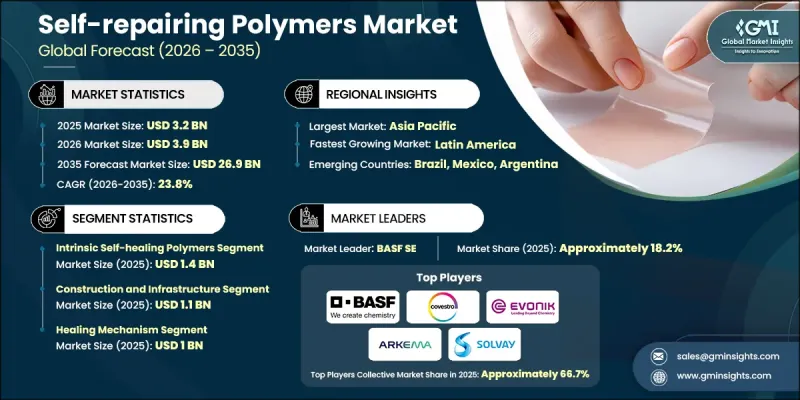
재료 과학에서 내구성, 제품 수명 연장 및 지속적인 성능에 대한 중요성이 점점 더 강조됨에 따라 자기 회복성 고분자 시장은 강한 추진력을 보이고 있습니다. 이 첨단 폴리머는 손상 후 기계적, 화학적, 기능적 특성을 회복하도록 설계되어 수리 및 재료 교체 빈도를 줄여줍니다. 이 분야의 연구는 고분자 구조 내 가역적 결합에 의존하는 '내재적 시스템'과 수복제가 포함된 '외재적 시스템' 모두에 초점을 맞추었습니다. 고분자 화학, 나노 기술 및 생물학에서 영감을 얻은 재료 설계의 지속적인 발전으로 인해 이러한 재료의 적용 범위는 까다로운 응용 분야로 확대되고 있습니다. 시장 성장은 재료의 고장이 높은 비용과 안전 위험으로 이어질 수 있는 분야에서의 채택 확대에 의해 주도되고 있습니다. 자기복원성 폴리머는 다양한 산업에서 제품의 수명주기 연장과 신뢰성 향상에 기여하고 있습니다. 현재 진행 중인 혁신은 수리 속도, 일관성 및 구조적 무결성을 향상시키는 것을 목표로 하고 있습니다. 지속 가능한 소재 솔루션에 대한 인식이 높아지고 순환 경제 원칙에 대한 관심이 높아지면서 폐기물을 줄이고 자원 효율을 향상시키는 자기복원성 폴리머에 대한 수요가 더욱 증가하고 있습니다.
| 시장 범위 | |
|---|---|
| 개시 연도 | 2025년 |
| 예측 기간 | 2026-2035년 |
| 개시 연도 시장 규모 | 32억 달러 |
| 예측액 | 269억 달러 |
| CAGR | 23.8% |
내재적 자가수복성 폴리머 부문은 2025년에 14억 달러를 차지할 것으로 예상되며 2026년부터 2035년까지 연평균 23% 성장할 것으로 예측됩니다. 이 부문은 폴리머 매트릭스 내에 내장된 가역적 결합 메커니즘을 통해 손상을 복구하는 능력으로 인해 중요한 위치를 차지하고 있습니다. 이러한 재료는 외부 약품 없이도 여러 번의 수리 주기를 거칠 수 있으며, 구조적 무결성과 장기적인 성능을 유지합니다. 미세한 손상으로부터 회복할 수 있는 능력으로 인해 반복적인 응력이 가해지는 조건에서도 일관된 기능성이 요구되는 응용 분야에 매우 적합합니다. 이러한 신뢰성과 더불어 유지보수 감소 및 경량화 등의 특성이 결합되어 업계에서 지속적으로 높은 관심을 받고 있습니다.
수리 메커니즘 부문은 2025년 10억 달러에 도달하여 30.7%의 점유율을 차지했으며, 2035년까지 연평균 22.4%의 성장률을 보일 것으로 예측됩니다. 수리 메커니즘의 유형은 재료가 손상으로부터 얼마나 효과적으로 회복할 수 있는지, 수리 프로세스가 얼마나 자주 발생하는지, 그리고 재료가 장기적으로 얼마나 안정성을 유지할 수 있는지를 결정하는 데 매우 중요한 역할을 합니다. 복구 효율, 복구 속도, 내환경성 등의 요인이 전반적인 성능에 영향을 미치지만, 근본적인 복구 메커니즘은 다양한 사용 조건과 용도에서 재료의 거동을 결정하는 중요한 요소로 작용합니다.
북미 자가수복성 폴리머 시장은 2025년 8억 6,850만 달러로 평가되었습니다. 이 지역은 이미 구축된 연구 생태계, 첨단 소재의 조기 도입, 하이테크 산업에서의 광범위한 응용이라는 이점을 가지고 있습니다. 미국은 연구기관, 전문 제조업체, 혁신 주도 산업으로 구성된 강력한 네트워크에 힘입어 지역 발전을 주도하고 있습니다. 캐나다는 지속 가능한 재료 및 인프라에 초점을 맞춘 연구 이니셔티브의 지속적인 진전을 통해 지역 발전에 기여하고 있으며, 이는 전체 시장 확대에 기여하고 있습니다.
자주 묻는 질문
목차
제1장 조사 방법
제2장 주요 요약
제3장 업계 인사이트
제4장 경쟁 구도
제5장 시장 추산 및 예측 : 유형별, 2022-2035
제6장 시장 추산 및 예측 : 용도별, 2022-2035
제7장 시장 추산 및 예측 : 성능 특성별, 2022-2035
제8장 시장 추산 및 예측 : 지역별, 2022-2035
제9장 기업 개요
LSH 26.05.08The Global Self-Repairing Polymers Market was valued at USD 3.2 billion in 2025 and is estimated to grow at a CAGR of 23.8% to reach USD 26.9 billion by 2035.
The self-repairing polymers market is gaining strong momentum as material science increasingly emphasizes durability, extended product life, and sustained performance. These advanced polymers are engineered to restore their mechanical, chemical, and functional properties after damage, reducing the frequency of repairs and material replacement. Research in this field is focused on both intrinsic systems, which rely on reversible bonding within the polymer structure, and extrinsic systems that incorporate embedded healing agents. Continuous advancements in polymer chemistry, nanotechnology, and bio-inspired material design are expanding the scope of these materials across demanding applications. Market growth is being driven by rising adoption in sectors where material failure can result in high costs or safety risks. Self-repairing polymers contribute to longer product lifecycles and improved reliability across various industries. Ongoing innovation is aimed at enhancing healing speed, consistency, and structural integrity. Increasing awareness of sustainable material solutions and the growing focus on circular economy principles are further supporting the demand for self-repairing polymers, as they help reduce waste and improve resource efficiency.
| Market Scope | |
|---|---|
| Start Year | 2025 |
| Forecast Year | 2026-2035 |
| Start Value | $3.2 Billion |
| Forecast Value | $26.9 Billion |
| CAGR | 23.8% |
The intrinsic self-healing polymers segment accounted for USD 1.4 billion in 2025 and is projected to grow at a CAGR of 23% from 2026 to 2035. This segment holds a prominent position due to its ability to repair damage through reversible bonding mechanisms embedded within the polymer matrix. These materials can undergo multiple healing cycles without requiring external agents, preserving their structural integrity and long-term performance. Their capability to recover from micro-level damage makes them highly suitable for applications requiring consistent functionality under repeated stress conditions. This reliability, combined with reduced maintenance needs and lightweight characteristics, continues to drive strong interest from industrial sectors.
The healing mechanism segment reached USD 1 billion in 2025, accounting for 30.7% share, and is anticipated to grow at a CAGR of 22.4% through 2035. The type of healing mechanism plays a critical role in determining how effectively a material can recover from damage, how frequently the healing process can occur, and how stable the material remains over time. Factors such as healing efficiency, recovery speed, and environmental resistance influence overall performance; however, the underlying healing mechanism remains the key factor shaping material behavior across different operating conditions and applications.
North America Self-Repairing Polymers Market was valued at USD 868.5 million in 2025. The region benefits from a well-established research ecosystem, early adoption of advanced materials, and broad application across high-technology industries. The United States leads regional development, supported by a strong network of research institutions, specialized manufacturers, and innovation-driven industries. Canada contributes to regional progress through continued advancements in sustainable materials and infrastructure-focused research initiatives, supporting the overall expansion of the market.
Key companies operating in the Global Self-Repairing Polymers Market include Covestro AG, Arkema, BASF SE, Evonik Industries AG, The Dow Chemical Company, Solvay S.A., Sika AG, Toray Industries, Inc., and NEI Corporation. Companies in the self-repairing polymers market are strengthening their competitive position through continuous innovation, strategic collaborations, and expansion into high-growth application areas. They are investing heavily in research and development to improve the healing efficiency, durability, and environmental performance of advanced polymer systems. Partnerships with end-use industries are enabling the development of customized solutions tailored to specific performance requirements. Manufacturers are also focusing on scaling production capabilities and optimizing supply chains to meet increasing demand efficiently. In addition, companies are exploring sustainable material innovations and integrating advanced technologies such as nanomaterials to enhance product functionality, while expanding their presence in emerging markets to capture new growth opportunities.
Table of Contents
Chapter 1 Methodology
- 1.1 Market scope and definition
- 1.2 Research design
- 1.2.1 Research approach
- 1.2.2 Data collection methods
- 1.3 Data mining sources
- 1.3.1 Global
- 1.3.2 Regional/Country
- 1.4 Base estimates and calculations
- 1.4.1 Base year calculation
- 1.4.2 Key trends for market estimation
- 1.5 Primary research and validation
- 1.5.1 Primary sources
- 1.6 Forecast model
- 1.7 Research assumptions and limitations
Chapter 2 Executive Summary
- 2.1 Industry 360° synopsis
- 2.2 Key market trends
- 2.2.1 Regional
- 2.2.2 Type
- 2.2.3 Application
- 2.2.4 Performance Characteristics
- 2.3 TAM Analysis, 2026-2035
- 2.4 CXO perspectives: Strategic imperatives
Chapter 3 Industry Insights
- 3.1 Industry ecosystem analysis
- 3.1.1 Supplier Landscape
- 3.1.2 Profit Margin
- 3.1.3 Value addition at each stage
- 3.1.4 Factor affecting the value chain
- 3.1.5 Disruptions
- 3.2 Industry impact forces
- 3.2.1 Growth drivers
- 3.2.2 Industry pitfalls and challenges
- 3.2.3 Market opportunities
- 3.3 Growth potential analysis
- 3.4 Regulatory landscape
- 3.4.1 North America
- 3.4.2 Europe
- 3.4.3 Asia Pacific
- 3.4.4 Latin America
- 3.4.5 Middle East & Africa
- 3.5 Porter's analysis
- 3.6 PESTEL analysis
- 3.7 Price trends
- 3.7.1 By region
- 3.7.2 By product
- 3.8 Future market trends
- 3.9 Technology and Innovation landscape
- 3.9.1 Current technological trends
- 3.9.2 Emerging technologies
- 3.10 Patent Landscape
- 3.11 Trade statistics
- 3.11.1 Major importing countries
- 3.11.2 Major exporting countries
- 3.12 Sustainability and Environmental Aspects
- 3.12.1 Sustainable Practices
- 3.12.2 Waste Reduction Strategies
- 3.12.3 Energy Efficiency in Production
- 3.12.4 Eco-friendly Initiatives
- 3.13 Carbon Footprint Considerations
Chapter 4 Competitive Landscape, 2025
- 4.1 Introduction
- 4.2 Company market share analysis
- 4.2.1 By region
- 4.2.1.1 North America
- 4.2.1.2 Europe
- 4.2.1.3 Asia Pacific
- 4.2.1.4 LATAM
- 4.2.1.5 MEA
- 4.2.1 By region
- 4.3 Company matrix analysis
- 4.4 Competitive analysis of major market players
- 4.5 Competitive positioning matrix
- 4.6 Key developments
- 4.6.1 Mergers & acquisitions
- 4.6.2 Partnerships & collaborations
- 4.6.3 New Product Launches
- 4.6.4 Expansion Plans
Chapter 5 Market Estimates and Forecast, By Type, 2022- 2035 (USD Billion, Kilo Tons)
- 5.1 Key trends
- 5.2 Intrinsic Self-healing Polymers
- 5.2.1 Reversible Covalent Bond-based
- 5.2.2 Supramolecular Interaction-based
- 5.2.3 Shape Memory Polymers
- 5.2.4 Others
- 5.3 Extrinsic Self-healing Polymers
- 5.3.1 Microcapsule-based Systems
- 5.3.2 Vascular Network Systems
- 5.3.3 Microfiber Reinforcement
- 5.3.4 Others
- 5.4 Hybrid Self-healing Systems
- 5.4.1 Combined Intrinsic-Extrinsic Systems
- 5.4.2 Multi-mechanism Systems
- 5.4.3 Others
Chapter 6 Market Estimates and Forecast, By Application, 2022 - 2035 (USD Billion, Kilo Tons)
- 6.1 Key trends
- 6.2 Construction and Infrastructure
- 6.2.1 Self-healing Concrete
- 6.2.2 Protective Coatings
- 6.2.3 Sealants and Adhesives
- 6.2.4 Others
- 6.3 Automotive and Aerospace
- 6.3.1 Structural Components
- 6.3.2 Coatings and Paints
- 6.3.3 Interior Applications
- 6.3.4 Others
- 6.4 Electronics and Energy
- 6.4.1 Battery Components
- 6.4.2 Flexible Electronics
- 6.4.3 Solar Panels
- 6.4.4 Others
- 6.5 Biomedical and Healthcare
- 6.5.1 Tissue Engineering
- 6.5.2 Drug Delivery Systems
- 6.5.3 Medical Devices
- 6.5.4 Others
- 6.6 Consumer Products
- 6.6.1 Packaging
- 6.6.2 Protective Films
- 6.6.3 Textiles
- 6.6.4 Others
- 6.7 Others
Chapter 7 Market Estimates and Forecast, By Performance Characteristics, 2022 - 2035 (USD Billion, Kilo Tons)
- 7.1 Key trends
- 7.2 Healing Mechanism
- 7.2.1 Thermally Activated
- 7.2.2 Light-activated
- 7.2.3 pH-responsive
- 7.2.4 Mechanically Activated
- 7.2.5 Others
- 7.3 Healing Efficiency
- 7.3.1 High Efficiency (>80%)
- 7.3.2 Medium Efficiency (50-80%)
- 7.3.3 Low Efficiency (<50%)
- 7.4 Healing Time
- 7.4.1 Rapid Healing (<1 hour)
- 7.4.2 Moderate Healing (1-24 hours)
- 7.4.3 Slow Healing (>24 hours)
- 7.5 Environmental Stability
- 7.5.1 Temperature Resistant
- 7.5.2 Chemical Resistant
- 7.5.3 UV Resistant
- 7.5.4 Others
Chapter 8 Market Estimates and Forecast, By Region, 2022 - 2035 (USD Billion, Kilo Tons)
- 8.1 Key trends
- 8.2 North America
- 8.2.1 U.S.
- 8.2.2 Canada
- 8.3 Europe
- 8.3.1 Germany
- 8.3.2 UK
- 8.3.3 France
- 8.3.4 Italy
- 8.3.5 Spain
- 8.3.6 Rest of Europe
- 8.4 Asia Pacific
- 8.4.1 China
- 8.4.2 India
- 8.4.3 Japan
- 8.4.4 Australia
- 8.4.5 South Korea
- 8.4.6 Rest of Asia Pacific
- 8.5 Latin America
- 8.5.1 Brazil
- 8.5.2 Mexico
- 8.5.3 Argentina
- 8.5.4 Rest of Latin America
- 8.6 Middle East & Africa
- 8.6.1 Saudi Arabia
- 8.6.2 South Africa
- 8.6.3 UAE
- 8.6.4 Rest of Middle East & Africa
Chapter 9 Company Profiles
- 9.1 BASF SE
- 9.2 Arkema
- 9.3 Covestro AG
- 9.4 Evonik Industries AG
- 9.5 The Dow Chemical Company
- 9.6 Sika AG
- 9.7 Solvay S.A.
- 9.8 Toray Industries, Inc.
- 9.9 NEI Corporation

(주말 및 공휴일 제외)


