
|
시장보고서
상품코드
2019157
플랫베드 다이 커터 시장 기회, 성장요인, 업계 동향 분석 및 예측(2026-2035년)Flatbed Die-Cutter Market Opportunity, Growth Drivers, Industry Trend Analysis, and Forecast 2026 - 2035 |
||||||

세계의 플랫베드 다이 커터 시장은 2025년에 5억 1,280만 달러로 평가되었고, 2035년까지 연평균 복합 성장률(CAGR) 4.9%로 성장하여 8억 1,320만 달러에 이를 것으로 추정되고 있습니다.
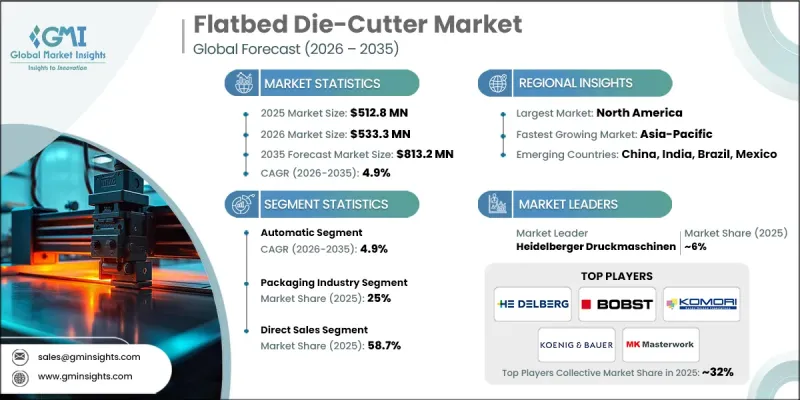
각 업계에서 제품의 차별화와 시각적 매력을 높이는 맞춤형 패키징 솔루션에 대한 관심이 높아지면서 수요가 증가하고 있습니다. 전자상거래 및 소매 부문의 급속한 확장은 첨단 포장 형태에 대한 강력한 수요를 지속적으로 창출하고 있으며, 제조업체들이 다용도 다이 커팅 기술을 채택하도록 유도하고 있습니다. 이 기계는 복잡한 형상의 생산과 고품질 마무리를 가능하게 하여 진화하는 포장 요구 사항에 매우 적합합니다. 패키지의 미적 감각과 표현에 대한 중요성이 높아진 것도 시장 확대를 더욱 촉진하고 있습니다. 기업은 제품 가치를 높이는 솔루션에 투자하기 때문입니다. 또한, 각 업계에서는 다양한 디자인 요구사항과 생산주기 단축에 대응할 수 있는 유연한 생산 시스템을 요구하고 있습니다. 기계 성능의 지속적인 개선은 업무 효율성을 강화하고 제조업체가 변화하는 시장 수요에 효과적으로 대응할 수 있도록 합니다.
| 시장 범위 | |
|---|---|
| 개시 연도 | 2025 |
| 예측 기간 | 2026-2035년 |
| 개시 연도 시장 규모 | 5억 1,280만 달러 |
| 예측액 | 8억 1,320만 달러 |
| CAGR | 4.9% |
자동차, 전자제품 등 산업 분야의 확장은 시장 성장을 더욱 촉진하고 있습니다. 이러한 산업에서는 부품 제조에 있어 높은 정밀도와 일관성이 요구되며, 이는 첨단 다이 커팅 장비의 도입을 뒷받침하고 있습니다. 이러한 분야의 생산량 증가와 기술 발전으로 인해 정확하고 신뢰할 수 있는 절단 솔루션에 대한 수요가 지속적으로 증가하고 있습니다.
자동 부문은 2025년 3억 2,750만 달러 시장 규모를 기록할 것으로 예상되며, 2026년부터 2035년까지 연평균 4.9%의 성장률을 보일 것으로 예측됩니다. 이 부문은 생산성, 정확성 및 운영 효율성을 향상시킬 수 있기 때문에 시장을 주도하고 있습니다. 자동화 시스템은 단일 워크플로우 내에서 여러 프로세스를 효율화하여 수작업 개입을 줄이고 일관된 출력 품질을 보장합니다. 첨단 제어 기술의 통합으로 장시간 연속 생산에서도 정확한 위치 결정과 높은 반복 성능을 실현합니다. 인건비 상승과 생산 효율성 향상의 필요성에 따라 각 제조업체들은 자동화 솔루션 도입을 추진하고 있습니다.
포장 산업 부문은 2025년 25%의 점유율을 차지했으며, 2035년까지 연평균 복합 성장률(CAGR) 5.3%를 나타낼 것으로 예측됩니다. 이 부문은 첨단 포장 형태에 대한 지속적인 수요와 제품 프레젠테이션에 대한 관심이 높아짐에 따라 선도적인 위치를 유지하고 있습니다. 혁신적인 포장 디자인과 효율적인 생산 방식에 대한 요구는 계속해서 장비 도입을 촉진하고 있습니다. 각 제조업체들은 플랫베드 다이 커팅 머신의 유연성을 활용하고 있습니다. 이 기계는 비용 효율성을 유지하면서 복잡한 구조의 형성 및 고품질 마무리를 실현합니다. 맞춤형 및 신속한 생산 능력에 대한 중요성이 높아진 것도 이 부문의 우위를 더욱 강화시키고 있습니다.
미국의 플랫 베드 다이 커팅 머신 시장은 2025년에 1억 2,540만 달러에 달할 것으로 예상되며, 2026년부터 2035년까지 연평균 4.8%의 연평균 복합 성장률(CAGR)을 보일 것으로 예측됩니다. 이 나라 시장 성장은 포장, 제조 및 인쇄 산업 전반의 견고한 수요에 힘입어 성장하고 있습니다. 첨단 기계에 대한 투자 증가는 효율성, 정확성, 확장성 향상에 대한 요구를 반영하고 있습니다. 통합 생산 시스템과 디지털 워크플로우의 도입으로 업무 역량이 지속적으로 향상되고 있으며, 자동화와 품질 관리에 대한 강력한 집중은 시장의 지속적인 확장을 주도하고 있습니다.
자주 묻는 질문
목차
제1장 조사 방법과 범위
제2장 주요 요약
제3장 업계 인사이트
제4장 경쟁 구도
제5장 플랫베드 다이 커터 시장 규모 추정 및 예측 : 동작 방식별, 2022-2035
제6장 플랫베드 다이 커터 시장 규모 추정 및 예측 : 작동 방식별, 2022-2035
제7장 플랫베드 다이 커터 시장 규모 추정 및 예측 : 용도별, 2022-2035
제8장 플랫베드 다이 커터 시장 규모 추정 및 예측 : 판매채널별, 2022-2035
제9장 시장 추산 및 예측 : 지역별, 2022-2035
제10장 기업 개요
LSHThe Global Flatbed Die-Cutter Market was valued at USD 512.8 million in 2025 and is estimated to grow at a CAGR of 4.9% to reach USD 813.2 million by 2035.
Demand is rising as industries increasingly prioritize customized packaging solutions that enhance product differentiation and visual appeal. The rapid expansion of e-commerce and retail sectors continues to create strong demand for advanced packaging formats, encouraging manufacturers to adopt versatile die-cutting technologies. These machines enable the production of intricate shapes and high-quality finishing, making them highly suitable for evolving packaging requirements. Growing emphasis on packaging aesthetics and presentation further supports market expansion, as companies invest in solutions that elevate product value. Additionally, industries are seeking flexible production systems that can accommodate varied design requirements and shorter production cycles. Continuous advancements in machinery capabilities are strengthening operational efficiency and enabling manufacturers to meet changing market demands effectively.
| Market Scope | |
|---|---|
| Start Year | 2025 |
| Forecast Year | 2026-2035 |
| Start Value | $512.8 Million |
| Forecast Value | $813.2 Million |
| CAGR | 4.9% |
The expansion of industrial sectors such as automotive and electronics is further contributing to market growth. These industries require high levels of precision and consistency in component manufacturing, which supports the adoption of advanced die-cutting equipment. Increasing production volumes and technological advancements across these sectors continue to generate demand for accurate and reliable cutting solutions.
The automatic segment generated USD 327.5 million in 2025 and is expected to grow at a CAGR of 4.9% from 2026 to 2035. This segment leads the market due to its ability to deliver enhanced productivity, accuracy, and operational efficiency. Automated systems streamline multiple processes within a single workflow, reducing manual intervention and ensuring consistent output quality. The integration of advanced control technologies allows for precise alignment and repeatable performance across extended production runs. Rising labor costs and the need for increased production efficiency are prompting manufacturers to adopt automated solutions.
The packaging industry segment held a 25% share in 2025 and is projected to grow at a CAGR of 5.3% through 2035. This segment maintains its leadership position due to sustained demand for advanced packaging formats and increasing focus on product presentation. The need for innovative packaging designs and efficient production methods continues to drive equipment adoption. Manufacturers benefit from the flexibility of flatbed die-cutting machines, which support the creation of complex structures and high-quality finishing while maintaining cost efficiency. The growing emphasis on customization and rapid production capabilities further strengthens the segment's dominance.
United States Flatbed Die-Cutter Market reached USD 125.4 million in 2025 and is anticipated to grow at a CAGR of 4.8% from 2026 to 2035. Market growth in the country is supported by strong demand across the packaging, manufacturing, and printing industries. Increasing investment in advanced machinery reflects the need for improved efficiency, precision, and scalability. The adoption of integrated production systems and digital workflows continues to enhance operational capabilities, while a strong focus on automation and quality control drives consistent market expansion.
Key companies operating in the Global Flatbed Die-Cutter Market include BOBST, Koenig & Bauer, Heidelberger Druckmaschinen, Komori, Masterwork Machinery, Duplo International, Yawa Printing Machinery, ASAHI MACHINERY, Winkler+Dunnebier, DeltaModTech, Hunkeler, SANWA, Sysco Machinery, Berhalter, and DIMO TECH. Companies in the flatbed die-cutter market are strengthening their competitive position through technological advancement and strategic expansion initiatives. They are investing in automation and digital integration to improve machine performance and production efficiency. Many players are focusing on expanding their product portfolios to address diverse industrial requirements and enhance market reach. Strategic collaborations and partnerships are being utilized to access new markets and strengthen distribution networks. Companies are also emphasizing research and development to introduce innovative features that improve precision and operational flexibility.
Table of Contents
Chapter 1 Methodology and Scope
- 1.1 Market scope and definition
- 1.2 Research design
- 1.2.1 Research approach
- 1.2.2 Data collection methods
- 1.3 Data mining sources
- 1.3.1 Global
- 1.3.2 Regional/Country
- 1.4 Base estimates and calculations
- 1.4.1 Base year calculation
- 1.4.2 Key trends for market estimation
- 1.5 Primary research and validation
- 1.5.1 Primary sources
- 1.6 Forecast model
- 1.7 Research assumptions and limitations
Chapter 2 Executive Summary
- 2.1 Industry 360° synopsis
- 2.2 Key market trends
- 2.2.1 Regional
- 2.2.2 Mode Of Operation
- 2.2.3 Application
- 2.2.4 End-Use Industry
- 2.2.5 Distribution Channel
- 2.3 CXO perspectives: Strategic imperatives
- 2.3.1 Key decision points for industry executives
- 2.3.2 Critical success factors for market players
- 2.4 Future outlook and strategic recommendations
Chapter 3 Industry Insights
- 3.1 Industry ecosystem analysis
- 3.1.1 Supplier landscape
- 3.1.2 Profit margin
- 3.1.3 Value addition at each stage
- 3.1.4 Factor affecting the value chain
- 3.2 Industry impact forces
- 3.2.1 Growth drivers
- 3.2.1.1 Growing demand for customized packaging solutions
- 3.2.1.2 Expansion of automotive and electronics industries
- 3.2.1.3 Rising automation and Industry 4.0 adoption
- 3.2.2 Industry pitfalls & challenges
- 3.2.2.1 High capital investment for advanced automatic systems
- 3.2.2.2 Competition from digital cutting and laser technologies
- 3.2.3 Opportunities
- 3.2.3.1 Growing demand for sustainable and recyclable packaging
- 3.2.3.2 Expansion in emerging markets and local manufacturing
- 3.2.1 Growth drivers
- 3.3 Growth potential analysis
- 3.4 Future market trends
- 3.5 Technology and innovation landscape
- 3.5.1 Current technological trends
- 3.5.2 Emerging technologies
- 3.6 Price trends
- 3.6.1 Historical Price Trend Analysis (Driven by Primary Research)
- 3.6.2 Pricing Strategy by Player Type (Premium/Value/Cost-plus) (Driven by Primary Research)
- 3.7 Regulatory landscape
- 3.7.1 Standards and compliance requirements
- 3.7.2 Regional regulatory frameworks
- 3.7.3 Certification standards
- 3.8 Porter's analysis
- 3.9 PESTEL analysis
- 3.10 Trade Data Analysis (Driven by Primary Research)
- 3.10.1 Import/Export Volume & Value Trends (Driven by Primary Research)
- 3.10.2 Key Trade Corridors & Tariff Impact (Driven by Primary Research)
- 3.10.3 Regional Trade Balances & Self-Sufficiency Levels
- 3.11 Impact of AI & Generative AI on the Market
- 3.11.1 AI-Driven Disruption of Existing Business Models
- 3.11.2 GenAI Use Cases & Adoption Roadmap by Segment
- 3.11.3 Risks, Limitations & Regulatory Considerations
- 3.12 Capacity & Production Landscape (Driven by Primary Research)
- 3.12.1 Installed Capacity by Region & Key Producer (Driven by Primary Research)
- 3.12.2 Capacity Utilization Rates & Expansion Pipelines (Driven by Primary Research)
Chapter 4 Competitive Landscape, 2025
- 4.1 Introduction
- 4.2 Company market share analysis
- 4.2.1 By region
- 4.2.1.1 North America
- 4.2.1.2 Europe
- 4.2.1.3 Asia Pacific
- 4.2.1.4 Latin America
- 4.2.1.5 Middle East and Africa
- 4.2.1 By region
- 4.3 Company matrix analysis
- 4.4 Competitive analysis of major market players
- 4.5 Competitive positioning matrix
- 4.6 Key developments
- 4.6.1 Mergers & acquisitions
- 4.6.2 Partnerships & collaborations
- 4.6.3 New product launches
- 4.6.4 Expansion plans
Chapter 5 Flatbed Die-Cutter Market Estimates & Forecast, By Mode of Operation, 2022-2035 (USD Million)
- 5.1 Key trends
- 5.2 Automatic
- 5.3 Semi-automatic
Chapter 6 Flatbed Die-Cutter Market Estimates & Forecast, By Application, 2022-2035 (USD Million)
- 6.1 Key trends
- 6.2 Boxes
- 6.3 Cartons
- 6.4 Labels and Stickers
- 6.5 Decorative Items
- 6.6 Rubber gaskets
- 6.7 Others (Flyers, etc.)
Chapter 7 Flatbed Die-Cutter Market Estimates & Forecast, By End-Use, 2022-2035 (USD Million)
- 7.1 Key trends
- 7.2 Packaging Industry
- 7.3 Automotive Industry
- 7.4 Pharmaceuticals
- 7.5 Textile
- 7.6 Printing and Publishing
- 7.7 Others (Electronics, etc.)
Chapter 8 Flatbed Die-Cutter Market Estimates & Forecast, By Distribution Channel, 2022-2035 (USD Million)
- 8.1 Key trends
- 8.2 Direct Sales
- 8.3 Indirect Sales
Chapter 9 Market Estimates and Forecast, By Region, 2022 - 2035 (USD Million) (Thousand Units)
- 9.1 Key trends
- 9.2 North America
- 9.2.1 U.S.
- 9.2.2 Canada
- 9.3 Europe
- 9.3.1 Germany
- 9.3.2 UK
- 9.3.3 France
- 9.3.4 Italy
- 9.3.5 Spain
- 9.4 Asia Pacific
- 9.4.1 China
- 9.4.2 Japan
- 9.4.3 India
- 9.4.4 Australia
- 9.4.5 South Korea
- 9.5 Latin America
- 9.5.1 Brazil
- 9.5.2 Mexico
- 9.5.3 Argentina
- 9.6 Middle East and Africa
- 9.6.1 South Africa
- 9.6.2 Saudi Arabia
- 9.6.3 UAE
Chapter 10 Company Profiles
- 10.1 Heidelberger Druckmaschinen
- 10.2 Komori
- 10.3 Duplo International
- 10.4 Yawa Printing Machinery
- 10.5 Masterwork Machinery
- 10.6 Hunkeler
- 10.7 BOBST
- 10.8 SANWA
- 10.9 ASAHI MACHINERY
- 10.10 DeltaModTech
- 10.11 Winkler+Dunnebier
- 10.12 Sysco Machinery
- 10.13 Berhalter
- 10.14 DIMO TECH
- 10.15 Koenig & Bauer