

|
시장보고서
상품코드
2019159
초음파 냉각 미터 시장 기회, 성장 촉진요인, 업계 동향 분석 및 예측(2026-2035년)Ultrasonic Cooling Meters Market Opportunity, Growth Drivers, Industry Trend Analysis, and Forecast 2026 - 2035 |
||||||

세계의 초음파 냉각 미터 시장은 2025년에 9억 2,630만 달러로 평가되었으며, CAGR 6.1%로 성장하여 2035년까지 16억 5,000만 달러에 달할 것으로 추정됩니다.
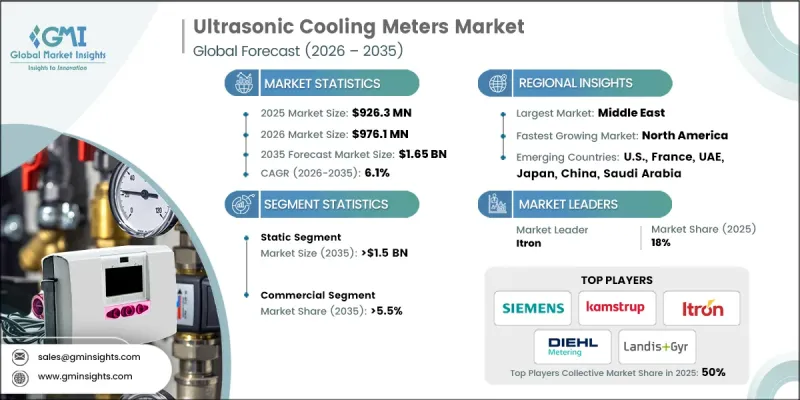
시장 확대는 상업용, 산업용 및 주거용 시스템에서 에너지 절약형 냉각 솔루션에 대한 수요 증가에 힘입어 성장하고 있습니다. 초음파 냉각 미터는 음파를 송수신하여 물이나 액체를 이용한 냉각 시스템에서 에너지 사용량을 정확하게 측정하여 운영자가 에너지 소비를 최적화하고 운영 비용을 절감할 수 있게 해줍니다. 정부의 엄격한 에너지 효율 규제와 건물 에너지 표준이 도입을 촉진하고 있으며, 이러한 장치는 보고 요건과 효율 표준을 준수할 수 있도록 보장합니다. 스마트 미터링 플랫폼과의 통합을 통해 실시간 모니터링 및 원격 데이터 액세스가 가능하여 IoT 지원 빌딩 관리 시스템을 지원합니다. 급속한 도시화, 디지털화, 개발도상국의 지역 냉방 시스템 도입도 큰 성장 기회를 창출하고 있습니다. 조직과 지자체가 탄소발자국을 줄이고 지속가능성을 향상시키기 위해 노력하고 있는 가운데, 초음파 냉각 미터는 에너지 관리 전략의 중심이 되고 있습니다.
| 시장 범위 | |
|---|---|
| 시작 연도 | 2025년 |
| 예측 기간 | 2026-2035년 |
| 시작 시점 시장 규모 | 9억 2,630만 달러 |
| 예측 규모 | 16억 5,000만 달러 |
| CAGR | 6.1% |
정적 초음파 냉각 미터 부문은 지역 냉방 애플리케이션에서 매우 중요한 유량 및 에너지 소비량 측정에 있어 높은 정확도를 제공함으로써 2035년까지 15억 달러 규모에 이를 것으로 예상됩니다. 작은 오차도 막대한 경제적 손실과 운영 효율성 저하로 이어질 수 있기 때문에 높은 정확도는 필수적입니다. 정적식 계량기는 기계식 계량기에 비해 뛰어난 신뢰성과 긴 수명을 자랑하며, 장기간에 걸쳐 일관되고 정확한 데이터를 제공합니다. 이러한 장점은 정밀한 모니터링이 필요한 대규모 설비에 적합하며, 시장의 견조한 성장세를 뒷받침하고 있습니다.
상업 부문은 2035년까지 CAGR 5.5%로 성장할 것으로 예상됩니다. 상업용 건물의 에너지 지출의 대부분은 냉방 시스템이 차지하고 있으며, 초음파 냉각 미터는 HVAC 성능을 최적화하고 에너지 낭비를 줄이며 운영 비용을 절감할 수 있는 정확한 데이터를 제공합니다. 에너지 감사에 도입하면 시스템의 비효율성을 파악하고, 설비 업그레이드 및 조정을 통해 전반적인 에너지 성능을 개선할 수 있습니다. 스마트 빌딩 플랫폼과의 통합을 통해 자동 제어, 데이터에 기반한 의사결정, 지속적인 성능 모니터링이 가능해져 그 가치가 더욱 높아져 상업 인프라 전반에 걸쳐 이러한 계량기의 도입을 촉진할 수 있습니다.
미국의 초음파 냉각 미터 시장은 2035년까지 4억 2,500만 달러에 달할 것으로 예상됩니다. 이 지역의 성장은 엄격한 에너지 효율 규제와 상업용 및 주거용 프로젝트에서 정확한 계측을 의무화하는 건축법 시행으로 뒷받침되고 있습니다. 스마트 빌딩 관리 시스템과의 통합을 통해 시설 관리자는 에너지 소비량을 실시간으로 모니터링하고, 시스템 성능을 최적화하며, 자동 제어를 수행할 수 있습니다. 또한, IoT 기술의 부상으로 초음파 냉각 미터를 포함한 스마트 계량기 도입이 가속화되어 운영 효율과 에너지 절약 효과가 향상되고 있습니다. 에너지 최적화와 지속가능성에 대한 이러한 집중은 미국에서 견조한 시장 성장을 계속 주도하고 있습니다.
자주 묻는 질문
목차
제1장 조사 방법과 범위
제2장 주요 요약
제3장 업계 인사이트
제4장 경쟁 구도
제5장 시장 규모 및 예측 : 기술별, 2022-2035
제6장 시장 규모 및 예측 : 용도별, 2022-2035
제7장 시장 규모 및 예측 : 지역별, 2022-2035
제8장 기업 개요
KSM 26.05.06The Global Ultrasonic Cooling Meters Market was valued at USD 926.3 million in 2025 and is estimated to grow at a CAGR of 6.1% to reach USD 1.65 billion by 2035.
The market expansion is fueled by increasing demand for energy-efficient cooling solutions in commercial, industrial, and residential systems. Ultrasonic cooling meters provide precise measurement of energy usage in water- or liquid-based cooling systems by transmitting and receiving sound waves, enabling operators to optimize energy consumption and reduce operational costs. Governments' stringent energy efficiency regulations and building energy codes are driving adoption, as these devices ensure compliance with reporting and efficiency standards. Integration with smart metering platforms allows real-time monitoring and remote data access, supporting IoT-enabled building management systems. Rapid urbanization, digitalization, and the adoption of district cooling systems in developing regions are also creating significant growth opportunities. As organizations and municipalities aim to reduce carbon footprints and improve sustainability, ultrasonic cooling meters have become central to energy management strategies.
| Market Scope | |
|---|---|
| Start Year | 2025 |
| Forecast Year | 2026-2035 |
| Start Value | $926.3 Million |
| Forecast Value | $1.65 Billion |
| CAGR | 6.1% |
The static ultrasonic cooling meters segment is expected to reach USD 1.5 billion by 2035, driven by their high accuracy in measuring flow and energy consumption, which is critical for district cooling applications. Precision is essential because even minor inaccuracies can lead to significant financial losses and operational inefficiencies. Static meters offer superior reliability and longer operational life compared to mechanical alternatives, providing consistent and accurate data over extended periods. These advantages make them ideal for large-scale installations requiring precise monitoring, supporting the market's robust growth trajectory.
The commercial segment is projected to grow at a 5.5% CAGR through 2035. Cooling systems constitute a major portion of energy expenditure in commercial buildings, and ultrasonic cooling meters provide precise data to optimize HVAC performance, reduce energy wastage, and lower operating costs. Their deployment in energy audits helps identify system inefficiencies, enabling equipment upgrades or adjustments to enhance overall energy performance. Integration into smart building platforms further amplifies their value by enabling automated control, data-driven decision-making, and continuous performance monitoring, strengthening the adoption of these meters across commercial infrastructure.
U.S. Ultrasonic Cooling Meters Market is expected to reach USD 425 million by 2035. Growth in the region is supported by strict energy efficiency regulations and the enforcement of building codes that mandate accurate metering in commercial and residential projects. Integration with smart building management systems allows facility managers to monitor energy consumption in real time, optimize system performance, and implement automated controls. Additionally, the rise of IoT technologies has accelerated the adoption of smart meters, including ultrasonic cooling meters, enhancing operational efficiency and energy savings. This focus on energy optimization and sustainability continues to drive robust market growth across the United States.
Prominent players in the Global Ultrasonic Cooling Meters Market include Kamstrup A/S, Itron Inc., Landis+Gyr, Schneider Electric, Axioma Metering, BMETERS Srl, Sontex SA, Zelsius GmbH, ZENNER International GmbH & Co. KG, Danfoss, Techem GmbH, Honeywell International Inc., Engelmann Sensor GmbH, Secure Meters Ltd., Diehl Stiftung & Co. KG, Ista Energy Solutions, Siemens AG, and QUNDIS GmbH. These companies focus on innovation, reliability, and digital integration to drive growth and maintain a competitive advantage. Companies operating in the Ultrasonic Cooling Meters Market are leveraging strategies such as technological innovation, strategic partnerships, and enhanced service offerings to solidify their market position. Key initiatives include developing advanced ultrasonic sensors with improved accuracy and reliability, integrating meters with smart building and IoT platforms, and offering turnkey solutions with installation, calibration, and maintenance support. Firms are also pursuing partnerships with HVAC contractors, utilities, and energy management companies to expand market reach. Emphasis on R&D for cost-effective, energy-efficient, and durable meters strengthens competitiveness, while geographic expansion and participation in sustainability programs enhance brand presence.
Table of Contents
Chapter 1 Methodology & Scope
- 1.1 Research design
- 1.2 Quality commitment
- 1.2.1 GMI AI policy & data integrity commitment
- 1.2.1.1 Source consistency protocol
- 1.2.1 GMI AI policy & data integrity commitment
- 1.3 Research trail & Confidence Scoring
- 1.3.1 Research trail components
- 1.3.2 Scoring components
- 1.4 Data Collection
- 1.4.1 Partial list of primary sources
- 1.5 Data mining sources
- 1.5.1 Paid sources
- 1.5.1.1 Sources, by region
- 1.5.1 Paid sources
- 1.6 Base estimates & calculations
- 1.6.1 Base year calculation for any one approach
- 1.7 Forecast model
- 1.8 Research transparency addendum
- 1.8.1 Source attribution framework
- 1.8.2 Quality assurance metrics
- 1.8.3 Our commitment to trust
- 1.9 Market definitions
Chapter 2 Executive Summary
- 2.1 Industry synopsis, 2022 - 2035
- 2.2 Business trends
- 2.3 Technology trends
- 2.4 Application trends
- 2.5 Regional trends
Chapter 3 Industry Insights
- 3.1 Industry ecosystem
- 3.2 Regulatory landscape
- 3.3 Industry impact forces
- 3.3.1 Growth drivers
- 3.3.2 Industry pitfalls & challenges
- 3.4 Growth potential analysis
- 3.5 Porter's analysis
- 3.5.1 Bargaining power of suppliers
- 3.5.2 Bargaining power of buyers
- 3.5.3 Threat of new entrants
- 3.5.4 Threat of substitutes
- 3.6 PESTEL analysis
- 3.6.1 Political factors
- 3.6.2 Economic factors
- 3.6.3 Social factors
- 3.6.4 Technological factors
- 3.6.5 Legal factors
- 3.6.6 Environmental factors
- 3.7 Cost structure analysis
- 3.8 Price trend analysis, 2022-2035
- 3.8.1 By Application
- 3.8.2 By Region
- 3.9 Emerging opportunities & trends
- 3.9.1 Digitalization & IoT integration
- 3.10 Investment analysis & future outlook
Chapter 4 Competitive landscape, 2026
- 4.1 Introduction
- 4.2 Company market share analysis, by region, 2025
- 4.2.1 North America
- 4.2.2 Europe
- 4.2.3 Asia Pacific
- 4.2.4 Middle East
- 4.3 Competitive positioning matrix
- 4.4 Key developments
- 4.4.1 Mergers & acquisitions
- 4.4.2 Partnerships & collaborations
- 4.4.3 New product launches
- 4.4.4 Expansion plans & funding
Chapter 5 Market Size and Forecast, By Technology, 2022 - 2035 (USD Million & MW)
- 5.1 Key trends
- 5.2 Mechanical
- 5.3 Static
Chapter 6 Market Size and Forecast, By Application, 2022 - 2035 (USD Million & MW)
- 6.1 Key trends
- 6.2 Residential
- 6.3 Commercial
- 6.3.1 College/University
- 6.3.2 Office Building
- 6.3.3 Government Building
- 6.3.4 Others
- 6.4 Industrial
Chapter 7 Market Size and Forecast, By Region, 2022 - 2035 (USD Million & MW)
- 7.1 Key trends
- 7.2 North America
- 7.2.1 U.S.
- 7.2.2 Canada
- 7.3 Europe
- 7.3.1 Germany
- 7.3.2 Poland
- 7.3.3 Sweden
- 7.3.4 Italy
- 7.3.5 France
- 7.3.6 Finland
- 7.3.7 Austria
- 7.3.8 Norway
- 7.4 Asia Pacific
- 7.4.1 China
- 7.4.2 Japan
- 7.4.3 South Korea
- 7.4.4 Singapore
- 7.5 Middle East
- 7.5.1 Saudi Arabia
- 7.5.2 UAE
- 7.5.3 Qatar
- 7.5.4 Oman
- 7.5.5 Kuwait
Chapter 8 Company Profiles
- 8.1 Axioma Metering
- 8.2 BMETERS Srl
- 8.3 Diehl Stiftung & Co. KG
- 8.4 Danfoss
- 8.5 Engelmann Sensor GmbH
- 8.6 Honeywell International Inc.
- 8.7 Ista Energy Solutions
- 8.8 Itron Inc.
- 8.9 Kamstrup A/S
- 8.10 Landis+Gyr
- 8.11 QUNDIS GmbH
- 8.12 Secure Meters Ltd.
- 8.13 Schneider Electric
- 8.14 Siemens AG
- 8.15 Sontex SA
- 8.16 Techem GmbH
- 8.17 Wasion Group
- 8.18 Zenner International GmbH & Co. KG
- 8.19 Zelsius GmbH
- 8.20 Diehl Metering


