

|
시장보고서
상품코드
2019184
레이저 용접기 시장 기회, 성장요인, 업계 동향 분석 및 예측(2026-2035년)Laser Welding Machine Market Opportunity, Growth Drivers, Industry Trend Analysis, and Forecast 2026 - 2035 |
||||||

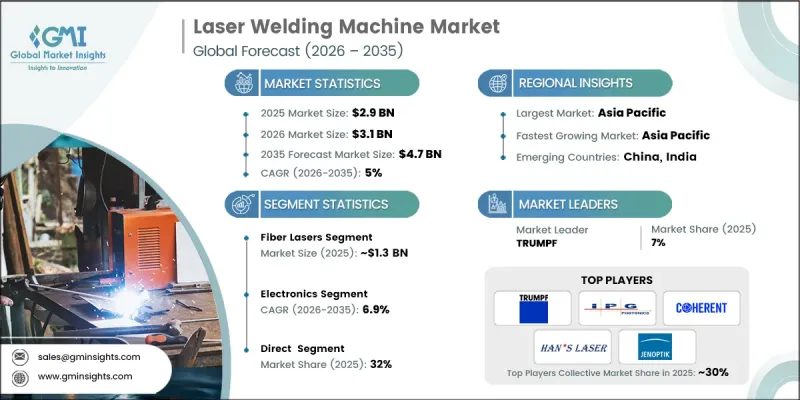
세계의 레이저 용접기 시장은 2025년에 29억 달러로 평가되었고, CAGR 5%로 성장하여 2035년까지 47억 달러에 이를 것으로 추정되고 있습니다.
각 산업이 자동화 및 디지털 통합 제조 환경으로의 전환을 가속화함에 따라 레이저 용접기 시장은 강한 모멘텀을 보이고 있습니다. 로봇 용접 셀, 스마트 생산 시스템 및 인더스트리 4.0 프레임워크의 도입 확대로 인해 고정밀 용접 기술에 대한 수요가 크게 증가하고 있습니다. 이 기계는 뛰어난 정밀도와 반복성을 갖추고 있으며, 고급 제어 플랫폼과 완벽하게 호환되어 일관성과 효율성을 중시하는 현대 산업 워크플로우에 매우 적합합니다. 비접촉식 작동으로 마모와 손상을 최소화하고 유지보수 빈도를 줄여 생산 주기의 중단 없는 연속성을 보장합니다. 또한, 실시간 모니터링과 통합된 센싱 기술이 자동화된 품질 보증을 지원하여 그 가치 제안을 더욱 강화합니다. 제조업체들이 생산성을 최적화하고 운영 변동성을 줄이는 것을 최우선 과제로 삼고 있는 가운데, 레이저 용접 솔루션은 차세대 생산 라인에서 필수적인 요소로 자리 잡고 있습니다. 스마트 팩토리와 첨단 제조 인프라에 대한 투자 확대로 여러 산업 분야에서의 도입이 더욱 가속화될 것으로 예측됩니다.
| 시장 범위 | |
|---|---|
| 개시 연도 | 2025년 |
| 예측 기간 | 2026-2035년 |
| 개시 연도 시장 규모 | 29억 달러 |
| 예측액 | 47억 달러 |
| CAGR | 5% |
자동화가 산업 운영의 핵심으로 떠오르면서 레이저 용접기 시장은 계속 진화하고 있으며, 고성능 용접 시스템의 광범위한 도입을 촉진하고 있습니다. 기업들은 효율적이고 확장성이 높은 생산에 대한 요구를 충족시키기 위해 다운타임을 최소화하고 연속적인 운영을 가능하게 하는 기술을 점점 더 많이 채택하고 있습니다. 정밀 제어 및 지능형 모니터링을 포함한 시스템 기능 강화를 통해 제조업체는 운영의 유연성을 유지하면서 우수한 출력 품질을 달성할 수 있습니다. 이러한 발전은 현대 제조 생태계에서 레이저 용접 장비의 역할을 강화하고 장기적인 시장 확대를 뒷받침하고 있습니다.
파이버 레이저 부문은 2025년 13억 달러 시장 규모를 기록할 것으로 예상되며, 2026년부터 2035년까지 연평균 복합 성장률(CAGR) 4.2%로 성장할 것으로 전망됩니다. 이 부문은 기존 레이저 기술에 비해 에너지 효율이 높고, 빔 품질이 우수하며, 유지 보수 요구 사항이 낮기 때문에 확고한 지위를 유지하고 있습니다. 파이버 레이저 시스템은 열 변형을 최소화하면서 정밀하고 깨끗한 용접이 가능하기 때문에 정밀도와 일관성이 요구되는 응용 분야에 매우 효과적입니다. 레이저의 채택이 확대됨에 따라 자동 및 수동 용접 작업 모두에서 기존 레이저 시스템을 점진적으로 대체하고 있으며, 시장에서의 우위를 더욱 강화하고 있습니다.
직접 판매 부문은 2025년 32%의 점유율을 차지할 것으로 예상되며, 복잡한 산업 솔루션 제공에 있어 그 중요성을 강조하고 있습니다. 직접 판매 채널을 통해 제조업체는 맞춤형 시스템 구성, 설치 지원, 기술 교육을 제공하면서 고객과의 견고한 관계를 구축할 수 있습니다. 이러한 접근 방식은 최종 사용자가 지속적인 서비스, 유지보수 및 전문가의 지도를 필요로 하는 고가의 투자 장비에서 특히 가치가 있습니다. 기업이 특정 운영 요구 사항을 충족하기 위해 신뢰할 수 있는 파트너십과 맞춤형 솔루션을 추구함에 따라 직접 참여에 대한 선호도가 계속 증가하고 있습니다.
미국 레이저 용접기 시장은 2025년 6억 달러에 달할 것으로 예상되며, 2035년까지 연평균 5.1%의 성장률을 보이며 북미에서 선두를 유지할 것으로 예측됩니다. 이러한 성장은 높은 수준의 제조 능력, 자동화 수준 향상, 주요 부문 전반의 강력한 산업 기반에 의해 뒷받침되고 있습니다. 정밀 제조 공정에 대한 수요 증가와 차세대 생산 기술에 대한 지속적인 투자가 시장 확대를 견인하고 있습니다. 중국 내 혁신과 효율성 향상에 대한 관심은 다양한 산업 분야에서 첨단 레이저 용접 시스템의 도입을 계속 주도하고 있습니다.
자주 묻는 질문
목차
제1장 조사 방법과 범위
제2장 주요 요약
제3장 업계 인사이트
제4장 경쟁 구도
제5장 시장 추산 및 예측 : 기술별, 2022-2035
제6장 시장 추산 및 예측 : 출력별, 2022-2035
제7장 시장 추산 및 예측 : 최종 용도별, 2022-2035
제8장 시장 추산 및 예측 : 유통 채널별, 2022-2035
제9장 시장 추산 및 예측 : 지역별, 2022-2035
제10장 기업 개요
LSH 26.05.08The Global Laser Welding Machine Market was valued at USD 2.9 billion in 2025 and is estimated to grow at a CAGR of 5% to reach USD 4.7 billion by 2035.
The laser welding machine market is gaining strong traction as industries accelerate their transition toward automation and digitally integrated manufacturing environments. Increasing deployment of robotic welding cells, smart production systems, and Industry 4.0 frameworks is significantly enhancing demand for high-precision welding technologies. These machines offer exceptional accuracy, repeatability, and seamless compatibility with advanced control platforms, making them highly suitable for modern industrial workflows focused on consistency and efficiency. Their non-contact operation minimizes wear and tear, reduces maintenance frequency, and ensures uninterrupted production cycles. Additionally, real-time monitoring and integrated sensing technologies support automated quality assurance, further strengthening their value proposition. As manufacturers continue to prioritize productivity optimization and reduced operational variability, laser welding solutions are becoming an essential component of next-generation production lines. Growing investments in smart factories and advanced manufacturing infrastructure are expected to further accelerate adoption across multiple industrial sectors.
| Market Scope | |
|---|---|
| Start Year | 2025 |
| Forecast Year | 2026-2035 |
| Start Value | $2.9 Billion |
| Forecast Value | $4.7 Billion |
| CAGR | 5% |
The laser welding machine market continues to evolve as automation becomes central to industrial operations, driving widespread implementation of high-performance welding systems. Companies are increasingly adopting technologies that deliver continuous operation with minimal downtime, aligning with the need for efficient and scalable production. Enhanced system capabilities, including precision control and intelligent monitoring, are enabling manufacturers to achieve superior output quality while maintaining operational flexibility. These advancements are reinforcing the role of laser welding equipment in modern manufacturing ecosystems and supporting long-term market expansion.
The fiber lasers segment generated USD 1.3 billion in 2025 and is projected to grow at a CAGR of 4.2% from 2026 to 2035. This segment maintains a strong position due to its high energy efficiency, superior beam quality, and lower maintenance requirements compared to conventional laser technologies. Fiber laser systems enable precise and clean welding with minimal thermal distortion, making them highly effective for applications that demand accuracy and consistency. Their growing adoption is gradually replacing traditional laser systems across both automated and manual welding operations, further strengthening their dominance in the market.
The direct distribution segment accounted for 32% share in 2025, highlighting its importance in delivering complex industrial solutions. Direct sales channels allow manufacturers to establish strong customer relationships while offering customized system configurations, installation support, and technical training. This approach is particularly valuable for high-investment equipment, where end users require ongoing service, maintenance, and expert guidance. The preference for direct engagement continues to grow as businesses seek reliable partnerships and tailored solutions to meet specific operational requirements.
United States Laser Welding Machine Market reached USD 600 million in 2025 and is expected to grow at a CAGR of 5.1% through 2035, maintaining its leadership in the North America region. This growth is supported by advanced manufacturing capabilities, increasing automation levels, and a strong industrial presence across key sectors. Rising demand for precision manufacturing processes, along with continuous investment in next-generation production technologies, is strengthening market expansion. The country's focus on innovation and efficiency improvements continues to drive the adoption of advanced laser welding systems across various industrial applications.
Key participants in the Global Laser Welding Machine Market include Amada Weld Tech, CHIRON Group, Coherent, Emerson Electric, Han's Laser Technology Industry Group, Huagong Laser Engineering, IPG Photonics, Jenoptik, KEYENCE, Laser Technologies, Laserline, Laser Star Technologies, Penta Laser, Precitec, and TRUMPF. Companies in the Laser Welding Machine Market are reinforcing their market position through continuous technological innovation, strategic collaborations, and customer-centric approaches. They are investing in advanced laser technologies, automation integration, and smart manufacturing solutions to enhance product performance and efficiency. Partnerships with industrial clients and system integrators enable tailored solutions and long-term contracts. Businesses are also expanding their global footprint through distribution networks and localized service support. Emphasis on research and development is driving improvements in precision, energy efficiency, and system reliability.
Table of Contents
Chapter 1 Methodology & Scope
- 1.1 Market scope & definitions
- 1.2 Research design
- 1.2.1 Research approach
- 1.2.2 Data collection methods
- 1.3 Base estimates and calculations
- 1.3.1 Base year calculation
- 1.3.2 Market estimates & forecasts parameters
- 1.4 Forecast Model
- 1.4.1 Key trends for market estimates
- 1.4.2 Quantified market impact analysis
- 1.4.2.1 Mathematical impact of growth parameters on forecast
- 1.4.3 Scenario analysis framework
- 1.5 Primary research and validation
- 1.5.1 Some of the primary sources (but not limited to)
- 1.6 Data mining sources
- 1.6.1 Paid Sources
- 1.7 Primary research and validation
- 1.7.1 Primary sources
- 1.8 Research Trail & confidence scoring
- 1.8.1 Research trail components
- 1.8.2 Scoring components
- 1.9 Research transparency addendum
- 1.9.1 Source attribution framework
- 1.9.2 Quality assurance metrics
- 1.9.3 Our commitment to trust
- 1.10 Market Definitions
Chapter 2 Executive Summary
- 2.1 Industry 360° synopsis
- 2.2 Key market trends
- 2.2.1 Regional
- 2.2.2 Technology
- 2.2.3 Output
- 2.2.4 End use industry
- 2.2.5 Distribution channel
- 2.3 CXO perspectives: Strategic imperatives
- 2.3.1 Key decision points for industry executives
- 2.3.2 Critical success factors for market players
- 2.4 Future outlook and strategic recommendations
Chapter 3 Industry Insights
- 3.1 Industry ecosystem analysis
- 3.1.1 Supplier landscape
- 3.1.2 Profit margin
- 3.1.3 Value addition at each stage
- 3.1.4 Factor affecting the value chain
- 3.2 Industry impact forces
- 3.2.1 Growth drivers
- 3.2.1.1 Growing adoption of automation in manufacturing
- 3.2.1.2 Rising demand for high-precision welding
- 3.2.1.3 Technological advancements in laser sources
- 3.2.2 Pitfalls & Challenges
- 3.2.2.1 High initial investment costs
- 3.2.2.2 Skilled workforce shortage
- 3.2.3 Opportunities
- 3.2.3.1 Increasing use in electric vehicle (EV) manufacturing
- 3.2.3.2 Expansion in medical device fabrication
- 3.2.1 Growth drivers
- 3.3 Growth potential analysis
- 3.4 Future market trends
- 3.5 Technology and innovation landscape
- 3.5.1 Current technological trends
- 3.5.2 Emerging technologies
- 3.6 Price trends
- 3.6.1 By region
- 3.6.2 By product
- 3.7 Regulatory landscape
- 3.7.1 North America
- 3.7.1.1 US: Consumer Product Safety Commission (CPSC) 16 Code of Federal Regulations (CFR) part 1512
- 3.7.1.2 Canada: International Organization for Standardization (ISO) 4210
- 3.7.2 Europe
- 3.7.2.1 Germany: Deutsches Institut fur Normung (DIN) European Norm (EN) ISO 4210
- 3.7.2.2 UK: European Norm (EN) ISO 4210 / United Kingdom Conformity Assessed (UKCA)
- 3.7.2.3 France: European Norm (EN) ISO 4210
- 3.7.3 Asia Pacific
- 3.7.3.1 China: Guobiao (GB) 3565
- 3.7.3.2 India: Indian Standard (IS) 10613
- 3.7.3.3 Japan: Japanese Industrial Standard (JIS) D 9110
- 3.7.4 Latin America
- 3.7.4.1 Brazil: Associacao Brasileira de Normas Tecnicas (ABNT) Norma Brasileira (NBR) ISO 4210
- 3.7.4.2 Mexico: International Organization for Standardization (ISO) 4210
- 3.7.5 Middle East & Africa
- 3.7.5.1 South Africa: South African National Standard (SANS) 311
- 3.7.5.2 Saudi Arabia: Saudi Standards, Metrology and Quality Organization (SASO) Gulf Standardization Organization (GSO) ISO 4210
- 3.7.1 North America
- 3.8 Trade data analysis (HS Code - 851580)
- 3.8.1 Import/export volume & value trends
- 3.8.2 Key trade corridors & tariff impact
- 3.9 Impact of ai & generative ai on the market
- 3.9.1 AI-driven disruption of existing business models
- 3.9.2 Genai use cases & adoption roadmap by segment
- 3.9.3 Risks, limitations & regulatory considerations
- 3.10 Porter's analysis
- 3.11 PESTEL analysis
Chapter 4 Competitive Landscape, 2025
- 4.1 Introduction
- 4.2 Company market share analysis
- 4.2.1 By Region
- 4.2.1.1 North America
- 4.2.1.2 Europe
- 4.2.1.3 Asia Pacific
- 4.2.1.4 Latin America
- 4.2.1.5 Middle East & Africa
- 4.2.1 By Region
- 4.3 Company matrix analysis
- 4.4 Competitive analysis of major market players
- 4.5 Competitive positioning matrix
- 4.6 Key developments
- 4.6.1 Mergers & acquisitions
- 4.6.2 Partnerships & collaborations
- 4.6.3 New product launches
- 4.6.4 Expansion plans
Chapter 5 Market Estimates & Forecast, By Technology, 2022 - 2035, (USD Billion) (Thousand Units)
- 5.1 Key trends
- 5.2 Fiber lasers
- 5.3 Co2 lasers
- 5.4 Diode lasers
- 5.5 Others
Chapter 6 Market Estimates & Forecast, By Output, 2022 - 2035, (USD Billion) (Thousand Units)
- 6.1 Key trends
- 6.2 Below 3 kW
- 6.3 3 kW - 6 kW
- 6.4 Above 6 kW
Chapter 7 Market Estimates & Forecast, By End Use, 2022 - 2035, (USD Billion) (Thousand Units)
- 7.1 Key trends
- 7.2 Automotive
- 7.3 Medical
- 7.4 Electronics
- 7.5 Aerospace & defense
- 7.6 Jewelry
- 7.7 Others
Chapter 8 Market Estimates & Forecast, By Distribution Channel, 2022 - 2035, (USD Billion) (Thousand Units)
- 8.1 Key trends
- 8.2 Direct
- 8.3 Indirect
Chapter 9 Market Estimates & Forecast, By Region, 2022 - 2035, (USD Billion) (Thousand Units)
- 9.1 Key trends
- 9.2 North America
- 9.2.1 U.S.
- 9.2.2 Canada
- 9.3 Europe
- 9.3.1 Germany
- 9.3.2 UK
- 9.3.3 France
- 9.3.4 Italy
- 9.3.5 Spain
- 9.4 Asia Pacific
- 9.4.1 China
- 9.4.2 India
- 9.4.3 Japan
- 9.4.4 South Korea
- 9.4.5 Australia
- 9.5 Latin America
- 9.5.1 Brazil
- 9.5.2 Mexico
- 9.5.3 Argentina
- 9.6 MEA
- 9.6.1 Saudi Arabia
- 9.6.2 UAE
- 9.6.3 South Africa
Chapter 10 Company Profiles
- 10.1 Amada Weld Tech
- 10.2 CHIRON Group
- 10.3 Coherent
- 10.4 Emerson Electric
- 10.5 Han's Laser Technology Industry Group
- 10.6 Huagong Laser Engineering
- 10.7 IPG Photonics
- 10.8 Jenoptik
- 10.9 KEYENCE
- 10.10 Laser Technologies
- 10.11 Laser line
- 10.12 Laser Star Technologies
- 10.13 Penta Laser
- 10.14 Precitec
- 10.15 TRUMPF


