|
시장보고서
상품코드
2019192
공항 퀵서비스 레스토랑 시장 기회, 성장요인, 업계 동향 분석 및 예측(2026-2035년)Airport Quick Service Restaurant (QSR) Market Opportunity, Growth Drivers, Industry Trend Analysis, and Forecast 2026 - 2035 |
||||||

세계의 공항 퀵서비스 레스토랑 시장은 2025년에 344억 달러로 평가되었고, CAGR 4.5%로 성장하여 2035년까지 534억 달러에 이를 것으로 추정되고 있습니다.
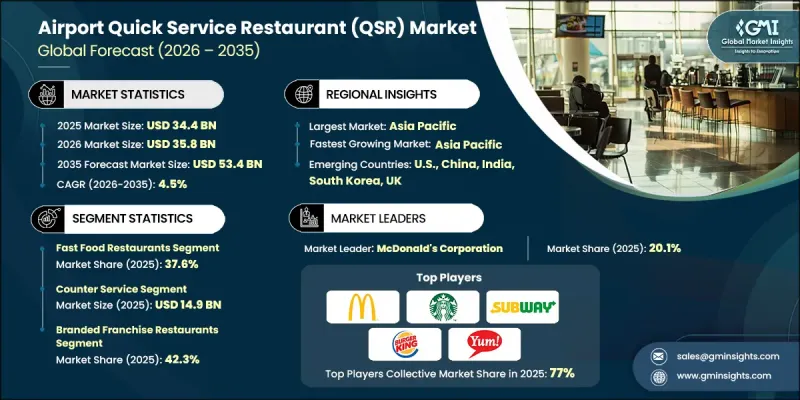
시장 확대는 전 세계 항공 승객 수 증가와 공항 내 빠르고 간편한 식사 솔루션에 대한 수요 증가에 힘입어 성장세를 보이고 있습니다. 디지털 주문 플랫폼, 모바일 기반 서비스, 셀프 서비스 기술의 도입으로 이동 공간에서의 식사 방식이 변화하고 있습니다. 또한, 공항 인프라에 대한 지속적인 투자와 터미널 확장으로 인해 외식 사업자들에게 더 많은 비즈니스 기회가 창출되고 있습니다. 여행자들은 점점 더 빠르고 신뢰할 수 있는 양질의 식사 옵션을 원하고 있으며, 이로 인해 사업자들은 서비스 속도와 메뉴의 효율성을 높이고 있습니다. 공항 당국과 외식 브랜드의 제휴와 더불어 건강하고 지속 가능한 메뉴로의 전환은 경쟁 구도를 더욱 형성하고 있습니다. 첨단 주문 기술의 통합과 편의성 및 개인화에 대한 승객의 기대치가 높아지면서 장기적인 시장 성장을 견인하고 있습니다.
| 시장 범위 | |
|---|---|
| 개시 연도 | 2025년 |
| 예측 기간 | 2026-2035년 |
| 개시 연도 시장 규모 | 344억 달러 |
| 예측액 | 534억 달러 |
| CAGR | 4.5% |
공항의 퀵서비스 레스토랑 시장은 전 세계 여객 수의 꾸준한 증가로 인해 강한 추진력을 보이고 있습니다. 이는 터미널 내 효율적인 푸드서비스 운영에 대한 수요에 직접적인 영향을 미치고 있습니다. 공항 시설 확장을 통해 사업자는 사업 규모를 확대하고 수익 창출 능력을 향상시킬 수 있게 되었습니다. 또한, 여행객들의 식음료 비용 증가와 모바일 주문, 자동 키오스크 등 디지털 도구의 보급도 시장 성장을 뒷받침하고 있습니다. 이러한 혁신은 주문의 정확성을 높이고, 대기 시간을 줄이며, 전반적인 고객 경험을 개선하는 등 현대의 공항 식음료 생태계에 필수적인 요소로 자리 잡고 있습니다.
패스트푸드점 부문은 대량의 고객을 신속하고 일관되게 처리할 수 있는 능력으로 인해 2025년 37.6%의 점유율을 차지할 것으로 예측됩니다. 이들 매장은 효율적인 운영, 표준화된 메뉴, 강력한 브랜드 인지도를 바탕으로 시간에 쫓기는 여행객들의 요구에 부응하고 있습니다. 여러 공항에 걸친 세계 진출은 고객과의 친밀감과 신뢰를 강화하여 부문의 성장과 운영의 확장성을 더욱 촉진하고 있습니다.
디지털 및 셀프 주문 부문은 모바일 앱, 자동 키오스크, 사전 주문 시스템의 보급 확대에 힘입어 2035년까지 연평균 5.1%의 성장률을 보일 것으로 예측됩니다. 이러한 기술을 통해 승객들은 줄을 서지 않고 맞춤형 메뉴 제안과 원활한 결제 옵션을 이용할 수 있게 됩니다. 로열티 프로그램 및 비접촉식 시스템과의 연계는 사용자의 편의성과 운영 효율성을 높여 디지털 주문이 공항 푸드서비스의 주요 촉진요인으로 자리매김하고 있습니다.
북미 공항 퀵서비스 레스토랑 시장은 지역 전체의 견조한 여객 수와 확립된 공항 컨세션 시스템에 힘입어 2025년 23.7%의 점유율을 차지할 것으로 예측됐습니다. 여행객 증가로 인해 퀵 다이닝 솔루션에 대한 지속적인 수요가 발생하고 있으며, 공항 운영사는 현대적인 소매 및 푸드서비스 개념에 대한 투자를 계속하고 있습니다. 첨단 주문 기술과 고효율 서비스 모델 도입으로 승객 만족도와 처리 능력이 향상되고 있습니다. 진행 중인 공항 개발 프로젝트와 항공 여행의 꾸준한 성장으로 향후 몇 년 동안 이 지역은 리더십을 유지할 것으로 예측됩니다.
자주 묻는 질문
목차
제1장 조사 방법과 범위
제2장 주요 요약
제3장 업계 인사이트
제4장 경쟁 구도
제5장 시장 추산 및 예측 : 레스토랑 유형별, 2022-2035
제6장 시장 추산 및 예측 : 서비스 모델별, 2022-2035
제7장 시장 추산 및 예측 : 비즈니스 모델별, 2022-2035
제8장 시장 추산 및 예측 : 여객 유형별, 2022-2035
제9장 시장 추산 및 예측 : 공항 장소/존별, 2022-2035
제10장 시장 추산 및 예측 : 지역별, 2022-2035
제11장 기업 개요
LSH 26.05.08The Global Airport Quick Service Restaurant Market was valued at USD 34.4 billion in 2025 and is estimated to grow at a CAGR of 4.5% to reach USD 53.4 billion by 2035.
Market expansion is fueled by rising global air passenger volumes and the increasing need for fast, accessible dining solutions within airport environments. The adoption of digital ordering platforms, mobile-based services, and self-service technologies is transforming how food is consumed in transit spaces. Additionally, continuous investments in airport infrastructure and terminal expansions are creating more commercial opportunities for food service providers. Travelers are increasingly seeking quick, reliable, and quality food options, encouraging operators to enhance service speed and menu efficiency. Partnerships between airport authorities and food service brands, combined with a shift toward healthier and more sustainable menu offerings, are further shaping the competitive landscape. The integration of advanced ordering technologies and evolving passenger expectations for convenience and personalization are reinforcing long-term market growth.
| Market Scope | |
|---|---|
| Start Year | 2025 |
| Forecast Year | 2026-2035 |
| Start Value | $34.4 Billion |
| Forecast Value | $53.4 Billion |
| CAGR | 4.5% |
The airport quick service restaurant market is witnessing strong momentum due to the steady increase in global passenger traffic, which is directly influencing demand for efficient food service operations within terminals. Expanding airport facilities are enabling operators to scale their presence and improve revenue generation capabilities. Growth is also supported by rising traveler spending on food and beverages and the widespread implementation of digital tools such as mobile ordering and automated kiosks. These innovations are improving order accuracy, reducing wait times, and enhancing the overall customer experience, making them integral to modern airport dining ecosystems.
The fast food restaurant segment accounted for 37.6% share in 2025, owing to its ability to handle high customer volumes with speed and consistency. These outlets benefit from streamlined operations, standardized menus, and strong brand visibility, allowing them to cater to time-sensitive travelers. Their global presence across multiple airport locations strengthens customer familiarity and trust, further supporting segment growth and operational scalability.
The digital and self-ordering segment is projected to grow at a CAGR of 5.1% throughout 2035, driven by the growing adoption of mobile applications, automated kiosks, and pre-ordering systems. These technologies enable passengers to avoid queues while accessing customized menu recommendations and seamless payment options. Integration with loyalty programs and contactless systems enhances user convenience and operational efficiency, positioning digital ordering as a key growth driver within airport food services.
North America Airport Quick Service Restaurant Market held 23.7% share in 2025, supported by strong passenger traffic and well-established airport concession frameworks across the region. The increasing number of travelers is generating sustained demand for quick dining solutions, while airport operators continue to invest in modern retail and food service concepts. The adoption of advanced ordering technologies and high-efficiency service models is improving passenger satisfaction and throughput. Ongoing airport development projects and consistent growth in air travel are expected to maintain the region's leadership position over the coming years.
Key companies operating in the Global Airport Quick Service Restaurant Market include Autogrill S.p.A., Burger King Company LLC, Chick-fil-A, Inc., Costa Limited, HMSHost Corporation, Inspire Brands, Inc., Lagardere Travel Retail, McDonald's Corporation, OTG Management, Panda Restaurant Group, Inc., SSP Group plc, Starbucks Corporation, Subway IP LLC, The Wendy's Company, and Yum! Brands, Inc. Companies in the Airport Quick Service Restaurant Market are strengthening their market position by focusing on digital transformation, strategic partnerships, and operational efficiency. They are investing heavily in mobile ordering platforms, self-service kiosks, and AI-driven analytics to improve customer experience and streamline operations. Expanding collaborations with airport authorities and concession operators allows brands to secure prime locations and increase visibility. Many players are also diversifying menus to include healthier and sustainable options, aligning with changing consumer preferences. Additionally, companies are enhancing supply chain efficiency and adopting data-driven decision-making to optimize inventory and reduce costs. Franchise expansion, brand localization, and personalized marketing strategies are further helping businesses strengthen their foothold and drive long-term growth.
Table of Contents
Chapter 1 Methodology and Scope
- 1.1 Market scope and definition
- 1.2 Research design
- 1.2.1 Research approach
- 1.2.2 Data collection methods
- 1.3 Data mining sources
- 1.3.1 Global
- 1.3.2 Regional/Country
- 1.4 Base estimates and calculations
- 1.4.1 Base year calculation
- 1.4.2 Key trends for market estimation
- 1.5 Primary research and validation
- 1.5.1 Primary sources
- 1.6 Forecast model
- 1.7 Research assumptions and limitations
Chapter 2 Executive Summary
- 2.1 Industry 360° synopsis, 2022 - 2035
- 2.2 Key market trends
- 2.2.1 Restaurant type trends
- 2.2.2 Service model trends
- 2.2.3 Business model trends
- 2.2.4 Passenger type trends
- 2.2.5 Airport location / zone trends
- 2.2.6 Regional trends
- 2.3 TAM Analysis, 2026-2035
- 2.4 CXO perspectives: Strategic imperatives
Chapter 3 Industry Insights
- 3.1 Industry ecosystem analysis
- 3.1.1 Supplier Landscape
- 3.1.2 Profit Margin
- 3.1.3 Cost structure
- 3.1.4 Value addition at each stage
- 3.1.5 Factor affecting the value chain
- 3.1.6 Disruptions
- 3.2 Industry impact forces
- 3.2.1 Growth drivers
- 3.2.1.1 Surging global air passenger traffic increases food demand
- 3.2.1.2 Digital/mobile ordering enhances speed and customer experience
- 3.2.1.3 Expansion of airport terminals boosts dining footprints
- 3.2.1.4 Budget airline growth raises airport layover food purchases
- 3.2.1.5 Rising traveler preference for convenient, fast meals
- 3.2.2 Industry pitfalls and challenges
- 3.2.2.1 High airport rents compress QSR profit margins
- 3.2.2.2 Footfall volatility from travel patterns impacts demand
- 3.2.3 Market opportunities
- 3.2.3.1 Healthy and sustainable menu innovations unlock demand
- 3.2.3.2 Tech-enabled pre-order and ready-pickup solutions expand reach
- 3.2.1 Growth drivers
- 3.3 Growth potential analysis
- 3.4 Regulatory landscape
- 3.4.1 North America
- 3.4.2 Europe
- 3.4.3 Asia Pacific
- 3.4.4 Latin America
- 3.4.5 Middle East & Africa
- 3.5 Porter's analysis
- 3.6 PESTEL analysis
- 3.7 Technology and Innovation landscape
- 3.7.1 Current technological trends
- 3.7.2 Emerging technologies
- 3.8 Price trends
- 3.8.1 By region
- 3.8.2 By product
- 3.9 Pricing Strategies
- 3.10 Emerging Business Models
- 3.11 Compliance Requirements
- 3.12 Patent and IP analysis
Chapter 4 Competitive Landscape, 2025
- 4.1 Introduction
- 4.2 Company market share analysis
- 4.2.1 By region
- 4.2.1.1 North America
- 4.2.1.2 Europe
- 4.2.1.3 Asia Pacific
- 4.2.1.4 Latin America
- 4.2.1.5 Middle East & Africa
- 4.2.2 Market concentration analysis
- 4.2.1 By region
- 4.3 Competitive benchmarking of key players
- 4.3.1 Financial performance comparison
- 4.3.1.1 Revenue
- 4.3.1.2 Profit margin
- 4.3.1.3 R&D
- 4.3.2 Product portfolio comparison
- 4.3.2.1 Product range breadth
- 4.3.2.2 Technology
- 4.3.2.3 Innovation
- 4.3.3 Geographic presence comparison
- 4.3.3.1 Global footprint analysis
- 4.3.3.2 Service network coverage
- 4.3.3.3 Market penetration by region
- 4.3.4 Competitive positioning matrix
- 4.3.4.1 Leaders
- 4.3.4.2 Challengers
- 4.3.4.3 Followers
- 4.3.4.4 Niche players
- 4.3.5 Strategic outlook matrix
- 4.3.1 Financial performance comparison
- 4.4 Key developments
- 4.4.1 Mergers and acquisitions
- 4.4.2 Partnerships and collaborations
- 4.4.3 Technological advancements
- 4.4.4 Expansion and investment strategies
- 4.4.5 Digital transformation initiatives
- 4.5 Emerging/ startup competitors landscape
Chapter 5 Market Estimates and Forecast, By Restaurant Type, 2022 - 2035 (USD Million)
- 5.1 Key trends
- 5.2 Fast food restaurants
- 5.3 Coffee & beverage chains
- 5.4 Bakery & snack outlets
- 5.5 Fast casual / fresh food QSR
Chapter 6 Market Estimates and Forecast, By Service Model, 2022 - 2035 (USD Million)
- 6.1 Key trends
- 6.2 Counter service
- 6.3 Grab-and-go
- 6.4 Digital / self-ordering
Chapter 7 Market Estimates and Forecast, By Business Model, 2022 - 2035 (USD Million)
- 7.1 Key trends
- 7.2 Airport concession operators
- 7.3 Branded franchise restaurants
- 7.4 Independent / local brands
Chapter 8 Market Estimates and Forecast, By Passenger Type, 2022 - 2035 (USD Million)
- 8.1 Key trends
- 8.2 Domestic passengers
- 8.3 International passengers
- 8.4 Transit / transfer passengers
Chapter 9 Market Estimates and Forecast, By Airport Location / Zone, 2022 - 2035 (USD Million)
- 9.1 Key trends
- 9.2 Landside / pre-security areas
- 9.3 Airside / post-security departure areas
- 9.4 Arrival halls
Chapter 10 Market Estimates and Forecast, By Region, 2022 - 2035 (USD Million)
- 10.1 Key trends
- 10.2 North America
- 10.2.1 U.S.
- 10.2.2 Canada
- 10.3 Europe
- 10.3.1 Germany
- 10.3.2 UK
- 10.3.3 France
- 10.3.4 Spain
- 10.3.5 Italy
- 10.4 Asia Pacific
- 10.4.1 China
- 10.4.2 India
- 10.4.3 Japan
- 10.4.4 Australia
- 10.4.5 South Korea
- 10.5 Latin America
- 10.5.1 Brazil
- 10.5.2 Mexico
- 10.5.3 Argentina
- 10.6 Middle East and Africa
- 10.6.1 South Africa
- 10.6.2 Saudi Arabia
- 10.6.3 UAE
Chapter 11 Company Profiles
- 11.1 Global Key Players
- 11.1.1 McDonald's Corporation
- 11.1.2 Starbucks Corporation
- 11.1.3 Subway IP LLC
- 11.1.4 Burger King Company LLC
- 11.1.5 Yum! Brands, Inc.
- 11.2 Regional key players
- 11.2.1 North America
- 11.2.1.1 OTG Management
- 11.2.1.2 Inspire Brands, Inc.
- 11.2.1.3 The Wendy’s Company
- 11.2.1.4 Chick fil A, Inc.
- 11.2.2 Asia Pacific
- 11.2.2.1 Panda Restaurant Group, Inc.
- 11.2.3 Europe
- 11.2.3.1 SSP Group plc
- 11.2.3.2 Autogrill S.p.A.
- 11.2.3.3 Lagardere Travel Retail
- 11.2.3.4 Costa Limited
- 11.2.1 North America
- 11.3 Niche Players/Disruptors
- 11.3.1 HMSHost Corporation