
|
시장보고서
상품코드
2019194
고기 분쇄기 시장 기회, 성장요인, 업계 동향 분석 및 예측(2026-2035년)Meat Grinder Market Opportunity, Growth Drivers, Industry Trend Analysis, and Forecast 2026 - 2035 |
||||||

세계의 고기 분쇄기 시장은 2025년에 12억 2,000만 달러로 평가되었고, CAGR 9.6%로 성장하여 2035년까지 30억 달러에 이를 것으로 예측됩니다.
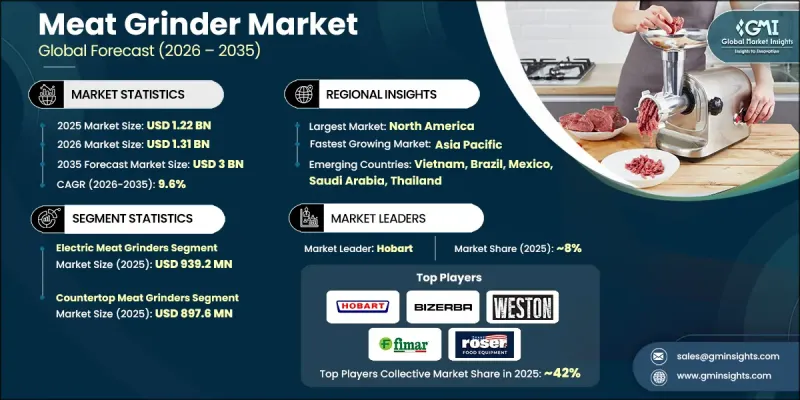
고기 분쇄기 산업은 저렴한 가격의 고품질 육가공품에 대한 수요 증가에 힘입어 최근 몇 년 동안 강력하고 꾸준한 성장세를 보이고 있습니다. 가정 요리에 대한 관심이 높아지면서 소비자들이 식재료의 품질과 맞춤형을 중요시하게 되면서 시장 확대가 더욱 가속화되고 있습니다. 고기 분쇄기는 변화하는 소비자의 기호에 부응하면서도 제품의 품질을 일정하게 유지하는 효과적인 수단으로 점점 더 많이 인식되고 있습니다. 동시에 식품 가공 기술의 발전으로 효율성과 생산 품질이 향상되어 주거용과 상업용 모두에 적용되고 있습니다. 이러한 긍정적인 추세에도 불구하고, 특히 산업용 사용자에게는 대형 장비와 첨단 가공 시스템에 대한 막대한 설비 투자가 필요하기 때문에 비용이 여전히 중요한 문제입니다. 따라서 시장에서는 강력한 수요 증가와 접근성 및 비용 효율성 향상을 위한 지속적인 노력의 균형을 유지하면서 다양한 최종 사용자층에 대한 지속적인 확장을 보장하고 있습니다.
| 시장 범위 | |
|---|---|
| 개시 연도 | 2025 |
| 예측 기간 | 2026-2035년 |
| 개시 시점 시장 규모 | 12억 2,000만 달러 |
| 예측액 | 30억 달러 |
| CAGR | 9.6% |
고기 분쇄기 시장은 자동화 시스템, 대용량 분쇄 장치, 가변 속도 운전 등 첨단 가공 기술의 도입과 함께 진화하고 있습니다. 이러한 혁신을 통해 업계 전반의 생산성과 업무 효율성이 향상되고 있습니다. 그러나 산업용 장비에 필요한 막대한 초기 투자비용이 여전히 중소기업이나 개인 사용자의 도입을 제한하고 있습니다.
전기 고기 분쇄기 시장은 2025년에 9억 3,920만 달러 규모를 기록할 것으로 예상되며, 2026년부터 2035년까지 연평균 10%의 성장률을 보일 것으로 예측됩니다. 이 제품은 수동식 대체품에 비해 처리 속도가 빠르고, 품질이 안정적이며, 사용 편의성이 뛰어나 널리 선호되고 있습니다. 모터의 효율성, 시스템 내구성, 안전 기능의 지속적인 개선으로 인해 더욱 널리 보급되고 있습니다. 또한, 가성비 좋은 전기 모델의 가용성이 높아지면서 더 많은 소비자들이 이러한 솔루션을 채택할 수 있도록 접근성이 확대되고 있습니다.
조리대형 고기 분쇄기 부문은 2025년에 73%의 점유율을 차지하며 시장 규모가 8억 9,760만 달러에 달할 것으로 예상되며, 2035년까지 연평균 10%의 성장률을 보일 것으로 예측됩니다. 휴대성, 컴팩트한 디자인, 보관이 용이해 현대의 주방 환경에 적합합니다. 이 제품들은 사용 및 설치 장소의 유연성을 제공하는 동시에 개선된 설계 기능으로 안전성과 편의성을 향상시켜 주택 사용자에게 매우 매력적입니다.
미국 고기 분쇄기 시장은 2025년에 2억 7,840만 달러에 달할 것으로 예상되며, 2026년부터 2035년까지 연평균 9.9% 성장할 것으로 예측됩니다. 이러한 성장은 가정식 요리와 맞춤형 요리에 대한 소비자의 관심이 높아진 데 따른 것입니다. 효율적이고 내구성이 뛰어난 주방 가전제품에 대한 수요가 증가하고 있지만, 공간과 비용에 대한 고려는 여전히 구매 결정에 영향을 미치고 있습니다. 그 결과, 컴팩트한 중저가형 제품이 폭넓은 사용자들의 지지를 받고 있습니다.
자주 묻는 질문
목차
제1장 조사 방법과 범위
제2장 주요 요약
제3장 업계 인사이트
제4장 경쟁 구도
제5장 시장 추산 및 예측 : 제품 유형별, 2022-2035
제6장 시장 추산 및 예측 : 급이 방식별, 2022-2035
제7장 시장 추산 및 예측 : 소재 유형별, 2022-2035
제8장 시장 추산 및 예측 : 구조별, 2022-2035
제9장 시장 추산 및 예측 : 용량별, 2022-2035
제10장 시장 추산 및 예측 : 용도별, 2022-2035
제11장 시장 추산 및 예측 : 가격별, 2022-2035
제12장 시장 추산 및 예측 : 최종사용자별, 2022-2035
제13장 시장 추산 및 예측 : 유통 채널별, 2022-2035
제14장 시장 추산 및 예측 : 지역별, 2022-2035
제15장 기업 개요
LSH 26.05.08The Global Meat Grinder Market was valued at USD 1.22 billion in 2025 and is estimated to grow at a CAGR of 9.6% to reach USD 3 billion by 2035.
The meat grinder industry has experienced strong and consistent expansion in recent years, driven by increasing demand for affordable and high-quality processed meat products. Rising interest in home-based food preparation is further accelerating adoption, as consumers seek greater control over ingredient quality and customization. Meat grinding solutions are increasingly being recognized as an effective way to maintain product consistency while meeting evolving consumer preferences. At the same time, advancements in food processing technology are improving efficiency and output quality, supporting both residential and commercial applications. Despite these positive trends, cost remains a key challenge, particularly for industrial users, as heavy-duty equipment and advanced processing systems require significant capital investment. The market is therefore balancing strong demand growth with ongoing efforts to improve accessibility and cost efficiency, ensuring continued expansion across diverse end-user segments.
| Market Scope | |
|---|---|
| Start Year | 2025 |
| Forecast Year | 2026-2035 |
| Start Value | $1.22 Billion |
| Forecast Value | $3 Billion |
| CAGR | 9.6% |
The meat grinder market is evolving with the adoption of advanced processing technologies, including automated systems, high-capacity grinding equipment, and variable-speed operations. These innovations are enhancing productivity and operational efficiency across the industry. However, the high upfront investment required for industrial-grade equipment continues to limit adoption among smaller businesses and individual users.
The electric meat grinders segment generated USD 939.2 million in 2025 and is expected to grow at a CAGR of 10% from 2026 to 2035. These products are widely preferred due to their high processing speed, consistent output quality, and ease of use compared to manual alternatives. Continuous improvements in motor efficiency, system durability, and safety features are further driving their adoption. Increased availability of cost-effective electric models is also expanding accessibility, allowing a broader range of consumers to adopt these solutions.
The countertop meat grinders segment held a 73% share and was valued at USD 897.6 million in 2025, with a projected CAGR of 10% through 2035. Their portability, compact design, and ease of storage make them well-suited for modern kitchen environments. These units offer flexibility in usage and placement, while improved design features enhance safety and convenience, making them highly appealing to residential users.
U.S. Meat Grinder Market captured USD 278.4 million in 2025 and is expected to grow at a CAGR of 9.9% from 2026 to 2035. Growth is supported by increasing consumer interest in home cooking and customized food preparation. Demand for efficient and durable kitchen appliances is rising, although space and cost considerations continue to influence purchasing decisions. As a result, compact and mid-range products are gaining traction among a wide range of users.
Key companies operating in the Global Meat Grinder Market include Bizerba, Hobart, Weston Brands, Fimar S.p.a., Roser Group, Dadaux SAS, ADE Germany, Dito Sama, Fatosa, S.A., Ari Makina, Amisy, Nikai Group, ASGO, C.R.M. s.r.l., Clearline, ABM Company, and AlexanderSolia GmbH. Companies in the Meat Grinder Market are strengthening their competitive position through product innovation and strategic expansion. They are investing in advanced technologies to improve efficiency, durability, and user safety. Manufacturers are focusing on developing compact and energy-efficient models that cater to both residential and commercial users. Strategic partnerships and distribution network expansion are helping companies reach new markets and enhance brand visibility. Firms are also emphasizing cost optimization and product differentiation to appeal to a broader customer base. Additionally, continuous improvements in design, functionality, and performance are enabling companies to meet evolving consumer demands while maintaining a strong market presence.
Table of Contents
Chapter 1 Methodology & Scope
- 1.1 Market scope and definition
- 1.2 Research design
- 1.2.1 Research approach
- 1.2.2 Data collection methods
- 1.3 Data mining sources
- 1.3.1 Global
- 1.3.2 Regional/Country
- 1.4 Base estimates and calculations
- 1.4.1 Base year calculation
- 1.4.2 Key trends for market estimation
- 1.5 Primary research and validation
- 1.5.1 Primary sources
- 1.6 Forecast model
- 1.7 Research assumptions and limitations
Chapter 2 Executive Summary
- 2.1 Industry 360° synopsis
- 2.2 Key market trends
- 2.2.1 Regional
- 2.2.2 Product Type
- 2.2.3 Feed Type
- 2.2.4 Material Type
- 2.2.5 Structure
- 2.2.6 Capacity
- 2.2.7 Operation
- 2.2.8 Price Range
- 2.2.9 End-Use
- 2.2.10 Distribution Channel
Chapter 3 Industry Insights
- 3.1 Industry ecosystem analysis
- 3.1.1 Supplier landscape
- 3.1.2 Profit margin
- 3.1.3 Value addition at each stage
- 3.1.4 Factor affecting the value chain
- 3.2 Industry impact forces
- 3.2.1 Growth drivers
- 3.2.1.1 Rising adoption of high-capacity industrial systems
- 3.2.1.2 Demand for "Clean-Label" and Freshly Processed Meat
- 3.2.1.3 Technological pivot to electric and "Smart" grinders
- 3.2.2 Industry pitfalls & challenges
- 3.2.2.1 Strict hygiene and food safety regulations (USDA/EFSA)
- 3.2.2.2 High initial investment for commercial-grade units
- 3.2.3 Industry Opportunities
- 3.2.3.1 Integration of AI-powered quality & contamination detection
- 3.2.3.2 Expansion of E-commerce and D2C sales channels
- 3.2.1 Growth drivers
- 3.3 Growth potential analysis
- 3.4 Future market trends
- 3.5 Technology and innovation landscape
- 3.5.1 Current technological trends
- 3.5.2 Emerging technologies
- 3.6 Price trends
- 3.6.1 Historical Price Trend Analysis (Driven by Primary Research) (2022-2024)
- 3.6.2 Pricing Strategy by Player Type (Premium / Value / Cost-Plus) (Driven by Primary Research)
- 3.6.3 Price Variation by Product Type & Capacity
- 3.6.4 Regional Price Benchmarking
- 3.6.5 Impact of Raw Material Costs on Pricing
- 3.7 Regulatory landscape
- 3.7.1 Standards and compliance requirements
- 3.7.2 Regional regulatory frameworks
- 3.7.3 Certification standards
- 3.8 Porter's analysis
- 3.9 PESTEL analysis
- 3.10 Trade Data Analysis (Driven by Primary Research)
- 3.10.1 Import/Export Volume & Value Trends (Driven by Primary Research) (2019-2024)
- 3.10.2 Key Trade Corridors & Tariff Impact (Driven by Primary Research)
- 3.10.3 Major Exporting Countries (Germany, China, Italy, U.S.)
- 3.10.4 Major Importing Countries & Regional Demand Patterns
- 3.10.5 Trade Policy Impact on Market Dynamics
- 3.11 Impact of AI & Generative AI on the Market
- 3.11.1 AI-Driven Disruption of Existing Business Models
- 3.11.2 GenAI Use Cases & Adoption Roadmap by Segment
- 3.11.3 Risks, Limitations & Regulatory Considerations
- 3.12 Capacity & Production Landscape (Driven by Primary Research)
- 3.12.1 Installed Capacity by Region & Key Producer (Driven by Primary Research)
- 3.12.2 Capacity Utilization Rates & Expansion Pipelines (Driven by Primary Research)
Chapter 4 Competitive Landscape, 2025
- 4.1 Introduction
- 4.2 Company market share analysis
- 4.2.1 By Region
- 4.2.1.1 North America
- 4.2.1.2 Europe
- 4.2.1.3 Asia Pacific
- 4.2.1.4 Latin America
- 4.2.1.5 Middle East & Africa
- 4.2.1 By Region
- 4.3 Company matrix analysis
- 4.4 Competitive analysis of major market players
- 4.5 Competitive positioning matrix
- 4.6 Key developments
- 4.6.1 Mergers & acquisitions
- 4.6.2 Partnerships & collaborations
- 4.6.3 New product launches
- 4.6.4 Expansion plans
Chapter 5 Market Estimates and Forecast, By Product Type, 2022 - 2035 (USD Million) (Million Units)
- 5.1 Key trends
- 5.2 Manual Meat Grinder
- 5.3 Electric Meat Grinder
Chapter 6 Market Estimates and Forecast, By Feed Type, 2022 - 2035 (USD Million) (Million Units)
- 6.1 Key trends
- 6.2 Tray Feed Grinder
- 6.3 Vertical Feed
- 6.4 Auger Feed
- 6.5 Manual Push Feed
- 6.6 Others (Vacuum Feed, etc.)
Chapter 7 Market Estimates and Forecast, By Material Type, 2022 - 2035 (USD Million) (Million Units)
- 7.1 Key trends
- 7.2 Aluminum
- 7.3 Cast Iron
- 7.4 Stainless Steel
- 7.5 Others (Carbon Steel, etc.)
Chapter 8 Market Estimates and Forecast, By Structure, 2022 - 2035 (USD Million) (Million Units)
- 8.1 Key trends
- 8.2 Countertop Meat Grinder
- 8.3 Mounted Meat Grinder
- 8.3.1 Floor Mounted
- 8.3.2 Table Mounted
Chapter 9 Market Estimates and Forecast, By Capacity, 2022 - 2035 (USD Million) (Million Units)
- 9.1 Key trends
- 9.2 Small (Up to 150 lbs/hour)
- 9.3 Medium (150-500 lbs/hour)
- 9.4 Large (Above 500 lbs/hour)
Chapter 10 Market Estimates and Forecast, By Operation, 2022 - 2035 (USD Million) (Million Units)
- 10.1 Key trends
- 10.2 Light-duty
- 10.3 Medium-duty
- 10.4 Heavy-duty
Chapter 11 Market Estimates and Forecast, By Price Range, 2022 - 2035 (USD Million) (Million Units)
- 11.1 Key trends
- 11.2 Low (Under USD 500)
- 11.3 Medium (USD 500 - USD 1000)
- 11.4 High (Above USD 1000)
Chapter 12 Market Estimates and Forecast, By End User, 2022 - 2035 (USD Million) (Million Units)
- 12.1 Key trends
- 12.2 Residential
- 12.3 Commercial
- 12.3.1 Hotels and Restaurants
- 12.3.2 Catering Services
- 12.3.3 Butcher Shops
- 12.3.4 Others
- 12.4 Industrial
- 12.4.1 Meat Processing Plants
- 12.4.2 Food Manufacturing Facilities
Chapter 13 Market Estimates & Forecast, By Distribution Channel, 2022 - 2035 (USD Million) (Million Units)
- 13.1 Key trends
- 13.2 Online
- 13.2.1 E-commerce Website
- 13.2.2 Company Website
- 13.3 Offline
- 13.3.1 Hypermarkets and Supermarkets
- 13.3.2 Specialty Stores
- 13.3.3 Others (Department Stores, Individual Stores, etc.)
Chapter 14 Market Estimates & Forecast, By Region, 2022 - 2035, (USD Million) (Million Units)
- 14.1 Key trends
- 14.2 North America
- 14.2.1 U.S.
- 14.2.2 Canada
- 14.3 Europe
- 14.3.1 Germany
- 14.3.2 UK
- 14.3.3 France
- 14.3.4 Italy
- 14.3.5 Spain
- 14.4 Asia Pacific
- 14.4.1 China
- 14.4.2 India
- 14.4.3 Japan
- 14.4.4 South Korea
- 14.4.5 Australia
- 14.4.6 Indonesia
- 14.4.7 Malaysia
- 14.5 Latin America
- 14.5.1 Brazil
- 14.5.2 Mexico
- 14.5.3 Argentina
- 14.6 MEA
- 14.6.1 Saudi Arabia
- 14.6.2 UAE
- 14.6.3 South Africa
Chapter 15 Company Profiles
- 15.1 Hobart
- 15.2 Bizerba
- 15.3 Weston Brands
- 15.4 Fimar S.p.a.
- 15.5 Roser Group
- 15.6 ADE Germany
- 15.7 Dito Sama
- 15.8 Fatosa, S.A.
- 15.9 Dadaux SAS
- 15.10 Ari Makina
- 15.11 Amisy
- 15.12 Nikai Group
- 15.13 ASGO
- 15.14 C.R.M. s.r.l.
- 15.15 Clearline
- 15.16 ABM Company
- 15.17 AlexanderSolia GmbH

(주말 및 공휴일 제외)


