
|
시장보고서
상품코드
2019207
헤마토크릿 테스트 장치 시장 : 시장 기회, 성장요인, 업계 동향 분석 및 예측(2026-2035년)Hematocrit Test Devices Market Opportunity, Growth Drivers, Industry Trend Analysis, and Forecast 2026 - 2035 |
||||||

세계의 헤마토크릿 테스트 장치 시장은 2025년에 39억 달러로 평가되었고, CAGR 4.8%로 성장하여 2035년까지 61억 달러에 이를 것으로 추정되고 있습니다.
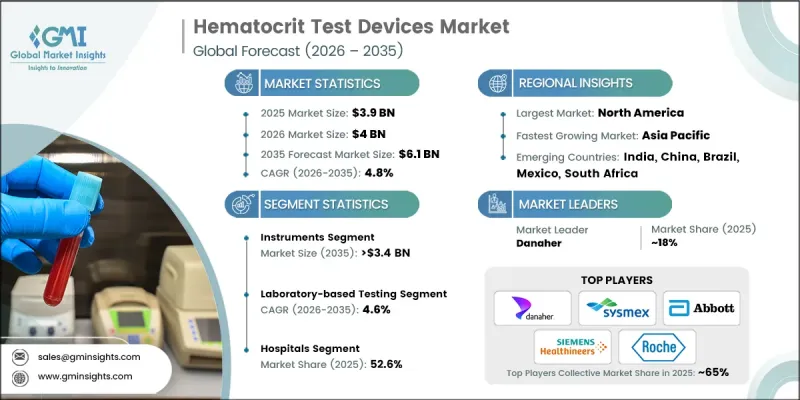
시장 성장은 혈액 질환의 유병률 증가, 전 세계 고령화, 현장 검사 기술의 지속적인 발전에 힘입어 성장세를 보이고 있습니다. 헤마토크릿 검사 장비는 환자의 혈액 내 적혈구 비율을 전체 혈액량의 백분율로 측정하여 빈혈, 탈수, 기타 혈액 질환 등의 상태를 모니터링하기 위해 병원, 진단실험실 및 현장 진료 시설에서 널리 사용되고 있습니다. 최신 장비는 컴팩트한 디자인, 디지털 인터페이스, 자동화된 시료 처리 기능을 통합하여 검사 속도, 정확도 및 운영 효율성을 향상시켰습니다. 휴대용 및 핸드헬드 헤마토크릿 분석기의 도입이 빠르게 증가하고 있으며, 의료진은 진료실, 응급실 및 외래 진료에서 침상 검사를 수행할 수 있게 되었습니다. 신속한 결과 제공은 임상적 의사결정을 강화하고, 외상 관리를 지원하며, 환자 예후를 개선하는 동시에 중앙 검사실에 대한 의존도를 낮춥니다. 이 시장은 마이크로플루이딕스 기술과 자동 혈액 검사 플랫폼의 혁신, 그리고 진단 정확도의 지속적인 향상으로 더욱 촉진되고 있습니다.
| 시장 범위 | |
|---|---|
| 개시 연도 | 2025 |
| 예측 기간 | 2026-2035년 |
| 개시 연도 시장 규모 | 39억 달러 |
| 예측액 | 61억 달러 |
| CAGR | 4.8% |
시약 및 소모품 부문은 2025년 16억 달러의 매출을 기록할 것으로 예상되며, 2035년까지 연평균 5.4%의 성장률을 보일 것으로 전망됩니다. 시약, 미세 모세관 튜브, 카트리지에 대한 수요는 병원과 진단실험실의 환자 검진 프로그램 확대와 헤마토크릿 검사 빈도가 높아짐에 따라 공급업체들의 지속적인 수익원이 되고 있습니다.
실험실 검사 장비 부문은 2025년 26억 달러로 2035년까지 연평균 4.6% 성장할 것으로 예측됩니다. 검사실용 시스템은 높은 정확도와 신뢰성을 바탕으로 빈혈, 다혈증 등의 질환을 진단하는 데 필요한 정확한 헤마토크릿 값을 제시합니다. 환자 사례의 복잡성과 상세한 진단에 대한 수요가 증가함에 따라 실험실 검사는 계속해서 표준으로 자리 잡고 있습니다.
미국의 헤마토크릿 검사 장비 시장은 2025년에 14억 5,000만 달러로 평가되었고, 2035년까지 연평균 4.3% 성장할 것으로 예측됩니다. 이 나라는 첨단 병원, 진단실험실, 대량 및 정밀 검사가 가능한 실험실로 구성된 정교한 의료 인프라의 혜택을 누리고 있습니다. 조기 발견과 지속적인 환자 모니터링에 대한 강조, 그리고 최첨단 혈액학 분석기기의 도입은 이 지역 시장 성장을 더욱 촉진하고 있습니다.
자주 묻는 질문
목차
제1장 조사 방법
제2장 주요 요약
제3장 업계 인사이트
제4장 경쟁 구도
제5장 시장 추산 및 예측 : 제품별, 2022-2035
제6장 시장 추산 및 예측 : 검사 방식별, 2022-2035
제7장 시장 추산 및 예측 : 용도별, 2022-2035
제8장 시장 추산 및 예측 : 최종 용도별, 2022-2035
제9장 시장 추산 및 예측 : 지역별, 2022-2035
제10장 기업 개요
LSH 26.05.08The Global Hematocrit Test Devices Market was valued at USD 3.9 billion in 2025 and is estimated to grow at a CAGR of 4.8% to reach USD 6.1 billion by 2035.
Market growth is driven by the rising prevalence of blood disorders, an aging global population, and continuous advancements in point-of-care testing technologies. Hematocrit test devices measure the proportion of red blood cells in a patient's blood, expressed as a percentage of total blood volume, and are widely used in hospitals, diagnostic labs, and point-of-care facilities to monitor conditions such as anemia, dehydration, and other hematological disorders. Modern devices integrate compact designs, digital interfaces, and automated sample processing, improving testing speed, accuracy, and operational efficiency. The adoption of portable and handheld hematocrit analyzers is rapidly increasing, enabling healthcare professionals to perform bedside testing in clinics, emergency care, and ambulatory services. Rapid results enhance clinical decision-making, support trauma management, and improve patient outcomes while reducing reliance on centralized laboratories. The market is further supported by innovations in microfluidics, automated hematology platforms, and continuous improvements in diagnostic accuracy.
| Market Scope | |
|---|---|
| Start Year | 2025 |
| Forecast Year | 2026-2035 |
| Start Value | $3.9 Billion |
| Forecast Value | $6.1 Billion |
| CAGR | 4.8% |
The reagents and consumables segment generated USD 1.6 billion in 2025 and is projected to grow at a CAGR of 5.4% through 2035. The demand for reagents, microcapillary tubes, and cartridges is driven by the high frequency of hematocrit testing and expanding patient screening programs across hospitals and diagnostic laboratories, ensuring recurring revenue for suppliers.
The laboratory-based testing devices segment accounted for USD 2.6 billion in 2025 and is expected to grow at a CAGR of 4.6% through 2035. Laboratory systems are favored for their high precision and reliability, offering accurate hematocrit results necessary for diagnosing conditions such as anemia and polycythemia. The increasing complexity of patient cases and demand for detailed diagnostics continue to reinforce laboratory-based testing as the benchmark standard.
U.S. Hematocrit Test Devices Market was valued at USD 1.45 billion in 2025, with a projected CAGR of 4.3% through 2035. The country benefits from a sophisticated healthcare infrastructure comprising advanced hospitals, diagnostic laboratories, and research institutions capable of high-volume, precise testing. The emphasis on early detection, continuous patient monitoring, and the adoption of cutting-edge hematology analyzers further support market growth in the region.
Key players operating in the Global Hematocrit Test Devices Market include Roche, Abbott, Danaher, Siemens Healthineers, Nova Biomedical, EKF Diagnostics, NIHON KOHDEN, Boule, Mindray, Diatron, HORIBA Medical, A. Menarini, BIO-RAD, SENSA CORE, and Sysmex. Companies in the Global Hematocrit Test Devices Market strengthen their presence by investing heavily in research and development to enhance device accuracy, processing speed, and usability. They are expanding their product portfolios to include portable, point-of-care, and automated systems tailored to hospital, laboratory, and emergency settings. Strategic partnerships with healthcare providers, distributors, and diagnostic laboratories help improve market access and reach. Firms focus on expanding geographic coverage, entering emerging markets, and offering training and after-sales support to build customer loyalty. Product differentiation through compact design, digital integration, and workflow optimization ensures sustained adoption, while ongoing technological innovation and marketing initiatives maintain competitive positioning and long-term growth.
Table of Contents
Chapter 1 Research Methodology
- 1.1 Research approach
- 1.2 Quality commitments
- 1.2.1 GMI AI policy & data integrity commitment
- 1.2.1.1 Source consistency protocol
- 1.2.1 GMI AI policy & data integrity commitment
- 1.3 Research trail & confidence scoring
- 1.3.1 Research trail components
- 1.3.2 Scoring components
- 1.4 Data collection
- 1.4.1 Partial list of primary sources
- 1.5 Data mining sources
- 1.5.1 Paid sources
- 1.5.1.1 Sources, by region
- 1.5.1 Paid sources
- 1.6 Base estimates and calculations
- 1.6.1 Base year calculation for any one approach
- 1.7 Forecast model
- 1.7.1 Quantified market impact analysis
- 1.7.1.1 Mathematical impact of growth parameters on forecast
- 1.7.1 Quantified market impact analysis
- 1.8 Research transparency addendum
- 1.8.1 Source attribution framework
- 1.8.2 Quality assurance metrics
- 1.8.3 Our commitment to trust
Chapter 2 Executive Summary
- 2.1 Industry 3600 synopsis
- 2.2 Key market trends
- 2.2.1 Regional trends
- 2.2.2 Product trends
- 2.2.3 Modality trends
- 2.2.4 Application trends
- 2.2.5 End use trends
- 2.3 CXO perspectives: Strategic imperatives
Chapter 3 Industry Insights
- 3.1 Industry ecosystem analysis
- 3.2 Industry impact forces
- 3.2.1 Growth drivers
- 3.2.1.1 Increasing prevalence of anemia and other blood disorders
- 3.2.1.2 Growing demand for point-of-care (POC) diagnostic testing
- 3.2.1.3 Technological advancements in hematology analyzers and diagnostic devices
- 3.2.1.4 Expansion of healthcare infrastructure and diagnostic laboratories
- 3.2.2 Industry pitfalls and challenges
- 3.2.2.1 High cost of advanced hematocrit testing devices
- 3.2.2.2 Risk of inaccurate results due to improper usage or environmental factors
- 3.2.3 Market opportunities
- 3.2.3.1 Expansion of hematocrit testing in emerging markets with high anemia burden
- 3.2.3.2 Growing adoption of portable and handheld hematocrit testing devices
- 3.2.1 Growth drivers
- 3.3 Growth potential analysis
- 3.4 Regulatory landscape (Driven by primary research)
- 3.4.1 North America
- 3.4.2 Europe
- 3.4.3 Asia Pacific
- 3.5 Technology landscape
- 3.5.1 Current technological trends
- 3.5.2 Emerging technologies (Driven by primary research)
- 3.6 Future market trends (Driven by primary research)
- 3.7 Porter's analysis
- 3.8 PESTEL analysis
- 3.9 Customer insights (Driven by primary research)
- 3.10 Start-up scenarios (Driven by primary research)
- 3.11 Investment landscape (Driven by primary research)
- 3.12 Impact of AI and its future assessment
- 3.13 Value chain analysis
- 3.14 Gap analysis
Chapter 4 Competitive Landscape, 2025
- 4.1 Introduction
- 4.2 Company matrix analysis
- 4.3 Company market share analysis
- 4.3.1 Global
- 4.3.2 North America
- 4.3.3 Europe
- 4.3.4 Asia Pacific
- 4.4 Competitive positioning matrix
- 4.5 Competitive analysis of major market players
- 4.6 Key developments
- 4.6.1 Mergers & acquisitions
- 4.6.2 Partnerships & collaborations
- 4.6.3 New product launches
- 4.6.4 Expansion plans
Chapter 5 Market Estimates and Forecast, By Product, 2022 - 2035 ($ Mn)
- 5.1 Key trends
- 5.2 Instruments
- 5.2.1 Hematocrit test analyzer
- 5.2.2 Hematocrit test meter
- 5.3 Reagents and consumables
Chapter 6 Market Estimates and Forecast, By Modality, 2022 - 2035 ($ Mn)
- 6.1 Key trends
- 6.2 Laboratory-based testing
- 6.3 Point-of-care (POC) testing
Chapter 7 Market Estimates and Forecast, By Application, 2022 - 2035 ($ Mn)
- 7.1 Key trends
- 7.2 Anemia
- 7.3 Congenital heart diseases
- 7.4 Polycythemia vera
- 7.5 Other applications
Chapter 8 Market Estimates and Forecast, By End Use, 2022 - 2035 ($ Mn)
- 8.1 Key trends
- 8.2 Hospitals
- 8.3 Diagnostic laboratories
- 8.4 Ambulatory surgical centers
- 8.5 Other end users
Chapter 9 Market Estimates and Forecast, By Region, 2022 - 2035 ($ Mn)
- 9.1 Key trends
- 9.2 North America
- 9.2.1 U.S.
- 9.2.2 Canada
- 9.3 Europe
- 9.3.1 Germany
- 9.3.2 UK
- 9.3.3 France
- 9.3.4 Spain
- 9.3.5 Italy
- 9.3.6 Netherlands
- 9.4 Asia Pacific
- 9.4.1 China
- 9.4.2 Japan
- 9.4.3 India
- 9.4.4 Australia
- 9.4.5 South Korea
- 9.5 Latin America
- 9.5.1 Brazil
- 9.5.2 Mexico
- 9.5.3 Argentina
- 9.6 Middle East and Africa
- 9.6.1 South Africa
- 9.6.2 Saudi Arabia
- 9.6.3 UAE
Chapter 10 Company Profiles
- 10.1 A. Menarini
- 10.2 Abbott
- 10.3 BIO-RAD
- 10.4 Boule
- 10.5 Danaher
- 10.6 Diatron
- 10.7 EKF Diagnostics
- 10.8 HORIBA Medical
- 10.9 Mindray
- 10.10 NIHON KOHDEN
- 10.11 Nova Biomedical
- 10.12 Roche
- 10.13 SENSA CORE
- 10.14 Siemens Healthineers
- 10.15 Sysmex