
|
시장보고서
상품코드
2019224
사탕수수 절단기 시장 기회, 성장요인, 업계 동향 분석 및 예측(2026-2035년)Cane Chopper Market Opportunity, Growth Drivers, Industry Trend Analysis, and Forecast 2026 - 2035 |
||||||

세계의 사탕수수 절단기 시장은 2025년에 13억 달러로 평가되었고, 2035년까지 연평균 복합 성장률(CAGR)23.1%로 성장하여 103억 달러에 이를 것으로 추정되고 있습니다.
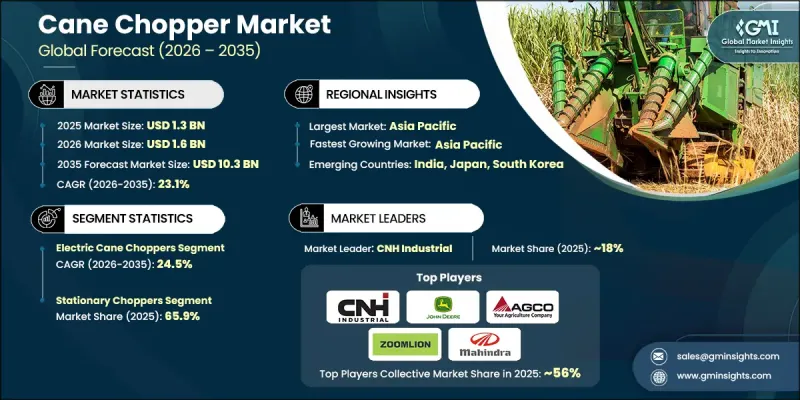
농부들은 효율성을 높이고, 노동력에 대한 의존도를 낮추며, 수확 과정을 가속화하기 위해 노동집약적인 수작업에서 기계화 초퍼로 전환하고 있습니다. 사탕수수용 초퍼는 보다 빠르고 균일한 수확을 가능하게 하여 소규모 농장부터 대규모 상업용 농장까지 폭넓게 활용되고 있습니다. 농업 계약업체는 안정적인 성능을 발휘하고 밭에서 손실을 최소화하는 기계를 원합니다. 인건비 상승, 노동력 부족, 그리고 농업 기계화에 대한 정부의 지원책도 도입을 더욱 부추기고 있습니다. 최신 초퍼는 내구성과 유지보수 용이성을 보장하면서 작물 밀도 및 밭 조건의 변화에 대응할 수 있도록 설계되어 있습니다. 제당 공장은 당 회수율과 생산의 연속성을 유지하기 위해 적시에 고품질의 사탕수수 공급이 필요하기 때문에 설탕 생산 및 가공 산업의 성장도 수요를 촉진하고 있습니다.
| 시장 범위 | |
|---|---|
| 개시 연도 | 2025년 |
| 예측 기간 | 2026-2035년 |
| 개시 연도 시장 규모 | 13억 달러 |
| 예측액 | 103억 달러 |
| CAGR | 23.1% |
전기 사탕수수 절단기 부문은 2025년에 6억 3,320만 달러 시장 규모를 기록할 것으로 예상되며, 2035년까지 연평균 24.5%의 성장률을 보일 것으로 예측됩니다. 이 기계는 작동 효율, 균일한 절단, 저소음, 적은 배기가스 배출, 적은 유지보수 필요성으로 시장을 선도하고 있습니다. 특히 위생적이고 신뢰할 수 있는 장비를 원하는 주스 판매업체, 소규모 가공업체, 외식업 매장들 사이에서 인기가 높습니다.
고정식 절단기 시장은 2025년에 65.9%의 점유율을 차지하고 2035년까지 연평균 복합 성장률(CAGR) 5%를 나타낼 것으로 예측됩니다. 고정식 설계로 뛰어난 안정성, 조작성, 안전성 및 안정적인 생산량을 보장하여 상업용 주스 매장 및 가공 시설에 적합합니다. 견고한 구조로 진동을 최소화하면서 장기적인 가동이 가능하며, 대량 생산의 요구에도 대응할 수 있습니다.
중국의 사탕수수 절단기 시장은 2025년에 1억 2,500만 달러에 달할 것으로 예상되며, 2026년부터 2035년까지 연평균 24.8%의 성장률을 보일 것으로 예측됩니다. 사탕수수 재배가 활발한 남부 지방에서는 기계화가 진행되고 있습니다. 농부들은 키가 크고 무거운 사탕수수를 처리할 수 있는 대용량, 트랙터 탑재형 또는 자가 추진식 절단기를 선호합니다. 각 제조업체들은 농장 규모와 열대 환경 조건에 유연하게 대응할 수 있도록 내구성, 내식성 및 모듈식 설계에 중점을 두고 있습니다.
자주 묻는 질문
목차
제1장 조사 방법과 범위
제2장 주요 요약
제3장 업계 인사이트
제4장 경쟁 구도
제5장 시장 추산 및 예측 : 제품 유형별, 2022-2035
제6장 시장 추산 및 예측 : 설계별, 2022-2035
제7장 시장 추산 및 예측 : 처리 능력별, 2022-2035
제8장 시장 추산 및 예측 : 최종사용자별, 2022-2035
제9장 시장 추산 및 예측 : 유통 채널별, 2022-2035
제10장 시장 추산 및 예측 : 지역별, 2022-2035
제11장 기업 개요
LSH 26.05.08The Global Cane Chopper Market was valued at USD 1.3 billion in 2025 and is estimated to grow at a CAGR of 23.1% to reach USD 10.3 billion by 2035.
Farmers are transitioning from labor-intensive manual methods to mechanized choppers to boost efficiency, reduce workforce dependency, and accelerate the harvesting process. Cane choppers enable faster, uniform cutting, supporting both small farms and large-scale commercial operations. Agricultural contractors seek machines that offer consistent performance and minimize field losses. Rising labor costs, worker shortages, and government incentives for farm mechanization are further driving adoption. Modern choppers are engineered to handle varying crop densities and field conditions while ensuring durability and easy maintenance. The growth of sugar production and processing industries also fuels demand, as mills require a timely, high-quality cane supply to maintain sugar recovery and production continuity.
| Market Scope | |
|---|---|
| Start Year | 2025 |
| Forecast Year | 2026-2035 |
| Start Value | $1.3 Billion |
| Forecast Value | $10.3 Billion |
| CAGR | 23.1% |
The electric cane choppers segment generated USD 633.2 million in 2025 and is expected to grow at a CAGR of 24.5% through 2035. These machines lead the market due to their operational efficiency, uniform cutting, low noise, minimal emissions, and low maintenance needs. They are particularly popular among juice vendors, small processing units, and food service outlets seeking hygienic and reliable equipment.
The stationary choppers segment held 65.9% share in 2025 and is projected to grow at a CAGR of 5% through 2035. Their fixed design offers superior stability, control, safety, and consistent output, making them ideal for commercial juice shops and processing facilities. The robust construction allows for long-term operation with minimal vibration, supporting high-volume requirements.
China Cane Chopper Market reached USD 125 million in 2025 and is expected to grow at a CAGR of 24.8% from 2026 to 2035. Mechanization is increasing in southern provinces with dense sugarcane cultivation. Farmers favor high-capacity, tractor-mounted, and self-propelled choppers capable of handling tall, heavy cane. Manufacturers focus on durability, corrosion resistance, and modular designs to adapt to varying farm sizes and tropical conditions.
Key players in the Global Cane Chopper Market include AGCO Corporation, BMA Group, CNH Industrial, Crystal Engineers, Jacto, John Deere, Mahindra & Mahindra, Pratco, Rachitech Pvt. Ltd., Saisidha Sugar Equipment, Tata Agrico, Three Star Engineering, Trimurti Project Engineers, Ulka Industries, and Zoomlion. Leading companies in the Global Cane Chopper Market are reinforcing their positions by investing in R&D to enhance blade efficiency, durability, and energy consumption. They are introducing modular and customizable designs to cater to diverse farm sizes and crop conditions. Partnerships with local distributors and service providers improve after-sales support and market penetration. Firms are also focusing on developing electric and hybrid models to meet sustainability standards while offering low-maintenance solutions. Marketing campaigns highlighting productivity gains, reduced labor dependency, and operational reliability help strengthen brand recognition. Additionally, expanding production capacities and entering emerging regions further solidify their competitive presence globally.
Table of Contents
Chapter 1 Methodology & Scope
- 1.1 Market scope and definition
- 1.2 Research design
- 1.2.1 Research approach
- 1.2.2 Data collection methods
- 1.3 Data mining sources
- 1.3.1 Global
- 1.3.2 Regional/Country
- 1.4 Base estimates and calculations
- 1.4.1 Base year calculation
- 1.4.2 Key trends for market estimation
- 1.5 Primary research and validation
- 1.5.1 Primary sources
- 1.6 Forecast model
- 1.7 Research assumptions and limitations
Chapter 2 Executive Summary
- 2.1 Industry 360° synopsis
- 2.2 Key market trends
- 2.2.1 Regional
- 2.2.2 Product Type
- 2.2.3 Design
- 2.2.4 Capacity
- 2.2.5 End-User
- 2.2.6 Distribution channel
Chapter 3 Industry Insights
- 3.1 Industry ecosystem analysis
- 3.1.1 Supplier landscape
- 3.1.2 Profit margin
- 3.1.3 Value addition at each stage
- 3.1.4 Factor affecting the value chain
- 3.2 Industry impact forces
- 3.2.1 Growth drivers
- 3.2.1.1 Increasing mechanization in sugarcane harvesting operations
- 3.2.1.2 Expansion of sugar production and processing industries
- 3.2.1.3 Growing adoption of integrated sugarcane harvesting machines
- 3.2.2 Pitfalls & Challenges
- 3.2.2.1 High capital cost of mechanized cane chopping equipment
- 3.2.2.2 Maintenance and operational complexity of harvesting machinery
- 3.2.3 Opportunities
- 3.2.3.1 Development of compact and cost-effective cane choppers for small farms
- 3.2.3.2 Increasing demand for fuel-efficient and low-emission agricultural machinery
- 3.2.1 Growth drivers
- 3.3 Growth potential analysis
- 3.4 Future market trends
- 3.5 Technology and innovation landscape
- 3.5.1 Current technological trends
- 3.5.2 Emerging technologies
- 3.6 Regulatory landscape
- 3.6.1 Standards and compliance requirements
- 3.6.2 Regional regulatory frameworks
- 3.6.3 Certification standards
- 3.7 Porter's analysis
- 3.8 PESTEL analysis
- 3.9 Pricing analysis (driven by primary research)
- 3.9.1 Historical price trend analysis (driven by primary research) (2019-2024)
- 3.9.2 Pricing strategy by player type (premium/value/cost-plus) (driven by primary research)
- 3.9.3 Regional price variations & drivers
- 3.9.4 Impact of raw material costs on equipment pricing
- 3.9.5 Price elasticity of demand by farm size
- 3.10 Trade data analysis (driven by paid database)
- 3.10.1 Import/export volume & value trends (driven by paid database) (2019-2024)
- 3.10.2 Key trade corridors & tariff impact (driven by paid database)
- 3.10.3 Major exporting countries
- 3.10.4 Major importing countries
- 3.10.5 Trade policy impact on market dynamics
- 3.11 Capacity & production landscape (driven by primary research)
- 3.11.1 Installed manufacturing capacity by region & key producer (driven by primary research)
- 3.11.2 Capacity utilization rates & expansion pipelines (driven by primary research)
Chapter 4 Competitive Landscape, 2025
- 4.1 Introduction
- 4.2 Company market share analysis
- 4.2.1 By Region
- 4.2.1.1 North America
- 4.2.1.2 Europe
- 4.2.1.3 Asia Pacific
- 4.2.1.4 Latin America
- 4.2.1.5 Middle East & Africa
- 4.2.1 By Region
- 4.3 Company matrix analysis
- 4.4 Competitive analysis of major market players
- 4.5 Competitive positioning matrix
- 4.6 Key developments
- 4.6.1 Mergers & acquisitions
- 4.6.2 Partnerships & collaborations
- 4.6.3 New product launches
- 4.6.4 Expansion plans
Chapter 5 Market Estimates & Forecast, By Product Type, 2022 - 2035, (USD Billion) (Thousand Units)
- 5.1 Key trends
- 5.2 Manual Cane Choppers
- 5.3 Electric Cane Choppers
- 5.4 Tractor-Mounted Cane Choppers
Chapter 6 Market Estimates & Forecast, By Design, 2022 - 2035, (USD Billion) (Thousand Units)
- 6.1 Key trends
- 6.2 Handheld Choppers
- 6.3 Stationary Choppers
Chapter 7 Market Estimates & Forecast, By Capacity, 2022 - 2035, (USD Billion) (Thousand Units)
- 7.1 Key trends
- 7.2 Small Capacity (Under 5 tons/hour)
- 7.3 Medium Capacity (5-10 tons/hour)
- 7.4 Large Capacity (10-20 tons/hour)
- 7.5 Heavy-Duty Capacity (Over 20 tons/hour)
Chapter 8 Market Estimates & Forecast, By End-User, 2022 - 2035, (USD Billion) (Thousand Units)
- 8.1 Key trends
- 8.2 Sugar Mills
- 8.3 Agricultural Cooperatives
- 8.4 Large Commercial Farms
- 8.5 Small to Medium Farming Enterprises
- 8.6 Others
Chapter 9 Market Estimates & Forecast, By Distribution Channel, 2022 - 2035, (USD Billion) (Thousand Units)
- 9.1 Key trends
- 9.2 Direct
- 9.3 Indirect
Chapter 10 Market Estimates & Forecast, By Region, 2022 - 2035, (USD Billion) (Thousand Units)
- 10.1 Key trends
- 10.2 North America
- 10.2.1 U.S.
- 10.2.2 Canada
- 10.3 Europe
- 10.3.1 Germany
- 10.3.2 UK
- 10.3.3 France
- 10.3.4 Italy
- 10.3.5 Spain
- 10.4 Asia Pacific
- 10.4.1 China
- 10.4.2 India
- 10.4.3 Japan
- 10.4.4 South Korea
- 10.4.5 Australia
- 10.5 Latin America
- 10.5.1 Brazil
- 10.5.2 Mexico
- 10.5.3 Argentina
- 10.6 MEA
- 10.6.1 Saudi Arabia
- 10.6.2 UAE
- 10.6.3 South Africa
Chapter 11 Company Profiles
- 11.1 AGCO Corporation
- 11.2 BMA Group
- 11.3 CNH Industrial
- 11.4 Crystal Engineers
- 11.5 Jacto
- 11.6 John Deere
- 11.7 Mahindra & Mahindra
- 11.8 Pratco
- 11.9 Rachitech Pvt. Ltd.
- 11.10 Saisidha Sugar Equipment
- 11.11 Tata Agrico
- 11.12 Three Star Engineering
- 11.13 Trimurti Project Engineers
- 11.14 Ulka Industries
- 11.15 Zoomlion