

|
시장보고서
상품코드
2019226
핫소스 시장 기회, 성장요인, 업계 동향 분석 및 예측(2026-2035년)Hot Sauce Market Opportunity, Growth Drivers, Industry Trend Analysis, and Forecast 2026 - 2035 |
||||||

세계의 핫소스 시장은 2025년에 45억 달러로 평가되었고, CAGR 10.4%로 성장하여 2035년까지 121억 달러에 이를 것으로 추정되고 있습니다.
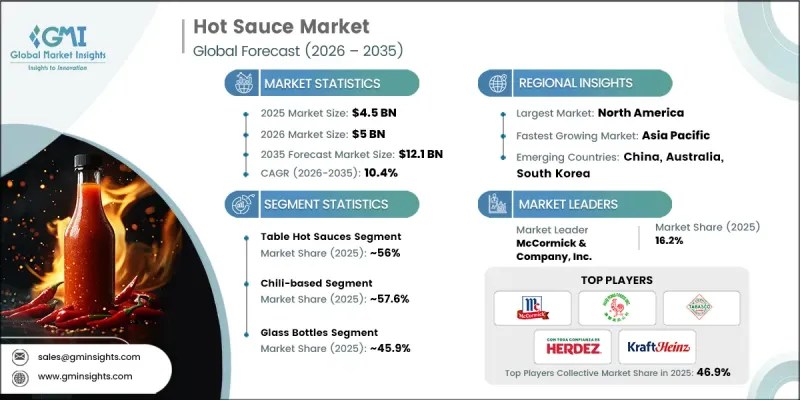
이러한 시장 확대는 유기농 및 천연 재료에 대한 소비자의 선호도 증가, 혁신적인 맛의 조합, 그리고 지속 가능한 생산 방식에 기인합니다. 소비자들은 다문화적 영향, 편의성, 매운 음식에 대한 수요 증가에 힘입어 대담하고 모험적인 맛을 추구하고 있습니다. 신흥 지역의 가처분 소득 증가는 틈새 취향에 부응하는 소규모 생산자들을 지원하고 있으며, 소셜 미디어 캠페인과 유명인사를 활용한 홍보는 브랜드 인지도 향상에 기여하고 있습니다. 또한, 소비자들이 맛뿐만 아니라 영양가도 중요하게 생각하게 되면서 클린 라벨과 건강 지향적 제품에 대한 관심이 높아지고 있습니다. 또한, 식생활 트렌드의 발전과 사용하기 쉽고 바로 사용할 수 있는 소스의 보급으로 일반 가정, 레스토랑, 패스트푸드점에서 수요가 더욱 증가하고 있어 핫소스가 세계 각국의 요리에 없어서는 안 될 존재로 자리 잡을 것이 확실시되고 있습니다.
| 시장 범위 | |
|---|---|
| 개시 연도 | 2025년 |
| 예측 기간 | 2026-2035년 |
| 개시 연도 시장 규모 | 45억 달러 |
| 예측액 | 121억 달러 |
| CAGR | 10.4% |
2025년 기준, 테이블용 핫소스 부문은 56%의 점유율을 차지했습니다. 이 부문이 선도적인 위치를 차지하고 있는 이유는 다재다능함, 문화적 연관성, 그리고 지속적인 혁신 덕분입니다. 테이블 소스는 편리하고 빠르게 요리의 맛을 업그레이드하는 데 이상적이며, 순한 입맛부터 모험심이 강한 입맛까지 다양한 취향에 맞게 다양한 맛과 매운맛의 레벨로 제공됩니다. 가정, 레스토랑, 상업용 주방에서의 보급은 다양한 소비자층에서 시장에서의 우위와 매력을 더욱 강화하고 있습니다.
고추 기반 핫소스 부문은 소비자의 선호도와 관련 건강 효과에 힘입어 2025년 57.6%의 점유율을 차지할 것으로 예측됩니다. 고추는 매운맛의 강도가 다른 자연스럽고 복합적인 풍미를 가지고 있어 향신료 애호가들 사이에서 인기를 얻고 있습니다. 이 소스는 라틴아메리카, 아시아, 아프리카의 향토 요리에 널리 사용되고 있으며, 가정과 전문 주방에서 일상적으로 사용되고 있습니다. 또한, 칠리 소스는 신진대사 촉진 및 심혈관계 지원과 같은 건강 효과로 인해 건강 지향적인 소비자들이 선호하고 있어 전 세계적으로 수요가 증가하고 있습니다.
북미 핫소스 시장은 2026년부터 2035년까지 연평균 복합 성장률(CAGR) 10.5%를 나타낼 것으로 예측됩니다. 이 지역의 성장은 대담하고 매콤한 맛의 자연식품과 유기농 식품에 대한 소비자의 관심이 높아지면서 성장세를 보이고 있습니다. 지속 가능한 포장, 환경 친화적인 제조 방법, 클린 라벨을 통해 각 브랜드는 환경 친화적인 생산 시스템을 도입하고, 건강 지향적인 맛을 추구하는 소비자의 요구에 부응하고 있습니다. 유통 채널의 확대와 강력한 디지털 마케팅 전략이 결합되어 이 지역 시장 침투와 브랜드 인지도 향상에 더욱 박차를 가하고 있습니다.
자주 묻는 질문
목차
제1장 조사 방법과 범위
제2장 주요 요약
제3장 업계 인사이트
제4장 경쟁 구도
제5장 시장 추산 및 예측 : 유형별, 2022-2035
제6장 시장 추산 및 예측 : 원재료별, 2022-2035
제7장 시장 추산 및 예측 : 포장별, 2022-2035
제8장 시장 추산 및 예측 : 유통 채널별, 2022-2035
제9장 시장 추산 및 예측 : 용도별, 2022-2035
제10장 시장 추산 및 예측 : 지역별, 2022-2035
제11장 기업 개요
LSH 26.05.08The Global Hot Sauce Market was valued at USD 4.5 billion in 2025 and is estimated to grow at a CAGR of 10.4% to reach USD 12.1 billion by 2035.
The market is expanding due to increasing consumer preference for organic and natural ingredients, innovative flavor combinations, and sustainable production practices. Consumers are seeking bold, adventurous tastes, driven by multicultural influences, convenience, and a growing appetite for spicy foods. Rising disposable incomes in emerging regions are supporting small-scale producers who cater to niche tastes, while social media campaigns and celebrity endorsements are boosting brand visibility. The market is also witnessing heightened interest in clean-label and health-focused products, as consumers increasingly value nutritional benefits alongside flavor. In addition, evolving culinary trends and the proliferation of easy-to-use, ready-to-serve sauces are further fueling demand across households, restaurants, and fast-food outlets, ensuring that hot sauce remains an integral part of global cuisine.
| Market Scope | |
|---|---|
| Start Year | 2025 |
| Forecast Year | 2026-2035 |
| Start Value | $4.5 Billion |
| Forecast Value | $12.1 Billion |
| CAGR | 10.4% |
The table hot sauces segment held a 56% share in 2025. This segment leads because of its versatility, cultural relevance, and continuous innovation. Table sauces offer convenience, making them ideal for quick meal enhancements, while available in a range of flavors and heat levels to suit both mild and adventurous palates. Their widespread presence in homes, restaurants, and commercial kitchens reinforces their market dominance and appeal across diverse consumer groups.
The chili-based hot sauces segment accounted for 57.6% share in 2025, driven by consumer preference and associated health benefits. Chili peppers provide a natural, complex flavor profile with varying heat intensities, making them a favorite among spice enthusiasts. These sauces are widely integrated into regional cuisines in Latin America, Asia, and Africa, ensuring regular household and professional kitchen use. Moreover, chili-based sauces are popular with health-conscious consumers due to benefits such as metabolism boosting and cardiovascular support, increasing their demand globally.
North America Hot Sauce Market is projected to grow at a CAGR of 10.5% between 2026 and 2035. Growth in this region is driven by rising consumer interest in natural and organic foods with bold, spicy flavors. Sustainable packaging, eco-friendly manufacturing methods, and clean-label initiatives are prompting brands to adopt environmentally responsible production while catering to health-conscious and flavor-seeking consumers. Expansion of distribution channels, along with strong digital marketing strategies, further supports market penetration and brand recognition in the region.
Key players operating in the Global Hot Sauce Market include Campbell Soup Company, Conagra Brands, Inc., Grupo Herdez, Heartbeat Hot Sauce Inc, Huy Fong Foods, Inc., La Costena, Marie Sharp's, McCormick & Company, Inc., McIlhenny Company, Pepper Palace, Inc., The Kraft Heinz Company, Torchbearer Sauces, Truff, and Unilever. Companies in the Global Hot Sauce Industry are implementing multiple strategies to strengthen their market position and expand reach. They are investing in research and development to create innovative flavors, organic and health-oriented formulations, and unique fusion products that appeal to evolving consumer tastes. Brands are leveraging social media, influencer partnerships, and celebrity endorsements to increase visibility and drive consumer engagement. Geographic expansion into emerging markets allows firms to tap into the growing demand for spicy and clean-label products. Companies are also focusing on sustainable production practices and eco-friendly packaging to meet consumer expectations.
Table of Contents
Chapter 1 Methodology & Scope
- 1.1 Market scope and definition
- 1.2 Research design
- 1.2.1 Research approach
- 1.2.2 Data collection methods
- 1.3 Data mining sources
- 1.3.1 Global
- 1.3.2 Regional/Country
- 1.4 Base estimates and calculations
- 1.4.1 Base year calculation
- 1.4.2 Key trends for market estimation
- 1.5 Primary research and validation
- 1.5.1 Primary sources
- 1.6 Forecast model
- 1.7 Research assumptions and limitations
Chapter 2 Executive Summary
- 2.1 Industry 360° synopsis
- 2.2 Key market trends
- 2.2.1 Regional
- 2.2.2 Type
- 2.2.3 Ingredients
- 2.2.4 Packaging
- 2.2.5 Distribution channel
- 2.2.6 Application
- 2.3 TAM Analysis, 2026-2035
- 2.4 CXO perspectives: Strategic imperatives
Chapter 3 Industry Insights
- 3.1 Industry ecosystem analysis
- 3.1.1 Supplier landscape
- 3.1.2 Profit margin
- 3.1.3 Value addition at each stage
- 3.1.4 Factor affecting the value chain
- 3.1.5 Disruptions
- 3.2 Industry impact forces
- 3.2.1 Growth drivers
- 3.2.1.1 Rising consumer preference for bold and spicy flavors
- 3.2.1.2 Expansion of E-commerce and global distribution channels
- 3.2.1.3 Increasing demand for premium, organic, and clean-label products
- 3.2.2 Industry pitfalls and challenges
- 3.2.2.1 Fluctuations in raw material prices and supply chain disruptions
- 3.2.2.2 Intense market competition and brand saturation
- 3.2.3 Market opportunities
- 3.2.3.1 Developing unique, artisanal hot sauce flavors to target niche markets and gourmet food lovers
- 3.2.3.2 Creating personalized or customizable hot sauce brands for restaurants, gift sets, or online retail
- 3.2.1 Growth drivers
- 3.3 Growth potential analysis
- 3.4 Regulatory landscape
- 3.4.1 North America
- 3.4.2 Europe
- 3.4.3 Asia Pacific
- 3.4.4 Latin America
- 3.4.5 Middle East & Africa
- 3.5 Porter's analysis
- 3.6 PESTEL analysis
- 3.7 Price trends
- 3.7.1 By region
- 3.7.2 By type
- 3.8 Future market trends
- 3.9 Technology and innovation landscape
- 3.9.1 Current technological trends
- 3.9.2 Emerging technologies
- 3.10 Patent Landscape
- 3.11 Trade statistics (HS code) (Note: the trade statistics will be provided for key countries only)
- 3.11.1 Major importing countries
- 3.11.2 Major exporting countries
- 3.12 Sustainability and environmental aspects
- 3.12.1 Sustainable practices
- 3.12.2 Waste reduction strategies
- 3.12.3 Energy efficiency in production
- 3.12.4 Eco-friendly initiatives
- 3.13 Carbon footprint consideration
Chapter 4 Competitive Landscape, 2025
- 4.1 Introduction
- 4.2 Company market share analysis
- 4.2.1 By region
- 4.2.1.1 North America
- 4.2.1.2 Europe
- 4.2.1.3 Asia Pacific
- 4.2.1.4 LATAM
- 4.2.1.5 MEA
- 4.2.1 By region
- 4.3 Competitive analysis of major market players
- 4.4 Competitive positioning matrix
- 4.5 Key developments
- 4.5.1 Mergers & acquisitions
- 4.5.2 Partnerships & collaborations
- 4.5.3 New product launches
- 4.5.4 Expansion plans
Chapter 5 Market Estimates and Forecast, By Type, 2022-2035 (USD Billion) (Kilo Tons)
- 5.1 Key trends
- 5.2 Table hot sauces
- 5.2.1 Traditional cayenne-based sauces
- 5.2.2 Buffalo-style wing sauces
- 5.2.3 Sriracha-style sauces
- 5.2.4 Green/jalapeno sauces
- 5.2.5 Others
- 5.3 Cooking sauces
- 5.3.1 Marinade & cooking sauces
- 5.3.2 Simmer sauces
- 5.3.3 Stir-fry & asian-style hot sauces
- 5.3.4 Others
- 5.4 Specialty sauces
Chapter 6 Market Estimates and Forecast, By Ingredients, 2022-2035 (USD Billion) (Kilo Tons)
- 6.1 Key trends
- 6.2 Chili-based
- 6.2.1 Cayenne pepper-based
- 6.2.2 Habanero-based
- 6.2.3 Jalapeno/green pepper-based
- 6.2.4 Others
- 6.3 Vinegar-based
- 6.3.1 Distilled vinegar-based
- 6.3.2 Apple cider vinegar-based
- 6.3.3 Blended vinegar
- 6.4 Tomato-based
- 6.5 Fruit-based
- 6.5.1 Mango-based hot sauces
- 6.5.2 Pineapple-based hot sauces
- 6.5.3 Tamarind & chamoy-style
- 6.6 Others
Chapter 7 Market Estimates and Forecast, By Packaging, 2022-2035 (USD Billion) (Kilo Tons)
- 7.1 Key trends
- 7.2 Glass bottles
- 7.3 Plastic jars
- 7.4 Pouches
- 7.5 Others
Chapter 8 Market Estimates and Forecast, By Distribution Channel, 2022-2035 (USD Billion) (Kilo Tons)
- 8.1 Key trends
- 8.2 Retail stores
- 8.3 Online retail
- 8.4 Food service
Chapter 9 Market Estimates and Forecast, By Application, 2022-2035 (USD Billion) (Kilo Tons)
- 9.1 Key trends
- 9.2 Table condiment/topping
- 9.3 Cooking ingredient
- 9.4 Wing sauce/coating
- 9.5 Dipping sauce
- 9.6 Beverage enhancement
- 9.7 Others
Chapter 10 Market Estimates and Forecast, By Region, 2022-2035 (USD Billion) (Kilo Tons)
- 10.1 Key trends
- 10.2 North America
- 10.2.1 U.S.
- 10.2.2 Canada
- 10.3 Europe
- 10.3.1 Germany
- 10.3.2 UK
- 10.3.3 France
- 10.3.4 Spain
- 10.3.5 Italy
- 10.3.6 Rest of Europe
- 10.4 Asia Pacific
- 10.4.1 China
- 10.4.2 India
- 10.4.3 Japan
- 10.4.4 Australia
- 10.4.5 South Korea
- 10.4.6 Rest of Asia Pacific
- 10.5 Latin America
- 10.5.1 Brazil
- 10.5.2 Mexico
- 10.5.3 Argentina
- 10.5.4 Rest of Latin America
- 10.6 Middle East and Africa
- 10.6.1 Saudi Arabia
- 10.6.2 South Africa
- 10.6.3 UAE
- 10.6.4 Rest of Middle East and Africa
Chapter 11 Company Profiles
- 11.1 Campbell Soup Company
- 11.2 Conagra Brands, Inc.
- 11.3 Grupo Herdez
- 11.4 Heartbeat Hot Sauce Inc
- 11.5 Huy Fong Foods, Inc.
- 11.6 La Costena
- 11.7 Marie Sharp’s
- 11.8 McCormick & Company, Inc.
- 11.9 McIlhenny Company
- 11.10 Pepper Palace, Inc.
- 11.11 The Kraft Heinz Company
- 11.12 Torchbearer Sauces
- 11.13 Truff
- 11.14 Unilever


