|
시장보고서
상품코드
2019244
아세톤 시장 기회, 성장요인, 업계 동향 분석 및 예측(2026-2035년)Acetone Market Opportunity, Growth Drivers, Industry Trend Analysis, and Forecast 2026 - 2035 |
||||||

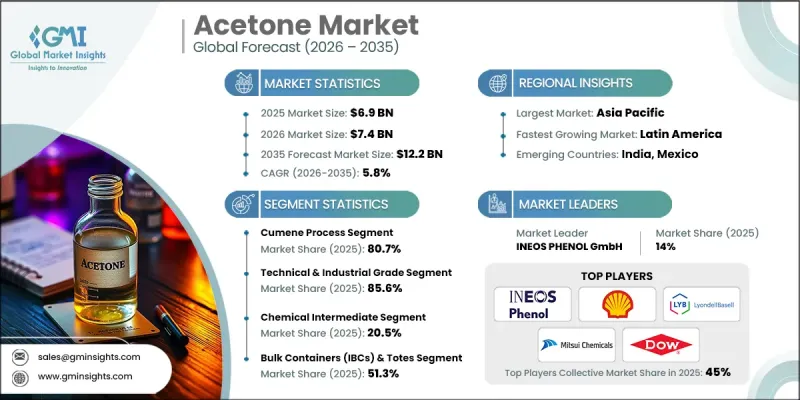
세계의 아세톤 시장은 2025년에 69억 달러로 평가되었고, CAGR 5.8%로 성장하여 2035년까지 122억 달러에 이를 것으로 추정되고 있습니다.
아세톤은 전통적인 기본 용매로서의 역할을 넘어 전 세계 현대 제조, 화학제품 생산 및 재료 개발 프로세스에서 필수적인 구성 요소로 진화했습니다. 아세톤은 다용도성, 우수한 용해력, 고부가가치 화학 반응 밸류체인의 전구체로서의 기능 등으로 인해 운영 효율성과 지속가능성을 최적화하고자 하는 산업에서 필수적인 요소로 자리 잡고 있습니다. 기업들은 환경에 미치는 영향을 최소화하고, 바이오 유래 원료를 활용하고, 순환형 화학을 도입하는 생산 방식에 점점 더 집중하고 있으며, 세계 환경 기준을 충족하기 위해 노력하고 있습니다. 이러한 변화는 플라스틱, 코팅, 제약, 퍼스널케어 등의 분야에서 제품 개발, 조달 및 다운스트림 파트너십 전략에 영향을 미치고 있습니다. 페놀 생산, 첨단 폐기물 저감 시스템, 환경 제어 기술의 통합은 공급망 운영을 재구성하고 전 세계 아세톤 생산업체들에게 새로운 경쟁 우위와 비용 효율성을 창출하고 있습니다.
| 시장 범위 | |
|---|---|
| 개시 연도 | 2025년 |
| 예측 기간 | 2026-2035년 |
| 개시 연도 시장 규모 | 69억 달러 |
| 예측액 | 122억 달러 |
| CAGR | 5.8% |
쿠멘법 부문은 80.7%의 점유율을 차지하고 있으며, 2035년까지 연평균 복합 성장률(CAGR) 6.8%를 나타낼 것으로 예측됩니다. 이 공정은 페놀 생산과의 완벽한 통합과 대규모 고품질 생산을 실현할 수 있는 능력으로 인해 업계의 핵심으로 자리 잡고 있습니다. IPA 탈수소법, 프로파일렌 산화법, 부탄 산화법 등의 대체법은 생산자에게 운영의 유연성과 원료의 다양성을 제공하고, 고순도 다운스트림 제품에 대한 수요를 충족시킬 수 있습니다.
기술 및 산업용 아세톤은 2025년 85.6%의 점유율을 차지했으며, 2026년부터 2035년까지 연평균 5.8%의 성장률을 보일 것으로 예측됩니다. 이 등급은 페인트, 플라스틱, 화학 중간체의 대규모 생산에 필수적이며, 안정된 용해력과 신뢰할 수 있는 가공 특성을 제공합니다. 고순도 ACS 및 시약 등급은 실험실 및 분석 용도를 지원하며, USP 및 제약 등급 아세톤은 의약품 개발 및 추출 공정의 엄격한 안전 및 품질 요구 사항을 충족합니다. FCC 및 식품 등급 아세톤은 식품 접촉, 향료 및 규제 물질 취급과 관련된 응용 분야에 필수적입니다.
2025년 기준 북미 아세톤 시장은 22.7%의 점유율을 차지했습니다. 이 지역은 높은 가동률로 운영되는 탄탄한 산업 기반, 첨단 생산 기술, 그리고 다운스트림 수요를 견인하는 고객 환경의 혜택을 누리고 있습니다. 혁신과 지속 가능한 제조 관행에 중점을 둔 북미는 세계 아세톤 공급망에서 주요 기여자로 자리매김하고 있습니다.
자주 묻는 질문
목차
제1장 조사 방법과 범위
제2장 주요 요약
제3장 업계 인사이트
제4장 경쟁 구도
제5장 시장 추산 및 예측 : 제조 기술별, 2022-2035
제6장 시장 추산 및 예측 : 등급별, 2022-2035
제7장 시장 추산 및 예측 : 용도별, 2022-2035
제8장 시장 추산 및 예측 : 유통 채널별, 2022-2035
제9장 시장 추산 및 예측 : 포장별, 2022-2035
제10장 시장 추산 및 예측 : 지역별, 2022-2035
제11장 기업 개요
LSH 26.05.08The Global Acetone Market was valued at USD 6.9 billion in 2025 and is estimated to grow at a CAGR of 5.8% to reach USD 12.2 billion by 2035.
Acetone has evolved beyond its traditional role as a basic solvent to become a vital component in modern manufacturing, chemical production, and material development processes across the globe. Its versatility, excellent solvency, and ability to act as a precursor in high-value chemical chains make it indispensable for industries aiming to optimize operational efficiency and sustainability. Companies are increasingly focusing on production methods that minimize environmental impact, leverage bio-derived raw materials, and adopt circular chemistry practices to meet global ecological standards. These shifts are influencing product development, procurement, and downstream partnership strategies across sectors such as plastics, coatings, pharmaceuticals, and personal care. Integration of phenol production, advanced waste minimization systems, and environmental control technologies is reshaping supply chain operations, creating new competitive advantages and cost efficiencies for acetone producers worldwide.
| Market Scope | |
|---|---|
| Start Year | 2025 |
| Forecast Year | 2026-2035 |
| Start Value | $6.9 Billion |
| Forecast Value | $12.2 Billion |
| CAGR | 5.8% |
The cumene process segment held an 80.7% share and is projected to grow at a CAGR of 6.8% through 2035. This process remains central to the industry due to its seamless integration with phenol production and its ability to deliver large-scale quality output. Alternative methods such as IPA dehydrogenation, propylene oxidation, and butane oxidation provide producers with operational flexibility and the ability to diversify feedstock while meeting the demand for high-purity downstream products.
The technical and industrial grade acetone held an 85.6% share in 2025 and is expected to grow at a CAGR of 5.8% from 2026 to 2035. These grades are essential for large-scale production in coatings, plastics, and chemical intermediates, offering stable solvency and reliable processing characteristics. High-purity ACS and reagent grades support laboratory and analytical applications, while USP and pharmaceutical grade acetone meet stringent safety and quality requirements for drug development and extraction processes. FCC and food-grade acetone are critical for applications involving food contact, flavoring, and regulated material handling.
North America Acetone Market accounted for 22.7% share in 2025. The region benefits from a strong industrial base operating at high capacity, advanced production techniques, and a customer landscape that drives demand for downstream applications. North America's focus on innovation and sustainable manufacturing practices positions it as a key contributor to the global acetone supply chain.
Leading companies in the Global Acetone Industry include INEOS Phenol GmbH, LyondellBasell Industries Holdings B.V., Royal Dutch Shell plc, BASF SE, Sumitomo Chemical Co., Ltd., Formosa Chemicals & Fibre Corporation, Reliance Industries Limited, The Dow Chemical Company, LG Chem Ltd., Celanese Corporation, Mitsui Chemicals, Inc., PTT Global Chemical Public Company Limited, LanzaTech, Inc., and Honeywell International Inc. Companies in the acetone market are strengthening their market foothold by investing in sustainable production technologies, expanding capacity, and diversifying feedstock sources. Key strategies include developing bio-based and environmentally friendly acetone to meet regulatory requirements, optimizing phenol integration for cost efficiency, and establishing partnerships with downstream industries. Firms are also focusing on innovation in production processes to improve yield, reduce energy consumption, and enhance product quality. Strategic acquisitions, expansion into emerging markets, and portfolio diversification are helping companies capture new applications in pharmaceuticals, coatings, and plastics, while maintaining a competitive advantage in both industrial and high-purity segments.
Table of Contents
Chapter 1 Methodology & Scope
- 1.1 Market scope and definition
- 1.2 Research design
- 1.2.1 Research approach
- 1.2.2 Data collection methods
- 1.3 Data mining sources
- 1.3.1 Global
- 1.3.2 Regional/Country
- 1.4 Base estimates and calculations
- 1.4.1 Base year calculation
- 1.4.2 Key trends for market estimation
- 1.5 Primary research and validation
- 1.5.1 Primary sources
- 1.6 Forecast model
- 1.7 Research assumptions and limitations
Chapter 2 Executive Summary
- 2.1 Industry 360° synopsis
- 2.2 Key market trends
- 2.2.1 Regional
- 2.2.2 Production Technology
- 2.2.3 Grade
- 2.2.4 Application
- 2.2.5 Distribution Channel
- 2.2.6 Packaging
- 2.3 TAM Analysis, 2026-2035
- 2.4 CXO perspectives: Strategic imperatives
- 2.4.1 Executive decision points
- 2.4.2 Critical success factors
- 2.5 Future Outlook and Strategic Recommendations
Chapter 3 Industry Insights
- 3.1 Industry ecosystem analysis
- 3.1.1 Supplier landscape
- 3.1.2 Profit margin
- 3.1.3 Value addition at each stage
- 3.1.4 Factor affecting the value chain
- 3.1.5 Disruptions
- 3.2 Industry impact forces
- 3.2.1 Growth drivers
- 3.2.1.1 Increasing demand in paints and coatings
- 3.2.1.2 Expansion of the pharmaceutical sector
- 3.2.1.3 Rising automotive industry activities
- 3.2.2 Industry pitfalls and challenges
- 3.2.2.1 Volatility in raw material prices
- 3.2.2.2 Stringent environmental regulations & compliance costs
- 3.2.3 Market opportunities
- 3.2.3.1 Carbon-negative acetone via gas fermentation
- 3.2.3.2 Ultra-high-purity electronic-grade for advanced semiconductors
- 3.2.1 Growth drivers
- 3.3 Growth potential analysis
- 3.4 Regulatory landscape
- 3.4.1 North America
- 3.4.2 Europe
- 3.4.3 Asia Pacific
- 3.4.4 Latin America
- 3.4.5 Middle East & Africa
- 3.5 Porter's analysis
- 3.6 PESTEL analysis
- 3.7 Price trends
- 3.7.1 By region
- 3.7.2 By production technology
- 3.8 Future market trends
- 3.9 Technology and Innovation landscape
- 3.9.1 Current technological trends
- 3.9.2 Emerging technologies
- 3.10 Patent Landscape
- 3.11 Trade statistics (HS code)
- 3.11.1 Major importing countries
- 3.11.2 Major exporting countries
- 3.12 Sustainability and environmental aspects
- 3.12.1 Sustainable practices
- 3.12.2 Waste reduction strategies
- 3.12.3 Energy efficiency in production
- 3.12.4 Eco-friendly initiatives
- 3.13 Carbon footprint consideration
Chapter 4 Competitive Landscape, 2025
- 4.1 Introduction
- 4.2 Company market share analysis
- 4.2.1 By region
- 4.2.1.1 North America
- 4.2.1.2 Europe
- 4.2.1.3 Asia Pacific
- 4.2.1.4 LATAM
- 4.2.1.5 MEA
- 4.2.1 By region
- 4.3 Company matrix analysis
- 4.4 Competitive analysis of major market players
- 4.5 Competitive positioning matrix
- 4.6 Key developments
- 4.6.1 Mergers & acquisitions
- 4.6.2 Partnerships & collaborations
- 4.6.3 New Product Launches
- 4.6.4 Expansion Plans
Chapter 5 Market Estimates and Forecast, By Production Technology, 2022-2035 (USD Billion) (Kilo Tons)
- 5.1 Key trends
- 5.2 Cumene process
- 5.3 Isopropyl alcohol (IPA) dehydrogenation & oxidation
- 5.4 Propylene & butane oxidation
- 5.5 Bio-based fermentation
- 5.6 Gas fermentation
Chapter 6 Market Estimates and Forecast, By Grade, 2022-2035 (USD Billion) (Kilo Tons)
- 6.1 Key trends
- 6.2 Technical & Industrial Grade
- 6.3 ACS & Reagent Grade
- 6.4 USP & Pharmaceutical Grade
- 6.5 FCC & Food Grade
- 6.6 Electronic & Semiconductor Grade
- 6.7 Others
Chapter 7 Market Estimates and Forecast, By Application, 2022-2035 (USD Billion) (Kilo Tons)
- 7.1 Key trends
- 7.2 Chemical Intermediate
- 7.2.1 Methyl Methacrylate (MMA) Production
- 7.2.2 Bisphenol A (BPA) Production
- 7.2.3 Methyl Isobutyl Ketone (MIBK)
- 7.3 Solvent - Industrial Applications
- 7.3.1 Paints & Coatings Solvent Applications
- 7.3.2 Adhesives & Sealants
- 7.3.3 Printing Inks
- 7.3.4 Cleaning & Degreasing
- 7.4 Pharmaceutical Solvent & Processing Aid
- 7.4.1 API Synthesis & Drug Manufacturing
- 7.4.2 Crystallization & Purification Applications
- 7.4.3 Equipment Cleaning & Sterilization Preparation
- 7.5 Electronics & Semiconductor Cleaning
- 7.5.1 Wafer Cleaning & Photoresist Removal
- 7.5.2 PCB Fabrication & Precision Cleaning
- 7.6 Cosmetics & Personal Care
- 7.7 Laboratory & Analytical Chemistry
- 7.7.1 Sample Preparation & Extraction
- 7.7.2 Chromatography & Spectroscopy Applications
- 7.8 3D Printing & Additive Manufacturing
- 7.9 Food Processing & Flavor Extraction
- 7.10 Others
Chapter 8 Market Estimates and Forecast, By Distribution Channel, 2022-2035 (USD Billion) (Kilo Tons)
- 8.1 Key trends
- 8.2 Manufacturer-to-Distributor-to-End-User
- 8.3 Online & E-Commerce Platforms
Chapter 9 Market Estimates and Forecast, By Packaging, 2022-2035 (USD Billion) (Kilo Tons)
- 9.1 Key trends
- 9.2 Intermediate Bulk Containers (IBCs) & Totes
- 9.3 Drums (55-Gallon & 360 lb)
- 9.4 Small Containers (1-5 Liters)
Chapter 10 Market Estimates and Forecast, By Region, 2022-2035 (USD Billion) (Kilo Tons)
- 10.1 Key trends
- 10.2 North America
- 10.2.1 U.S.
- 10.2.2 Canada
- 10.3 Europe
- 10.3.1 Germany
- 10.3.2 UK
- 10.3.3 France
- 10.3.4 Spain
- 10.3.5 Italy
- 10.3.6 Rest of Europe
- 10.4 Asia Pacific
- 10.4.1 China
- 10.4.2 India
- 10.4.3 Japan
- 10.4.4 Australia
- 10.4.5 South Korea
- 10.4.6 Rest of Asia Pacific
- 10.5 Latin America
- 10.5.1 Brazil
- 10.5.2 Mexico
- 10.5.3 Argentina
- 10.5.4 Rest of Latin America
- 10.6 Middle East and Africa
- 10.6.1 Saudi Arabia
- 10.6.2 South Africa
- 10.6.3 UAE
- 10.6.4 Rest of Middle East and Africa
Chapter 11 Company Profiles
- 11.1 INEOS Phenol GmbH
- 11.2 Royal Dutch Shell plc
- 11.3 Mitsui Chemicals, Inc.
- 11.4 LyondellBasell Industries Holdings B.V.
- 11.5 The Dow Chemical Company
- 11.6 BASF SE
- 11.7 Formosa Chemicals & Fibre Corporation
- 11.8 Sumitomo Chemical Co., Ltd.
- 11.9 LG Chem Ltd.
- 11.10 Reliance Industries Limited
- 11.11 PTT Global Chemical Public Company Limited
- 11.12 Celanese Corporation
- 11.13 LanzaTech, Inc.
- 11.14 Honeywell International Inc.